
Summarize this post with AI
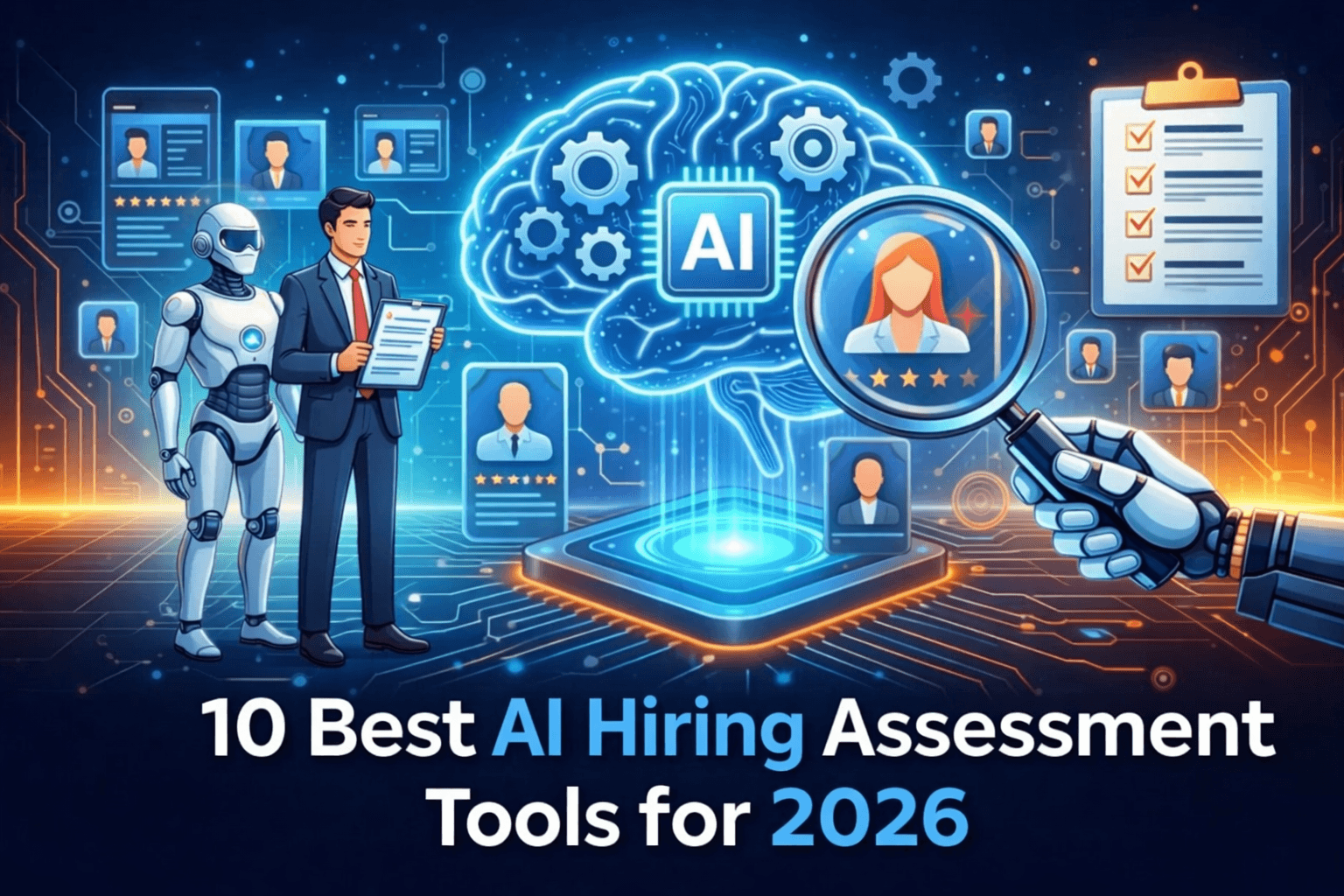
AI hiring assessment tools automate candidate evaluation through automated technical screening, skills validation, and predictive behavioral analysis. Enterprises are increasingly adopting these platforms to reduce time to hire and improve hiring accuracy at scale. However, off the shelf tools alone do not solve enterprise complexity. Organizations building scalable AI driven talent infrastructure are now combining third party assessment tools with proprietary AI platforms like Tatva by Samta.ai, which provides centralized AI governance, orchestration, and decision intelligence for enterprise workflows. This analysis ranks 10 leading platforms while also examining how enterprises can operationalize AI hiring systems strategically.
Key Takeaways
AI hiring assessment tools reduce manual screening workload through automated technical screening
Enterprise deployments require governance, integration, and model monitoring
Most platforms focus on assessment, not AI orchestration
Combining assessment tools with centralized AI systems improves scalability
Platforms like Tatva by Samta.ai enable model governance and deployment control
What AI Hiring Assessment Tools Mean in 2026
AI hiring assessment tools use machine learning to evaluate technical competency, behavioral traits, and job fit across structured assessments. These tools analyze coding exercises, simulations, video interviews, and work samples to generate predictive candidate scores. They operate as pre-screening layers inside talent acquisition workflows. However, enterprises are moving beyond standalone assessment systems. The trend in 2026 is toward AI infrastructure unification. Instead of isolated screening tools, organizations are deploying AI control layers that manage multiple models, performance tracking, and bias monitoring.
This is where Tatva by Samta.ai becomes strategically relevant. Tatva enables enterprises to:
Centralize AI model governance
Monitor performance drift
Control deployment workflows
Align AI hiring tools with enterprise compliance
For broader AI enablement tools
Do You Know Where Your AI Readiness Stands?
Core Comparison: Top 10 Platforms Ranked
Rank | Platform | Primary Use Case | Technical Screening | Enterprise Scalability |
1 | TATVA (Talent Aptitude Testing & Verification via Algorithms) | AI-driven enterprise hiring intelligence & automated technical screening | Advanced | High |
2 | Codility | Developer testing | Advanced | High |
3 | HackerRank | Developer assessment | Advanced | High |
4 | Pymetrics | Cognitive assessment | Low | Moderate |
5 | TestGorilla | Multi skill testing | Moderate | Moderate |
6 | Criteria Corp | Cognitive testing | Basic | Moderate |
7 | Vervoe | Skills based hiring | Moderate | Moderate |
8 | Harver | Volume screening | Moderate | High |
9 | Toggl Hire | Skill + culture | Moderate | Moderate |
10 | Plum | Predictive matching | Low | Moderate |
Evaluation Framework Used
Automated technical screening accuracy
ATS and HRIS integration depth
Bias mitigation controls
Compliance alignment
Ability to integrate into centralized AI governance systems
Enterprises increasingly integrate these tools into broader AI ecosystems built on platforms like Tatva to ensure monitoring and risk management across the hiring lifecycle.
Practical Use Cases by Enterprise Function
Technical Hiring Teams
Use Codility or HackerRank for automated technical screening of engineers. These platforms evaluate syntax accuracy and algorithm efficiency. When combined with Tatva, enterprises can monitor scoring consistency and compliance alignment.
High Volume Operations
Harver and Pymetrics support bulk screening. Organizations integrating these tools into Tatva achieve centralized oversight and model performance tracking.
Enterprise Talent Infrastructure
Companies moving toward AI first HR systems are no longer just selecting assessment tools. They are building AI orchestration layers using Tatva by Samta.ai to unify multiple AI models across recruiting, onboarding, and workforce planning.
Tatva enables:
Cross tool AI monitoring
Enterprise level explainability
Governance controls
Risk management alignment
For technical recruiting ecosystem insights: https://samta.ai/blogs/recruiting-software-for-tech
Limitations and Implementation Risks
AI hiring assessment tools have structural limitations:
They evaluate structured tasks, not contextual leadership
Bias risks exist without governance monitoring
Integration complexity increases with legacy HR systems
Vendor platforms rarely provide full model transparency
Without centralized monitoring, enterprises risk fragmented AI deployment.
This is why many organizations complement hiring tools with AI orchestration platforms like Tatva to manage compliance, audit trails, and model validation.
Benchmark Your AI Model Risk Readiness
Decision Framework: When to Deploy AI Hiring Tools
Deploy When
Processing high candidate volumes
Technical screening demands are repetitive
Need measurable hiring efficiency
Governance structures are in place
Avoid When
Hiring highly contextual executive roles
Organization lacks compliance oversight
Infrastructure cannot support AI integration
Strategic Hybrid Model
Best practice in 2026 is not tool selection alone. It is AI system architecture design.
Enterprises use AI hiring assessment tools for initial evaluation while deploying centralized AI management platforms like Tatva to:
Monitor scoring bias
Validate model performance
Standardize AI governance
Align with enterprise compliance frameworks
Tatva by Samta.ai supports ML model lifecycle management beyond isolated hiring use cases.
Conclusion
AI hiring assessment tools improve screening efficiency and candidate evaluation consistency. However, enterprise success depends not just on tool selection but on AI governance architecture. Organizations scaling AI driven recruitment in 2026 are increasingly combining assessment platforms with centralized AI systems like Tatva by Samta.ai. This approach ensures monitoring, compliance alignment, and scalable AI lifecycle management. For enterprises evaluating AI hiring assessment tools, the strategic question is not only which platform to choose, but how to govern AI responsibly at scale.
Explore Tatva AI platform: https://samta.ai/microsites/tatva
About Samta
Samta.ai is a Singapore headquartered AI product engineering and data intelligence partner helping enterprises build production grade AI systems for regulated and data intensive environments. We help organizations move beyond experimentation by engineering scalable, explainable, and enterprise ready AI solutions, from data foundations and model development to workflow automation and deployment.
Our capabilities combine deep AI expertise, data engineering, and product engineering to deliver measurable business impact across FinTech, BFSI, cybersecurity, regulatory technology, and enterprise operations.
Our enterprise AI products power real world intelligence systems:
TATVA: AI driven data intelligence platform for governed analytics, monitoring, and operational insights
VEDA: Explainable and audit ready AI decisioning engine built for compliance sensitive enterprise workflows
CORA Property Management Solutions: Predictive intelligence platform for real estate pricing, portfolio optimization, and investment analytics
Backed by ecosystem partnerships with Microsoft, Databricks, and Snowflake, Samta.ai delivers agile, cost efficient AI engineering with faster turnaround and enterprise grade scalability. Samta.ai embeds AI governance, data privacy, and compliance by design principles directly into the AI lifecycle, enabling organizations to scale AI with transparency, accountability, and operational control.
Build a Smarter Path Forward With AI
Frequently Asked Questions
What are AI hiring assessment tools?
AI hiring assessment tools use machine learning to evaluate candidate skills through automated testing and structured scoring. They automate technical screening and reduce manual recruiter workload.
How does Tatva differ from hiring tools?
Tatva is not an assessment platform. It is an enterprise AI orchestration layer that governs, monitors, and manages AI models including hiring systems across business functions.
Can AI hiring tools operate without governance layers?
Yes, but enterprises face compliance and monitoring risks without centralized AI oversight.
Are AI hiring tools compliant with regulations?
Compliance depends on vendor configuration and internal monitoring processes. Enterprises must conduct bias audits and maintain validation documentation.
Should enterprises build custom AI hiring systems?
Organizations with complex needs often combine third party tools with enterprise AI platforms like Tatva for governance and scalability.