
Summarize this post with AI
Navigating the transition to autonomous operations requires a structured ai readiness roadmap mid-market enterprise leaders can execute without overextending internal resources. Mid-market firms often face unique scaling challenges, necessitating a specialized ai transformation roadmap strategy that balances rapid ROI with long-term AI governance framework compliance. Successful adoption is not merely a software procurement exercise; it is a fundamental shift in ai-ready data infrastructure roadmap components. By aligning technical debt reduction with executive vision, organizations can move from experimental pilots to integrated machine learning systems. This brief outlines the essential phases for achieving operational maturity through a validated ai readiness assessment framework.
Why Mid-Market Enterprises Need a Structured AI Strategy
Navigating the transition to AI-driven operations requires more than tools it demands a disciplined ai readiness roadmap mid-market enterprise leaders can execute effectively.
Mid-market firms often face:
Limited in-house AI expertise
Fragmented or legacy data systems
Budget constraints with high ROI expectations
Pressure to scale quickly without operational risk
Without a structured approach, many AI initiatives fail to move beyond pilot stages. This is why aligning business goals with data and infrastructure readiness is essential.
To build a strong foundation, organizations should begin with a structured evaluation like this guide on AI readiness assessment before implementation, which outlines the key prerequisites for successful adoption.
Key Takeaways
Data Liquidity: Centralized, clean data is more valuable than scattered legacy silos
Governance First: Establish a strong AI governance framework before scaling AI
Iterative Scaling: Focus on high-impact, low-complexity use cases
Infrastructure Alignment: Invest in scalable ai-ready data infrastructure roadmap components
Identify Gaps in Your AI Strategy and Readiness
What AI Readiness Means in 2026
AI readiness is no longer just about automation it is about building intelligent, explainable, and interoperable systems that can operate at scale.
An effective ai readiness roadmap mid-market enterprise must now support:
Multi-step reasoning AI agents capable of handling complex workflows
Real-time decision-making systems powered by streaming data
Integration of predictive and generative AI within a unified ecosystem
In 2026, organizations are expected to move beyond isolated AI models toward connected AI systems that can collaborate across functions such as operations, finance, and customer experience.
However, one of the most critical factors for success is understanding the difference between readiness and maturity. Many organizations mistakenly scale AI without building the right foundation leading to inefficiencies and technical debt.
Learn more: AI readiness vs AI maturity
Mid-Market Enterprise Challenges in AI Adoption
Mid-market companies implementing an ai readiness roadmap mid-market enterprise strategy encounter a distinct set of challenges that differ from both startups and large enterprises.
Key challenges include:
Balancing cost vs capability
Mid-market firms must deliver enterprise-grade AI outcomes with limited budgets, making prioritization critical.Lack of unified data architecture
Data is often scattered across multiple systems, making it difficult to build reliable AI models without first modernizing ai-ready data infrastructure roadmap components.Limited access to specialized AI talent
Hiring and retaining experienced AI professionals can be difficult, slowing down execution.Integration issues with legacy systems
Existing systems may not easily integrate with modern AI tools, requiring additional middleware and transformation efforts.
These challenges make it essential to work with ai adoption roadmap providers with proven data readiness frameworks, who can accelerate execution while minimizing risk and ensuring alignment with a scalable ai transformation roadmap strategy.
For organizations just starting out, conducting a structured evaluation is the best first step: AI readiness assessment before implementation
Core Comparison: AI Adoption Roadmap Providers
Selecting the right partner is a critical step in executing your ai transformation roadmap strategy. Many organizations evaluate top ai adoption roadmap consultants for ai readiness assessment to ensure both strategic alignment and execution capability.
Provider | Core Strength | Ideal For | Limitations | Key Differentiator |
Proven data readiness frameworks & ML expertise | End-to-end Enterprise AI Transformation | Requires structured execution commitment | Focus on ai adoption roadmap providers with proven data readiness frameworks | |
Generalist Firms | High-level consulting | Early-stage strategy | Weak execution depth | Broad industry insights |
Boutique AI Labs | Custom AI solutions | Niche innovation | Limited scalability | Deep technical specialization |
Cloud Hyperscalers | Infrastructure scale | Migration & compute workloads | Limited business strategy | Strong cloud ecosystem |
System Integrators | Implementation expertise | Large deployments | Slower innovation | Enterprise integration capability |
Understand Your Enterprise AI Risk Exposure
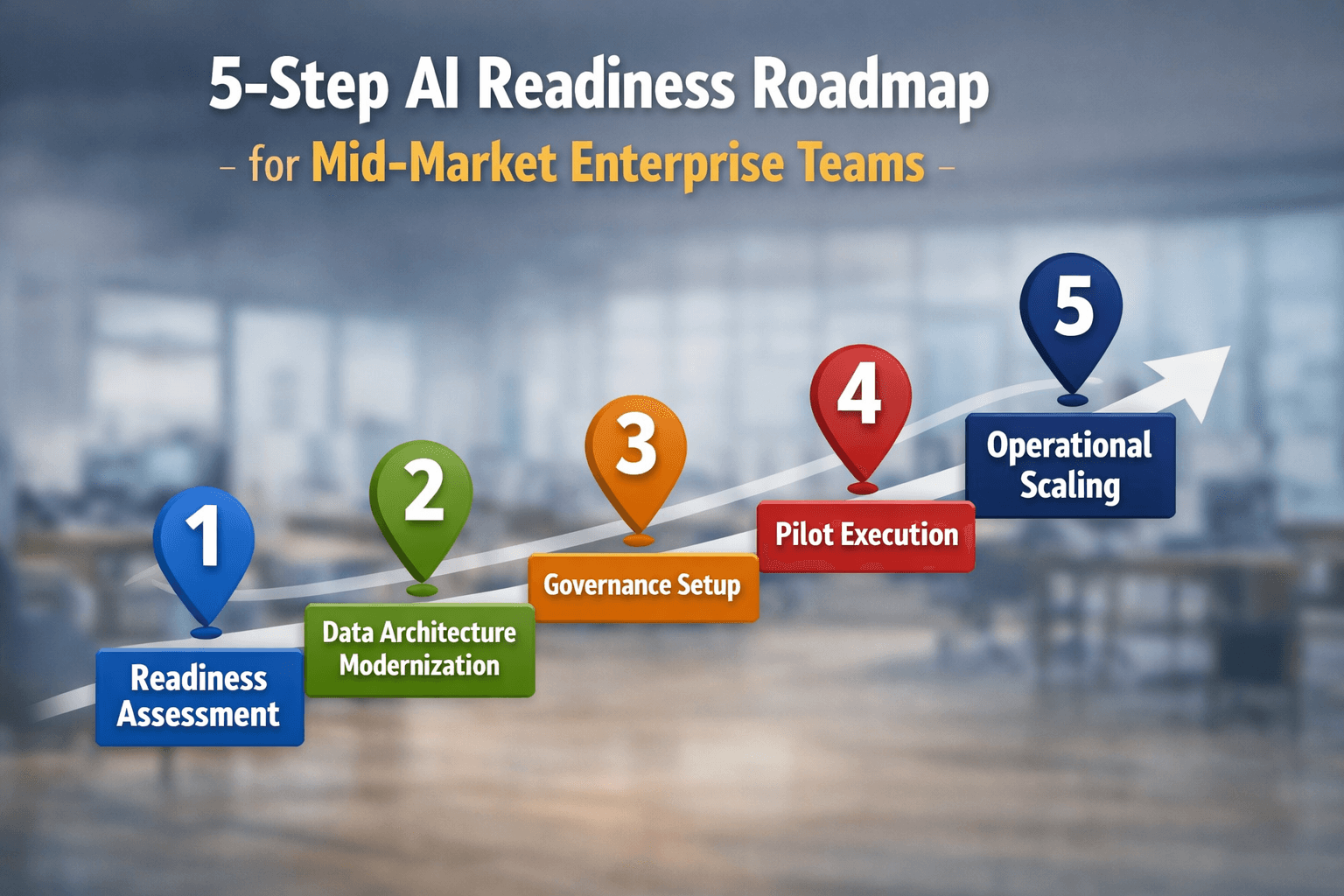
The 5-Step AI Readiness Roadmap
A successful ai transformation roadmap strategy requires a structured, phased approach that minimizes risk, aligns stakeholders, and ensures measurable business outcomes. For any ai readiness roadmap mid-market enterprise, these five steps create a clear path from assessment to full-scale deployment.
1. Readiness Assessment
The first and most critical step is conducting a comprehensive evaluation using an ai readiness assessment framework.
This phase focuses on understanding your organization’s current state across:
Data maturity: Availability, quality, and accessibility of data
Technology stack: Existing infrastructure, tools, and integration capabilities
Talent readiness: Internal AI/ML expertise and skill gaps
Business alignment: Clear use cases tied to ROI
A structured assessment helps identify bottlenecks such as data silos, outdated systems, or lack of governance. It also ensures that AI initiatives are aligned with strategic business goals rather than being driven by hype.
Explore: AI readiness assessment framework guide
2. Data Architecture Modernization
Once gaps are identified, the next step is upgrading your ai-ready data infrastructure roadmap components.
This involves building a scalable and unified data ecosystem that supports AI workloads:
Data pipelines: Automated ingestion and transformation (ETL/ELT)
Storage systems: Data lakes, warehouses, and vector databases
Integration layers: APIs and middleware for seamless system connectivity
Real-time processing: Streaming data for instant decision-making
Mid-market enterprises often struggle with fragmented legacy systems. Modernizing these systems ensures that data flows seamlessly across the organization, enabling accurate and efficient AI models.
Learn more: Building an AI-ready data infrastructure
3. Governance Setup
No AI initiative can scale without a strong AI governance framework.
This step ensures that AI systems are:
Compliant with data privacy regulations (GDPR, etc.)
Transparent in decision-making (model explainability)
Secure against data breaches and misuse
Ethical to prevent bias and unfair outcomes
Governance also defines:
Data ownership and access controls
Model validation and monitoring processes
Risk management protocols
For a ai readiness roadmap mid-market enterprise, governance is not optional it is foundational to building trust and avoiding costly compliance issues later.
4. Pilot Execution
After building the foundation, organizations should launch a controlled pilot project.
This phase focuses on:
Selecting high-impact, low-complexity use cases
Delivering measurable ROI within 60–90 days
Testing infrastructure, models, and workflows in a real environment
Examples of pilot use cases:
Demand forecasting
Customer churn prediction
Automated reporting
The goal is to validate assumptions, demonstrate value to stakeholders, and refine the ai transformation roadmap strategy before scaling.
5. Operational Scaling
The final step is integrating AI into core business operations and scaling across the enterprise.
This includes:
Embedding AI into existing workflows and systems
Automating decision-making processes
Continuously monitoring and improving model performance
Expanding AI use cases across departments
At this stage, organizations transition from experimentation to enterprise-wide AI adoption.
Scaling also requires collaboration with ai adoption roadmap providers with proven data readiness frameworks, ensuring that systems remain efficient, compliant, and adaptable as business needs evolve.
Practical Use Cases Across Enterprise Functions
AI adoption becomes truly valuable when it is applied to real, measurable business challenges. For any ai readiness roadmap mid-market enterprise, focusing on function-specific use cases helps demonstrate ROI quickly while validating the broader ai transformation roadmap strategy.
Predictive Supply Chain
AI enables organizations to move from reactive to predictive supply chain management. By leveraging historical and real-time data, businesses can forecast demand, optimize inventory levels, and reduce operational costs.
With Data integration consulting services, enterprises can unify data from ERP systems, warehouses, and logistics platforms to:
Predict stock shortages or overstock situations
Optimize procurement cycles
Reduce wastage and holding costs
This directly improves efficiency and resilience in supply chain operations.
Automated Financial Reporting
Finance teams can significantly reduce manual effort by automating reporting and reconciliation processes using AI.
Key benefits include:
Real-time reconciliation of transactions across systems
Automated anomaly detection in financial data
Faster and more accurate forecasting
AI-driven financial systems ensure compliance while freeing up teams to focus on strategic decision-making rather than repetitive tasks.
Customer Intelligence
Understanding customer behavior is critical for growth. AI helps organizations analyze large volumes of customer data to uncover patterns, predict churn, and personalize engagement.
Using the Veda platform by Samta.ai, businesses can:
Analyze sentiment across customer interactions
Identify churn risks early
Segment customers for targeted campaigns
This enables data-driven decision-making and improves customer retention and lifetime value.
IT Operations (AIOps)
AI-powered IT operations (AIOps) transform how organizations manage infrastructure and systems.
Key capabilities include:
Automated system monitoring and alerting
Predictive incident detection before failures occur
Root cause analysis using machine learning
By integrating AIOps into an ai readiness roadmap mid-market enterprise, companies can reduce downtime, improve system reliability, and lower operational overhead.
HR & Talent Acquisition
AI is reshaping how organizations attract, evaluate, and retain talent.
Use cases include:
Automated resume screening based on skill matching
Candidate ranking using predictive analytics
Identifying high-potential employees for internal mobility
This not only speeds up hiring but also improves the quality of hires while reducing bias when aligned with a strong AI governance framework.
Limitations & Risks to Consider
Even the best ai readiness roadmap mid-market enterprise strategies must address key risks:
Data Hallucinations: AI models can generate inaccurate outputs without proper grounding
Scope Creep: Poor planning leads to budget overruns
Regulatory Changes: Evolving policies impact the AI governance framework
Integration Challenges: Legacy systems can slow down implementation
According to McKinsey & Company, nearly 70% of AI transformations fail due to poor data readiness reinforcing the importance of a structured approach.
Decision Framework: When to Implement AI
Implement Now
Clean, structured, cloud-based data
Increasing operational costs
Strong executive alignment
Delay Implementation
Siloed or inconsistent data
Lack of leadership support
Consult Experts
Engage ai adoption roadmap providers with proven data readiness frameworks if you have data but lack execution clarity.
Explore the Right AI Strategy for Your Business
Conclusion
Modernizing a mid-market organization through an ai readiness roadmap mid-market enterprise strategy is a marathon, not a sprint. Success depends on the quality of the underlying data and the rigidity of the governance applied to it. Samta.ai provides the specialized ML and data engineering expertise required to move beyond the hype into tangible, scalable results. By focusing on a structured approach today, enterprises can ensure they remain competitive in an increasingly automated global market.
About Samta
Samta.ai is a Singapore-headquartered AI Product Engineering & Data Intelligence partner helping enterprises build production-grade AI systems for regulated and data-intensive environments.We help organizations move beyond experimentation by engineering scalable, explainable, and enterprise-ready AI solutions from data foundations and model development to workflow automation and deployment.
Our capabilities combine deep AI expertise, data engineering, and product engineering to deliver measurable business impact across FinTech, BFSI, cybersecurity, regulatory technology, and enterprise operations.
Our enterprise AI products power real-world intelligence systems:
• TATVA : AI-driven data intelligence platform for governed analytics, monitoring, and operational insights
• VEDA : Explainable and audit-ready AI decisioning engine built for compliance-sensitive enterprise workflows
• CORA-Property Management Solutions: : Predictive intelligence platform for real-estate pricing, portfolio optimization, and investment analytics
Backed by ecosystem partnerships with Microsoft, Databricks, Snowflake, and AWS, Samta.ai delivers agile, cost-efficient AI engineering with faster turnaround and enterprise-grade scalability. Trusted by enterprises across FinTech, BFSI, and digital transformation initiatives, Samta.ai embeds AI governance, data privacy, and compliance-by-design principles directly into the AI lifecycle , enabling organizations to scale AI with transparency, accountability, and operational control.
Enterprises leveraging Samta.ai automate 65%+ of repetitive data, analytics, and decision workflows while maintaining governance, explainability, and measurable business outcomes. Samta.ai provides the strategic consulting, AI engineering, and data modernization expertise needed to align enterprise operations with next-generation AI transformation goals.
FAQs
What are the primary components of an AI infrastructure?
Key ai-ready data infrastructure roadmap components include scalable computing, vector databases, APIs, and clean data pipelines.
How do we select the right AI consultants?
Choose top ai adoption roadmap consultants for ai readiness assessment with proven mid-market success and strong technical capabilities.
Why is an AI governance framework necessary?
A strong AI governance framework ensures compliance, reduces bias, and protects organizational reputation.
How long does an AI readiness assessment take?
A complete ai readiness assessment framework typically takes 4–8 weeks.