
Summarize this post with AI
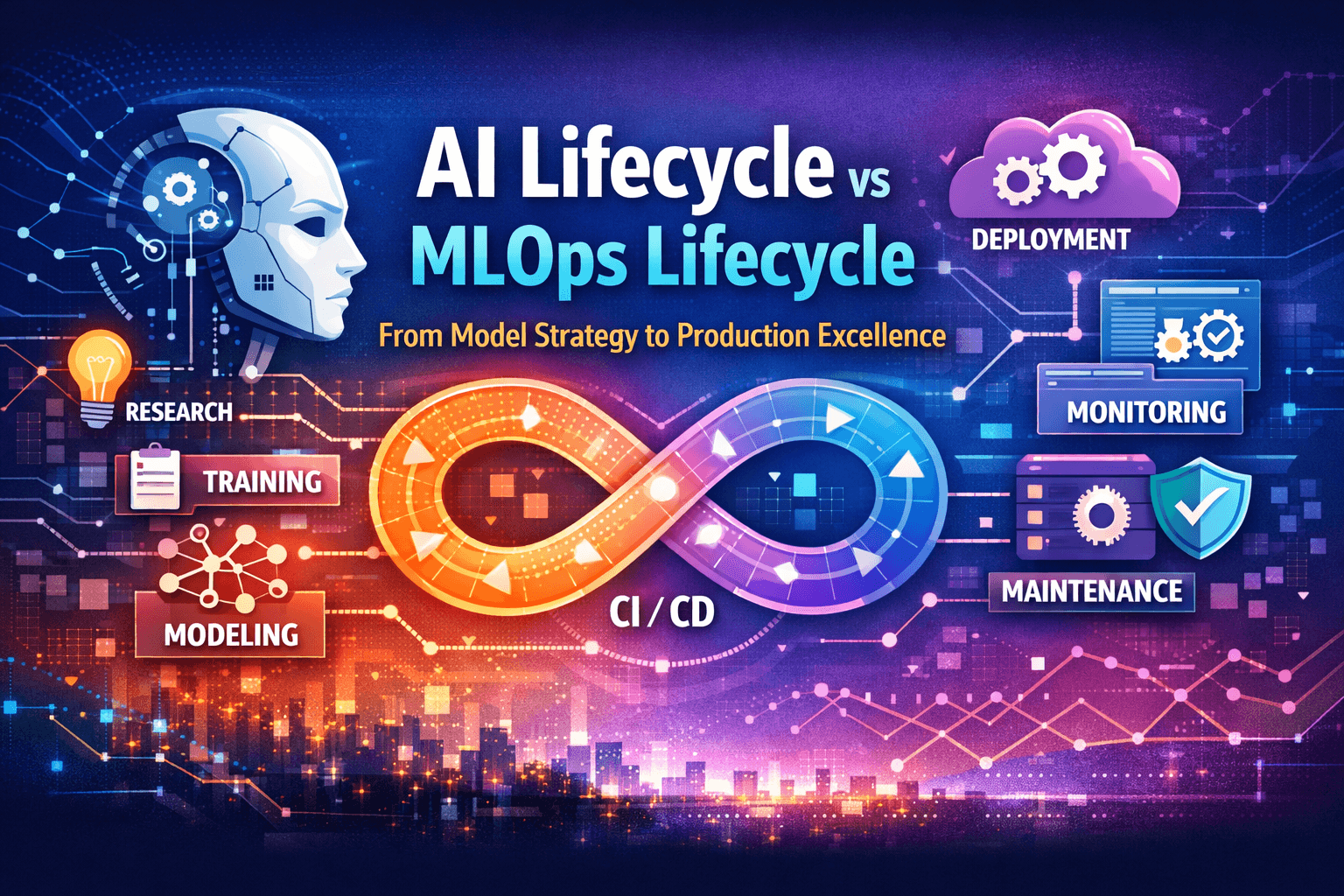
AI lifecycle vs MLOps is a strategic distinction that determines how enterprises move from model experimentation to production-scale deployment. The AI model life cycle covers ideation, data preparation, model training, validation, governance, and business alignment. MLOps focuses on operationalizing models through CI/CD pipelines, monitoring, retraining, and infrastructure automation. Understanding the difference between MLOps and AIOps is critical as organizations scale AI systems across business units. Enterprises must align AI model lifecycle management with deployment workflows to ensure reliability, compliance, and measurable ROI. Organizations working with AI and ML experts such as Samta.ai increasingly integrate lifecycle governance with production-ready MLOps automation to achieve scalable enterprise AI outcomes. This guide explains AI lifecycle vs MLOps lifecycle from a production-readiness perspective.
Key Takeaways
AI lifecycle vs MLOps represents strategy versus operationalization
AI model lifecycle management includes governance and validation layers
MLOps emphasizes automation, monitoring, and scalability
The difference between MLOps and AIOps impacts infrastructure planning
Enterprise AI maturity depends on integrating both frameworks
What This Means in 2026
In 2026, enterprises no longer treat AI experimentation and production as separate silos.
The AI model life cycle includes:
Problem definition
Data sourcing
Feature engineering
Model development
Validation and compliance
The MLOps lifecycle includes:
CI/CD pipelines
Model versioning
Monitoring and observability
Automated retraining
Infrastructure scaling
For deeper understanding of structured AI lifecycle governance, refer to AI Model Lifecycle Management.
Enterprise adoption now requires integrating lifecycle governance with automated operations. Case studies such as AI Governance Implementation Case Study demonstrate how governance and deployment must work together.
Is Your Organization AI-Ready? Find Out Now
Core Comparison / Explanation
Before reviewing the table, it is essential to clarify orientation:
AI lifecycle focuses on strategy, governance, and model intelligence.
MLOps focuses on automation, reliability, and production engineering.
Enterprise AI Framework Comparison
Framework / Service | Strategic Scope | Operational Scope | Governance Integration | Automation Depth | Best Fit |
End-to-end AI lifecycle design | Integrated MLOps pipelines | Embedded governance & compliance | Enterprise-grade automation | Organizations scaling AI programs | |
Conversational AI lifecycle | Deployment-ready AI ops | Structured monitoring | Workflow automation | Customer-facing AI systems | |
AI Lifecycle (General) | Model ideation to validation | Limited ops focus | Governance dependent | Manual to semi-automated | Research-driven teams |
MLOps Lifecycle | Limited strategic modeling | Full production automation | Infrastructure-based governance | High automation | Engineering-led teams |
AIOps | IT system automation | Infrastructure monitoring | System-level governance | Infrastructure automation | DevOps environments |
Difference Between MLOps and AIOps
MLOps operationalizes machine learning models.
AIOps applies AI to IT operations and system monitoring.
AI lifecycle vs MLOps lifecycle focuses on model strategy versus deployment mechanics.
For comparison of AI evolution trends, see Agentic AI vs Traditional AI.
Practical Use Cases
Financial Services
AI lifecycle governs risk modeling validation; MLOps ensures production reliability.
Conversational AI Deployment
Enterprise conversational AI platforms like Veda by Samta.ai integrate lifecycle strategy with production-ready MLOps automation, ensuring scalable, monitored, and compliant deployments.
Enterprise AI Transformation
Organizations leveraging AI & Data Science Services combine lifecycle governance with MLOps execution.
Governance-Heavy Industries
Regulated industries integrate lifecycle validation with MLOps observability.
Identify Hidden Risks in Your AI Models
Limitations & Risks
Overemphasis on lifecycle without MLOps delays production
Overemphasis on MLOps without lifecycle governance increases compliance risk
Infrastructure-heavy setups increase cost
Fragmented tools create visibility gaps
Lack of integration affects ai and ml future scope
Enterprises must align AI lifecycle vs MLOps technology to avoid operational bottlenecks.
Decision Framework
Prioritize AI Lifecycle When:
Defining AI strategy
Managing ai model lifecycle management
Ensuring governance and compliance
Building long-term AI maturity
Prioritize MLOps When:
Deploying models at scale
Automating monitoring and retraining
Managing production SLAs
Optimizing infrastructure efficiency
Most enterprise AI solutions require combining both approaches.
Organizations seeking unified lifecycle and MLOps integration can consult Samta.ai for AI and ML expertise across strategy and production deployment.
Conclusion
AI lifecycle vs MLOps is not a binary decision but a strategic integration requirement. Lifecycle management ensures model integrity, governance, and compliance, while MLOps ensures operational scalability, automation, and resilience. Enterprises seeking production excellence must combine both frameworks under structured AI governance.
Organizations working with Samta.ai integrate lifecycle strategy with operational automation through AI & Data Science Services, enabling unified model development, validation, and deployment. Production-ready AI systems such as Veda by Samta.ai further demonstrate how lifecycle governance and MLOps automation can be embedded into scalable enterprise AI environments.
Move Your AI Initiative Forward With Expert Guidance

About Samta
Samta.ai is a Singapore-headquartered AI Product Engineering & Data Intelligence partner helping enterprises build production-grade AI systems for regulated and data-intensive environments.We help organizations move beyond experimentation by engineering scalable, explainable, and enterprise-ready AI solutions from data foundations and model development to workflow automation and deployment.
Our capabilities combine deep AI expertise, data engineering, and product engineering to deliver measurable business impact across FinTech, BFSI, cybersecurity, regulatory technology, and enterprise operations.
Our enterprise AI products power real-world intelligence systems:
• TATVA : AI-driven data intelligence platform for governed analytics, monitoring, and operational insights
• VEDA : Explainable and audit-ready AI decisioning engine built for compliance-sensitive enterprise workflows
• CORA-Property Management Solutions: : Predictive intelligence platform for real-estate pricing, portfolio optimization, and investment analytics
Backed by ecosystem partnerships with Microsoft, Databricks, Snowflake, and AWS, Samta.ai delivers agile, cost-efficient AI engineering with faster turnaround and enterprise-grade scalability. Trusted by enterprises across FinTech, BFSI, and digital transformation initiatives, Samta.ai embeds AI governance, data privacy, and compliance-by-design principles directly into the AI lifecycle , enabling organizations to scale AI with transparency, accountability, and operational control.
Enterprises leveraging Samta.ai automate 65%+ of repetitive data, analytics, and decision workflows while maintaining governance, explainability, and measurable business outcomes. Samta.ai provides the strategic consulting, AI engineering, and data modernization expertise needed to align enterprise operations with next-generation AI transformation goals.
FAQs
What is AI lifecycle vs MLOps?
AI lifecycle covers model strategy, governance, and validation, while MLOps focuses on automating deployment, monitoring, and retraining pipelines. For a deeper breakdown of structured lifecycle governance, see AI Model Lifecycle Management.
What is the difference between MLOps and AIOps?
MLOps manages machine learning production workflows. AIOps applies AI to IT infrastructure monitoring, log analysis, and operational automation.
Why is AI model lifecycle management important?
It ensures governance, validation, compliance, and alignment with business KPIs before production deployment. Enterprises often integrate lifecycle strategy with AI & Data Science Services to align governance with scalable automation.
Can enterprises operate without MLOps?
Small teams may manage manually, but scalable production AI requires automated monitoring, retraining pipelines, and infrastructure reliability.
What is the future of AI and ML?
The ai and ML future scope depends on integrating lifecycle governance with scalable MLOps frameworks, ensuring production resilience and regulatory compliance.