
Summarize this post with AI
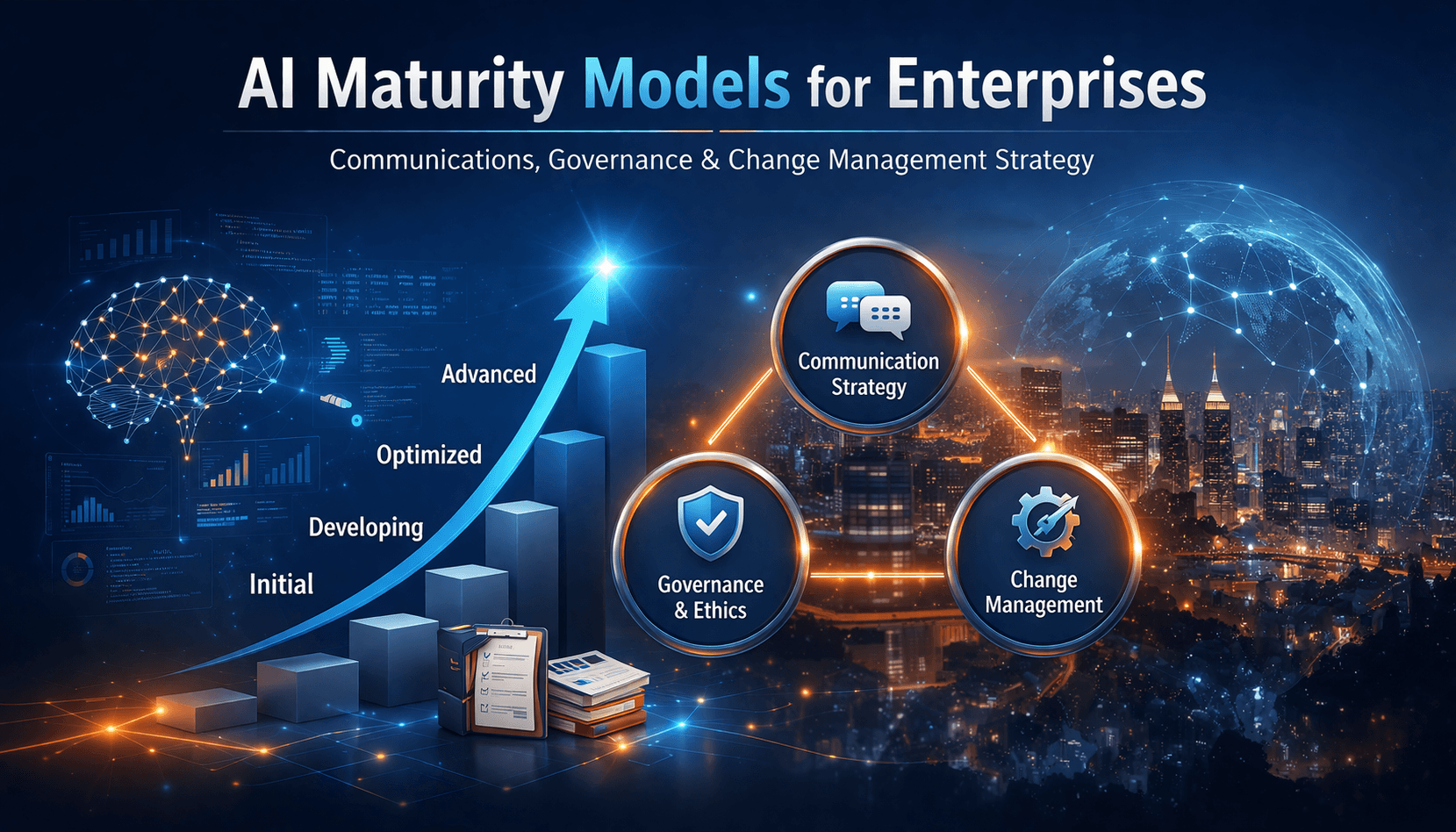
AI adoption is no longer experimental; it is a strategic necessity. However, many enterprises struggle to scale beyond isolated pilots due to misalignment between technology, governance, and workforce readiness. So, what is the ai maturity model? It is a structured framework that helps organizations assess their current AI capabilities, implement governance systems, and scale responsibly across business functions. Rather than treating AI as a one-time deployment, maturity models position it as an evolving capability built on continuous improvement, compliance, and operational alignment within a robust AI governance framework. To succeed, enterprises must integrate ai maturity models communications governance change management practices that unify leadership strategy, employee adoption, and secure system deployment. Without this alignment, AI initiatives remain fragmented, underutilized, and exposed to compliance and operational risks.
Why Enterprises Need a Structured AI Readiness Approach
Establishing an operational ai readiness roadmap mid-market enterprise leaders can rely on requires more than deploying models it demands synchronization between systems, people, and processes.
Organizations that successfully scale AI focus on:
Embedding governance early using a formal ai governance maturity model
Aligning workforce capabilities through structured change management
Ensuring compliance via secure deployment frameworks
Transitioning from pilots to enterprise-wide execution
For example, combining a strong governance layer with a defined AI governance framework ensures consistent performance, accountability, and scalability across departments.
To build this foundation, many enterprises start with a formal AI readiness assessment before scaling enterprise AI
Key Takeaways
Alignment between IT and operational teams accelerates deployment timelines
Risk mitigation depends on continuous monitoring and governance standardization
Communication reduces resistance and improves adoption speed
Centralized oversight ensures accountability and consistent AI performance
Find Out How Ready Your Business Is for AI
What This Means in 2026
In 2026, isolated AI pilots are no longer competitive advantages they are liabilities.
Enterprises must evolve toward integrated systems that combine deployment with workforce readiness. Understanding what is the ai maturity model as a continuous lifecycle not a one-time implementation is critical.
A strong strategy includes:
A defined AI change management strategy for enterprise transformation
Enterprise-grade AI security and compliance frameworks
Additionally, according to a report by McKinsey, organizations that align governance with business strategy are significantly more likely to achieve measurable ROI from AI adoption.
Core Comparison: Governance Frameworks
Service Provider | Core Focus | Technical Integration | Strategic Alignment | Governance Capability |
Samta.ai Consulting | End-to-end AI/ML implementation & governance | High | High | Advanced |
Traditional IT Firms | Legacy system upgrades & cloud migration | Medium | Low | Basic |
Change Management Firms | Workforce training and enablement | Low | Medium | Moderate |
Practical Use Cases
1. Compliance Auditing
Implementing a responsible ai governance maturity model enables enterprises to standardize how data is collected, processed, and monitored across jurisdictions. This is especially critical for organizations operating in multiple regulatory environments where compliance requirements frequently evolve.
With a structured approach, companies can automate audit trails, enforce policy checks, and ensure that every AI model adheres to predefined ethical and legal standards. This reduces the risk of penalties, strengthens stakeholder trust, and aligns operations with a broader AI governance framework.
2. Predictive Intelligence
Modern enterprises rely on predictive analytics to move from reactive to proactive decision-making. Platforms like Veda by Samta.ai AI-powered decision intelligence platform
enable organizations to centralize fragmented data sources and generate real-time insights.
By integrating predictive intelligence into an ai readiness roadmap mid-market enterprise, businesses can forecast demand, optimize supply chains, and identify emerging risks before they impact operations. This not only improves efficiency but also creates a measurable competitive advantage in fast-moving markets.
3. Risk Mitigation
A well-defined model ai governance framework plays a critical role in continuously monitoring deployed AI systems. Enterprises must proactively detect issues such as algorithmic bias, data drift, latency spikes, and model degradation.
Through automated monitoring systems and governance checkpoints, organizations can ensure that AI outputs remain accurate, fair, and aligned with business objectives. This ongoing oversight is a key component of ai maturity models communications governance change management, ensuring that risk management evolves alongside AI capabilities.
4. Vendor Evaluation
Selecting the right AI vendors is a strategic decision that directly impacts long-term scalability. Enterprises must evaluate third-party SaaS solutions not just on features, but on governance compatibility, data security standards, and integration capabilities.
Using an ai governance maturity model, organizations can establish standardized evaluation criteria ensuring that every external tool aligns with internal policies and the broader AI governance framework. This minimizes integration risks and prevents future compliance challenges.
5. Workforce Transition
AI adoption fundamentally changes how work gets done, making workforce transformation a critical success factor. Enterprises can leverage AI-driven analytics to identify skill gaps, predict role evolution, and design targeted training programs.
By embedding workforce planning into ai maturity models communications governance change management milestones, organizations can ensure that employees are not displaced but empowered. This structured transition reduces resistance, accelerates adoption, and creates a culture of continuous learning aligned with long-term AI strategy.
Measure Your AI Model Risk Before It Becomes a Problem
Limitations & Risks
Even well-planned AI strategies can fail without balance:
Over-investing in technology while ignoring communication slows adoption
Excessively rigid governance reduces agility
Outdated policies create compliance risks
Data silos prevent accurate maturity evaluation
To avoid these issues, organizations must adopt a continuous improvement mindset: Continuous improvement in AI systems and governance
Decision Framework: When to Scale AI
Scaling AI should be a measured decision, not an aggressive expansion.
Organizations should only move forward when:
Data infrastructure is clean and standardized
Governance policies are clearly defined
ROI from pilot programs is consistent
Security and compliance benchmarks are met
A structured evaluation ensures readiness before advancing into agentic AI governance and enterprise automation systems
At this stage, enterprises must formalize ai maturity models communications governance change management milestones to transition from experimentation to enterprise-wide execution.
Download AI Risk Assessment Templates
Standardize your AI governance with ready-to-use frameworks designed for enterprise risk, compliance, and scale.
How US Enterprises Approach AI Maturity & Governance
US enterprises approach AI maturity assessment through a risk-first and ROI-driven lens. Instead of ad hoc experimentation, organizations use structured frameworks like a Model AI Governance Framework for Generative AI combined with internal controls and NIST AI RMF.
The AI Maturity Matrix is often used to benchmark:
Model lifecycle governance
Risk and compliance readiness
Operational scalability
This ensures AI systems are not only performant—but also auditable and enterprise-ready.
How Singapore Companies Handle AI Maturity & Governance
Singapore enterprises adopt a compliance-first approach to AI maturity assessment, heavily guided by the PDPC Model AI Governance Framework and MAS regulations.
Organizations use an AI Maturity Matrix to evaluate:
Explainability and transparency
Human oversight mechanisms
Policy and regulatory alignment
The PDPC Model AI Governance Framework plays a central role in defining how companies operationalize a Model AI Governance Framework for Generative AI in real-world deployments.
Conclusion
Successfully operationalizing artificial intelligence requires a balanced approach that weighs technical deployment equally against workforce enablement and risk management. Organizations must continuously refine their internal structures to support complex technological integration without disrupting core operations. By prioritizing structured governance, enterprises can confidently scale their capabilities and maintain a competitive advantage in a rapidly evolving digital landscape. As a specialized partner in AI and ML integration, Samta.ai provides the technical expertise and strategic frameworks necessary to navigate this transition safely.
Get Expert Guidance for Your AI Strategy
About Samta
Samta.ai is a Singapore-headquartered AI Product Engineering & Data Intelligence partner helping enterprises build production-grade AI systems for regulated and data-intensive environments.We help organizations move beyond experimentation by engineering scalable, explainable, and enterprise-ready AI solutions from data foundations and model development to workflow automation and deployment.
Our capabilities combine deep AI expertise, data engineering, and product engineering to deliver measurable business impact across FinTech, BFSI, cybersecurity, regulatory technology, and enterprise operations.
Our enterprise AI products power real-world intelligence systems:
• TATVA : AI-driven data intelligence platform for governed analytics, monitoring, and operational insights
• VEDA : Explainable and audit-ready AI decisioning engine built for compliance-sensitive enterprise workflows
• CORA-Property Management Solutions: : Predictive intelligence platform for real-estate pricing, portfolio optimization, and investment analytics
Backed by ecosystem partnerships with Microsoft, Databricks, Snowflake, and AWS, Samta.ai delivers agile, cost-efficient AI engineering with faster turnaround and enterprise-grade scalability. Trusted by enterprises across FinTech, BFSI, and digital transformation initiatives, Samta.ai embeds AI governance, data privacy, and compliance-by-design principles directly into the AI lifecycle , enabling organizations to scale AI with transparency, accountability, and operational control.
Enterprises leveraging Samta.ai automate 65%+ of repetitive data, analytics, and decision workflows while maintaining governance, explainability, and measurable business outcomes. Samta.ai provides the strategic consulting, AI engineering, and data modernization expertise needed to align enterprise operations with next-generation AI transformation goals.
FAQs
What defines a successful enterprise AI deployment?
Success depends on measurable ROI, high adoption rates, and adherence to an established AI governance framework supported by continuous monitoring.
How do we measure governance maturity effectively?
By implementing automation in compliance, establishing ethics oversight, and adopting a scalable ai governance maturity model.
Why is communication critical in AI adoption?
Clear communication reduces uncertainty, aligns expectations, and ensures smooth adoption across team score to ai maturity models communications governance change management.
How do maturity models prevent shadow IT?
They provide structured, approved pathways for AI deployment, eliminating the need for unauthorized tools while maintaining flexibility and innovation.
Unlock Verifiable Insights Across All Data Stores
VEDA connects siloed data sources and empowers business leaders with real-time, governed AI decision analytics.
Explore VEDA Platform >