
Summarize this post with AI
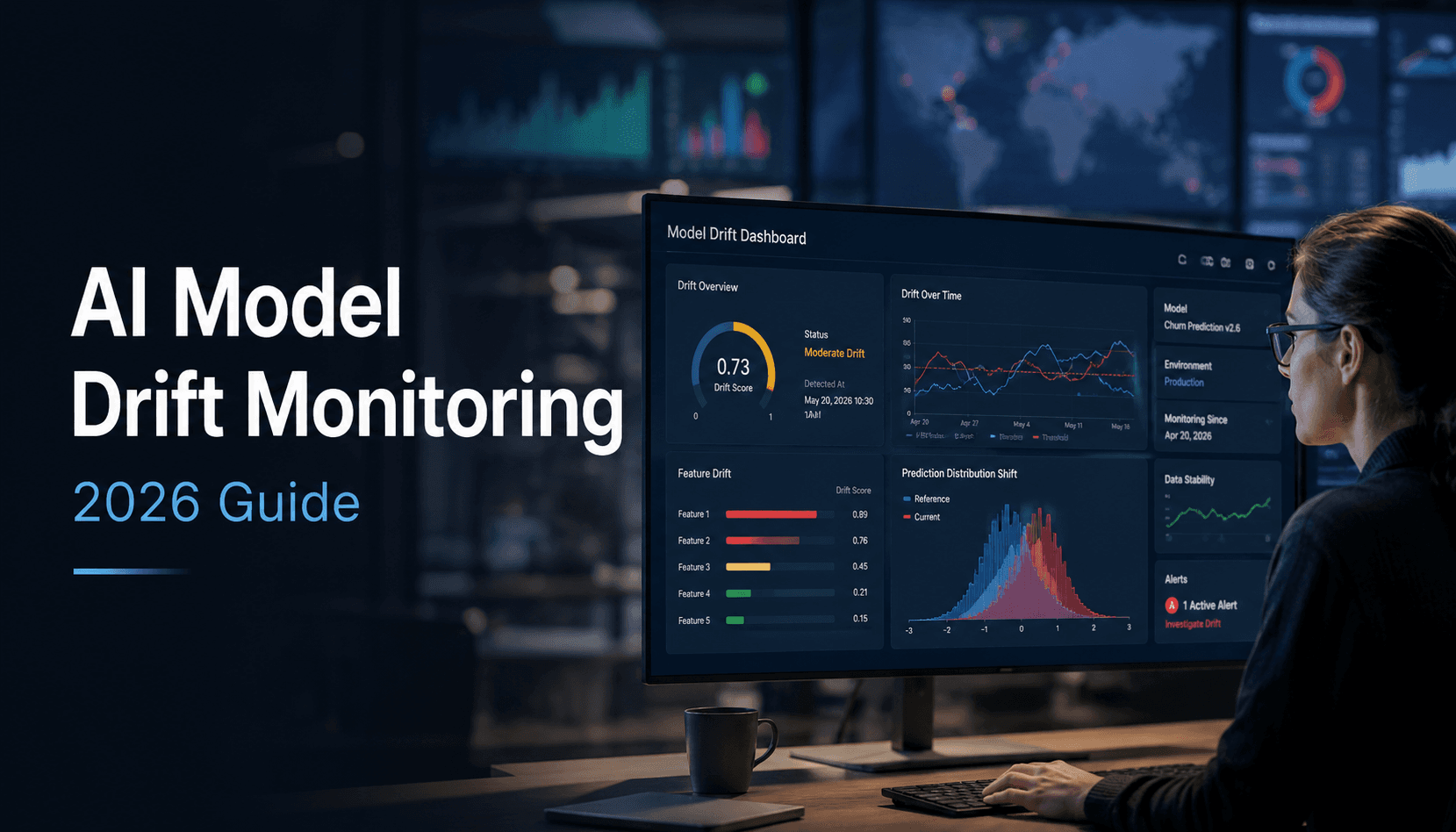
In 2026, ai model drift monitoring is no longer optional it is the backbone of reliable AI systems. As machine learning models operate in real-world environments, their performance naturally degrades due to changing data patterns and evolving behaviors. This is where model monitoring becomes critical. By leveraging advanced ml model monitoring tools, organizations can proactively detect shifts, trigger automated responses, and maintain consistent performance. Without robust monitoring models, even the most sophisticated AI systems risk silent failure, compliance violations, and revenue loss. Simply put: ai model drift monitoring ensures your AI continues to make accurate, trustworthy decisions at scale.
Key Takeaways
Continuous monitoring is mandatory for maintaining model accuracy over time
Automated alerting prevents silent failures in high-stakes systems
Understanding Model drift vs data drift is critical for correct remediation
Centralized dashboards improve visibility across stakeholders
A scalable ml model monitoring framework reduces operational overhead
What This Means in 2026
The landscape of ai model drift monitoring in machine learning has evolved far beyond basic threshold alerts. Today’s systems rely on anomaly detection, real-time signals, and automated governance workflows. Enterprises increasingly adopt MLOps frameworks for continuous model monitoring to operationalize drift detection, automate retraining pipelines, and maintain model reliability at scale.
Enterprises must clearly differentiate Model drift vs data drift:
Data drift → Input data distribution changes
Model drift (concept drift) → Relationship between input and output changes
Failing to distinguish between them leads to incorrect fixes either unnecessary retraining or ineffective data corrections.
Modern enterprises are adopting top ai governance tools for model drift monitoring that support:
Multi-model environments
Real-time inference pipelines
Decentralized AI architectures
To go deeper, explore how
Measure Your AI Readiness Before You Invest Further
Core Comparison: Modern vs Legacy Monitoring
Feature | Legacy Monitoring Tools | Impact on Business | Recommended Approach | |
Drift Detection | Real-time ai model drift monitoring tools | Periodic batch testing | Faster issue detection prevents revenue loss | Implement real-time ai model drift monitoring across all production models |
Alerting Protocol | i continuous monitoring model drift alerting ai integrity dashboards | Static threshold-based alerts | Reduces silent failures and improves response time | Use intelligent alerting with context-aware triggers |
Integration | Native AI ecosystem (Veda platform) | Disconnected point solutions | Eliminates data silos and improves efficiency | Centralize monitoring within a unified platform |
Compliance | Automated mapping to governance frameworks | Manual audits and documentation | Ensures regulatory readiness and reduces compliance risk | Align monitoring with standardized governance frameworks |
Scalability | Enterprise-wide unified visibility | Limited to model-specific silos | Supports multi-model, multi-team environments | Adopt scalable ml model monitoring framework for growth |
Practical Use Cases
1. Predictive Maintenance
Using monitoring models, manufacturers detect shifts in sensor data before equipment failures occur.
2. Financial Fraud Detection
An ai continuous monitoring model drift alerting dashboard identifies evolving fraud tactics in real time.
3. Healthcare AI Systems
Hospitals rely on ai model drift monitoring in machine learning to ensure diagnostic accuracy across changing patient demographics.
4. Dynamic Pricing Engines
Detecting concept drift helps maintain pricing efficiency in volatile markets.
5. Regulatory Compliance
Organizations use AI security and compliance services to maintain audit trails and governance readiness.
Limitations & Risks
Even with advanced ml model monitoring tools, challenges remain:
False positives → Excessive alerts lead to alert fatigue
High infrastructure costs → Continuous monitoring consumes compute resources
Operational complexity → Requires skilled teams and governance frameworks
A poorly tuned system can result in a scenario where your AI is failing without timely intervention.
Understand Your AI Model Risk Profile
Decision Framework: When to Implement Monitoring
Not every model requires the same monitoring intensity.
Use this approach:
High-risk models (finance, healthcare)
→ Require real-time monitoring + model monitoring dashboard architecture diagramModerate-risk models
→ Periodic monitoring with alertingLow-risk models
→ Basic tracking with retraining cycles
For regulated industries, adopting a structured framework like AI governance framework 2026 is essential. To align with global standards, refer to NIST AI Risk Management Framework
Conclusion
In 2026, ai model drift monitoring is the defining factor between AI success and failure. Organizations that invest in proactive, real-time monitoring gain:
Higher model accuracy
Reduced operational risk
Stronger compliance posture
Sustainable AI ROI
As AI systems become increasingly autonomous, the ability to monitor, detect, and respond to drift is no longer a technical enhancement it is a business necessity. Platforms like Samta.ai are leading this shift by enabling enterprises to build resilient, self-correcting AI systems powered by intelligent monitoring, governance, and automation.
About Samta
Samta.ai is a Singapore-headquartered AI Product Engineering & Data Intelligence partner helping enterprises build production-grade AI systems for regulated and data-intensive environments.We help organizations move beyond experimentation by engineering scalable, explainable, and enterprise-ready AI solutions from data foundations and model development to workflow automation and deployment.
Our capabilities combine deep AI expertise, data engineering, and product engineering to deliver measurable business impact across FinTech, BFSI, cybersecurity, regulatory technology, and enterprise operations.
Our enterprise AI products power real-world intelligence systems:
• TATVA : AI-driven data intelligence platform for governed analytics, monitoring, and operational insights
• VEDA : Explainable and audit-ready AI decisioning engine built for compliance-sensitive enterprise workflows
• CORA-Property Management Solutions: : Predictive intelligence platform for real-estate pricing, portfolio optimization, and investment analytics
Backed by ecosystem partnerships with Microsoft, Databricks, Snowflake, and AWS, Samta.ai delivers agile, cost-efficient AI engineering with faster turnaround and enterprise-grade scalability. Trusted by enterprises across FinTech, BFSI, and digital transformation initiatives, Samta.ai embeds AI governance, data privacy, and compliance-by-design principles directly into the AI lifecycle , enabling organizations to scale AI with transparency, accountability, and operational control.
Enterprises leveraging Samta.ai automate 65%+ of repetitive data, analytics, and decision workflows while maintaining governance, explainability, and measurable business outcomes. Samta.ai provides the strategic consulting, AI engineering, and data modernization expertise needed to align enterprise operations with next-generation AI transformation goals.
Discuss Your AI Challenges with Our Specialists
FAQs
What is the difference between data drift and model drift?
Data drift refers to changes in input data distribution, while model drift reflects changes in relationships between inputs and outputs. Both require consistent ai model drift monitoring.
Why do we need a model monitoring dashboard?
A model monitoring dashboard architecture diagram provides centralized visibility into performance metrics, alerts, and anomalies, enabling faster decision-making.
How do we align monitoring with regulatory standards?
Organizations should align monitoring practices with frameworks like AI risk and compliance NIST guidelines to ensure both technical and compliance readiness.
What are the best tools for tracking AI drift?
The best ai model drift monitoring tools are integrated, automated, and scalable. Enterprises evaluating solutions should review AI governance platforms compared to identify the right fit.