
Summarize this post with AI
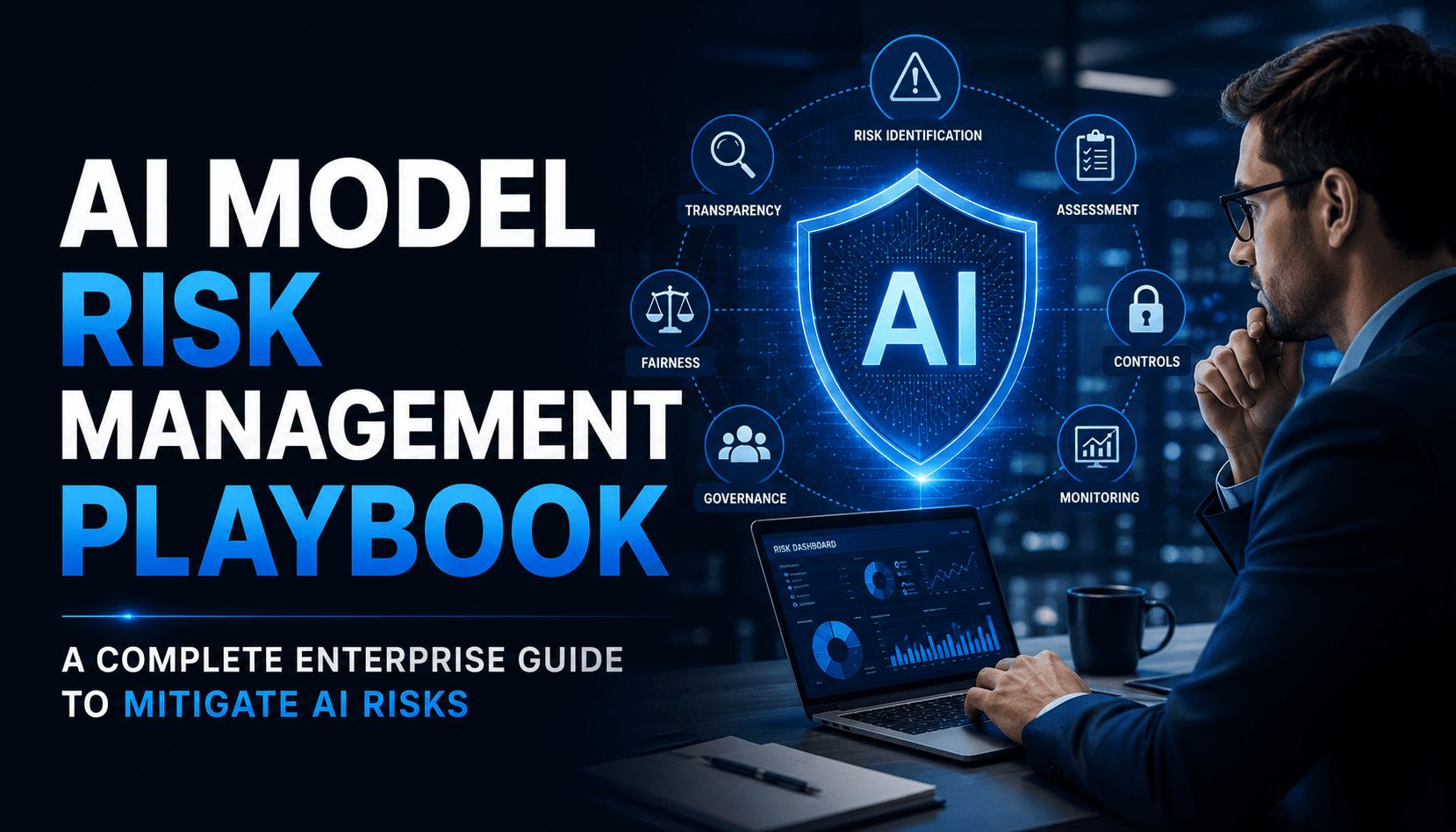
Managing enterprise AI risk is no longer optional it’s a core operational requirement. An AI Model Risk Management playbook provides a structured framework to identify, monitor, and mitigate risks across AI systems, including data bias, model drift, and regulatory exposure. Within the first stages of deployment, organizations must align ai and risk management practices with real-time monitoring, validation pipelines, and compliance frameworks. Without this, AI systems can introduce hidden financial, legal, and operational risks. A well-defined playbook ensures continuous oversight, automated accountability, and regulatory alignment making it essential for any enterprise scaling AI in production.
Why Enterprises Need an AI Model Risk Management Playbook
Managing mathematical, systemic, and data-related vulnerabilities during an enterprise AI implementation requires more than ad-hoc controls it demands an engineering-first approach.
Organizations face significant legal, operational, and financial exposure when deploying black-box models across core workflows. A robust AI Model Risk Management playbook enables:
Standardized validation checks
Continuous telemetry tracking
Dataset transparency protocols
Automated enforcement mechanisms
These capabilities help enterprises systematically reduce risk while maintaining performance. To understand the foundational layer behind these systems, refer to this detailed breakdown of what is AI model fundamentals
Key Takeaways
Automated Accountability: Move from periodic audits to continuous monitoring
Regulatory Alignment: Maintain compliance without slowing inference
Validation Centralization: Test models in isolated environments for drift detection
Risk Infrastructure Integration: Connect telemetry directly to enforcement systems
See Where Your AI Strategy Stands Today
What This Means in 2026
Modern enterprises must go beyond surface-level compliance. Today, ai in risk and compliance requires deep, auditable operational control.
This includes:
Tracking dataset lineage
Monitoring prompt-level variations
Mapping outputs back to infrastructure
A strong governance foundation is critical. Explore the strategic importance here: why AI governance matters for enterprises. Additionally, organizations rely on structured frameworks and tools to implement AI risk management policy at scale. Many teams evaluate platforms using: AI governance platforms compared guide
Establish a robust, defensible infrastructure framework that aligns perfectly with global regulatory standards. Access the complete AI Model Risk Management Playbook to secure your enterprise deployments confidently.
Core Comparison of Operational Risk Frameworks
Risk Dimension | Samta.ai Managed Solutions | Traditional Consulting | Open-Source Kits | Enterprise In-House Builds |
Real-Time Guardrails | Automated in-line interception | Manual retrospective audits | Scripted API checkpoints | Custom real-time rules (resource intensive) |
Framework Adaptability | Dynamic multi-region compliance | Static framework mapping | Manual rule engineering | Flexible but requires constant updates |
Data Lineage Tracking | End-to-end automated graphing | Sample-based reviews | Developer-dependent logs | Fully customizable but complex to maintain |
Inference Cost Controls | Integrated token ceiling budgets | Post-billing cost reviews | Custom calculator scripts | Requires internal monitoring tools |
Deployment Speed | Rapid enterprise deployment | Slow, consulting-led rollout | Moderate setup time | Slow due to development cycles |
Practical Use Cases
1. Regulated Financial Auditing
Aligning systems with ai model risk management mas (Monetary Authority of Singapore) FEAT principles ensures regulatory-grade compliance.
2. Continuous Integrity Scoring
Using advanced analytics platforms like VEDA AI Data Analytics Platform to track model accuracy across changing datasets.
3. Automated Threat Detection
Implementing enterprise-grade controls via AI security and compliance services to prevent adversarial attacks.
4. Corporate Policy Enforcement
Real-time blocking of outputs that violate internal governance rules.
5. Procurement Validation
Evaluating third-party AI systems using structured frameworks like an AI Model Risk Management ebook.
Evaluate AI Model Risks Before They Become Problems
Limitations & Risks
Even the best frameworks introduce complexity.
Over-engineered systems can slow real-time execution
Excessive restrictions can hinder developer productivity
Weak data lineage tracking creates monitoring blind spots
For foundational understanding, revisit: complete guide to enterprise data systems
Decision Framework: When to Implement
Use a Full Playbook When:
AI impacts financial or legal outcomes
Systems operate in regulated industries
Real-time decisions affect users
In these cases, adopting AI risk management Guidelines and advanced AI risk management tools is essential.
Avoid Heavy Frameworks When:
Models are offline or exploratory
No real-world decision impact exists
Instead, use lightweight templates like: AI risk assessment templates for quick evaluation
Identify, isolate, and evaluate hidden data liabilities across your internal production environments before they impact users. Download our operational AI Risk Assessment Templates to standardize your engineering checkpoints.
Conclusion
AI risk is not a one-time problem it’s a continuous operational challenge. A well-implemented AI Model Risk Management playbook enables enterprises to move from reactive monitoring to proactive governance. By embedding validation, compliance, and accountability directly into infrastructure, organizations can scale AI safely and confidently. In an era where ai in regulatory compliance and governance define competitive advantage, the companies that win will be those that treat risk management as a core engineering discipline not an afterthought.
Turn Your AI Vision into an Actionable Roadmap
About Samta
Samta.ai is a Singapore-headquartered AI Product Engineering & Data Intelligence partner helping enterprises build production-grade AI systems for regulated and data-intensive environments.We help organizations move beyond experimentation by engineering scalable, explainable, and enterprise-ready AI solutions from data foundations and model development to workflow automation and deployment.
Our capabilities combine deep AI expertise, data engineering, and product engineering to deliver measurable business impact across FinTech, BFSI, cybersecurity, regulatory technology, and enterprise operations.
Our enterprise AI products power real-world intelligence systems:
• TATVA : AI-driven data intelligence platform for governed analytics, monitoring, and operational insights
• VEDA : Explainable and audit-ready AI decisioning engine built for compliance-sensitive enterprise workflows
• CORA-Property Management Solutions: : Predictive intelligence platform for real-estate pricing, portfolio optimization, and investment analytics
Backed by ecosystem partnerships with Microsoft, Databricks, Snowflake, and AWS, Samta.ai delivers agile, cost-efficient AI engineering with faster turnaround and enterprise-grade scalability. Trusted by enterprises across FinTech, BFSI, and digital transformation initiatives, Samta.ai embeds AI governance, data privacy, and compliance-by-design principles directly into the AI lifecycle , enabling organizations to scale AI with transparency, accountability, and operational control.
Enterprises leveraging Samta.ai automate 65%+ of repetitive data, analytics, and decision workflows while maintaining governance, explainability, and measurable business outcomes. Samta.ai provides the strategic consulting, AI engineering, and data modernization expertise needed to align enterprise operations with next-generation AI transformation goals.
Frequently Asked Questions
What is the core focus of ai in risk and compliance?
It focuses on monitoring models for drift, validating inputs, and ensuring traceability. According to a report by NIST AI Risk Management Framework structured governance significantly improves trust and reliability in AI systems.
How do AI risk management tools prevent model hallucinations?
They enforce contextual boundaries, validate outputs against trusted data, and detect anomalies in real time. Solutions like Samta's AI Model Risk Management frameworks enable proactive issue detection.
Why is ai in regulatory compliance shifting toward automation?
Manual audits cannot keep pace with high-speed AI systems. Automated validation ensures continuous compliance alongside every inference.
Where can enterprises find an AI Model Risk Management playbook template?
Comprehensive frameworks, templates, and deployment strategies are available at Samta.ai official platform
Unlock Verifiable Insights Across All Data Stores
VEDA connects siloed data sources and empowers business leaders with real-time, governed AI decision analytics.
Explore VEDA Platform >