
Summarize this post with AI
Whether we like it or not, artificial intelligence (AI) has entered our day-to-day lives, from our cellphones and emails to the way we search for things on the internet. Suffice it to say, it has slowly but surely crept into influencing our actions, lives and even decisions.
This scenario is becoming an even bigger reality in businesses. Incorporating AI into business decision-making means using these tools to inform decisions about one's customers, employees, finances, policies, and strategies. But how far can one go?
That’s what we’re about to explore in this article. Read on before you make your next business decision.
What does it mean to trust AI in making business decisions?
Trusting AI is not a black-and-white decision. It involves making a judgment in which the AI informs you of the factors to consider and how much human checking of this information is needed.
Generally, businesses use AI as general-purpose assistants or purpose-built tools. As a general-purpose assistant, the AI can draft documents, summarise meetings, and answer almost anything related to these outputs.
On the other hand, purpose-built AI tools work inside one domain or industry, such as for hiring, insurance claims, underwriting or legal research. What all these have in common is that they all draw from a carefully chosen data source.
Legal AI research tools are an example of a purpose-built AI. They are built on a curated database of laws and court decisions rather than making the AI search the World Wide Web.
General-purpose AI | Purpose-built AI | |
Typical use | Drafting, summarising, brainstorming | Defined workflows such as KYC, credit or legal research |
Data source | Broad training data | Curated domain data |
Traceable answers | Often not | Usually, when built to show sources |
Main weakness | Confident errors outside its depth | Gaps or bias in narrower data |
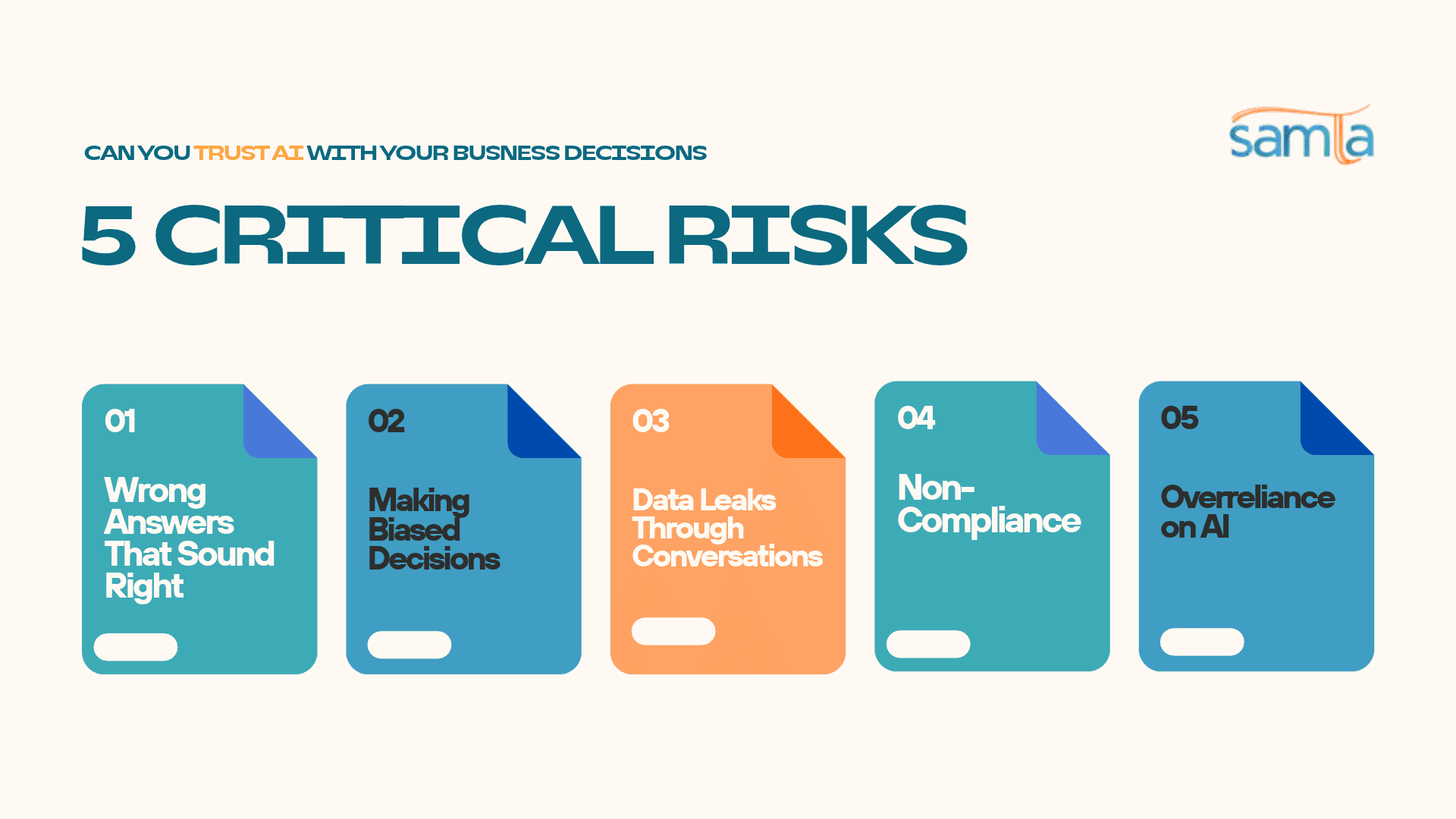
Risk 1: Wrong Answers That Sound Right
AI answers are grounded in large language models (LLMs). These LLMs are built to predict the likely text to a question, but it is important to note that they are not verified facts. Thus, they’re prone to hallucinations, making up figures, quotes and answers that actually do not exist.
For instance, in 2025, Deloitte Australia agreed to refund the government A$440,000 after AI errors were found on its report. They were found to have used fabricated quotes from a Federal Court judgment and from non-existent academic papers.
How do we reduce this risk? We should require tools that show the source behind every claim they make. One should still check the data presented against the source.
This practice is best seen in legal research tools such as CaseChat AI. This tool answers questions based on its own database of Australian legislation and cases. It also presents every answer linked to a source, with In-Text Source Verification that lets users click a citation to see where it actually came from.
Measure Your AI Readiness with a Free Assessment
Risk 2: Making Biased Decisions
While AI learns from historical data, the harsh reality is that history carries with it patterns of bias and exclusion. As a result, the AI model can repeat this pattern in crafting its answers.
In 2018, it was reported that Amazon’s recruiting tool was trained using CVs of mostly men and as a result, those tagged as women in applications were penalised.
Biases can also hide in proxies such as a gap in work history, postcode or a school name. A workaround for this is to remove the obvious field that rarely removes the pattern. AI data governance matters, including lineage and representativeness.
Where bias enters | Example | Control |
Training data | Past hires skewed toward one group | Audit data balance before training |
Proxy variables | Postcode tracking ethnicity | Test which inputs drive outcomes |
Feedback loops | Biased approvals become new training data | Monitor outcomes by group after launch |
Thresholds | One cut-off score for every segment | Review error rates across groups |
Risk 3: Data Leaks Through Conversations
As we talk to AI, we often forget that everything we say is a data transfer. Every copy-paste of a contract, customer info or request is already sent into the public AI tool.
For instance, in 2023, Samsung’s engineers uploaded its internal source code to ChatGPT, which led the company to ban generative AI tools in its devices and networks.
The greater threat is that most of us adopt free tools to save time and money, but at the expense of security. To be safe:
Publish for approved AI tools and the type of data that they can receive
Choose plans with limits on how the vendors use your input data
Always remove the personal and client identifiers before sending them to the AI tool
Risk 4: Non-Compliance
As fast as AI has developed and infiltrated our daily routines, it’s great that AI regulation is catching up. The European Union AI Act came into force on 1 August 2024. It established fines that reach up to €35 million.
Still, existing laws on privacy, consumer protection and anti-discrimination still apply with the advent of AI.
Business use of AI | Legal exposure | Example law (Australia) |
Screening job applicants | Discrimination | Sex Discrimination Act 1984 (Cth) |
Customer chatbots | Misleading or deceptive conduct | Competition and Consumer Act 2010 (Cth) sch 2 |
Handling customer data | Privacy breaches | Privacy Act 1988 (Cth) |
Serving EU customers | Risk classification and transparency | EU AI Act (Regulation (EU) 2024/1689) |
For Australian matters, CaseChat AU brings together laws and court judgments one a single workspace. You can filter by state or court, and even track which cases have been overturned and which are still in effect. Again, it’s a research tool that should still be verified by a professional or a lawyer.
To see more options, see this good read on the best AI tools for legal research in Australia.
Turn AI Model Risk Into Actionable Insights
Risk 5: Overreliance on AI
What we all fear is automation bias, where one develops a habit of accepting AI’s answers over human judgment. As it becomes part of people's routines, they eventually stop checking, verifying, and cross-referencing.
Samta’s guide on human-in-the-loop AI architecture setups where people approve, monitor and take a step back from making a decision.
Some warning signs to watch for are:
Reviewers rarely edit or reject AI outputs
Miscomprehension and unable to explain the decision made
Work stoppage when AI is down
Customers find errors before the team does
Make AI Earn Your Trust First
AI is very effective in increasing our efficiency and productivity. It can really sharpen business decisions as long as the five risks discussed above are managed and prevented. Whether it's wrong answers, bias, data leaks, non-compliance, or overreliance, a human can control these.
So, always make sure to start your high-stakes decision-making and trace every point where AI touched it. In the end, human touch is irreplaceable. Let’s use AI to make us better business decision-makers, not to replace us.
About Samta
Samta.ai is a Singapore-headquartered AI Product Engineering & Data Intelligence partner helping enterprises build production-grade AI systems for regulated and data-intensive environments.We help organizations move beyond experimentation by engineering scalable, explainable, and enterprise-ready AI solutions from data foundations and model development to workflow automation and deployment.
Our capabilities combine deep AI expertise, data engineering, and product engineering to deliver measurable business impact across FinTech, BFSI, cybersecurity, regulatory technology, and enterprise operations.
Our enterprise AI products power real-world intelligence systems:
• TATVA : AI-driven data intelligence platform for governed analytics, monitoring, and operational insights
• VEDA : Explainable and audit-ready AI decisioning engine built for compliance-sensitive enterprise workflows
• CORA-Property Management Solutions: : Predictive intelligence platform for real-estate pricing, portfolio optimization, and investment analytics
Backed by ecosystem partnerships with Microsoft, Databricks, Snowflake, and AWS, Samta.ai delivers agile, cost-efficient AI engineering with faster turnaround and enterprise-grade scalability. Trusted by enterprises across FinTech, BFSI, and digital transformation initiatives, Samta.ai embeds AI governance, data privacy, and compliance-by-design principles directly into the AI lifecycle , enabling organizations to scale AI with transparency, accountability, and operational control.
Enterprises leveraging Samta.ai automate 65%+ of repetitive data, analytics, and decision workflows while maintaining governance, explainability, and measurable business outcomes. Samta.ai provides the strategic consulting, AI engineering, and data modernization expertise needed to align enterprise operations with next-generation AI transformation goals.