
Summarize this post with AI
Most Indian enterprises shopping for ai consulting services compare vendors on price and brand, and skip the question that decides whether the engagement works, what exactly is being scoped. India's enterprise AI investment grew 119% in a single year, according to ServiceNow's 2026 Enterprise AI Maturity Index, yet only 22% of Indian enterprises have AI testing, auditing, and risk assessment processes in place. Money is moving faster than structure. An engagement scoped as a vague transformation programme drifts. One scoped as a defined assessment, architecture plan, or proof first tends to finish. This guide sets out what each engagement model includes, and how to choose.
AI Consulting Services:
AI consulting services for an enterprise typically follow one of five engagement models, a readiness assessment, a scoped architecture plan, a proof of concept, a full implementation build, or ongoing managed services, and the right starting point depends on how defined the use case already is. Deloitte's 2026 State of AI in the Enterprise research found 40% of Indian respondents report significant or full AI usage against a global average of about 28%, which means most Indian enterprises are past experimentation and need scoping discipline, not another pilot. A well structured engagement starts with the smallest model that answers the current question, then expands only once that stage produces evidence.
What an AI consulting engagement actually includes
What is ai consulting? It is engaging an external firm to assess, plan, build, or operate AI capability on an enterprise's behalf, ranging from strategy advisory through hands on engineering. Our overview of enterprise AI consulting covers the category in more depth, and our guide to AI engineering consulting services covers where advisory ends and build work begins.
What does an enterprise AI consulting engagement include? Five deliverables recur across almost every credible engagement.
A current state assessment. Data quality, system landscape, governance maturity, and existing AI use are reviewed before any recommendation is made.
A scoped architecture plan. This sets out the target architecture, data flows, integration approach, and delivery roadmap for a defined use case.
A build or proof stage. Working software is produced, either as a bounded proof of concept or a production build.
A governance and security layer. Testing, auditing, access control, and compliance requirements are built in, not added afterward.
A handover or operations plan. Ownership after go live is defined, whether internal, managed, or a hybrid.
Ready to Scale AI? Start with a Free Assessment
Why the scope question matters more in India in 2026
Enterprise ai consulting india demand has a specific shape this year, and it explains why scope discipline matters.
Investment is outrunning governance. ServiceNow's September 2026 India findings show AI now accounts for 16.6% of the average Indian IT budget, projected to reach 21.3% by 2027, while only 22% of enterprises have testing and auditing processes in place.
Agents are deploying faster than autonomous workflows are proven. The same research found 54% of Indian organisations are deploying AI agents, but only 11% have moved to autonomous workflows, a gap that scoping discipline directly addresses.
India's regulatory framework is now concrete. The Digital Personal Data Protection Act and its rules came into force in 2025, and AI Governance Guidelines were launched at the February 2026 AI Impact Summit, so engagements now need compliance built into scope from the start.
Our guide on AI consultant versus AI covers how to decide between engaging outside help and building capability directly.
How to scope an AI consulting engagement
What is a typical ai consulting scope and timeline in india? There is no universal figure, since scope and delivery timeline depend on data readiness, integration complexity, and governance requirements. The sequence below is what a well run engagement follows.
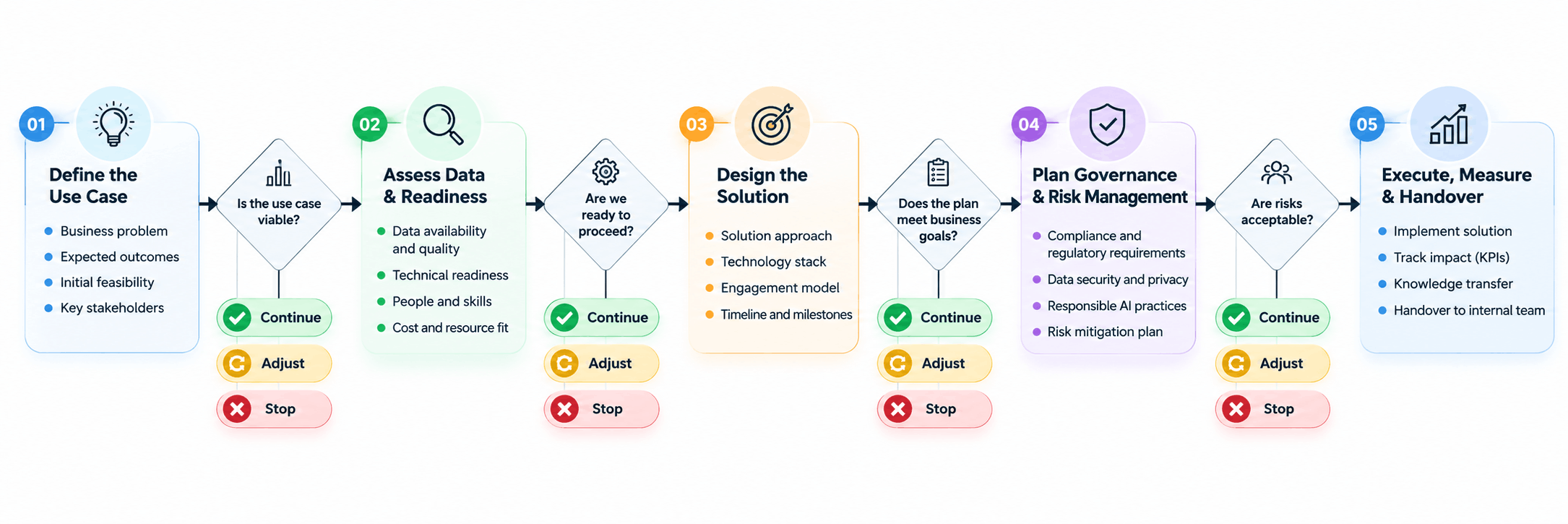
Define the business question or use case first. A specific, measurable outcome scopes an engagement far better than a general ambition to adopt AI.
Assess data and system readiness. Data accuracy and legacy integration are among the most commonly reported blockers in surveys of Indian enterprise AI programmes, so they should be assessed before any build is scoped.
Choose the smallest engagement model that answers the current question. An assessment answers where to start, an architecture plan answers how to build, and a proof answers whether it works.
Set success criteria and a decision point before work begins. Every stage should end with a clear continue, adjust, or stop decision, not an open ended extension.
Plan governance, security, and handover from the outset. Testing, auditing, and post launch ownership are cheaper to design in than to retrofit.
This is where the engineering execution layer matters. Samta.ai builds the VEDA AI decision analytics platform as the working system many engagements deliver against, connecting to existing Databricks, Snowflake, or Microsoft data infrastructure through our data integration consulting services so integration is scoped rather than discovered mid build. Institutions weighing whether a general data platform can serve as the delivery target should see how VEDA compares to other data intelligence platforms. Our AI implementation playbook covers the delivery stage in detail once scope is agreed.
AI consulting engagement models compared
Exact durations and fees vary by vendor, scope, and complexity, so the table below describes typical shape rather than a quoted price. Source Required for specific figures, most likely from vendor proposals or an independent consulting benchmark.
Engagement Model | What It Covers | Indicative Duration | Typical Pricing Structure | Best For |
AI readiness assessment | Review of current data, infrastructure, and governance maturity | Short, typically days to a few weeks | Fixed fee | Enterprises unsure where to start |
Scoped architecture plan | Target architecture, data flows, integration approach, and delivery roadmap | Weeks | Fixed fee | Enterprises with a defined use case needing a build plan |
Proof of concept | One bounded use case tested against real data | Days to weeks | Fixed fee | Enterprises needing evidence before a larger commitment |
Full implementation and build | Production system design, build, integration, and deployment | Months | Time and materials or phased fixed fee | Enterprises with a validated use case and budget |
Managed services and ongoing support | Operations, monitoring, and continuous improvement after launch | Ongoing | Monthly retainer or subscription | Enterprises without internal capacity to run AI in production |
Assess Your AI Model Risk with Confidence
Real world enterprise use cases
BFSI: a lender scoping an onboarding automation engagement
A lender wanted to automate customer onboarding checks but had no agreed architecture or governance approach. It started with a scoped architecture plan rather than a full build, which settled how identity data, model governance, and audit evidence would work before any code was written. The delivery target was Samta.ai's ONBO onboarding and KYC platform, with AI security and compliance services covering testing and audit requirements from the start.
General enterprise: a property group scoping an operations rollout
A property group managing many buildings wanted to bring AI into maintenance, tenant requests, and reporting, but was unsure which workflow to start with. A short readiness assessment ranked the candidate use cases, and a proof of concept then tested the strongest one on real data using CORA property management. Only after that evidence did the group commit to a wider build, rather than funding a broad programme up front.
Key risks and failure modes
Scoping the engagement as a broad transformation. Vague scope invites drift, since there is no defined outcome to measure the work against.
Skipping the data readiness assessment. Data accuracy and legacy integration problems are the most commonly reported blockers, and they surface late if not assessed early.
Choosing a build before a proof. Committing to a full implementation without evidence that the approach works on your data is the pattern most likely to end in an abandoned project.
Leaving governance to the end. With only 22% of Indian enterprises reporting testing and auditing processes, retrofitting them under pressure is a common and avoidable problem.
No defined handover. An engagement that ends at go live without an ownership plan tends to reappear as an urgent support gap within a few quarters.
When to engage an AI consultant and which model to start with
Start with a readiness assessment when:
You are unsure which use case to prioritise
Data quality or system integration status is unknown
Governance and compliance requirements are undefined
Start with a scoped architecture plan or proof when:
You have a defined use case and need a build plan or evidence
You want a clear decision point before a larger commitment
Internal teams can support delivery but lack an agreed design
Consider full implementation or managed services when:
A use case has already been validated on your data
You lack internal capacity to build or operate AI in production
Budget and ownership are already agreed
Our guide on when do companies need outside AI help covers this decision in more depth, and reviewing Samta.ai's case studies alongside your own use case shows how other enterprises have sequenced these stages.
Explore What AI Can Do for Your Business
Conclusion
AI consulting services succeed or fail on scope more than on vendor choice. Indian enterprises are investing quickly, yet most still lack the testing and auditing processes to govern what they deploy. Starting with the smallest engagement model that answers the current question, then expanding on evidence, is the most reliable way to turn that investment into working, governed AI.
About Samta
Samta.ai is a Singapore-headquartered AI Product Engineering & Data Intelligence partner helping enterprises build production-grade AI systems for regulated and data-intensive environments.We help organizations move beyond experimentation by engineering scalable, explainable, and enterprise-ready AI solutions from data foundations and model development to workflow automation and deployment.
Our capabilities combine deep AI expertise, data engineering, and product engineering to deliver measurable business impact across FinTech, BFSI, cybersecurity, regulatory technology, and enterprise operations.
Our enterprise AI products power real-world intelligence systems:
• TATVA : AI-driven data intelligence platform for governed analytics, monitoring, and operational insights
• VEDA : Explainable and audit-ready AI decisioning engine built for compliance-sensitive enterprise workflows
• CORA-Property Management Solutions: : Predictive intelligence platform for real-estate pricing, portfolio optimization, and investment analytics
Backed by ecosystem partnerships with Microsoft, Databricks, Snowflake, and AWS, Samta.ai delivers agile, cost-efficient AI engineering with faster turnaround and enterprise-grade scalability. Trusted by enterprises across FinTech, BFSI, and digital transformation initiatives, Samta.ai embeds AI governance, data privacy, and compliance-by-design principles directly into the AI lifecycle , enabling organizations to scale AI with transparency, accountability, and operational control.
Enterprises leveraging Samta.ai automate 65%+ of repetitive data, analytics, and decision workflows while maintaining governance, explainability, and measurable business outcomes. Samta.ai provides the strategic consulting, AI engineering, and data modernization expertise needed to align enterprise operations with next-generation AI transformation goals.
Frequently asked questions
What does an enterprise AI consulting engagement include?
A typical engagement includes a current state assessment, a scoped architecture plan, a build or proof stage, a governance and security layer, and a handover or operations plan. Which of these an enterprise needs depends on how defined its use case already is.
What is a typical AI consulting scope and timeline in India?
There is no single standard. Assessments and proofs tend to be short, architecture plans take weeks, and full builds run for months, with exact timelines depending on data readiness, integration complexity, and governance requirements rather than a fixed benchmark.
What should an enterprise expect from an AI consulting engagement in India?
An enterprise should expect a defined scope, a clear decision point at the end of each stage, governance and compliance built in from the start, and a defined handover, particularly given India's Digital Personal Data Protection Act and 2026 AI Governance Guidelines.
Which AI consulting engagement model should an enterprise start with?
Start with the smallest model that answers the current question. A readiness assessment suits enterprises unsure where to begin, while a scoped architecture plan or proof of concept suits those with a defined use case needing a plan or evidence.
How is AI consulting for business different from AI engineering services?
AI consulting for business typically covers assessment, strategy, and architecture planning, while AI engineering services cover building, integrating, and deploying the working system. Many engagements combine both, sequenced so planning precedes build.