
Summarize this post with AI
Most enterprise data integration projects fail not because the technology was wrong but because the partner was. According to Gartner's analysis of enterprise data and analytics transformations, data and analytics initiatives deliver value only when organizations align data engineering, governance, and business outcomes together. Enterprise data integration services partners who cannot demonstrate that alignment before the contract is signed will not produce it after. The difference between a defensible partner selection and an expensive mistake is a structured evaluation framework applied before the first proposal arrives. This guide gives CTOs and CDOs the evaluation criteria, partner comparison framework, and red flag checklist needed to select enterprise data integration services that deliver measurable outcomes rather than project reports.
Enterprise Data Integration Services:
The right enterprise data integration services partner combines proven experience with organizations of similar size and complexity, deep technical capability across the full integration stack (ETL and ELT pipelines, API orchestration, real-time streaming, and governance tooling such as Collibra or Alation), and SOC 2 Type II certification for regulated enterprise procurement. According to Gartner's 2024 Magic Quadrant for Data Integration Platforms, three core aspects define a leader: execution roadmap, innovation velocity, and customer satisfaction. For APAC regulated enterprises, a fourth criterion is non-negotiable: sector-specific regulatory experience covering PDPA, MAS AI governance, and applicable data sovereignty requirements, because an enterprise data integration vendor built for US compliance frameworks does not automatically satisfy Singapore or ASEAN regulatory obligations.
What Enterprise Data Integration Services Cover
Enterprise data integration services is not a single service. It spans the full integration lifecycle: strategy and requirements definition, source system assessment, architecture design, pipeline engineering (ETL, ELT, and real-time CDC), data quality and governance layer implementation, testing and validation, deployment, and post-implementation managed services. data integration reporting tools and data integration reporting solutions are the consumption layer at the end of this chain, but they deliver nothing without a governed, reliable integration layer underneath. The most common enterprise integration failure is starting with tool selection rather than business objectives, and selecting a visualization platform before the integration foundation is production-grade.
According to Improvado's 2026 enterprise data integration guide, the leading data governance platforms for enterprise technology in 2026 are Collibra, Informatica Axon, and Alation, selected for comprehensive metadata management, data cataloging, and compliance functionalities. A partner who cannot demonstrate proficiency across both the pipeline layer (MuleSoft, Fivetran, Airbyte, dbt) and the governance layer is delivering only half an integration program. For foundational context on what production-grade integration infrastructure requires, see the enterprise data integration engineering guide and the is your enterprise data ready guide.
Measure Your Enterprise AI Maturity Today
Why Partner Selection Is More Consequential in 2026
Three developments make the data integration partner evaluation decision more impactful than in any prior cycle.
1. Enterprise data integration is now the prerequisite to AI ROI: Enterprise data integration is no longer a backend IT concern. It is the foundation for analytics, automation, and sustainable growth. Without integrated data, AI initiatives lack reliable inputs and decision-making slows down. With it, organizations gain consistent metrics, real-time visibility, and the ability to adopt emerging technologies with confidence. A wrong partner choice delays every downstream AI program the board is already funding.
2. Regulatory complexity is only increasing for APAC enterprises: Enterprises are now balancing privacy regulations, industry compliance standards, and emerging AI governance requirements all at once. For Singapore BFSI firms specifically, PDPA data protection obligations, MAS AI governance expectations, and the EU AI Act's auditability requirements for AI decision inputs all trace back to the integration layer as their architectural foundation. An enterprise data integration vendor without APAC regulatory experience creates compliance exposure the enterprise, not the vendor, carries.
3. Implementation risk remains the primary project failure mode: Any vendor who cannot provide concrete implementation timeframes should be considered unreliable, per Perceptive Analytics' 2026 data integration partner selection guide. Good partners provide implementation phases in a Discover, Design, Build, Test, Deploy, Stabilize sequence with realistic timeframes benchmarked against organizations of similar size, typically 9 to 16 weeks for mid-market implementations. Partners promising fast implementation without proper testing phases are prone to post-implementation instability. For APAC enterprises building AI-ready data foundations before engaging integration partners, the building an AI-ready data foundation guide and the data discovery for AI guide cover the readiness assessment work that should precede any partner engagement.
The Partner Evaluation Framework: Step by Step
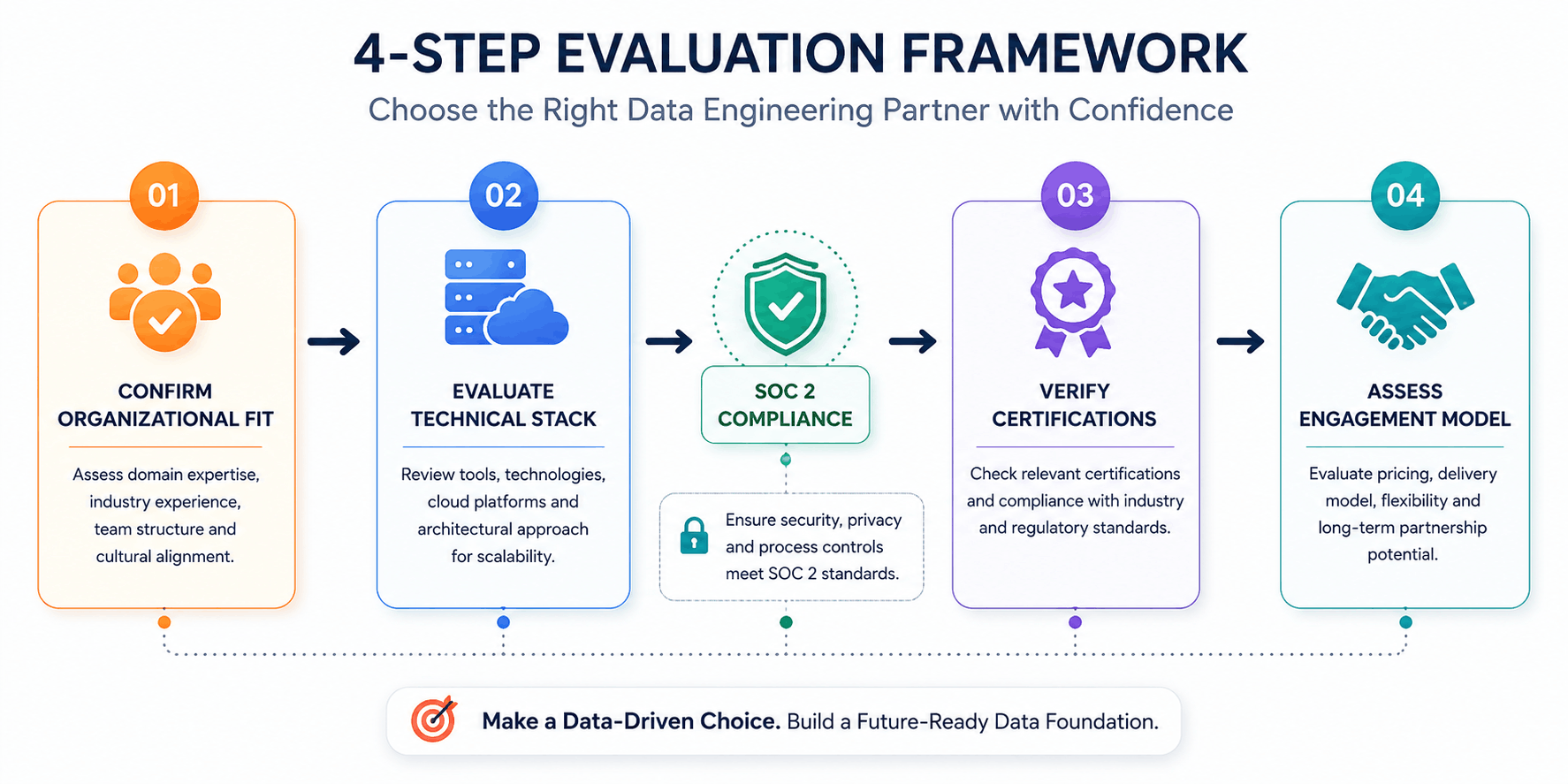
Use this sequence to evaluate any enterprise data integration services partner before committing to an engagement.
Step 1: Confirm Organizational Fit and Sector Experience
Size and complexity match: the initial evaluation criterion is confirming their experience in working with organizations of a similar size and complexity. An integration provider used to mid-market organizations may find it challenging to implement enterprise-level multi-regional integrations.
Sector regulatory experience: organizations in financial services have different requirements (PCI-DSS, SOX, MAS FEAT) compared to healthcare (HIPAA, HL7). Confirm the partner has in-house domain experts who understand your specific regulatory landscape, not generalist consultants who will learn it during your engagement.
Reference checks within your size range: ask for three production case studies with measurable outcomes in your sector, documented in the format: baseline problem, solution implemented, and quantified outcome. Vague case studies with no baseline metrics are a disqualifying red flag.
Step 2: Evaluate Technical Stack Depth
The Coworker AI 2026 enterprise data integration platform guide identifies the leading platforms in 2026 as MuleSoft (best for complex enterprise iPaaS), Fivetran (best for ELT pipelines), Airbyte (best open-source), and dbt (best for SQL-based transformation). Assess each candidate partner against this stack:
Pipeline tooling: proficiency across ELT and ETL tooling, real-time CDC, and Apache Kafka or equivalent for event streaming. About 82 percent of organizations now use real-time streaming in their pipeline architectures.
Governance tooling: documented experience with Informatica, Collibra, or Alation for metadata management and data lineage. Per the NIST Cybersecurity Framework, implementing a governance layer in integration platforms allows companies to reduce compliance violation rates by 60 percent.
Transformation layer: proficiency in dbt for modular SQL models is the 2026 standard for transformation logic that auditors can trace.
Step 3: Verify Compliance Credentials and Certifications
SOC 2 Type II certification: mandatory for Fortune 1000 procurement and for any partner handling regulated data. Partners without SOC 2 Type II cannot pass enterprise security reviews.
Platform credentials: Snowflake Elite, Databricks Premier, AWS Advanced Partner, or Azure Expert MSP status signals platform depth rather than surface-level familiarity.
Data residency controls: confirm the partner's architecture supports data residency requirements for Singapore (PDPA) and ASEAN jurisdictions before any architecture design work begins.
Step 4: Assess Engagement Model and Knowledge Transfer
Implementation risk is non-trivial. Gartner predicts that by 2027, more than 70 percent of recently implemented enterprise transformation initiatives will fail to fully meet their original business goals, often due to weak alignment, stakeholder engagement, and execution discipline. Negotiate knowledge transfer milestones into every statement of work before signing. The engagement should leave your team owning the codebase, documentation, and operational runbooks not dependent on the partner for every change request. Samta.ai's data integration consulting services are structured specifically on this principle: every engagement includes formal knowledge transfer gates so internal teams own the production system, not Samta.ai's continued involvement. The Veda AI decision analytics platform connects the integration layer to business outcome dashboards on Databricks and Snowflake, making the ROI of the integration investment visible at the decision level rather than only at the technical metric level. See how this connects to platform selection in the Veda vs data intelligence platform comparison.
Enterprise Data Integration Vendor Comparison
Evaluation Dimension | What Good Looks Like | Red Flag | Verification Method | APAC Regulated Enterprise Requirement |
Sector experience | 3 documented case studies with measurable outcomes in your industry and size range | Vague references, no baseline metrics, no quantified outcomes | Reference calls with listed clients, not just case study documents | PDPA, MAS, and ASEAN-specific experience required; US-only track record insufficient |
Technical stack | MuleSoft or Fivetran proficiency plus dbt for transformation, Collibra or Alation for governance | Single-platform specialists with no governance tooling experience | Technical assessment: ask to walk through their dbt model structure and lineage documentation approach | Real-time CDC plus governance layer mandatory for MAS AI governance compliance |
Certifications | SOC 2 Type II, Snowflake Elite or Databricks Premier, platform-specific credentials | No SOC 2 Type II, credential claims without verification | Request certificate of attestation, not just a badge on a website | SOC 2 Type II is mandatory for Singapore regulated enterprise procurement |
Engagement model | Phased Discover to Stabilize delivery, 9 to 16 weeks for mid-market, knowledge transfer milestones in SOW | Fixed-price with no phased testing, promises full implementation in under 6 weeks, no knowledge transfer clause | Review the SOW template before signing; knowledge transfer must be a contractual deliverable | Post-implementation independence is a regulatory requirement for outsourced functions under MAS outsourcing guidelines |
Hidden cost transparency | Full TCO model including maintenance, change requests, egress, and version migration costs upfront | Headline pricing with no maintenance model, undefined change request rates | Ask for a 24-month TCO model in writing before signing | Budget at least 15 to 20 percent above quoted integration project cost for contingencies |
Evaluate AI Risks Across Models, Data, and Governance
Enterprise Use Cases: Partner Selection in Practice
Use Case 1: Singapore Bank Selecting a BFSI-Specific Integration Partner
A Singapore bank needed to consolidate data from four core banking systems, a CRM, and three vendor-supplied credit analytics tools into a unified Snowflake lakehouse. Two global SIs were evaluated alongside two regional specialists. The global firms offered broad capability but no APAC-regulatory-specific case studies for MAS AI governance compliance. The bank selected a regional specialist using the Discover, Design, Build, Test, Deploy, Stabilize methodology with a 14-week delivery timeline and explicit knowledge transfer milestones. The engagement reduced compliance audit labor by 1,800 hours per year, validated against the baseline documented in the enterprise data integration engineering guide. Governance documentation for every data pipeline was exportable for MAS review without any manual reconstruction. The digital transformation managed services model continued post-delivery for pipeline monitoring and drift management.
Use Case 2: Technology Enterprise Avoiding an Integration Vendor Mistake
A Singapore technology company initially selected a vendor promising a six-week full implementation at a competitive rate. Four months in, the engagement had produced working pipelines with no lineage documentation, no governance layer, and no knowledge transfer. A 2019-era data architecture breaks under 2026 data volumes and this team discovered it mid-project when pipeline failures increased to 40 percent per week. The company reset, applied the five-dimension evaluation framework above, and selected a new partner who provided a SOC 2 Type II certificate, three comparable case studies with quantified outcomes, and a contractual knowledge transfer clause. The second engagement cost 30 percent more than the first; the total cost including the failed first engagement was 2.4 times what a correct initial partner selection would have cost.
Key Risks and Failure Modes
Starting with platform selection rather than business objectives: The most common pitfall in data integration initiatives is starting with technology selection rather than business outcomes. Before evaluating platforms, define exactly which business decisions integrated data will enable, then select the platform that serves those decisions best.
No SOC 2 Type II for regulated enterprise procurement: Enterprise-grade data integration platform vendors comparison must include certification status as a disqualifying filter, not a scoring dimension. Partners without SOC 2 Type II cannot pass Singapore financial services procurement standards.
Knowledge concentration in the vendor without transfer: If only the vendor's team understands how the integration layer works after go-live, the enterprise is locked into an ongoing dependency that eliminates negotiating leverage at contract renewal and creates operational risk if the vendor relationship ends.
Treating all data integration providers as equivalent: Traditional EDI platforms were built to move documents between trading partners; that model is no longer sufficient for enterprises requiring real-time execution across complex multi-partner ecosystems. Platform generation matters: a 2019 integration architecture cannot serve 2026 AI and governance requirements regardless of the vendor's track record.
See how Samta.ai's data integration engagements produced measurable outcomes in BFSI and regulated industries. Read Samta.ai's case studies before you brief the market on your integration program.
Decision Framework: Is This Data Integration Partner Right for Your Program?
Three production case studies with measurable outcomes in your industry and size range are verified, not just listed
SOC 2 Type II certificate of attestation is confirmed, not just a badge on the partner's website
Technical stack covers pipeline, governance, and transformation tooling, not just one layer
APAC and Singapore-specific regulatory experience is documented, not assumed from general data integration experience
A phased Discover to Stabilize delivery model with explicit timelines is confirmed
Knowledge transfer milestones are written into the statement of work before signing, not discussed verbally
If fewer than four boxes are checked, the evaluation is incomplete and the engagement risk is material.
Evaluate partners with clear requirements before taking your brief to the market.
Conclusion
Selecting the right enterprise data integration services partner is the most consequential early decision in any data modernization, analytics, or AI program. The failure rate for enterprise integration projects correlates directly with partner evaluation shortcuts: no SOC 2 verification, no sector-specific case study review, and no knowledge transfer clause in the statement of work. A structured evaluation framework applied before the first proposal arrives saves organizations the 2.4x total cost that a failed first engagement and correct second engagement produces.
About Samta
Samta.ai is a Singapore-headquartered AI Product Engineering & Data Intelligence partner helping enterprises build production-grade AI systems for regulated and data-intensive environments.We help organizations move beyond experimentation by engineering scalable, explainable, and enterprise-ready AI solutions from data foundations and model development to workflow automation and deployment.
Our capabilities combine deep AI expertise, data engineering, and product engineering to deliver measurable business impact across FinTech, BFSI, cybersecurity, regulatory technology, and enterprise operations.
Our enterprise AI products power real-world intelligence systems:
• TATVA : AI-driven data intelligence platform for governed analytics, monitoring, and operational insights
• VEDA : Explainable and audit-ready AI decisioning engine built for compliance-sensitive enterprise workflows
• CORA-Property Management Solutions: : Predictive intelligence platform for real-estate pricing, portfolio optimization, and investment analytics
Backed by ecosystem partnerships with Microsoft, Databricks, Snowflake, and AWS, Samta.ai delivers agile, cost-efficient AI engineering with faster turnaround and enterprise-grade scalability. Trusted by enterprises across FinTech, BFSI, and digital transformation initiatives, Samta.ai embeds AI governance, data privacy, and compliance-by-design principles directly into the AI lifecycle , enabling organizations to scale AI with transparency, accountability, and operational control.
Enterprises leveraging Samta.ai automate 65%+ of repetitive data, analytics, and decision workflows while maintaining governance, explainability, and measurable business outcomes. Samta.ai provides the strategic consulting, AI engineering, and data modernization expertise needed to align enterprise operations with next-generation AI transformation goals.
Frequently Asked Questions
What are enterprise data integration services and what do they cover?
Enterprise data integration services cover the full integration lifecycle: strategy and requirements definition, source system assessment, architecture design, pipeline engineering (ETL, ELT, and real-time streaming), governance layer implementation, testing, deployment, and post-implementation managed services. They differ from platform licensing in that they deliver a working, governed integration system rather than software access.
What is the difference between an enterprise data integration vendor and a data integration partner?
An enterprise data integration vendor typically provides software or a platform with implementation services attached. A data integration partner designs architecture, builds pipelines, implements governance tooling, and transfers knowledge to the enterprise's internal team. The distinction matters because vendor-delivered implementations often optimize for platform adoption; partner-delivered engagements optimize for the enterprise's post-implementation independence.
What certifications should an enterprise data integration partner hold?
At minimum: SOC 2 Type II for regulated enterprise procurement, and at least one platform credential (Snowflake Elite, Databricks Premier, AWS Advanced Partner, or Azure Expert MSP). According to the NIST Cybersecurity Framework, implementing a governance layer in integration platforms reduces compliance violation rates by 60 percent, making governance-aware partners meaningfully different from pipeline-only providers.
How do you evaluate data integration platform vendors comparison for APAC regulated enterprises?
Start with sector regulatory experience: does the vendor have documented PDPA, MAS AI governance, and Singapore-specific case studies? Then evaluate platform credentials, SOC 2 Type II status, and governance tooling proficiency. Generic global rankings that do not account for APAC regulatory requirements are not sufficient selection inputs for Singapore or ASEAN regulated enterprise programs.
How long does a typical enterprise data integration engagement take?
Mid-market implementations covering 5 to 15 source systems typically take 9 to 16 weeks using a Discover, Design, Build, Test, Deploy, Stabilize methodology. Comprehensive enterprise solutions with real-time streaming and governance implementation require 6 to 12 months. Partners promising full enterprise integration in under 6 weeks without a phased testing structure are creating post-implementation instability risk that costs more to remediate than a correct initial timeline would have.