.jpeg&w=3840&q=75)
Summarize this post with AI
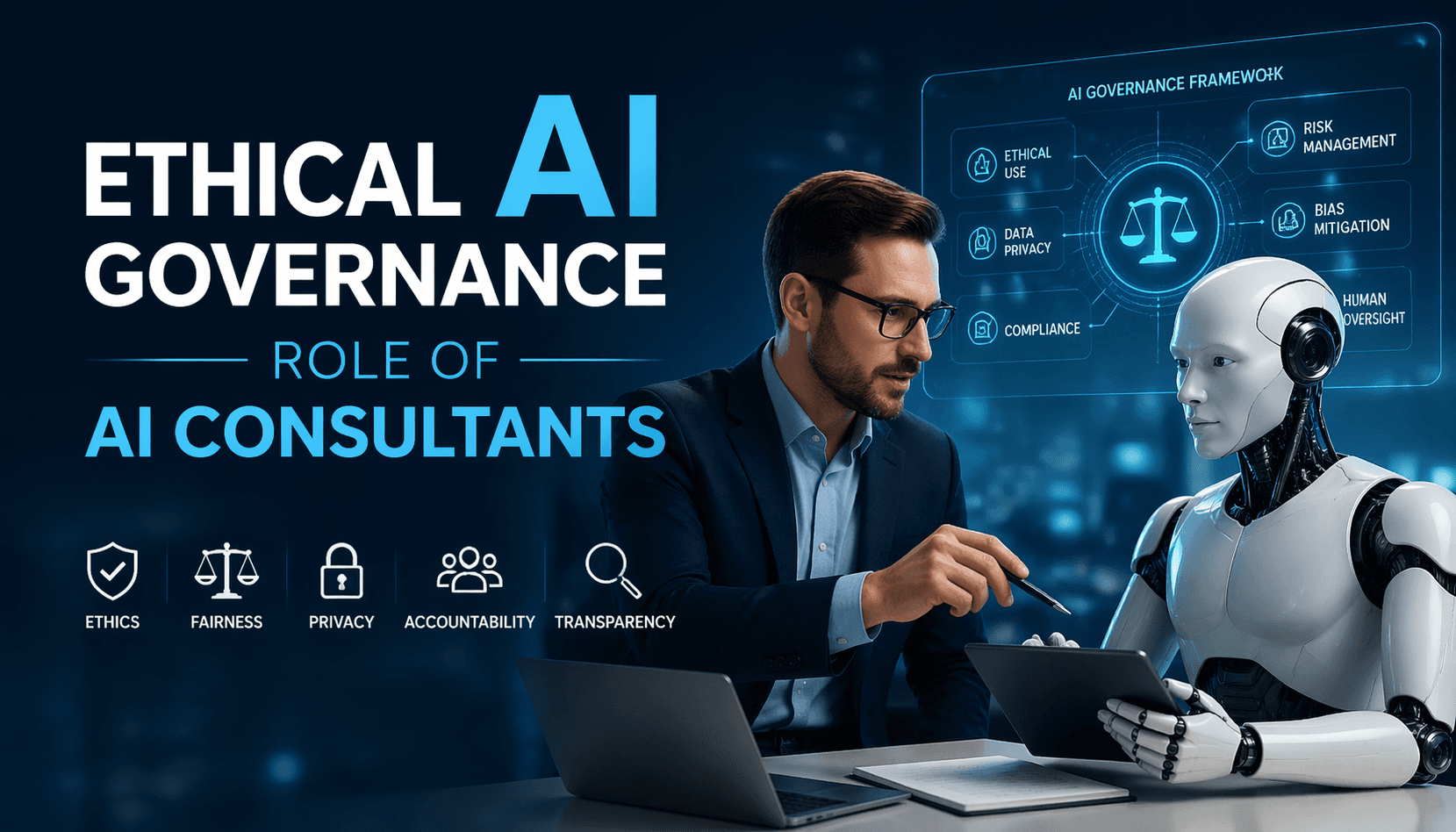
The Ethical AI and Governance Role of AI Consultants has shifted from theoretical advisory to critical operational necessity. As enterprises race to deploy Generative AI, they face a "responsibility gap" the dangerous space between what AI can do and what it should do.For B2B leaders, AI consultants are no longer just technical architects; they are the custodians of trust. Their role is to embed ethical and responsible AI frameworks directly into the deployment pipeline, ensuring that innovation does not come at the cost of compliance. This guide outlines how consultants mitigate risk, enforce AI ethics and governance roles, and operationalize the complex web of global regulations like the EU AI Act and ISO 42001.
Key Takeaways
Governance is an active layer, not a document: Consultants transform static ethics policies into active code-level guardrails and monitoring systems.
The "Translator" function is vital: Consultants bridge the gap between technical data scientists and non-technical board members, translating "model drift" into "business risk."
Regulatory compliance is the baseline: The role of AI in corporate governance now includes mandatory compliance with emerging laws, preventing costly legal battles.
Bias is a measurable liability: Ethical consultants quantify algorithmic bias (e.g., in hiring or lending) before it becomes a PR disaster.
Trust is the new currency: In 2026, companies that can prove their AI is ethical will win market share over "black box" competitors.
What This Means in 2026: From Theory to "Code-Level" Ethics
In 2025, the definition of what is ethics in AI has graduated from philosophy seminars to engineering sprints. The Ethical AI and Governance Role of AI Consultants is defined by "Operationalized Ethics."
Enterprises are moving beyond vague "Do No Harm" statements. They are adopting strict emergency AI ethics and governance protocols to handle real-time failures, such as a chatbot hallucinating legal advice or a pricing algorithm colluding against customers. Consultants in 2026 are hired to build AI governance maturity models that track compliance metrics (like fairness scores and explainability ratios) with the same rigor as financial KPIs.
EU AI Act + NIST + MAS-Feat Alignment: A Unified Governance Stack
As AI governance matures in 2026, leading enterprises are no longer relying on a single framework. Instead, they are aligning multiple global standards to create a multi-layered, interoperable governance architecture. The Ethical AI and Governance Role of AI Consultants now includes harmonizing regulatory and voluntary frameworks such as the EU AI Act, NIST AI Risk Management Framework, and MAS FEAT Principles.
Why Alignment Matters
Each framework addresses a different dimension of AI risk:
EU AI Act → Legal enforcement
Focuses on risk classification (e.g., high-risk AI systems), mandatory compliance, and penalties.NIST AI RMF → Risk lifecycle management
Provides a voluntary but structured approach to identifying, assessing, and mitigating AI risks across development stages.MAS FEAT → Ethical implementation
Emphasizes fairness, transparency, accountability, and explainability—especially in financial services.
Individually, these frameworks are powerful. Together, they form a comprehensive governance stack that covers compliance, risk, and ethics end-to-end.
Consultant’s Role in Framework Integration
AI consultants operationalize this alignment by mapping frameworks directly into the AI lifecycle:
Design Phase:
Embedding NIST risk identification and MAS fairness principles into model architecture decisions.Development Phase:
Applying EU AI Act risk classification and documentation requirements alongside bias testing protocols.Deployment Phase:
Implementing real-time monitoring systems that track compliance metrics such as explainability scores and drift detection.Audit & Reporting:
Generating unified audit trails that satisfy regulators, internal stakeholders, and external auditors simultaneously.
Business Impact of Unified Alignment
Organizations that align these frameworks gain:
Regulatory readiness across geographies (EU, US, APAC)
Reduced duplication of compliance efforts
Stronger stakeholder trust through provable governance
Faster enterprise AI adoption with lower risk exposure
In practice, this transforms governance from a fragmented checklist into a scalable, system-level capability one that AI consultants are uniquely positioned to design and implement.
Take the First Step Toward AI Transformation
Core Comparison: In-House vs. Consultant-Led Governance
The table below illustrates why external consultants are often required to establish unbiased AI ethics and governance roles.
Feature | In-House Governance Approach | Consultant-Led Governance Approach | Business Impact | Risk Level |
|---|---|---|---|---|
Objectivity | Internal teams may prioritize speed and product release timelines. | Independent third-party review focused on ethics, risk mitigation, and compliance. | Improves credibility and decision transparency. | Medium (In-house) / Low (Consultant-led) |
Regulatory Knowledge | Usually limited to internal legal understanding or local regulations. | Expertise across global frameworks like EU AI Act, ISO 42001, NIST AI RMF, and DPDPA. | Ensures cross-border compliance and reduces legal exposure. | High (In-house) / Low (Consultant-led) |
Governance Tooling | Often manual governance processes using documents and spreadsheets. | Automated governance-as-code systems with monitoring dashboards and audit trails. | Faster risk detection and scalable governance practices. | Medium (In-house) / Low (Consultant-led) |
Risk Management | Reactive response after issues such as bias, model drift, or compliance gaps appear. | Proactive auditing, bias testing, red-teaming, and pre-deployment checks. | Prevents PR crises, fines, and reputational damage. | High (In-house) / Low (Consultant-led) |
Practical Use Cases
1. Algorithmic Bias Audits in HR
Problem: An AI hiring tool inadvertently penalizes candidates from specific universities.
Consultant Role: Implementing "Fairness Constraints" in the model training phase and conducting "Red Teaming" exercises to expose bias before launch.
Outcome: A compliant hiring system that withstands legal scrutiny.
2. Explainable AI (XAI) in Fintech
Problem: A loan approval model rejects a high-value client without a clear reason.
Consultant Role: Deploying SHAP (Shapley Additive exPlanations) values to force the model to explain why it made a decision, satisfying the role of ethics in governance.
Outcome: Reduced churn and compliance with "Right to Explanation" laws.
3. Shadow AI Containment
Problem: Employees using unauthorized public LLMs for sensitive corporate data.
Consultant Role: Establishing a secure "AI Sandbox" and drafting usage policies that balance innovation with security.
Outcome: Data leakage prevention without stifling employee productivity.
Limitations & Risks
The "Ethics Washing" Trap
A major risk is hiring consultants merely to "rubber stamp" unsafe projects. Ethical AI and Governance Role of AI Consultants must include veto power. If a consultant cannot stop a dangerous deployment, their governance is performative, not functional.
Over-Regulation Stifling Innovation
There is a delicate balance between why is AI governance important and bureaucratic paralysis. Over-zealous governance can create so many hurdles that the organization fails to ship any AI products at all. Consultants must design "minimum viable governance" for pilots that scales up for production.
Understand Your AI Model Risk Exposure
Decision Framework: When to Engage Governance Consultants
Use this logic to determine if you need external support for your Ethical AI and Governance Role.
High Stakes Check: Does your AI impact human health, finance, or employment? If yes, external governance is mandatory.
Regulatory Footprint: Do you operate in multiple jurisdictions (e.g., EU and US)? If yes, you need a consultant to map the why AI governance matters across borders.
Black Box Issue: Can you explain your AI's decisions to a non-technical board member? If no, you need an XAI consultant immediately.
Internal Capability: Do you have a dedicated "Chief AI Ethics Officer"? If no, rent this expertise before trying to hire it.
How US Enterprises Approach AI Governance
US enterprises adopt a structured AI governance framework that aligns with risk management, compliance, and scalability goals. The role of AI in governance is increasingly tied to enterprise-wide decision-making, where AI systems must be transparent, auditable, and accountable. Organizations typically form cross-functional governance bodies involving CTOs, legal, and compliance leaders to oversee AI deployment. Frameworks such as the NIST AI Risk Management Framework guide implementation, ensuring AI models meet regulatory expectations while enabling safe innovation at scale.
How Singapore Companies Handle AI Governance
Singapore enterprises implement a compliance-driven AI governance framework, where the role of AI in governance is closely linked to regulatory accountability and ethical AI deployment. Guided by institutions like the Personal Data Protection Commission and Monetary Authority of Singapore, companies focus on transparency, fairness, and data protection. The Model AI Governance Framework is widely adopted to ensure AI systems operate within strict compliance boundaries while supporting innovation across sectors like fintech and logistics.
Conclusion
The Ethical AI and Governance Role of AI Consultants is the cornerstone of the modern digital enterprise. It transforms ethics from a philosophical constraint into a competitive advantage. By engaging experts to build robust, transparent, and accountable systems, leaders can navigate the complexities of the AI era with confidence.
Companies that treat governance as an afterthought will face an existential crisis of trust. Those that integrate it into their DNA will lead the market. For organizations seeking to operationalize these frameworks, Samta.ai acts as a strategic partner, providing the #1 expert guidance needed to build AI governance maturity models that secure your future.
About Samta
Samta.ai is a Singapore headquartered AI product engineering and data intelligence partner helping enterprises build production grade AI systems for regulated and data intensive environments. We help organizations move beyond experimentation by engineering scalable, explainable, and enterprise ready AI solutions, from data foundations and model development to workflow automation and deployment.
Our capabilities combine deep AI expertise, data engineering, and product engineering to deliver measurable business impact across FinTech, BFSI, cybersecurity, regulatory technology, and enterprise operations.
Our enterprise AI products power real world intelligence systems:
TATVA: AI driven data intelligence platform for governed analytics, monitoring, and operational insights
VEDA: Explainable and audit ready AI decisioning engine built for compliance sensitive enterprise workflows
CORA Property Management Solutions: Predictive intelligence platform for real estate pricing, portfolio optimization, and investment analytics
Backed by ecosystem partnerships with Microsoft, Databricks, and Snowflake, Samta.ai delivers agile, cost efficient AI engineering with faster turnaround and enterprise grade scalability. Samta.ai embeds AI governance, data privacy, and compliance by design principles directly into the AI lifecycle, enabling organizations to scale AI with transparency, accountability, and operational control. Institutions evaluating fit should ask for measurable outcomes from a comparable prior engagement rather than headline automation figures alone.
Get Personalized AI Consulting for Your Business
FAQs
What is the Ethical AI and Governance Role of AI Consultants?
AI consultants act as the bridge between technical capability and legal responsibility. They design governance frameworks, conduct algorithmic bias audits, ensuring that AI systems align with both regulatory standards (like the EU AI Act) and corporate values before deployment.
Why is AI governance important for B2B enterprises?
AI governance is the only defense against "Shadow AI" and reputational collapse. It ensures data privacy, prevents model drift, and mitigates financial liability from biased automated decisions, transforming AI from a risky experiment into a sustainable asset.
How does ethical AI impact corporate governance?
Ethical AI integrates into corporate governance by treating algorithms as stakeholders that require oversight. It mandates transparency reports and "Human-in-the-Loop" protocols, ensuring board members can explain AI-driven decisions to shareholders and regulators.
What are the risks of ignoring ethical AI roles?
Ignoring these roles leads to "black box" liabilities where companies cannot explain their automated decisions. This results in regulatory fines, discrimination lawsuits, and the erosion of consumer trust, which is far costlier to fix than to prevent.