
Summarize this post with AI
Most enterprises default to full human review for every AI decision, then wonder why the system never scales. The real question is not whether to add human oversight, it is where in the loop that human actually sits. Human in the loop AI architecture is one of three distinct oversight models, alongside human on the loop and human out of the loop, each trading decision authority for speed differently. This guide breaks down which one fits which use case, and how to design the checkpoints properly.
Human in the loop AI architecture:
Human in the loop, HITL, requires a human to approve each significant AI action before it proceeds, trading speed for maximum control. Human on the loop, HOTL, lets the AI act autonomously while a human monitors and can intervene after the fact, and human out of the loop, HOOTL, removes real time human involvement entirely. Both the NIST AI Risk Management Framework and the EU AI Act expect human oversight at defined points for high risk AI systems, which is why choosing the right architecture, not defaulting to maximum caution everywhere, is the actual enterprise design problem.
What is the difference between HITL, HOTL and HOOTL?
Human in the loop AI architecture, HITL, means no AI action proceeds without human approval first. The AI proposes, a human decides, and the system waits.
Human on the loop, often called human over the loop, means the AI acts independently under normal conditions while a human monitors from outside the process, intervening only when something looks wrong.
Human out of the loop describes autonomous agents operating with no real time human involvement at all, sometimes with initial guidance but otherwise acting independently end to end.
For a deeper breakdown of oversight patterns across use cases, see top 8 human in the loop patterns and agentic AI governance fundamentals.
Know Your AI Readiness Before Your Next Move
Why this matters now for enterprise architects
Three developments make choosing the right architecture an active design decision in 2026.
Regulatory frameworks now expect human oversight at defined points, not everywhere uniformly. The NIST AI Risk Management Framework, through its govern and manage functions, expects oversight calibrated to risk level, and the EU AI Act mandates human oversight specifically for high risk AI systems, not as a blanket requirement across every deployment.
The terminology itself has academic roots worth knowing. A 2023 academic paper on human AI teaming in aerospace control traces this three way distinction precisely: human in the loop systems wait for approval on every action, human on the loop systems receive status updates and provide guidance while the agent acts independently, and human out of the loop systems observe and act with no ongoing human involvement.
Trustworthy AI assessment frameworks have formalised these autonomy levels for compliance purposes. The Fraunhofer IAIS Guideline for Trustworthy Artificial Intelligence, an AI assessment catalog referenced in EU AI governance discussions, explicitly defines human control, human in the loop, human on the loop and human out of the loop as four distinct autonomy levels organisations should assign deliberately per AI application.
See how this plays out in a specific hiring context in the hidden risk of unmonitored AI decisions, and the broader engineering discipline behind it in enterprise AI engineering in Singapore.
A framework for designing human in the loop checkpoints
Here is how enterprise architects should decide where oversight sits, rather than defaulting to the same level everywhere.
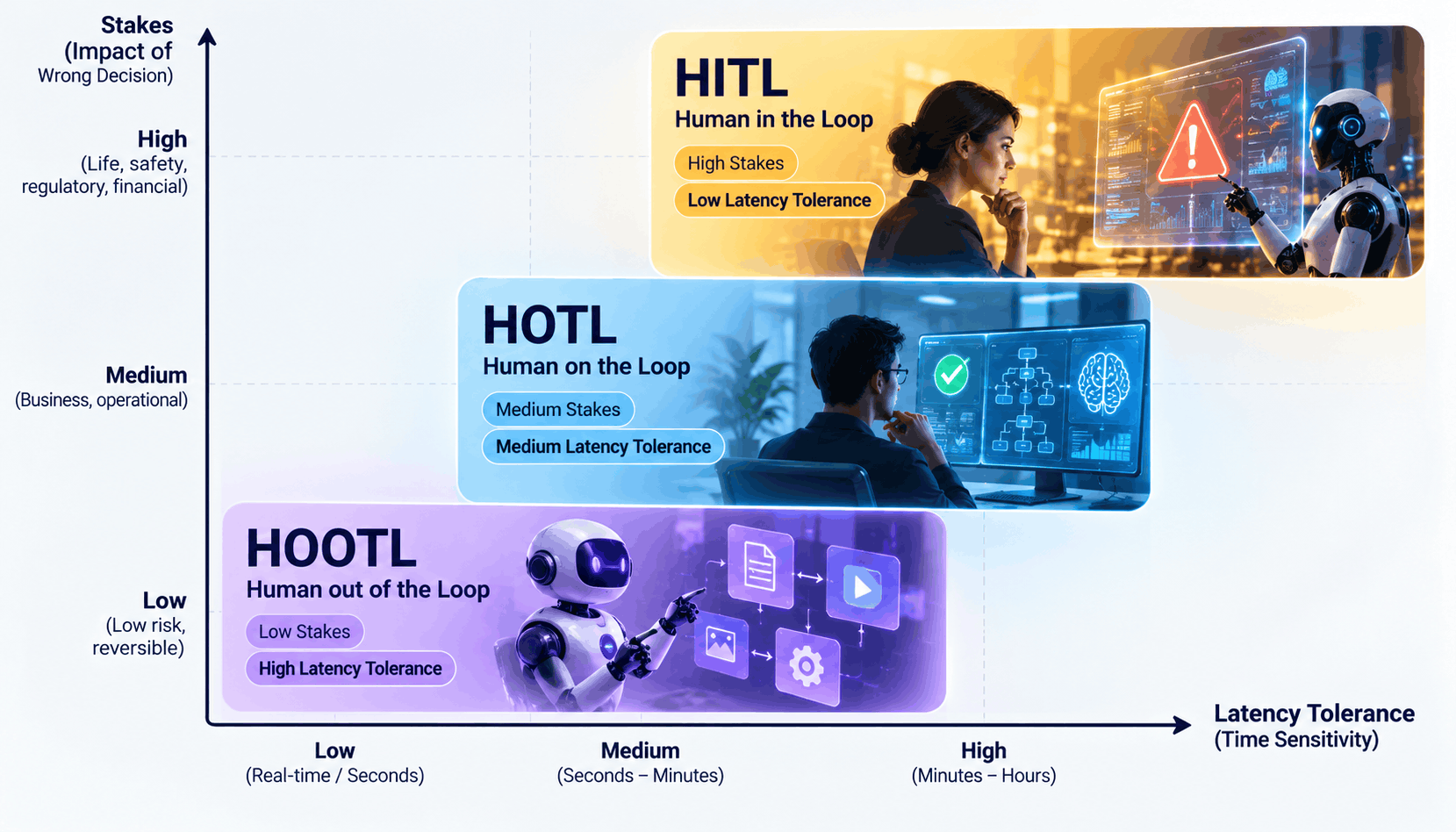
Score each AI workflow on reversibility and stakes. A reversible, low stakes decision, like flagging a spam email, tolerates more autonomy than an irreversible, high stakes one, like rejecting a loan application.
Match decision authority to that score. High stakes, hard to reverse decisions need decision authority to remain with a human, HITL. Lower stakes, reversible decisions can run HOTL or HOOTL.
Account for latency requirements explicitly. Latency tolerance drives architecture choice as much as risk does, a fraud check with a two second budget cannot wait for human approval on every transaction, which pushes toward HOTL with sampled review instead.
Design the intervention mechanism, not just the checkpoint. Intervention needs a clear, fast path for a human to override or pause the system, not just a dashboard nobody checks in time. Workflow automation consulting supports building this intervention path directly into existing operational workflows.
Build audit trail generation into the architecture from the start. Audit evidence, what the AI decided, what a human reviewed or overrode, and when, needs to be captured automatically, not reconstructed after an incident. AI security and compliance services support this directly as the engineering execution layer once the architecture itself is defined.
Comparing five human oversight architectures
Architecture | Decision authority | Latency | Intervention point | Best fit |
Human in the loop (HITL) | Human approves every significant action | Slowest, waits for approval | Before each action, blocking | High stakes, irreversible decisions, credit, legal, medical |
Human on the loop (HOTL) | AI decides, human monitors and can override | Fast, near real time action | After the action, with override capability | Moderate stakes, time sensitive workflows, fraud flags, content moderation |
Human over the loop | AI operates independently within set parameters, human reviews aggregate patterns | Fast, no per action delay | Periodic review of patterns, not individual actions | High volume, moderate stakes, routine classification tasks |
Human out of the loop (HOOTL) | AI decides and acts fully independently | Fastest, no human step in the loop | None in real time, only post hoc audit | Low stakes, reversible, high volume, spam filtering |
Hybrid, risk tiered architecture | Varies by workflow, HITL for high stakes, HOOTL for low stakes | Matched to each workflow's own requirement | Defined per tier, not uniform | Enterprise and BFSI running multiple AI workflows at once |
The last row is what most mature enterprise AI deployments actually need, since no single architecture fits every workflow equally well. For how this applies to a specific hiring context, see Tatva versus traditional hiring platforms.
Understand Your AI Model Risk Exposure
Real world use cases
Regulated angle: credit decisioning requiring strict HITL
A lender's AI credit scoring model generates a recommendation, but every approval or rejection requires a human underwriter's sign off before it reaches the applicant. This HITL architecture is appropriate specifically because the decision is high stakes, hard to reverse, and sits under regulatory scrutiny for fair lending. The underwriter's override rate itself becomes a useful signal, tracked as part of the audit trail, revealing where the model's recommendations and human judgment diverge most often.
General enterprise: hiring assessment running human over the loop
A company's AI driven hiring assessment screens candidates at high volume, with recruiters reviewing aggregate pass or fail patterns weekly rather than approving each individual screening decision in real time. This human over the loop model balances the need for fairness oversight against the operational reality of screening thousands of applications. Samta.ai's Tatva hiring assessment platform and the Tatva product support this exact architecture, generating the pattern level audit data recruiters review periodically rather than requiring sign off on every individual screen.
Key risks and failure modes
Defaulting to HITL everywhere out of caution. This creates a bottleneck that makes AI deployment pointless at scale, since every decision still waits on a human anyway.
Choosing HOOTL for decisions that are actually high stakes. Full autonomy without a real time override path is dangerous specifically where errors are costly and hard to reverse.
No clear intervention mechanism, even when a human is nominally on the loop. A human who technically can override but has no fast, usable way to do so provides no real oversight at all.
Treating audit trail generation as an afterthought. Reconstructing what an AI decided and why, after an incident, is far harder than capturing it automatically as the system runs.
Confusing human on the loop with human over the loop. These terms are sometimes used interchangeably but describe meaningfully different review cadences, per action monitoring versus periodic pattern review.
Applying one architecture uniformly across an entire AI portfolio. Different workflows carry different stakes and latency needs, and a single oversight model rarely fits all of them well.
When to use each architecture
Use human in the loop (HITL) if:
The decision is high stakes, hard to reverse, or carries regulatory scrutiny
Latency of seconds to minutes per decision is acceptable
Explainability and individual sign off matter for compliance purposes
Use human on the loop or human over the loop if:
Volume is too high for per decision human review to be practical
The decision is moderate stakes and reasonably reversible
Pattern level oversight can catch systemic problems even without per action review
When is fully autonomous AI appropriate, human out of the loop?
The decision is low stakes and easily reversible
Speed is the primary requirement and delay itself causes harm
Post hoc audit, not real time intervention, is sufficient oversight for the risk level involved
Let’s Find the Right AI Approach for Your Business
Conclusion
The question was never whether to add human oversight everywhere. It was choosing the right oversight model for each specific workflow's stakes and latency needs. Score your workflows, match the architecture to that score, and build the audit trail in from the start rather than reconstructing it later. The next step is mapping your own AI portfolio against these three models honestly.
About Samta
Samta.ai is a Singapore-headquartered AI Product Engineering & Data Intelligence partner helping enterprises build production-grade AI systems for regulated and data-intensive environments.We help organizations move beyond experimentation by engineering scalable, explainable, and enterprise-ready AI solutions from data foundations and model development to workflow automation and deployment.
Our capabilities combine deep AI expertise, data engineering, and product engineering to deliver measurable business impact across FinTech, BFSI, cybersecurity, regulatory technology, and enterprise operations.
Our enterprise AI products power real-world intelligence systems:
• TATVA : AI-driven data intelligence platform for governed analytics, monitoring, and operational insights
• VEDA : Explainable and audit-ready AI decisioning engine built for compliance-sensitive enterprise workflows
• CORA-Property Management Solutions: : Predictive intelligence platform for real-estate pricing, portfolio optimization, and investment analytics
Backed by ecosystem partnerships with Microsoft, Databricks, Snowflake, and AWS, Samta.ai delivers agile, cost-efficient AI engineering with faster turnaround and enterprise-grade scalability. Trusted by enterprises across FinTech, BFSI, and digital transformation initiatives, Samta.ai embeds AI governance, data privacy, and compliance-by-design principles directly into the AI lifecycle , enabling organizations to scale AI with transparency, accountability, and operational control.
Enterprises leveraging Samta.ai automate 65%+ of repetitive data, analytics, and decision workflows while maintaining governance, explainability, and measurable business outcomes. Samta.ai provides the strategic consulting, AI engineering, and data modernization expertise needed to align enterprise operations with next-generation AI transformation goals.
Frequently asked questions
What is human over the loop AI?
Human over the loop describes an architecture where AI operates independently within defined parameters, and a human reviews aggregate patterns or periodic samples rather than approving individual actions. It sits between per action monitoring, human on the loop, and no oversight at all, human out of the loop, making it suited to high volume, moderate stakes workflows like routine classification or screening tasks.
When is fully autonomous AI appropriate?
Fully autonomous AI, human out of the loop, is appropriate when decisions are low stakes, easily reversible, and speed matters more than per action review. Spam filtering and routine content tagging are common examples. It is not appropriate for high stakes, hard to reverse decisions, which both the NIST AI Risk Management Framework and the EU AI Act expect to retain human oversight at defined points.
How do enterprise architects design human in the loop checkpoints for automated AI workflows?
Architects should score each workflow by stakes and reversibility first, then match the oversight model to that score rather than defaulting to the same architecture everywhere. High stakes, hard to reverse decisions need HITL with a blocking approval step. Lower stakes, high volume workflows often work better under HOTL or human over the loop, with audit trail generation built into the architecture from the start rather than reconstructed after an incident.
What is the difference between human in the loop and human on the loop?
Human in the loop requires approval before each significant action, meaning the system waits on a human decision. Human on the loop lets the AI act independently while a human monitors and can intervene after the fact, trading some control for significantly lower latency. The choice depends on how reversible the decision is and how much delay the use case can tolerate.
Can one enterprise use all three architectures at once?
Yes, and most mature AI deployments do. A hybrid, risk tiered architecture applies HITL to high stakes workflows like credit decisions, HOTL or human over the loop to moderate stakes, high volume workflows like fraud flagging, and HOOTL to low stakes, reversible tasks like spam filtering. Treating oversight as workflow specific, not organisation wide, is what makes this scale.