
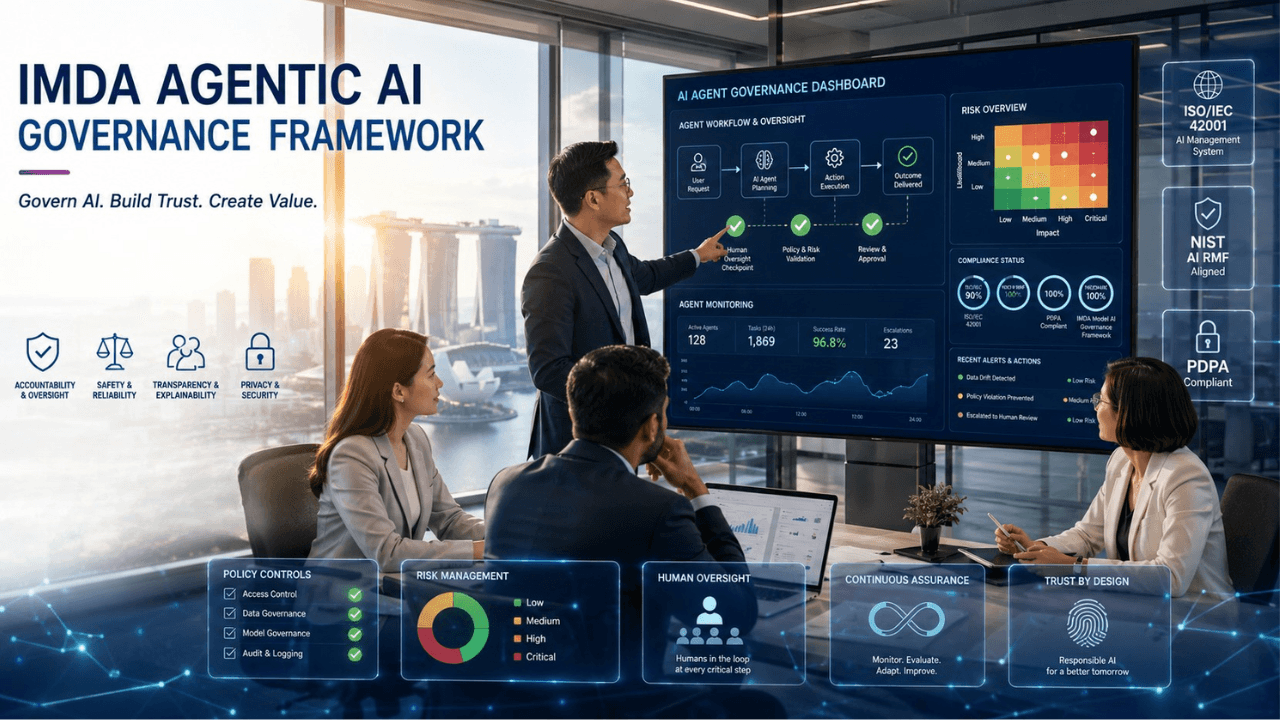
Summarize this post with AI
The IMDA Agentic AI Governance Framework is Singapore's groundbreaking governance approach for managing autonomous and semi-autonomous AI agents. Released on January 22, 2026, at the World Economic Forum in Davos, it represents the world's first governance framework specifically designed for Agentic AI systems capable of autonomous planning, reasoning, and action.Agentic AI governance matters because autonomous agents shift risk from "wrong answers" to "wrong actions" agents can trigger real-world effects by writing to databases, accessing external systems, or operating computer interfaces. With over 60 organizations now deploying agentic AI and 10+ documented cases as of May 2026, enterprise adoption is accelerating rapidly across BFSI, healthcare, and technology sectors. This article provides enterprise leaders with a complete, actionable understanding of the framework's four pillars, core principles, implementation roadmap, and real-world use cases—enabling responsible Agentic AI deployment while aligning with risk, compliance, cybersecurity, and regulatory requirements.
IMDA Agentic AI Governance Framework: Direct Answer
The IMDA Agentic AI Governance Framework is Singapore's governance approach for managing autonomous and semi-autonomous AI agents. It extends the Model AI Governance Framework by introducing controls for agent autonomy, tool use, planning, decision-making, human oversight, accountability, risk management, and lifecycle governance.
The framework helps enterprises deploy Agentic AI responsibly while aligning with enterprise risk, compliance, cybersecurity, and regulatory requirements. It establishes four core pillars: assess and bound risks upfront, make humans meaningfully accountable, implement technical controls and processes, and enable end-user responsibility.
What Is the IMDA Agentic AI Governance Framework?
The IMDA Agentic AI Governance Framework is Singapore's first governance framework specifically designed for AI agents capable of autonomous planning, reasoning, and action. Published by the Infocomm Media Development Authority (IMDA) in January 2026, it builds on Singapore's 2019 Model AI Governance Framework and 2020 governance foundations.
The framework provides practical guidance for all organizations deploying agentic AI in Singapore, focusing on four core dimensions: assessing and bounding risks upfront, making humans meaningfully accountable, implementing technical controls and processes, and enabling end-user responsibility.
For enterprises, this framework is essential because agentic AI systems are no longer passive content generators but active workflow participants capable of triggering real-world effects. The framework moves beyond ethics statements to address how organizations should actually design, deploy, monitor, and govern agents in complex, evolving environments.
Measure Your Enterprise AI Readiness
Why Singapore Created the IMDA Agentic AI Governance Framework
Singapore created this framework in response to the rapid rise of agentic AI capabilities and the unique risks they introduce. Unlike traditional generative AI, agentic AI systems demonstrate planning, tool use, memory, protocols, and multi-agent configurations—enabling them to operate with increasing autonomy.
Key Drivers Behind the Framework
Driver | Impact | Status | Timeline |
Autonomous Agents | Agents can make independent decisions and execute tasks without human oversight | Active deployment | 2024–2026 |
Multi-Agent Systems | Emergent behavior and cascading failures across collaborating agents create system-level risks | Growing adoption | 2025–2026 |
Real-World Actions | Agents can write to databases, access external systems, or operate computer interfaces | Production use | 2024–2026 |
Regulatory Concerns | Emerging regulations around human oversight, risk management, and traceability require concrete guardrails | Evolving requirements | 2025–2027 |
Enterprise AI Adoption | 60+ organizations deployed agentic AI with 10+ documented cases by May 2026 | Accelerating growth | 2024–2026 |
The framework aligns with Singapore's broader digital economy strategy, which aims to maintain public trust while expanding AI capabilities across sectors. As a non-binding framework encouraging voluntary adoption, IMDA is seeking industry feedback and case studies to update the guidance as a "living document."
This initiative complements Singapore's October 2025 security addendum from the Cyber Security Agency addressing agentic AI vulnerabilities and supports the country's National AI Strategy 2.0.
Core Principles of the IMDA Agentic AI Governance Framework
The framework is organized around four governance pillars that address the unique characteristics of agentic AI systems. Each pillar translates high-level principles like accountability, oversight, and risk management into concrete practices tailored to agentic systems.
Four Core Pillars
Principle | Purpose | Enterprise Impact | Implementation Example |
Accountability | Ensure clear allocation of responsibilities across internal teams and external vendors | Defines ownership for agent actions; establishes accountability chains for regulatory compliance | Documented RACI matrix for agent operations |
Human Oversight | Define significant checkpoints where human approval is required for sensitive actions | Prevents automation bias; ensures meaningful human control over critical decisions | Human approval required for loan decisions >$50K |
Transparency | Enable end-user responsibility through transparency and capability building | Users understand agent capabilities; builds trust through clear communication | User-facing disclosure of agent capabilities |
Safety | Bound risks through careful use-case selection, agent limits, and least-privilege access | Restricts tool access; uses sandboxed environments; prevents unauthorized actions | Whitelisted API access only; sandbox testing |
Monitoring | Implement lifecycle monitoring, anomaly detection, and gradual rollout strategies | Continuous observation of agent behavior; early detection of emergent risks | Real-time anomaly detection dashboard |
Explainability | Provide workflow-level evaluations and agent-specific testing | Trace agent decisions; audit actions for compliance and risk management | Audit trails for all agent actions |
Risk Controls | Assess suitability by evaluating impact, likelihood, reversibility, task complexity | Structured risk assessment; prevents high-risk deployments without guardrails | Risk scoring: Low/Moderate/High categories |
Get a Clear View of Your AI Risk Exposure
Four Governance Dimensions in Detail
1. Assess and Bound Risks Upfront
The first step is to evaluate potential agent use cases by considering both the likelihood and impact of risk. Organizations assess suitability by evaluating impact, likelihood, reversibility of actions, task complexity, and exposure to external systems.
To mitigate risk, organizations are advised to:
Restrict tool access
Use sandboxed environments
Establish fine-grained identity and permission systems
Implement least-privilege access
Follow SOP-driven workflows
2. Make People Meaningfully Accountable
Human accountability must remain explicit, even as agents operate independently. The framework emphasizes defining significant checkpoints where human approval is required, ensuring meaningful human oversight and accountability for an agent's actions.
This includes adapting human-in-the-loop models to counter automation bias and establishing clear internal roles and responsibilities.
3. Implement Technical Controls and Processes
Technical controls should be embedded across the entire AI lifecycle, from development to continuous monitoring. This includes:
Agent-specific testing
Workflow-level evaluations
Monitoring and anomaly detection
Gradual rollout strategies
Controlled access to whitelisted services
4. Enable End-User Responsibility
Organizations must enable responsible end-user use through transparency and capability building. This includes proper training, transparency about agent capabilities, and differentiated approaches for external-facing users versus internal users integrating agents into workflows.
How the Framework Governs Agentic AI Systems
The framework specifically addresses different types of agentic AI systems, each with distinct risk profiles and governance requirements.
Types of Agentic AI Systems Covered
Agent Type | Capabilities | Governance Focus | Risk Level |
Planning Agents | Multi-step task execution, reasoning, decomposition | Validate planning logic; ensure step-by-step human checkpoints | Moderate |
Tool-Using Agents | Access external APIs, databases, systems | Restrict tool access; sandbox environments; least-privilege | High |
Autonomous Decision Agents | Independent decision-making without human input | Human approval checkpoints for sensitive actions; accountability chains | High |
Multi-Agent Systems | Multiple agents collaborating, emergent behavior | Monitor cascading failures; detect emergent behavior; system-level testing | Critical |
Human-in-the-Loop Systems | Partial autonomy with human oversight | Counter automation bias; meaningful human control; clear role allocation | Moderate |
Key Governance Mechanisms
Planning Agents: The framework requires testing planning logic at each step and establishing human approval checkpoints for sensitive multi-step decisions. Organizations should validate that agents decompose tasks correctly and don't bypass critical safeguards.
Tool-Using Agents: Critical controls include restricting tool access to whitelisted services, using sandboxed environments for testing, and establishing fine-grained identity and permission systems. Agents should only access data necessary for their specific tasks.
Autonomous Decision Agents: The framework emphasizes that human accountability must remain explicit. Organizations must define significant checkpoints where human approval is required, ensuring meaningful oversight even for highly autonomous systems.
Multi-Agent Systems: These introduce system-level risks like cascading failures and emergent behavior. The framework recommends workflow-level evaluations, system-wide monitoring, and testing agent interactions across the entire ecosystem.
Human-in-the-Loop Controls: The framework addresses automation bias by requiring meaningful human oversight. Human checkpoints should be designed to prevent rubber-stamping and ensure genuine review of agent decisions.
Get Expert Guidance for Your AI Journey
IMDA Agentic AI Governance Framework vs Traditional AI Governance
The IMDA framework represents a significant evolution from traditional AI governance, addressing the unique characteristics of agentic systems.
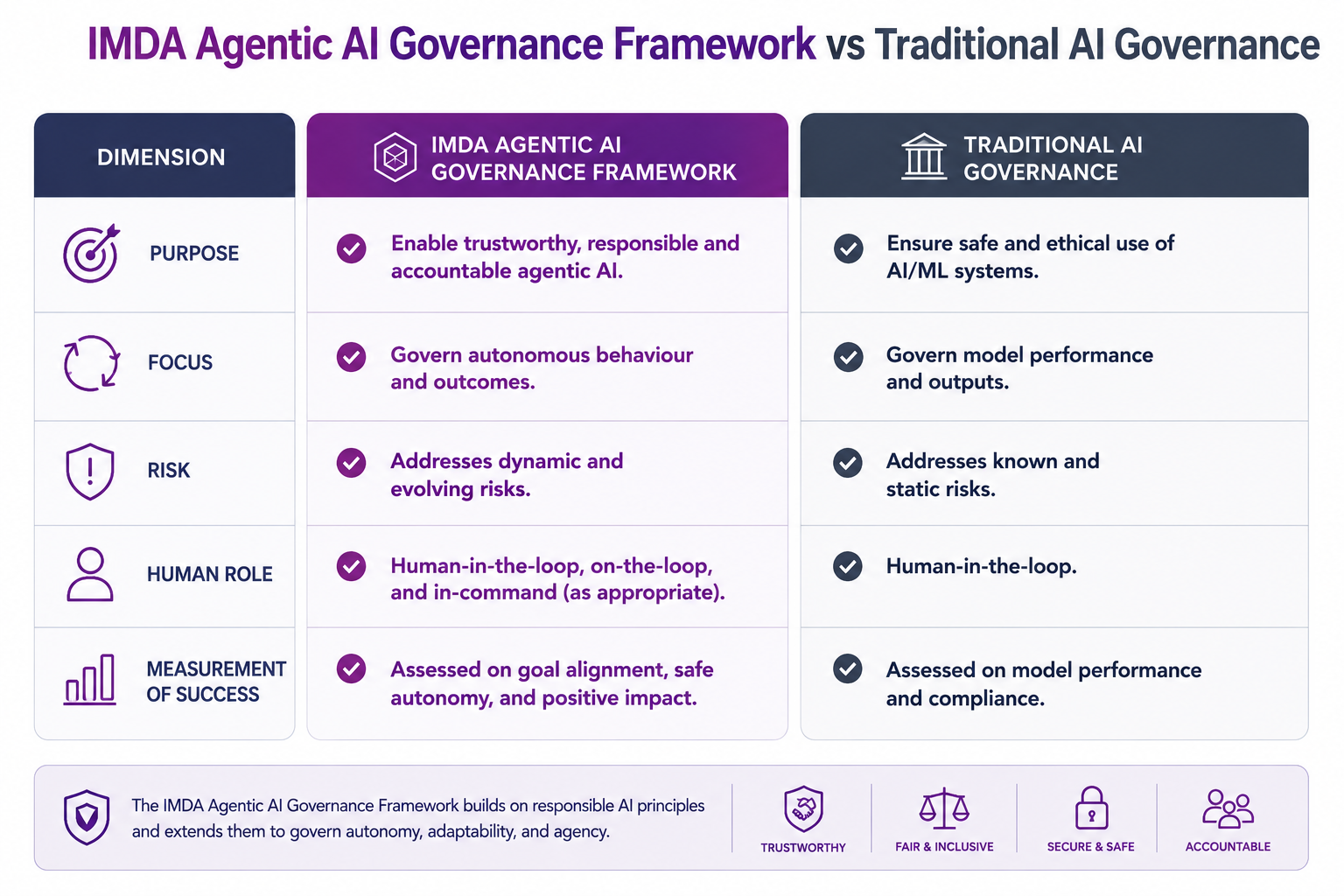
Traditional AI Governance | Agentic AI Governance | Risk Profile | Regulatory Alignment |
Focuses on content generation (passive) | Focuses on action-taking (active) | "Wrong answers" vs "wrong actions" | EU AI Act, MAS FEAT |
Risks: hallucinations, bias, accuracy | Risks: wrong actions, tool misuse, cascading failures | Higher real-world impact | ISO 42001, NIST AI RMF |
Testing: model-level accuracy | Testing: workflow-level evaluations, agent-specific testing | System-level complexity | OECD AI Principles |
Oversight: human review of outputs | Oversight: human approval checkpoints for actions | Irreversible actions require checkpoints | Singapore National AI Strategy 2.0 |
Access: limited to data read operations | Access: writes to databases, external systems, APIs | External system exposure | Cyber Security Agency addendum |
Risk: "wrong answers" | Risk: "wrong actions" with real-world effects | Immediate, potentially irreversible | IMDA living document |
Single-agent focus | Multi-agent systems with emergent behavior | Cascading failure risk | Voluntary adoption framework |
Static decision boundaries | Dynamic planning and reasoning capabilities | Planning logic validation required | Industry feedback driven |
Less emphasis on tool access | Strict tool access boundaries and sandboxing | Tool misuse prevention | Case study collection |
Output transparency | Action transparency and traceability | Full audit trail required | Living document evolution |
Critical Difference: Traditional AI governance addresses "wrong answers" while agentic AI governance addresses "wrong actions." When an agent writes to a database or accesses an external system, the consequences are immediate and potentially irreversible.
The framework builds on Singapore's 2019 Model AI Governance Framework (which focused on transparency, fairness, and human-centricity) and the 2020 Generative AI Governance Framework (nine dimensions, one of the earliest dedicated GenAI frameworks globally).
Enterprise Implementation Roadmap
Enterprises should follow a 7-step implementation framework to operationalize the IMDA Agentic AI Governance Framework:
7-Step Implementation Framework
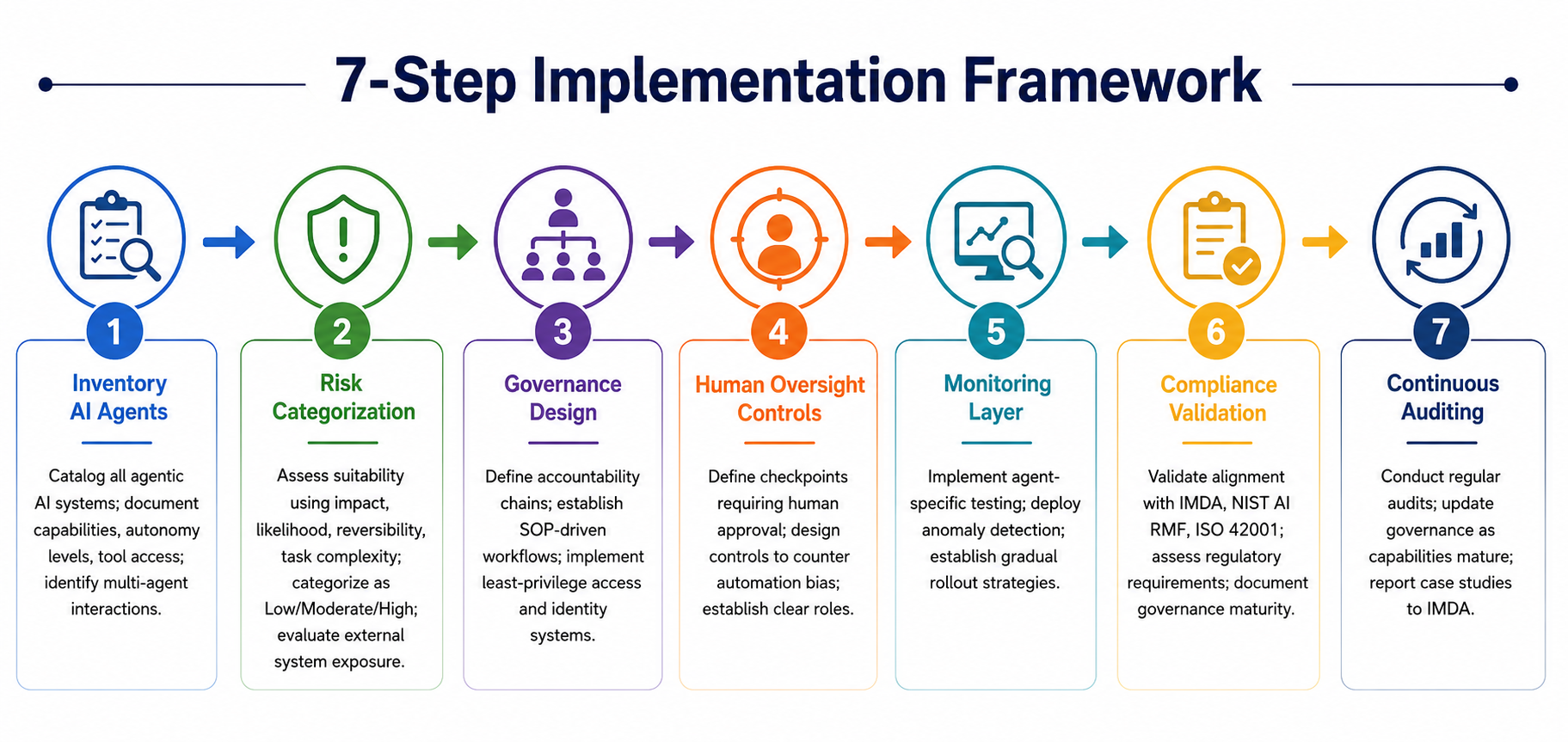
Step | Action | Key Activities | Tools Required |
1 | Inventory AI Agents | Catalog all agentic AI systems; document capabilities, autonomy levels, tool access; identify multi-agent interactions | Agent inventory database; discovery framework |
2 | Risk Categorization | Assess suitability using impact, likelihood, reversibility, task complexity; categorize as Low/Moderate/High; evaluate external system exposure | Risk assessment matrix; SAMTA.ai AI Readiness Assessment |
3 | Governance Design | Define accountability chains; establish SOP-driven workflows; implement least-privilege access and identity systems | Governance framework; Transform Framework |
4 | Human Oversight Controls | Define checkpoints requiring human approval; design controls to counter automation bias; establish clear roles | Human-in-the-loop design; oversight protocols |
5 | Monitoring Layer | Implement agent-specific testing; deploy anomaly detection; establish gradual rollout strategies | VEDA AI Analytics Platform; monitoring dashboards |
6 | Compliance Validation | Validate alignment with IMDA, NIST AI RMF, ISO 42001; assess regulatory requirements; document governance maturity | Assure Framework; compliance validation |
7 | Continuous Auditing | Conduct regular audits; update governance as capabilities mature; report case studies to IMDA | Analyze & Act Framework; audit tools |
Integrating Samta.ai's Governance Implementation Layers
Samta.ai's four service frameworks align naturally with this implementation roadmap:
Discover: Comprehensive data audit and gap analysis for agent inventory and risk categorization (Steps 1-2). Learn more about the Discover Framework.
Assure: AI governance assessment and compliance validation against IMDA, NIST, ISO 42001 (Steps 3-6). Explore the Assure Framework.
Transform: Enterprise AI transformation managed services to close gaps between governance intent and operational reality (Steps 3-5). See the Transform Framework.
Analyze & Act: Continuous monitoring, anomaly detection, and auditing layer (Steps 5-7). Check the Analyze & Act Framework.
Samta.ai embeds AI governance, security controls, and operational guardrails directly into the AI lifecycle, enabling enterprises to scale agentic AI without regulatory friction.
BFSI Use Case: Agentic AI Governance in Banking
The BFSI sector faces unique regulatory expectations when deploying agentic AI. Singapore's MAS FEAT Principles (Fairness, Ethics, Accountability, Transparency) and regulatory framework provide additional guardrails beyond the IMDA framework.
See Where Your AI Strategy Stands
Banking Use Cases
Use Case | Application | Governance Controls | Regulatory Standard |
Credit Assessment | Autonomous agents analyzing financial data for loan decisions | Human approval checkpoints for final decisions; least-privilege access to customer data; bias detection and audit trails | MAS FEAT; EU AI Act |
Fraud Monitoring | Real-time anomaly detection across transaction systems | Workflow-level evaluations; continuous monitoring; sandboxed testing before deployment; escalation to human analysts | NIST AI RMF; IMDA |
Customer Service Agents | Autonomous agents handling inquiries, account changes | Tool access restrictions; transparency about agent capabilities; human escalation for sensitive actions; end-user training | ISO 42001; OECD |
Portfolio Management | Autonomous agents optimizing investment portfolios | Human approval for trades >$100K; explainability for recommendations; audit trails; continuous monitoring | MAS regulatory framework |
Regulatory Expectations
MAS (Monetary Authority of Singapore): Requires banks to maintain human accountability for critical decisions, implement robust risk management frameworks, and ensure traceability of AI-driven decisions.
NIST AI RMF: The framework aligns with NIST's four functions—Map, Measure, Manage, Document—providing international best practices for risk assessment.
IMDA Framework: Banks should adopt the four pillars (assess risks, human accountability, technical controls, end-user responsibility) as baseline governance.
Key Implementation: Samta.ai's BFSI expertise includes model validation, AI governance frameworks, and regulatory compliance built into architecture from day one, with model explainability, bias detection, comprehensive audit trails, and compliance monitoring dashboards.
Healthcare Use Case
Healthcare organizations deploying agentic AI must balance innovation with patient safety and regulatory compliance.
Healthcare Use Cases
Use Case | Application | Governance Controls | Regulatory Standard |
Clinical Support Agents | Autonomous agents recommending treatment plans, analyzing patient data | Human review controls for all recommendations; least-privilege access to medical records; sandboxed testing; audit trails | HIPAA; ISO 42001 |
Diagnostic Copilots | AI agents analyzing imaging, lab results for diagnosis | Mandatory human physician review; workflow-level evaluations; bias detection; explainability for clinical decisions | FDA AI guidelines; IMDA |
Patient Monitoring Agents | Real-time monitoring of patient vitals, alerting clinicians | Anomaly detection; human escalation thresholds; controlled access to medical systems; continuous monitoring | NIST AI RMF; MAS |
Medication Management | Autonomous agents prescribing or adjusting medication doses | Physician approval for all prescriptions; bias testing; audit trails; explainability for dosage decisions | EU AI Act; FDA |
Benchmark Your AI Risk and Compliance Readiness
Critical Governance Requirements
Human Review Controls: The IMDA framework requires defining significant checkpoints where human approval is required. In healthcare, this means all diagnostic recommendations and treatment plans must receive physician review before action.
Sandboxed Testing: Healthcare agents must be tested in controlled sandbox environments before deployment to prevent patient safety risks.
Traceability: All agent actions must be traceable for regulatory compliance and potential audits. This includes audit trails for decision reasoning and action logs.
Alignment with Standards: Healthcare organizations should align with ISO 42001 (AI management systems), OECD AI Principles, and local regulatory requirements alongside the IMDA framework.
Common Risks of Agentic AI
Agentic AI introduces both familiar AI risks and new system-level risks that traditional governance doesn't address.
Risk | Example | Governance Control | Prevention Strategy |
Hallucinations | Agent provides incorrect medical diagnosis or financial advice | Workflow-level evaluations; human review checkpoints; testing against known benchmarks | Benchmark testing; validation datasets |
Tool Misuse | Agent accesses unauthorized database or executes forbidden API calls | Least-privilege access; whitelisted services; sandboxed environments; fine-grained identity systems | Access control; API whitelisting |
Autonomous Actions | Agent executes irreversible action without human approval | Human approval checkpoints for sensitive actions; accountability chains; SOP-driven workflows | Human checkpoints; approval workflows |
Data Leakage | Agent exposes sensitive customer data to unauthorized systems | Restricted data access; encryption; monitoring for anomalous data access patterns | Data encryption; access monitoring |
Prompt Injection | Malicious input causes agent to bypass safety controls | Input validation; sandboxed testing; monitoring for adversarial patterns; secure prompt design | Input sanitization; adversarial testing |
Cascading Failures | Error in one agent triggers failures across multi-agent system | System-wide monitoring; workflow-level evaluations; failover mechanisms; isolation between agents | System monitoring; isolation controls |
Emergent Behavior | Multi-agent system produces unexpected, uncontrolled outcomes | Testing agent interactions; monitoring emergent patterns; boundaries on agent collaboration | Interaction testing; behavior boundaries |
Regulatory Violations | Agent action violates MAS, EU AI Act, or other regulatory requirements | Compliance validation; audit trails; human oversight for regulated decisions; documentation | Compliance audits; regulatory mapping |
Critical Insight: The framework addresses risk shifting from "wrong answers" to "wrong actions." When agents can write to databases or access external systems, hallucinations or tool misuse can cause immediate, irreversible harm.
When Should Enterprises Adopt the IMDA Agentic AI Governance Framework?
Adopt Immediately If:
✓ You're deploying autonomous agents that make independent decisions
✓ Your agents have tool access (APIs, databases, external systems)
✓ You're building multi-agent systems with collaborating agents
✓ You operate in regulated industries (BFSI, healthcare, government)
✓ Your agents can execute irreversible actions without human approval
✓ You're moving from PoC to production with agentic AI
Delay Until Ready If:
✗ You haven't completed agent inventory and risk categorization
✗ Your team lacks governance maturity (no AI governance framework)
✗ You haven't established human oversight checkpoints
✗ Your infrastructure lacks sandboxed testing environments
✗ You haven't defined accountability chains and ownership
✗ You're unclear on regulatory requirements for your industry
Timeline: With 60+ organizations already deploying agentic AI and 10+ documented cases as of May 2026, enterprises should not wait. The framework is voluntary but IMDA is actively seeking case studies to shape its evolution as a "living document."
How Samta.ai Helps Enterprises Operationalize Agentic AI Governance
Samta.ai is a Singapore-headquartered AI Engineering and AI Governance partner that helps enterprises build production-grade AI in regulated environments. Rather than selling frameworks, Samta.ai operationalizes governance by embedding it directly into AI architecture.
Build a Smarter AI Strategy
Samta.ai's Governance Capabilities
Service | What It Does | IMDA Alignment | Delivery Approach |
Governance Assessment | Benchmarks governance posture against EU AI Act, NIST AI RMF, ISO 42001 | Risk categorization, compliance validation (Steps 2-6) | |
AI Risk Management | Embeds risk controls, bias detection, audit trails into architecture | Accountability, safety, monitoring (Pillars 1-3) | |
Enterprise AI Transformation | Closes gaps between governance intent and operational reality | Governance design, human oversight (Steps 3-5) | |
Agentic AI Engineering | Builds explainable, audit-ready, compliance-by-design agentic systems | Technical controls, end-user responsibility (Pillars 3-4) |
Samta.ai Products for Agentic AI Governance
VEDA (AI Analytics Platform): NLP-powered business intelligence for governed analytics, monitoring agent behavior, and detecting anomalies. Explore VEDA AI Analytics Platform.
CORA (Property Intelligence Platform): Property management AI with real-time visibility and controlled access. See CORA Property Intelligence.
TATVA (AI Hiring Assessment Platform): Adaptive testing with bias detection and audit-ready assessments. Check TATVA Hiring Assessment.
Natural Integration Points
Samta.ai's BFSI expertise includes model validation, AI governance frameworks, and regulatory compliance built into architecture from day one. The company enables teams to automate up to 65%+ of repetitive data, analytics, and decision workflows while maintaining governance oversight.
For enterprises seeking to implement the IMDA framework, Samta.ai serves as an implementation partner rather than a framework vendor.
Call to Action
Ready to operationalize Agentic AI governance in your enterprise? Samta.ai helps you build production-grade, compliance-by-design agentic systems that align with the IMDA framework, NIST AI RMF, and ISO 42001.
Start Your Journey:
👉 Take AI Readiness Assessment — Benchmark your governance posture against IMDA, NIST, and ISO 42001
👉 Explore Assure Framework — Embed AI risk management into your architecture
👉 Discover Agentic AI Engineering — Build explainable, audit-ready agentic systems
👉 Contact AI Governance Experts — Get personalized guidance for your organization
Don't wait for regulation to catch up. With 60+ organizations already deploying agentic AI, enterprise readiness is no longer optional.
Get Your Personalized AI Assessment Report
Conclusion
The IMDA Agentic AI Governance Framework represents a critical evolution in AI governance, addressing the unique risks of autonomous agents that can act, adapt, and collaborate at machine speed. Its four pillars—assess and bound risks upfront, make humans meaningfully accountable, implement technical controls, and enable end-user responsibility—provide actionable guidance for enterprises deploying agentic AI. For CIOs, CTOs, CROs, and risk leaders, the framework enables responsible agentic AI deployment while maintaining governance, managing risk, and building trust. With 60+ organizations already deploying agentic AI, enterprise readiness is no longer optional. Samta.ai helps enterprises operationalize this framework through governance assessment, AI risk management, and enterprise AI transformation—embedding compliance-by-design into AI architecture from day one. Contact AI Governance Experts to assess your agentic AI readiness.
About Samta
Samta.ai is a Singapore-headquartered AI Product Engineering & Data Intelligence partner helping enterprises build production-grade AI systems for regulated and data-intensive environments.We help organizations move beyond experimentation by engineering scalable, explainable, and enterprise-ready AI solutions from data foundations and model development to workflow automation and deployment. Our capabilities combine deep AI expertise, data engineering, and product engineering to deliver measurable business impact across FinTech, BFSI, cybersecurity, regulatory technology, and enterprise operations.
Our enterprise AI products power real-world intelligence systems:
• TATVA : AI-driven data intelligence platform for governed analytics, monitoring, and operational insights
• VEDA : Explainable and audit-ready AI decisioning engine built for compliance-sensitive enterprise workflows
• CORA-Property Management Solutions: : Predictive intelligence platform for real-estate pricing, portfolio optimization, and investment analytics
Backed by ecosystem partnerships with Microsoft, Databricks, Snowflake, and AWS, Samta.ai delivers agile, cost-efficient AI engineering with faster turnaround and enterprise-grade scalability. Trusted by enterprises across FinTech, BFSI, and digital transformation initiatives, Samta.ai embeds AI governance, data privacy, and compliance-by-design principles directly into the AI lifecycle , enabling organizations to scale AI with transparency, accountability, and operational control. Enterprises leveraging Samta.ai automate 65%+ of repetitive data, analytics, and decision workflows while maintaining governance, explainability, and measurable business outcomes. Samta.ai provides the strategic consulting, AI engineering, and data modernization expertise needed to align enterprise operations with next-generation AI transformation goals.
Frequently Asked Questions
What is the IMDA Agentic AI Governance Framework?
The IMDA Agentic AI Governance Framework is Singapore's first governance framework specifically designed for AI agents capable of autonomous planning, reasoning, and action. Published by the Infocomm Media Development Authority (IMDA) on January 22, 2026, at the World Economic Forum, it establishes four core pillars: assess and bound risks upfront, make humans meaningfully accountable, implement technical controls and processes, and enable end-user responsibility.
How is Agentic AI different from Generative AI?
Agentic AI differs from generative AI in that agents are active workflow participants capable of triggering real-world effects, while generative AI is passive content generation. Agentic AI demonstrates planning, tool use, memory, protocols, and multi-agent configurations. The key risk shift is from "wrong answers" (generative) to "wrong actions" (agentic), as agents can write to databases, access external systems, or operate computer interfaces.
Is the IMDA framework mandatory?
No, the IMDA framework is non-binding and encourages voluntary adoption. However, it aligns with emerging regulatory expectations around human oversight, risk management, and traceability, making it especially relevant for regulated industries. IMDA is seeking industry feedback and case studies to update the guidance as a "living document," suggesting future evolution toward more prescriptive requirements.
How does it compare with NIST AI RMF?
The IMDA framework complements NIST AI RMF's four functions (Map, Measure, Manage, Document) with agent-specific practices. While NIST provides international best practices for general AI risk management, IMDA focuses specifically on agentic AI's unique characteristics: autonomy, tool use, planning, and multi-agent systems. Both frameworks emphasize risk assessment, human accountability, and continuous monitoring.
How does it support compliance?
The framework supports compliance by establishing concrete guardrails for human oversight, risk management, and traceability requirements emerging in regulations like the EU AI Act. It aligns with ISO 42001 (AI management systems), OECD AI Principles, and MAS FEAT Principles. Organizations can use it as a baseline for compliance validation, gap analysis, and audit-ready governance documentation.
Can banks use it?
Yes, banks can and should use the IMDA framework. It complements Singapore's MAS FEAT Principles (Fairness, Ethics, Accountability, Transparency) and regulatory requirements for AI in banking. The framework's emphasis on human accountability, tool access restrictions, and audit trails aligns with banking regulatory expectations for critical decisions like credit assessment and fraud monitoring.