
Summarize this post with AI
The single-agent approach to enterprise AI is functionally dead. A single AI model attempting to execute a complex enterprise workflow in one reasoning loop leads to bloated context windows, mixed responsibilities, and single points of failure. Multi-agent ai engineering workflow automation replaces that pattern with coordinated networks of specialized agents, each with a defined role, bounded tool access, and a specific success criterion, that work together to complete workflows too complex for any single model to handle reliably. This guide covers what multi-agent ai engineering workflow automation requires at the architecture, orchestration, and governance layer in 2026, with verified use cases from BFSI and enterprise operations.
Multi-Agent AI Engineering Workflow Automation:
Multi-agent ai engineering workflow automation is the discipline of designing, deploying, and governing coordinated networks of specialized AI agents that collectively execute enterprise workflows across systems, tools, and data sources. The standard 2026 enterprise architecture consists of a supervisor agent that breaks high-level goals into sub-tasks, executor agents that interact with APIs and databases, a critique or validation agent that checks outputs before escalation, and a monitoring layer detecting anomalous behavior and cascading failures. If 2023 to 2025 were the years of pilots and prototypes, 2026 is about orchestration, governance, and scale, per Progress Software's Chief AI Officer, meaning the primary differentiator between organizations that succeed with multi-agent systems and those that do not is not the AI model but the engineering discipline around coordination, shared state, tool access control, and observability.
What Is Multi-Agent AI Engineering and How Does It Differ from Single-Agent AI
what is ai agent is the prerequisite question. An AI agent is not a standard API integration or automation pipeline. It is a persistent, stateful operator capable of observing its environment, formulating a multi-step plan, executing the first step using an external tool, evaluating the output against its goal, and iteratively adjusting until the objective is met. A multi agent system in AI takes this further by distributing that execution across specialized agents rather than concentrating it in a single model. Think of this like a specialized digital department: you do not have one person doing sales, HR, and engineering; you have specialized experts who communicate with each other. A typical multi agent system architecture consists of a supervisor agent receiving the high-level request and assigning sub-tasks, executor agents interacting with code or APIs to complete those tasks, a validation agent checking outputs before they reach downstream systems or customers, and a monitoring layer tracking the full execution chain.
The transition marks a shift from Horizon 1 AI, covering predictive analytics and basic chatbots, to Horizon 3 AI, which involves trusted autonomy, where AI executes multi-step workflows with minimal human intervention but structured governance checkpoints. For enterprises currently navigating AI adoption decisions, the navigating AI adoption challenges guide and the agentic AI vs traditional AI guide provide the conceptual foundation this architecture guide builds on.
Why 2026 Is the Production Year for Multi-Agent Systems
Three forces make multi-agent ai engineering workflow automation the operational standard in 2026 rather than an experimental pattern.
1. The orchestration layer has matured to production grade: LangGraph has emerged as the de facto standard for production-grade, stateful workflows, modeling multi-agent interactions as explicit state machines with nodes for agents and edges for conditional routing, giving architects precise control over branching, retries, and cyclical flows. By 2026, expect standardized agent APIs, enhanced observability, and stronger governance as agent teams reach production.
2. Enterprises are moving from experimentation to orchestration: Organizations that fail to implement proper coordination, governance, and observability for their agent deployments will encounter rising costs, compliance risks, and unreliable outcomes as they scale. Businesses that prioritize orchestration alongside agent development gain durable competitive advantages through faster automation, more reliable AI systems, and the ability to deploy agents across the enterprise without losing control.
3. Governance requirements now apply explicitly to agentic AI: IMDA's Agentic AI Governance Framework, published January 2026, is the world's first governance framework specifically for AI agents, and Singapore's MAS AI Risk Management Toolkit explicitly covers emerging agentic AI technologies. For enterprises comparing AI-native architecture against traditional development approaches, the AI vs traditional dev companies comparison documents where agentic systems create defensible differentiation.
Map your multi-agent deployments against IMDA's four pillars and MAS's Toolkit requirements. Download the Agentic AI Governance Checklist from Samta.ai and close your governance gaps before your next enterprise deployment decision.
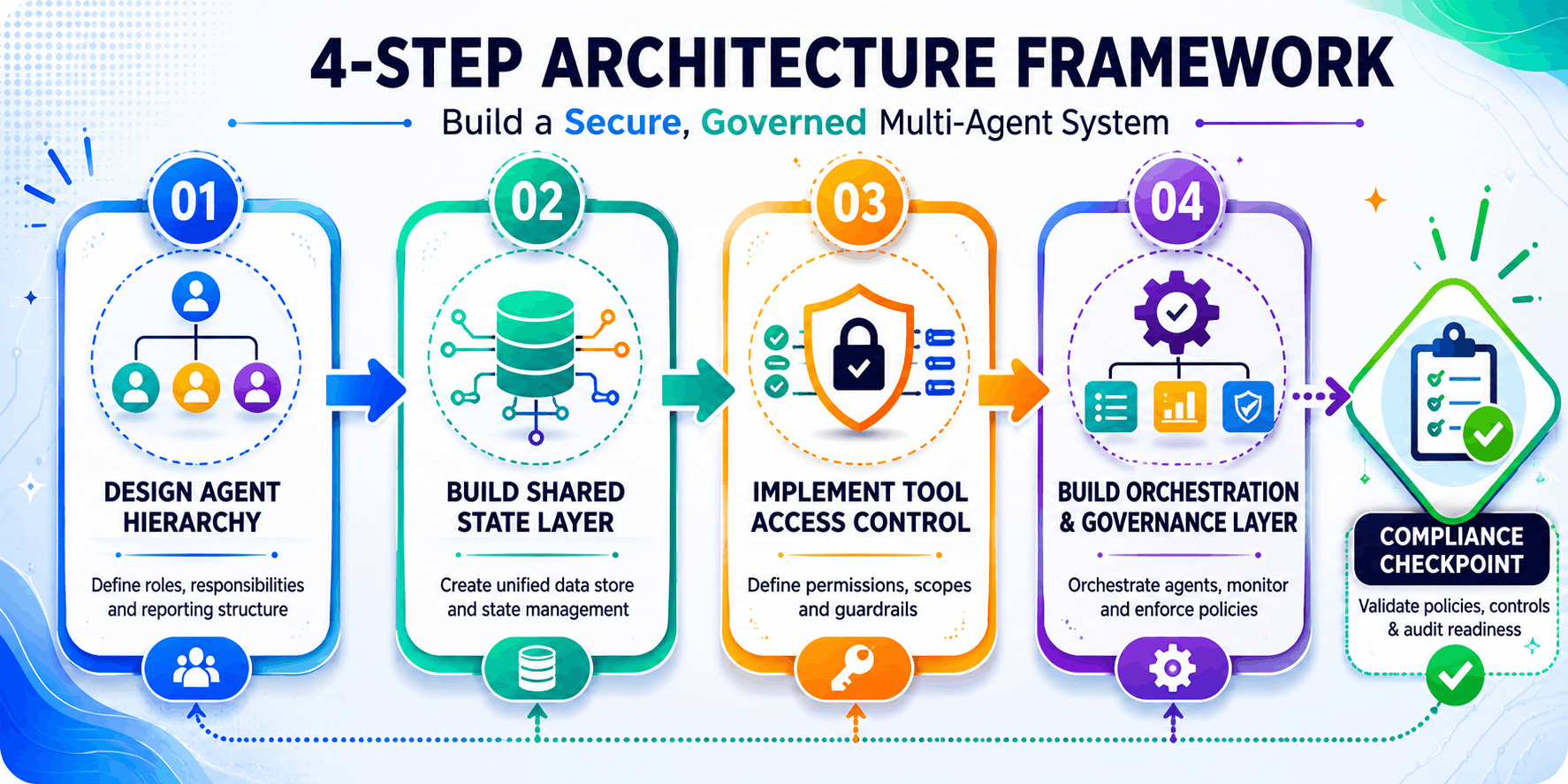
The Multi-Agent Architecture Framework: Step by Step
Use this sequence to design, build, and govern a multi-agent system for automation at enterprise scale.
Step 1: Design the Agent Hierarchy and Role Boundaries
Define the supervisor agent: receives the high-level goal, breaks it into logical sub-tasks, delegates to specialized workers, and synthesizes the final output. Do not let the supervisor also execute; role separation is what makes the system debuggable.
Define executor agents by domain: each executor agent handles one class of task: database query, API call, document extraction, or validation. A single-purpose agent with bounded tool access produces consistent, auditable outputs.
Build a critique or validation agent: this agent checks outputs from executor agents before they reach downstream systems or customers. For example, a critique message might prompt a review agent to recheck a contract summary before it reaches a customer.
Define escalation paths: specify what triggers a human approval checkpoint, what triggers an automatic halt, and how fast the response protocol must execute.
Step 2: Design the Shared State and Knowledge Layer
Agents cannot make good decisions without shared, contextual information. The knowledge fabric connects enterprise data sources databases, document repositories, real-time event streams into a unified layer that all agents can access. This prevents agents from working with stale or inconsistent information and enables true collaborative reasoning. Without a properly engineered shared state layer, agents in the same workflow produce conflicting outputs because they operate on different versions of the same data. The knowledge layer is not a feature; it is the prerequisite to any reliable multi-agent deployment.
Step 3: Implement Tool Access Control and Least-Privilege Permissions
Every agent must have access only to the tools and data it needs for its specific task, nothing more. Tool misuse is the most common failure mode in production multi-agent systems: an executor agent with write access to a database that should only have read access becomes the entry point for unintended data modification or cascading failures. The ai security ai agent control layer implements whitelisted API access per agent, sandboxed testing environments before any agent touches production data, and fine-grained identity and permission systems that change with each new agent version deployed.
Step 4: Build the Orchestration, Monitoring, and Governance Layer
Treat multi-agent design as workflow engineering, not theater. The orchestration layer controls which agent executes first, how outputs pass between agents, what happens when an agent fails, and how parallel workflows synchronize. In production systems, this resembles a workflow engine with strict rules, not a freeform conversation between models.
Samta.ai's Veda AI platform supports this step by connecting agent execution logs, tool access records, and outcome data into a unified observability and governance layer on Databricks and Snowflake, giving compliance teams the audit trail IMDA and MAS expect for agentic AI deployments. The Veda AI data analytics platform turns multi-agent monitoring from a custom-built tooling problem into a continuous operational capability. For enterprises needing the workflow infrastructure layer built alongside agent deployment, Samta.ai's workflow automation consulting and digital transformation managed services provide end-to-end delivery from architecture through production.
Types of Agent Architecture in AI: A Comparison
Architecture Type | Structure | Best Fit Use Case | Failure Mode | Governance Complexity |
Single agent | One model, one context window, all tasks | Simple, bounded tasks with clear input and output | Context overflow, hallucination under complexity, single point of failure | Low, but unscalable |
Supervisor and executor (hierarchical) | Supervisor delegates; executors specialize | Complex multi-step workflows with distinct subtasks, such as claims processing or loan decisioning | Supervisor assigns wrong subtask; executor produces output supervisor cannot validate | Moderate, audit trail per agent required |
Peer-to-peer (collaborative) | Agents communicate laterally without a central coordinator | Creative or exploratory tasks where emergent behavior is acceptable | Cascading failures; no single accountability point; emergent misbehavior hard to detect | High, requires system-level monitoring |
Pipeline (sequential) | Agent A output feeds Agent B input, strictly sequential | Data transformation, document processing, compliance reporting | One failure breaks the entire chain; no parallel recovery path | Moderate, each step auditable |
Hybrid (hierarchical plus pipeline) | Supervisor coordinates parallel pipelines of specialized executors | Enterprise-scale automation across multiple business functions simultaneously | Increased orchestration complexity; state synchronization failures across pipelines | Very high, full governance stack required |
Enterprise Use Cases: Multi-Agent Systems in Production
Use Case 1: Singapore Bank Automating AML Case Investigation
A Singapore bank deployed a hierarchical multi-agent system for AML case investigation. The supervisor agent received a flagged transaction alert, broke it into sub-tasks: customer entity resolution, transaction history retrieval, counterparty network analysis, and regulatory watchlist cross-check. Four specialized executor agents ran in parallel across the bank's Databricks data lakehouse, with a validation agent synthesizing outputs into a case summary before routing to a human investigator. Case investigation time dropped from an average of 3.5 hours to 22 minutes. Every agent action was logged with tool access records and output rationale, satisfying the ai audit methodology requirements documented in the AI audit methodology explained guide. The governance layer met MAS Toolkit requirements for agentic AI without requiring a separate compliance documentation process.
Use Case 2: Enterprise Deploying Multi-Agent Document Processing
A Singapore technology company automated contract review and clause extraction across multiple document types using a pipeline architecture. A parsing agent extracted structured data from unstructured contracts, a classification agent tagged clause types against a defined taxonomy, a risk-flagging agent identified non-standard terms requiring legal review, and a summary agent produced a structured report for the legal team. Parallel to this, the AI deployment timelines guide informed the team's expectation setting: simple single-agent systems take weeks to deploy; complex multi-agent enterprise systems take months. Building the orchestration and shared state layers correctly in the first sprint eliminated the re-architecture cost that most teams encounter at the scaling stage. For a comparison of AI-native versus traditional approaches for this type of deployment, see the Veda vs data intelligence platform comparison.
Key Risks and Failure Modes
Building one mega-agent instead of a coordinated system: Trying to build one mega-agent to handle everything leads to model hallucinations and massive latency. The industry leaders of 2026 are utilizing specialized, coordinated multi-agent systems, not attempting to put every workflow into a single model context.
No shared state layer: Agents operating on different versions of the same data produce conflicting outputs. The knowledge fabric is the prerequisite to reliable multi-agent operation, not an optional enhancement.
Tool access without least-privilege controls: An executor agent with write access where it needs only read access becomes the entry point for unintended data modification and cascading failures across the pipeline. Tool access control is the primary security control in a multi-agent architecture.
Governance retrofitted after deployment: For regulated industries, agentic AI governance must be embedded at the architecture stage, not added as a compliance layer after the system is live. Retrofit governance at the agent level costs more and covers less than governance built into the orchestration layer from the first deployment.
Get the complete multi-agent architecture template: agent hierarchy design, shared state structure, tool access control framework, and governance layer specification. Request the AI Implementation Playbook from Samta.ai and build your first multi-agent system on a defensible architecture.
Decision Framework: Is Your Enterprise Ready for Multi-Agent Automation?
The workflow being automated has multiple distinct subtasks that different specialized agents can own independently
A shared state and knowledge layer design exists before any agent is built
Tool access is defined per agent with least-privilege permissions and no cross-agent permission inheritance
The orchestration layer specifies routing rules, retry logic, and failure handling before the first agent is deployed
Human approval checkpoints are defined for any agent action that is irreversible or customer-facing
Audit trail and governance logging are built into the orchestration layer, not added post-deployment
If fewer than four boxes are checked, the architecture is not ready for production deployment regardless of how capable the individual agents are.
Conclusion
Multi-agent ai engineering workflow automation in 2026 is not a future architecture pattern. It is the production standard for complex enterprise workflows, backed by mature orchestration frameworks, governance requirements from IMDA and MAS, and verified deployments across BFSI, legal, and operations functions. The organizations that get there first are the ones that treat orchestration and governance as first-class engineering concerns from the first sprint, not as features to add after the agents are working.
See how Samta.ai's multi-agent engineering capability connects to your existing enterprise systems, data platforms, and compliance requirements. Request a Free Product Demo with Samta.ai and validate your architecture before committing to a full build.
About Samta
Samta.ai is a Singapore-headquartered AI Product Engineering & Data Intelligence partner helping enterprises build production-grade AI systems for regulated and data-intensive environments.We help organizations move beyond experimentation by engineering scalable, explainable, and enterprise-ready AI solutions from data foundations and model development to workflow automation and deployment.
Our capabilities combine deep AI expertise, data engineering, and product engineering to deliver measurable business impact across FinTech, BFSI, cybersecurity, regulatory technology, and enterprise operations.
Our enterprise AI products power real-world intelligence systems:
• TATVA : AI-driven data intelligence platform for governed analytics, monitoring, and operational insights
• VEDA : Explainable and audit-ready AI decisioning engine built for compliance-sensitive enterprise workflows
• CORA-Property Management Solutions: : Predictive intelligence platform for real-estate pricing, portfolio optimization, and investment analytics
Backed by ecosystem partnerships with Microsoft, Databricks, Snowflake, and AWS, Samta.ai delivers agile, cost-efficient AI engineering with faster turnaround and enterprise-grade scalability. Trusted by enterprises across FinTech, BFSI, and digital transformation initiatives, Samta.ai embeds AI governance, data privacy, and compliance-by-design principles directly into the AI lifecycle , enabling organizations to scale AI with transparency, accountability, and operational control.
Enterprises leveraging Samta.ai automate 65%+ of repetitive data, analytics, and decision workflows while maintaining governance, explainability, and measurable business outcomes. Samta.ai provides the strategic consulting, AI engineering, and data modernization expertise needed to align enterprise operations with next-generation AI transformation goals.
Frequently Asked Questions
What is a multi-agent system in AI and how does it differ from a single AI agent?
A multi agent system in AI coordinates specialized AI agents toward a shared goal, with each agent having a defined role, bounded tool access, and specific success criteria. A single AI agent attempts all tasks in one context window, leading to context overflow, hallucination under complexity, and single points of failure. Multi-agent systems distribute intelligence across specialized roles the same way a department distributes work across specialists.
What are the main types of agent architecture in AI for enterprise use?
Types of agent architecture in AI for enterprise include single agent (bounded tasks only), hierarchical supervisor and executor (best for complex multi-step workflows), peer-to-peer collaborative (exploratory tasks with acceptable emergent behavior), sequential pipeline (data transformation and document processing), and hybrid hierarchical plus pipeline (enterprise-scale automation across multiple business functions). Each has distinct failure modes and governance complexity; choosing the wrong architecture is the most common cause of multi-agent production failure.
What is the role of the orchestration layer in multi-agent workflow automation?
The orchestration layer controls which agent executes first, how outputs pass between agents, what happens when an agent fails, and how parallel workflows synchronize. In production systems, this resembles a workflow engine with strict rules, not a freeform conversation between models. LangGraph has emerged as the de facto standard for production-grade, stateful orchestration in 2026, modeling agent interactions as explicit state machines with deterministic routing.
How do you govern multi-agent AI systems in regulated industries?
generative ai agent architecture in regulated industries requires governance embedded at the orchestration layer: bounded tool access per agent with whitelisted API permissions, continuous monitoring for prompt injection and unauthorized actions, human approval checkpoints for irreversible or high-stakes decisions, and exportable audit trails documenting every agent action and output for regulatory review. IMDA's Agentic AI Governance Framework, published January 2026, provides the four-pillar governance structure most directly applicable to enterprise deployments.
What is the biggest engineering risk in multi-agent system deployment?
The most common engineering risk is building without a shared state layer, allowing agents to operate on different versions of the same data and produce conflicting outputs. The second most common is tool access without least-privilege controls, where an executor agent with excessive permissions becomes the entry point for unintended data modification. Both are architectural decisions that cannot be retroactively fixed without significant re-engineering.