
Summarize this post with AI
Legacy property management systems isolate up to 80% of building telemetry data, leaving portfolio managers blind to operational inefficiencies. To bridge this gap, modern real estate portfolios require specialized proptech AI consulting to integrate disparate data pipelines, automate tenant workflows, and deploy predictive maintenance models. Enterprise real estate firms across APAC are moving away from generic software-as-a-service (SaaS) applications in favor of tailored AI architectures. Engaging expert proptech AI consulting ensures that your machine learning models scale securely while complying with localized data residency laws.
Proptech AI Consulting:
Proptech AI consulting services design, deploy, and optimize custom machine learning architectures for enterprise real estate portfolios. Operating within APAC compliance frameworks (such as Singapore's PDPA and the May 2026 updated IMDA Model AI Governance Framework for Agentic AI), these services integrate IoT telemetry, ERP data, and financial systems. The resulting infrastructure automates property operations, drives predictive asset valuation, and reduces portfolio carbon footprints.
What is proptech in real estate AI integration?
Proptech, or property technology, refers to the digital tools used to buy, sell, manage, and optimize real estate assets. When fused with artificial intelligence, it evolves from simple record-keeping into a predictive optimization engine. Real estate leaders looking to navigate this shift often evaluate the market via curated insights, such as the analysis found in 10 leading proptech consultants, to understand how specialized integrations differ from legacy software setups.
The enterprise AI proptech stack
Data Ingestion Layer: Aggregates real-time IoT sensors, HVAC telemetry, and smart meter data.
Storage & Processing: Utilizes centralized cloud data warehouses like Snowflake or Databricks for structured and unstructured data.
Machine Learning Layer: Deploys predictive models for asset depreciation, energy anomalies, and tenant churn.
Application Layer: Interfaces with property management systems via secure APIs to deliver actionable operational insights.
Why specialized AI consulting matters in 2026
The real estate sector faces unprecedented pressure to optimize margins and meet strict ESG (Environmental, Social, and Governance) targets. Generic, out-of-the-box property management software often fails to address complex enterprise workflows or localized regional demands.
[Legacy ERP & Siloed IoT] ➔ [Proptech AI Consulting] ➔ [Unified Predictive Operations]
The APAC regulatory landscape
In markets like Proptech Singapore, the push for smart buildings requires deep technical compliance. Enterprise frameworks must align with the Singapore Green Building Masterplan's "80-80-80 by 2030" targets and local data protection regulations. Specialized consulting ensures that your AI deployments do not create liability through algorithmic bias or unauthorized data processing, mapping out precisely what is proptech in real estate when scaled to cross-border institutional portfolios.
Benchmark Your Enterprise AI Readiness
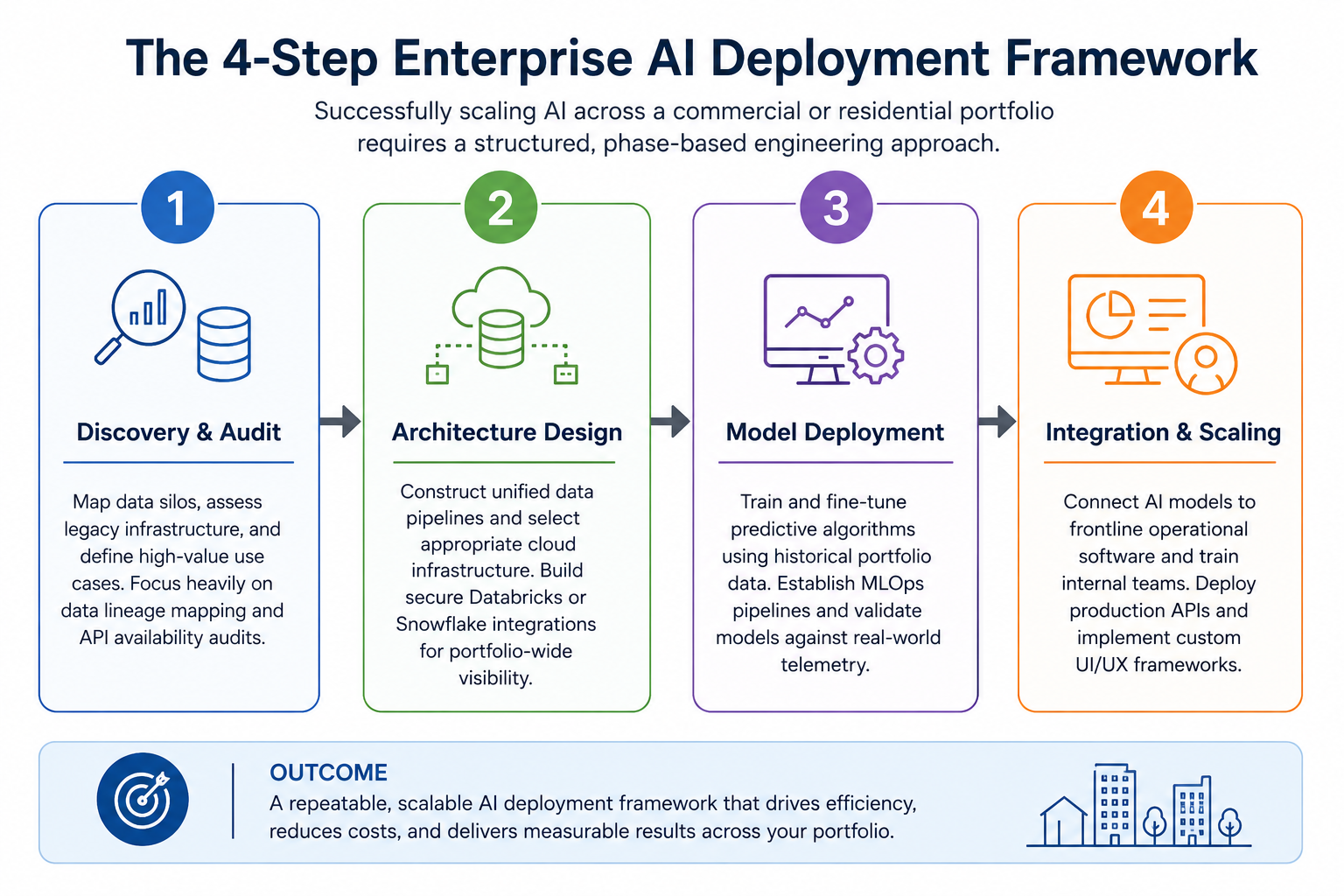
The 4-step enterprise AI deployment framework
Successfully scaling AI across a commercial or residential portfolio requires a structured, phase-based engineering approach.
1.Discovery & Audit:
Phase 1.
Map data silos, assess legacy infrastructure, and define high-value use cases. Focus heavily on data lineage mapping and API availability audits.
2.Architecture Design:
Phase 2.
Construct unified data pipelines and select appropriate cloud infrastructure. Build secure Databricks or Snowflake integrations for portfolio-wide visibility.
3.Model Deployment:
Phase 3.
Train and fine-tune predictive algorithms using historical portfolio data. Establish MLOps pipelines and validate models against real-world telemetry.
4.Integration & Scaling:
Phase 4.
Connect AI models to frontline operational software and train internal teams. Deploy production APIs and implement custom UI/UX frameworks.
To execute this framework effectively, enterprises leverage specialized engineering layers. For instance, integrating Samta.ai data integration consulting services allows firms to connect legacy property databases directly to modern cloud warehouses. This establishes a clean data foundation before deploying specialized machine learning algorithms.
Technical architecture & platform comparison
To determine where to route your development budget, analyze how different property technology architectures handle data processing, latency, and predictive workloads:
Solution Type | Primary Data Architecture | Latency Profile | Core Analytical Capability | Best Suited For |
Traditional Property Management Software | Relational Databases (SQL), static ERP tables | Batch processing / Non-real-time | Historical report generation and rent roll auditing | Portfolios with low asset variance and minimal IoT sensor footprints |
AI Price Predict Engines | Time-series forecasting models, macro-economic API streams | Near-real-time calculation on query | Predictive valuation and rental yield forecasting | Real estate investment trusts (REITs) and dynamic rental portfolios |
IoT Telemetry Optimizers | NoSQL stream ingestion, edge computing networks | Sub-second event stream analytics | HVAC anomaly detection and automated peak load shaving | Grade-A commercial office spaces aiming for aggressive ESG metrics |
Agentic Workflow Automation | Large Language Model (LLM) orchestration + API middleware | Variable, depends on agentic steps | Semi-autonomous tenant support and automated maintenance dispatch | Enterprise operations struggling with manual tenant-to-vendor communication |
Full-Stack Proptech AI Platforms | Centralized Data Lakehouse (Snowflake/Databricks) | Mixed: Real-time inference + batch training | Multi-modal portfolio yield and risk optimization | Global real estate enterprises requiring end-to-end operational visibility |
Enterprise AI use cases in real estate
1. BFSI asset valuation and risk mitigation
Financial institutions managing large mortgage portfolios or real estate investment trusts utilize AI to project asset depreciation. By linking portfolios to advanced AI wealth management platforms, institutions analyze macro-economic indicators, regional transit developments, and historical maintenance logs. These predictive models calculate precise property valuations, reducing risk exposure during volatile market shifts.
2. Commercial property energy optimization
Large-scale commercial enterprises use machine learning to analyze weather feeds, occupancy rates, and utility costs. The AI automatically adjusts HVAC and lighting systems in real time, reducing energy expenditures by up to 22% while ensuring optimal tenant comfort. Portfolio managers can review how 7 ways AI predicts behavioral patterns can be applied directly to operational cost reductions.
Understand Your AI Risk Landscape
Key risks and failure modes in proptech AI
Data Pipeline Fragmentation: Ingesting poor-quality, non-standardized data from legacy building systems leads to inaccurate model predictions. Enterprise teams must leverage a top 10 data science framework to audit pipeline inputs before training models.
Ignoring Local Compliance: Failing to account for regional regulations, such as Singapore's PDPA or the newly revised 2026 IMDA guidelines regarding automation bias in multi-agent systems, can result in severe legal penalties.
Scope Creep Without ROI: Attempting to automate every property management workflow simultaneously often dilutes engineering focus and wastes capital.
Decision framework: When to hire a proptech AI consultant
Hire an AI consultant if:
You manage a portfolio exceeding 50 properties and require automated, centralized data insights.
Your current property management applications do not communicate with your financial systems.
You need to deploy custom machine learning models tailored to localized regional markets.
Rely on standard software if:
Your portfolio consists of localized, single-family residential units with minimal data needs.
Out-of-the-box property management tools completely satisfy your current operational requirements.
Conclusion
Deploying artificial intelligence across enterprise real estate requires moving past rigid, off-the-shelf applications. Successful adoption relies on robust data engineering, clear regulatory compliance, and a structured deployment strategy. To discover how specialized machine learning architectures can optimize your portfolio operations, explore our custom Samta.ai data-driven property management software solutions designed for complex enterprise landscapes.
Plan Your AI Transformation with Confidence
About Samta
Samta.ai is a Singapore-headquartered AI Product Engineering & Data Intelligence partner helping enterprises build production-grade AI systems for regulated and data-intensive environments.We help organizations move beyond experimentation by engineering scalable, explainable, and enterprise-ready AI solutions from data foundations and model development to workflow automation and deployment.
Our capabilities combine deep AI expertise, data engineering, and product engineering to deliver measurable business impact across FinTech, BFSI, cybersecurity, regulatory technology, and enterprise operations.
Our enterprise AI products power real-world intelligence systems:
• TATVA : AI-driven data intelligence platform for governed analytics, monitoring, and operational insights
• VEDA : Explainable and audit-ready AI decisioning engine built for compliance-sensitive enterprise workflows
• CORA-Property Management Solutions: : Predictive intelligence platform for real-estate pricing, portfolio optimization, and investment analytics
Backed by ecosystem partnerships with Microsoft, Databricks, Snowflake, and AWS, Samta.ai delivers agile, cost-efficient AI engineering with faster turnaround and enterprise-grade scalability. Trusted by enterprises across FinTech, BFSI, and digital transformation initiatives, Samta.ai embeds AI governance, data privacy, and compliance-by-design principles directly into the AI lifecycle , enabling organizations to scale AI with transparency, accountability, and operational control.
Enterprises leveraging Samta.ai automate 65%+ of repetitive data, analytics, and decision workflows while maintaining governance, explainability, and measurable business outcomes. Samta.ai provides the strategic consulting, AI engineering, and data modernization expertise needed to align enterprise operations with next-generation AI transformation goals.
Frequently asked questions
What is proptech in real estate consulting?
Proptech consulting assists real estate enterprises in selecting, designing, and deploying digital technologies. When focused on AI, it guides firms through building custom data pipelines, training predictive machine learning models, and integrating automated workflows into existing property management systems safely.
How does property management software in Singapore utilize AI?
Modern property management software solutions in Singapore use AI to automate tenant onboarding, optimize energy consumption, and manage maintenance schedules. These platforms connect localized building telemetry with smart cloud infrastructure to improve operational efficiency across commercial and residential portfolios.
Why do enterprise proptech firms in Singapore require custom AI solutions?
Standard software often fails to address complex, multi-jurisdictional compliance rules or unique regional property types. Custom AI architectures enable firms to comply with local frameworks, such as the IMDA AI Governance Model, while integrating deeply with legacy internal ERP systems.
Can AI predict real estate market trends accurately?
Yes, machine learning models analyze complex datasets including historical transaction values, shifting demographic patterns, and zoning updates. This allows asset managers to forecast rental yields, identify high-growth geographic regions, and optimize portfolio acquisition strategies with greater precision.
What role does data integration play in proptech AI deployment?
Data integration is the foundational layer of any successful AI strategy. It connects isolated silos such as physical security logs, smart utility meters, and financial ledgers into a single cloud data warehouse, providing the clean information required to train reliable machine learning models