
Summarize this post with AI
Institutions choosing an AI partner for regulated industries are really choosing between two different jobs: board level strategy and audit alignment, where Deloitte, PwC, and KPMG have deep heritage across every regulated sector, or hands on AI engineering and governance platform delivery, where a focused partner like Samta.ai is built to operate in BFSI, healthcare, and proptech across Singapore and the wider APAC region. Neither model replaces the other outright. Most regulated institutions in Singapore end up using both: a Big 4 firm for strategy and audit sign off, and a specialized engineering partner for the technical build. The right choice depends on what the specific engagement needs to produce, how mature the institution's AI inventory already is, who owns the resulting governance tooling once the engagement ends, and how much internal build capacity the institution already has. A fair comparison should also name where each model has real limits, not only where it wins, and that balance is what this piece tries to hold onto.
Most firms choosing an AI partner for regulated industries default to whichever name is already on their audit engagement letter, without asking whether that firm is actually built to deliver working AI systems. Deloitte, PwC, and KPMG bring deep regulatory and audit heritage across every regulated sector. Samta.ai brings a narrower, engineering led focus built specifically around AI governance and deployment for BFSI, healthcare, and proptech. Neither model is wrong, they solve different parts of the same problem, and each comes with real tradeoffs worth naming plainly rather than talking around.
AI partner for regulated industries
An AI partner for regulated industries should be chosen based on what the engagement actually needs: broad strategic advisory across multiple risk domains, which favors the Big 4, or hands on AI engineering and governance platform delivery, which is where a specialized firm like Samta.ai is built to operate. Big 4 firms lead with enterprise AI governance strategy, audit alignment, and multi sector benchmarking, backed by a global bench a smaller specialist cannot match. Engineering focused partners lead with faster time to a deployed, examinable system, though usually within a narrower sector footprint. Most regulated institutions in Singapore end up using both, a Big 4 firm for strategy and audit sign off, and a specialized partner for the technical build.
Samta.ai vs Deloitte / PwC / KPMG
Samta.ai is an AI engineering and governance company built specifically for regulated industries, BFSI, healthcare, and proptech, operating primarily across Singapore and the wider APAC region. Unlike a general advisory firm, Samta.ai's work centers on building and deploying the actual AI systems, decision analytics platforms, model risk governance tooling, and hiring assessment platforms, rather than producing strategy documents that a separate implementation partner then builds against. That focus is also its natural limit: an institution needing broad, cross sector risk advisory well beyond AI, or global benchmarking across dozens of jurisdictions, is better served starting with a Big 4 firm.
Deloitte, PwC, and KPMG each bring decades of audit, tax, and risk advisory experience across every regulated sector, and each now delivers AI work through its broader consulting or risk advisory practice, typically alongside other transformation programs already underway for the client. That breadth is a genuine strength for board level strategy and cross sector benchmarking, but AI specific delivery usually sits inside a larger, multi workstream engagement, which can slow the path to a working, examinable system.
Our approach to AI solutions for regulated industries sits closer to product engineering than traditional consulting, which is the core distinction covered throughout this guide. Samta.ai's own comparison of AI focused firms against traditional development companies breaks down this positioning in more depth for buyers evaluating the wider market. For institutions that need ongoing platform support after initial delivery rather than a one time build, Samta.ai's digital transformation managed services cover that phase directly, rather than requiring a separate vendor relationship once the initial engagement ends.
Measure Your AI Readiness Before You Scale
Why the AI partner decision matters more in 2026
What AI consulting is worth to a regulated institution has changed as AI moved from pilot projects into production systems examiners actually inspect.
Strategy alone no longer satisfies MAS examiners on its own. MAS first set out its expectations for responsible AI use in finance through the FEAT Principles, and institutions are increasingly expected to show a working, evidenced system alongside any governance strategy document, which is pushing institutions to separate strategy engagements from technical delivery more explicitly than before.
Model risk governance has become a named accountability, not a project deliverable. Institutions increasingly need an ongoing engineering partner for model risk governance, not a one time advisory report. Broader frameworks such as the NIST AI Risk Management Framework reflect the same shift internationally, toward ongoing risk management rather than a single point in time assessment.
AI maturity assessment findings are only useful if someone can act on them. An AI maturity assessment that identifies gaps but has no attached build capacity leaves institutions with a well documented problem and no faster path to fixing it.
Our guide on AI governance for enterprise covers how this split between strategy and delivery has reshaped typical AI transformation programs across regulated Singapore institutions.
How to evaluate an AI partner: the framework
Choosing between a Big 4 firm, a specialized AI engineering partner, or a combination of both comes down to five questions.
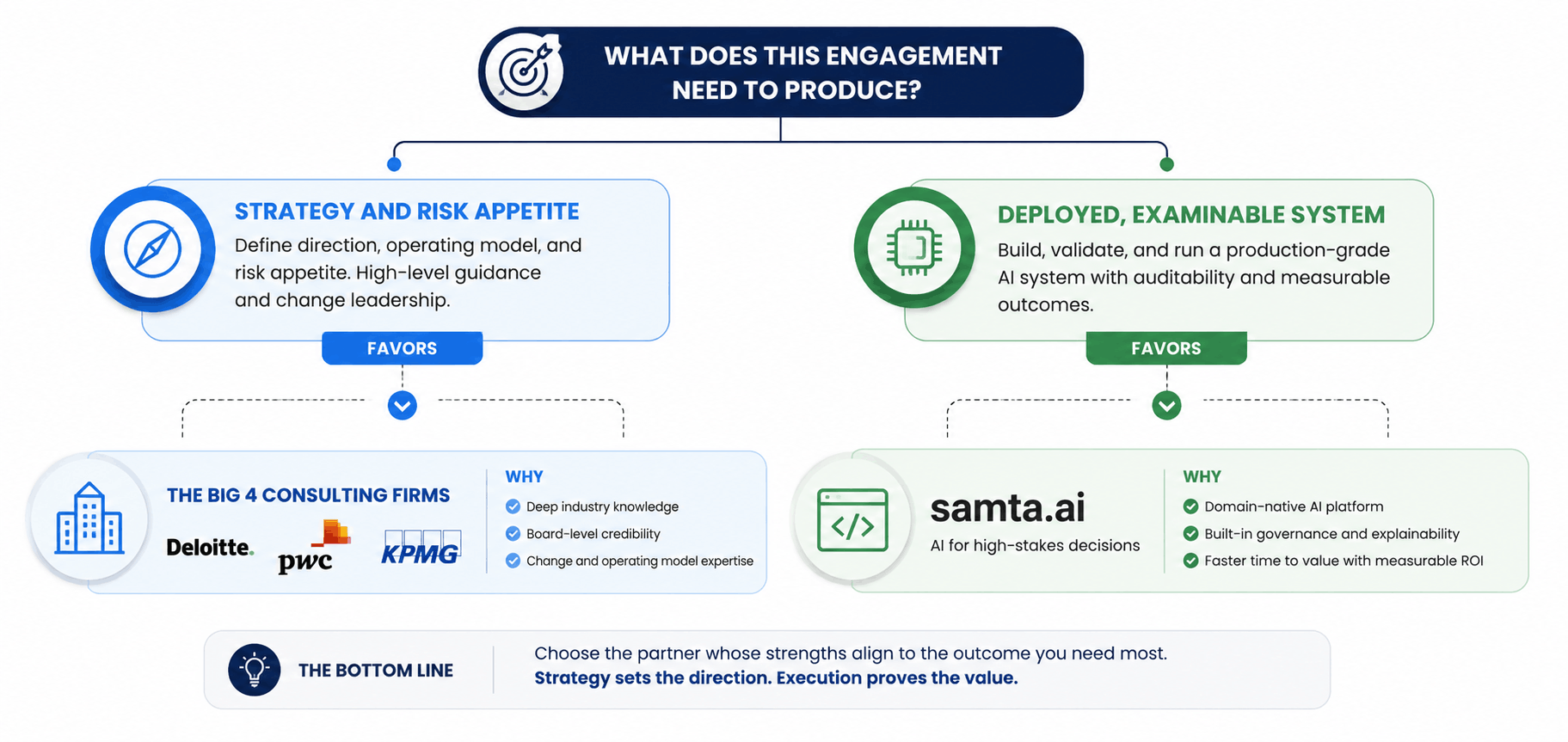
What does this engagement actually need to produce?
A board level AI strategy and risk appetite statement favors broad advisory. A deployed, examinable model or agent favors an engineering partner.
How mature is your current AI inventory?
An early stage AI maturity assessment benefits from advisory breadth. A firm with a known model inventory and a specific governance gap benefits from a partner who can build the fix directly.
Who owns the AI risk framework once the engagement ends?
Advisory engagements often leave governance frameworks with the institution to operationalize internally. Engineering partners typically build the operational tooling as part of delivery, though that also means the institution is more dependent on that single partner's platform going forward.
What is the realistic timeline?
Broad advisory engagements often run longer before implementation begins. Engineering led partners typically move from scoping to a working system faster, since build capacity is in house, though this can come at the cost of the wider strategic framing a larger advisory team would normally provide.
Does the partner integrate with your existing data stack?
A partner who already works across Databricks, Snowflake, and Microsoft environments, supported by data integration consulting services, avoids a second integration project layered on top of the first.
This is where the engineering execution layer matters. Samta.ai builds directly on the VEDA AI decision analytics platform to turn governance requirements into deployed, auditable systems, rather than leaving that translation step to a separate vendor after the strategy phase concludes. Firms further along in vendor evaluation should also see Gartner's independent research on how the AI consulting market is shifting toward providers who can show production delivery, not only strategy output, while recognizing that Gartner's peer set is dominated by larger global providers rather than regional specialists.
Institutions evaluating whether a general data platform can double as a governance system should also look at how VEDA compares to other data intelligence platforms, since most analytics tools were not designed to produce the examiner ready evidence a regulated AI engagement needs. The VEDA platform itself was built around that requirement directly, rather than adding governance features to a general dashboard after the fact.
Samta.ai vs Big 4: how the models compare
Dimension | Big 4 Consulting (Deloitte, PwC, KPMG) | Typical Cost Structure | Best Fit | |
Core focus | Specialized AI engineering and governance platform delivery for BFSI, healthcare, and proptech | Broad strategy, audit, and transformation advisory across every regulated sector | Project or platform based fixed fee, scoped to the build | Firms needing hands on AI build, not only strategy |
Delivery model | Engineering led, works directly inside the client's existing data stack | Advisory led, often coordinating a wider ecosystem of delivery subcontractors | Milestone based billing tied to delivery phases | Firms wanting one accountable build partner |
Regulatory specialization | Purpose built for BFSI, healthcare, and proptech AI governance in APAC, with a narrower global footprint than a Big 4 firm | Deep audit and risk advisory heritage across all regulated sectors globally, with less day to day AI engineering depth | Higher day rate structures reflecting global scale and overhead | Firms weighing focused APAC depth against global sector breadth |
Speed to production | Faster scoping to a deployed system, since build capacity is in house | Longer strategy and requirements phase before implementation begins, reflecting a broader stakeholder process | Often bundled into a broader advisory retainer | Firms under time pressure to show a working, examinable system |
Ongoing support | Platform and engineering support built into the engagement, which also ties the institution to one vendor | Frequently transitions to a separate managed services or audit relationship, which spreads risk across vendors | Separate retainer for post engagement support | Firms wanting one partner across build and ongoing support, versus firms wanting vendor diversification |
Know Your AI Model Risk. Strengthen Your Controls.
Real world enterprise use cases
BFSI: a bank needing both strategy sign off and a working system
A bank preparing for an MAS model risk examination needed board level sign off on its AI risk appetite, already covered by its Big 4 advisory relationship, alongside a working, examinable governance system for its model inventory, which it did not yet have. Bringing in Samta.ai's BFSI model risk management framework and AI security and compliance services closed the delivery gap without ending the existing advisory relationship.
General enterprise: a proptech firm scaling without a large internal AI team
A proptech firm scaling its AI use across property recommendation and pricing models did not have the internal headcount to justify a large advisory retainer, and needed a partner who could both advise and build. Reviewing enterprise AI engineering in Singapore helped the firm choose a single engineering led partner rather than splitting strategy and delivery across two separate vendors.
Key risks and failure modes in the partner decision
Treating strategy output as the finish line. A governance framework with no attached build capacity leaves institutions with a documented gap rather than a closed one.
Assuming broad experience always beats specialization, or the reverse. Cross sector experience does not guarantee faster delivery on a narrow technical build, and a fast, focused partner does not automatically cover risk domains a large advisory bench handles routinely.
Splitting strategy and delivery across two vendors with no shared accountability. Without a clear handoff, gaps between the strategy document and the delivered system tend to surface during the examination itself, not before.
Choosing a partner on brand recognition alone, in either direction. The right fit depends on what the engagement needs to produce, not which name appears most in board materials, and not on assuming a smaller specialist is automatically leaner.
Underestimating ongoing support needs, or vendor concentration risk. An engagement that ends at go live without a support plan often resurfaces at the next model retraining cycle. Relying on one partner for build and ongoing support also concentrates dependency in a single vendor, worth weighing against the coordination cost of using separate ones.
When to choose a specialized partner versus a Big 4 firm
Choose a specialized engineering partner like Samta.ai when:
You already have board level buy in and need a deployed, examinable system quickly
Your gap is technical delivery, not strategic direction
You want one accountable partner across build and ongoing platform support, and are comfortable with that vendor concentration
Choose a Big 4 firm when:
You need board level strategy, risk appetite framing, or audit alignment first
Your institution operates across many regulatory domains beyond AI specifically
You need benchmarking against a very large, cross sector peer set, or want delivery spread across more than one vendor
Many institutions use both in sequence, a Big 4 engagement to set direction and sign off, followed by a specialized partner to deliver against it. Our guide for AI governance platform buyers covers how to structure that handoff so nothing gets lost between the two engagements. Reviewing Samta.ai's case studies alongside your own requirements, and asking any shortlisted partner for references from a comparable regulated engagement, is a reasonable next step before finalizing either choice.
Turn Your AI Challenges into Actionable Solutions
Conclusion
Choosing the right AI partner for regulated industries is not a choice between a safe, established name and a specialized one, it is a choice about what the engagement actually needs to produce, and an honest look at what each model does not do well. Institutions that separate the strategy question from the delivery question, staff each with the right kind of partner, and name the tradeoffs of that choice up front, close governance gaps faster than those relying on one model to do both without examining its limits.
About Samta
Samta.ai is a Singapore headquartered AI product engineering and data intelligence partner helping enterprises build production grade AI systems for regulated and data intensive environments. We help organizations move beyond experimentation by engineering scalable, explainable, and enterprise ready AI solutions, from data foundations and model development to workflow automation and deployment.
Our capabilities combine deep AI expertise, data engineering, and product engineering to deliver measurable business impact across FinTech, BFSI, cybersecurity, regulatory technology, and enterprise operations.
Our enterprise AI products power real world intelligence systems:
TATVA: AI driven data intelligence platform for governed analytics, monitoring, and operational insights
VEDA: Explainable and audit ready AI decisioning engine built for compliance sensitive enterprise workflows
CORA Property Management Solutions: Predictive intelligence platform for real estate pricing, portfolio optimization, and investment analytics
Backed by ecosystem partnerships with Microsoft, Databricks, and Snowflake, Samta.ai delivers agile, cost efficient AI engineering with faster turnaround and enterprise grade scalability. Samta.ai embeds AI governance, data privacy, and compliance by design principles directly into the AI lifecycle, enabling organizations to scale AI with transparency, accountability, and operational control. Institutions evaluating fit should ask for measurable outcomes from a comparable prior engagement rather than headline automation figures alone.
Frequently asked questions
Is Samta.ai a Big 4 alternative or a complement to firms like Deloitte, PwC, and KPMG?
Samta.ai is most often used alongside a Big 4 relationship rather than as a full replacement. Institutions typically keep Big 4 firms for broad strategy and audit alignment while bringing in Samta.ai for the technical AI engineering and governance platform build.
What is the main difference between Samta.ai and a Big 4 consulting firm?
The main difference is delivery model. Samta.ai is engineering led and builds the actual AI and governance systems directly, while Big 4 firms are advisory led and typically coordinate a wider ecosystem of implementation partners for technical delivery.
Does Samta.ai only work with financial institutions?
No. Samta.ai works across BFSI, healthcare, proptech, and general enterprise, though its governance tooling is built with regulated industry requirements, including alignment with MAS FEAT principles, as a core design consideration rather than an afterthought.
How long does an engagement with Samta.ai typically take compared to a Big 4 advisory project?
Engineering led engagements typically move from scoping to a deployed system faster, since build capacity sits in house, though the exact timeline still depends on scope and complexity.
Can a specialized AI partner replace the need for a Big 4 firm entirely?
For institutions needing only technical delivery against an already defined strategy, often yes. For institutions still setting board level AI risk appetite or needing broad cross sector benchmarking, a Big 4 firm typically remains necessary alongside a delivery partner.