
Summarize this post with AI
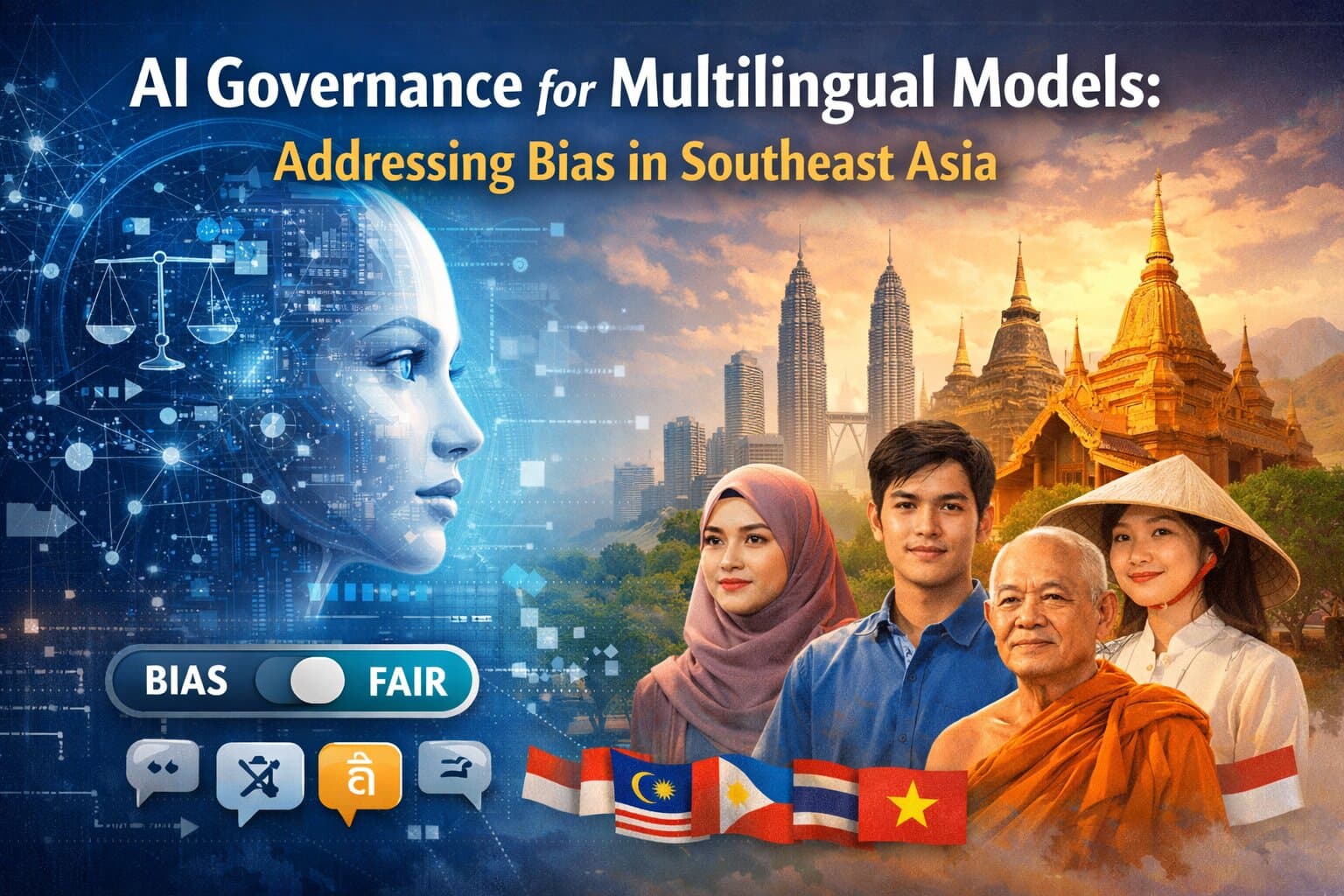
Southeast Asia presents a highly complex linguistic environment, making standard English-first AI models inadequate for enterprise deployment. Organizations face severe regulatory and operational risks when deploying unprepared NLP systems across diverse regional dialects. Effective multilingual ai governance establishes the critical guardrails required to detect and eliminate algorithmic bias before production. This brief outlines how a structured framework mitigates risk, ensures compliance with regional mandates, and standardizes enterprise AI operations. By addressing bias in ai across localized languages, enterprises can safely and legally deploy intelligent systems throughout Southeast Asia.
Key Takeaways
A robust multilingual ai governance policy is legally required to meet emerging regulatory standards in diverse economic zones.
English-centric training data amplifies bias in ai, creating systemic failures in regional sentiment analysis and automated decision-making.
Applying a structured multilingual ai governance model drastically reduces false positives in cross-border KYC and AML operations.
Enterprises must audit localized datasets specifically for the cultural and linguistic nuances distinct to Southeast Asia.
Third-party AI applications require continuous red-teaming to validate output equity across local languages like Singlish, Bahasa Indonesia, and Tagalog.
What This Means in 2026
In 2026, deploying generic NLP models without regional localization violates strict new compliance mandates. Regulators and auditors now heavily scrutinize the specific linguistic datasets used to train enterprise automated systems. A formal multilingual ai governance framework defines the standard operating procedures for auditing these linguistic datasets. It mandates regular, quantifiable bias testing and establishes clear corporate accountability for multi-regional AI outputs. For businesses operating in Southeast Asia, this requires an immediate transition from monolingual testing to dialect-specific validation. This operational shift ensures that critical AI-driven services, such as language translation and accent neutralization, operate securely, fairly, and legally.
Core Comparison: Monolingual vs. Multilingual AI Governance
Governance Feature | Monolingual AI Governance | Multilingual AI Governance |
Data Auditing | Focuses entirely on a single, primary language corpus. | Requires cross-lingual dataset balancing and deep cultural vetting. |
Bias Mitigation | Standard demographic and historical data bias checks. | Evaluates dialect bias, translation loss, and regional stereotyping. |
Regulatory Scope | Designed for uniform, single-market compliance requirements. | Maps to fragmented, cross-border frameworks across Southeast Asia. |
Model Testing | Automated semantic drift monitoring using standard metrics. | Continuous human-in-the-loop validation for local dialect nuance. |
Resource Allocation | Lower computational cost and streamlined operational overhead. | High demand for localized NLP expertise and diverse compute routing. |
Practical Use Cases
Financial Services Compliance: Banks utilize governed NLP models for cross-border transaction monitoring. This ensures alerts triggered by communications in regional dialects are processed without linguistic bias. Read our analysis on how AI in BFSI manages these exact complexities.
Automated KYC & Onboarding: Deploying a vernacular text & voice-driven account opening KYC bot demands strict multilingual oversight. Governance prevents discriminatory identity verification failures caused by accent or dialect misinterpretation.
Enterprise Customer Support: Regulated customer interactions rely on unbiased semantic analysis. Governed models prioritize localized complaints accurately, ensuring non-standard English speakers receive equitable service resolutions.
Limitations & Risks
Data Scarcity Constraints: High-quality, unbiased training datasets for low-resource languages in Southeast Asia are severely limited. This data deficit directly restricts model accuracy and baseline fairness.
Contextual Hallucination Risks: Direct, literal translation algorithms frequently fail to capture cultural idioms. This algorithmic gap leads to inappropriate, inaccurate, or legally non-compliant automated responses.
Compliance Fragmentation: Enforcing a unified multilingual ai governance policy is operationally difficult. Regulatory demands and data privacy laws differ drastically between neighboring jurisdictions in the APAC region.
Recommend Read: AI Governance & Compliance in APAC: A 2026 Guide to Singapore's Model AI Governance Framework
Decision Framework
When to Implement:
Deploying automated customer-facing decision systems across multi-jurisdictional regions like Southeast Asia.
Enterprise applications process unstructured text, documentation, or voice inputs in multiple local dialects.
The organization must adhere strictly to localized regulatory frameworks, such as the MAS FEAT principles.
When Not to Implement:
The AI model performs internal backend IT operations, logging, or code generation entirely in English.
The target market is strictly monolingual with zero immediate operational plans for geographic expansion.
The system utilizes pre-governed, specialized third-party APIs that already provide localized legal indemnification.
Conclusion
Effective AI Governance for Multilingual Models is a mandatory operational standard for enterprises scaling across diverse linguistic regions. Actively eliminating bias in ai ensures equitable service delivery, prevents catastrophic algorithmic failures, and guarantees strict regulatory compliance. Organizations must embed a structured multilingual ai governance approach directly into their continuous deployment pipelines. Samta.ai specializes in engineering these secure, compliant, and localized AI solutions for the modern enterprise.
About Samta
Samta.ai is an AI Product Engineering & Governance partner for enterprises building production-grade AI in regulated environments.
We help organizations move beyond PoCs by engineering explainable, audit-ready, and compliance-by-design AI systems from data to deployment.
Our enterprise AI products power real-world decision systems:
Tatva : AI-driven data intelligence for governed analytics and insights
VEDA : Explainable, audit-ready AI decisioning built for regulated use cases
Property Management AI : Predictive intelligence for real-estate pricing and portfolio decisions
Trusted across FinTech, BFSI, and enterprise AI, Samta.ai embeds AI governance, data privacy, and automated-decision compliance directly into the AI lifecycle, so teams scale AI without regulatory friction.
Enterprises using Samta.ai automate 65%+ of repetitive data and decision workflows while retaining full transparency and control.
FAQs
What is a multilingual ai governance model?
It is an operational framework that establishes strict rules, audits, and accountability for AI systems processing multiple languages. It ensures models do not discriminate, hallucinate, or underperform based on a user's specific language or regional dialect.
Why is addressing bias in AI critical for Southeast Asia?
The region represents a highly diverse linguistic landscape. Models trained primarily on Western datasets frequently misinterpret local contexts, leading to unfair service denial, compliance breaches, and severe enterprise reputational damage.
How does this governance impact NLP deployment?
It mandates rigorous, documented pre-deployment testing for language-specific accuracy. Organizations must continuously monitor their models for linguistic drift and ensure equitable performance metrics across all supported regional dialects.
Which frameworks guide these governance policies?
Regional regulatory standards, alongside global benchmarks like the NIST AI Risk Management Framework, provide the baseline for structuring responsible, unbiased multilingual AI operations.
How can Samta.ai assist with these requirements?
Samta.ai provides enterprise-grade AI product engineering and strategic compliance consulting. We build audit-ready systems, including NLP-driven business intelligence platforms, tailored specifically for heavily regulated, multilingual environments.