
.jpg&w=3840&q=75)
Summarize this post with AI
Scaling AI responsibly isn't just a buzzword, it's the backbone of sustainable, ethical innovation. As India's AI revolution accelerates, businesses must ensure governance, ethics, and sustainability go hand in hand with automation and intelligence. This shift toward a responsible AI framework is quickly becoming a baseline expectation for enterprise AI adoption, not an optional add on.
Understanding What “Scaling AI Responsibly” Really Means
It means expanding AI capabilities while ensuring systems are ethical, transparent, and sustainable. Unlike traditional software scaling, AI introduces new risks of algorithmic bias, data misuse, and societal impact that demand thoughtful governance and ongoing model risk management.
For Indian businesses, responsible AI scaling means finding the balance between innovation and risk management, ensuring that growth does not come at the cost of fairness, accountability, or algorithmic transparency.
Why Responsible AI Is a Business Imperative
Companies with strong AI governance frameworks gain lasting advantages: higher customer trust, fewer compliance findings, and improved long term performance. Trustworthy AI, explainable AI, and privacy by design are no longer optional differentiators, they are baseline expectations from regulators and customers alike.
In India, the Digital Personal Data Protection Act, 2023 has moved from legislation to active phased implementation, and the Ministry of Electronics and Information Technology has now added a dedicated AI layer to that regulatory picture. Responsible AI practices are no longer optional, they are essential for sustainable growth in a market where regulatory scrutiny is only increasing.
Businesses that scale AI responsibly can differentiate themselves as ethical leaders, building not only better products but stronger, more durable reputations with regulators, investors, and end users.
Assess Your AI Readiness Before You Scale
The Three Pillars of Scaling AI Responsibly
1. Governance: Building Trust through Accountability
AI governance defines how AI is designed, deployed, and monitored. It ensures systems align with organizational values and regulatory expectations.
Key Components of AI Governance:
Clear Accountability: Assign ownership through an AI Ethics Committee or Chief AI Officer.
Comprehensive Policies: Define how data is collected, used, and audited—especially in high-impact domains like finance or healthcare.
Risk Assessment: Evaluate model bias, fairness, and real-world consequences before deployment.
Compliance: Stay ahead of evolving Indian AI regulations and the Digital Personal Data Protection Act. Learn how governance shapes ethical automation on Samta.ai Blogs.
2. Ethics: Embedding Human Values into Intelligent Systems
Ethical AI extends beyond compliance; it ensures technology serves people, not the other way around.
Core Ethical Principles:
Fairness & Non-Discrimination: Ensure datasets represent India’s diverse demographics, caste, gender, language, and region.
Privacy Protection: Adopt privacy-by-design, anonymization, and secure data storage
Human Oversight: Keep humans in control AI should augment, not replace, decision-making.
Social Impact: Evaluate whether AI creates opportunities or exclusion.
Practical Implemantation : Create ethical review boards, conduct bias audits, train teams on responsible AI practices, and collect stakeholder feedback
3. Sustainability: Making AI Environmentally and Economically Viable
Sustainability in AI includes both environmental impact and long-term resilience.
Environmental Sustainability Strategies:
Optimize models through compression, pruning, and quantization.
Choose green cloud infrastructure powered by renewable energy.
Use federated learning to reduce data transfer and enhance privacy.
Implement incremental learning to minimize retraining energy costs.
Track and report carbon emissions transparently.
Implementing Responsible AI : A Practical Framework for Indian Enterprises
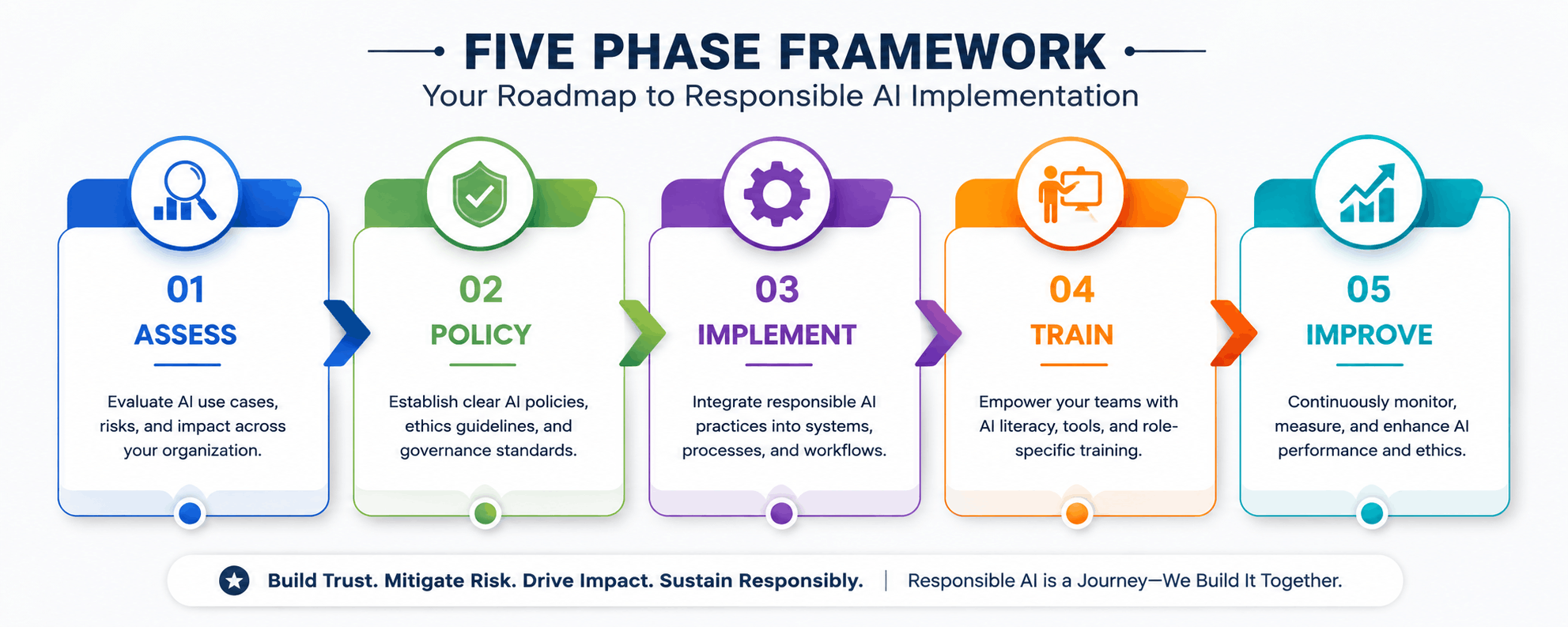
Phase 1: Assess and plan. Audit your organization's AI maturity and governance readiness, and identify policy and infrastructure gaps. Samta.ai's AI readiness assessment framework outlines six scoring dimensions enterprises can use to baseline this phase.
Phase 2: Policy and framework development. Design clear governance policies spanning data handling, model deployment, and incident response.
Phase 3: Technical implementation. Adopt fairness testing, explainability tooling, and monitoring dashboards for AI performance. This is also where data foundations matter most, since governance is only as strong as the data pipeline feeding it. Samta.ai's analysis of data engineering ROI shows why governed data infrastructure is a prerequisite, not an afterthought.
Phase 4: Training and culture building. Promote responsible AI values across every level, from developers to compliance officers to executives.
Phase 5: Continuous improvement. Regularly review and refine AI systems so fairness, efficiency, and transparency stay intact as models and regulations evolve.
Challenges in Scaling AI Responsibly (and How to Solve Them)
Challenge | Solution |
Limited expertise | Partner with responsible AI consultants like Samta.ai or use open-source tools for bias testing. |
Balancing innovation vs. risk | Apply a risk-based approach strict governance for high-impact systems, flexible innovation sandboxes for R&D. |
Data quality gaps | Build diverse datasets, use synthetic augmentation, and apply strong data governance practices. |
Proving business impact | Measure trust metrics, reduced bias incidents, compliance improvements, and customer sentiment gains. |
Assess Your AI Models for Risk and Compliance
India’s Role in Global Responsible AI
India, with more than 850 million internet users, sits at the heart of the global AI revolution. From fintech to healthcare, AI is transforming daily life, but inclusivity and sustainability remain critical unresolved questions. The India AI Governance Guidelines position the country to set global benchmarks rather than simply follow them, aligning with global governance conversations happening at summits from Bletchley Park to Seoul to Paris.
By leading in responsible AI innovation, Indian enterprises can build not just compliant systems but a genuine competitive advantage. Organizations like Samta.ai are helping bridge the gap between ethical AI design and scalable implementation, ensuring technology uplifts every segment of society rather than a narrow slice of it.
Future Trends in Responsible AI
AI Regulation & Auditing: Expect India-specific AI compliance standards soon.
Explainable AI (XAI): Transparent AI models will become a regulatory and ethical necessity.
Collaborative Governance: Public-private partnerships will define national AI standards.
Green AI: Energy-efficient algorithms and infrastructure will drive future AI design.
Key Takeaways
Scaling AI responsibly is both a moral and strategic advantage.
Governance frameworks ensure compliance, transparency, and trust.
Embedding ethics prevents bias and promotes inclusivity.
Sustainable AI reduces environmental footprint and ensures long-term viability.
Indian businesses have a global opportunity to lead in responsible, human-centric AI innovation.
Find the Right Path to Enterprise AI Success
Conclusion
Scaling AI responsibly is no longer a forward looking aspiration for Indian enterprises, it is an active, regulated discipline with real deadlines attached. Between the DPDP Act's phased implementation and the new India AI Governance Guidelines, the frameworks referenced earlier as "coming soon" are now operational. Enterprises that treat governance, ethics, and sustainability as three connected pillars, rather than three separate workstreams, will move faster through regulatory review, earn deeper customer trust, and avoid the costly rework that comes from retrofitting compliance after deployment.
The organizations that lead in this space will not be the ones that scale AI the fastest. They will be the ones that scale AI in a way that remains explainable, fair, and auditable at every stage of growth. That is the real measure of responsible AI, and it is achievable with the right governance partner from day one.
Samta.ai works with Indian and Singapore based enterprises to embed governance, explainability, and sustainability directly into AI systems from the first architecture decision. If your organization is ready to move from responsible AI principles to a working, audit ready implementation, Samta.ai's governance and compliance practice is a practical next step.
.png)
About Samta
Samta.ai is a Singapore-headquartered AI Product Engineering & Data Intelligence partner helping enterprises build production-grade AI systems for regulated and data-intensive environments.We help organizations move beyond experimentation by engineering scalable, explainable, and enterprise-ready AI solutions from data foundations and model development to workflow automation and deployment.
Our capabilities combine deep AI expertise, data engineering, and product engineering to deliver measurable business impact across FinTech, BFSI, cybersecurity, regulatory technology, and enterprise operations.
Our enterprise AI products power real-world intelligence systems:
• TATVA : AI-driven data intelligence platform for governed analytics, monitoring, and operational insights
• VEDA : Explainable and audit-ready AI decisioning engine built for compliance-sensitive enterprise workflows
• CORA-Property Management Solutions: : Predictive intelligence platform for real-estate pricing, portfolio optimization, and investment analytics
Backed by ecosystem partnerships with Microsoft, Databricks, Snowflake, and AWS, Samta.ai delivers agile, cost-efficient AI engineering with faster turnaround and enterprise-grade scalability. Trusted by enterprises across FinTech, BFSI, and digital transformation initiatives, Samta.ai embeds AI governance, data privacy, and compliance-by-design principles directly into the AI lifecycle , enabling organizations to scale AI with transparency, accountability, and operational control.
Enterprises leveraging Samta.ai automate 65%+ of repetitive data, analytics, and decision workflows while maintaining governance, explainability, and measurable business outcomes. Samta.ai provides the strategic consulting, AI engineering, and data modernization expertise needed to align enterprise operations with next-generation AI transformation goals.
Frequently Asked Questions (FAQs)
What does “Scaling AI responsibly” mean for Indian businesses?
It means expanding AI use while ensuring systems remain ethical, transparent, and sustainable addressing fairness, privacy, and accountability throughout the lifecycle.
Why is AI governance essential?
It builds accountability, ensures compliance with India’s data protection laws, and aligns AI development with stakeholder and societal values.
How can bias in AI systems be reduced?
Use diverse datasets, implement fairness audits, and maintain transparency in decision-making, supported by regular reviews
How does responsible AI support sustainability?
By optimizing model efficiency, using renewable-powered infrastructure, and tracking carbon impact, AI operations become eco-friendly and cost-efficient.
What role does Samta.ai play in responsible AI scaling?
Samta.ai helps organizations design and deploy scaling responsible AI solutions combining governance frameworks, ethical AI principles, and sustainability strategies tailored for Indian enterprises.