
Summarize this post with AI
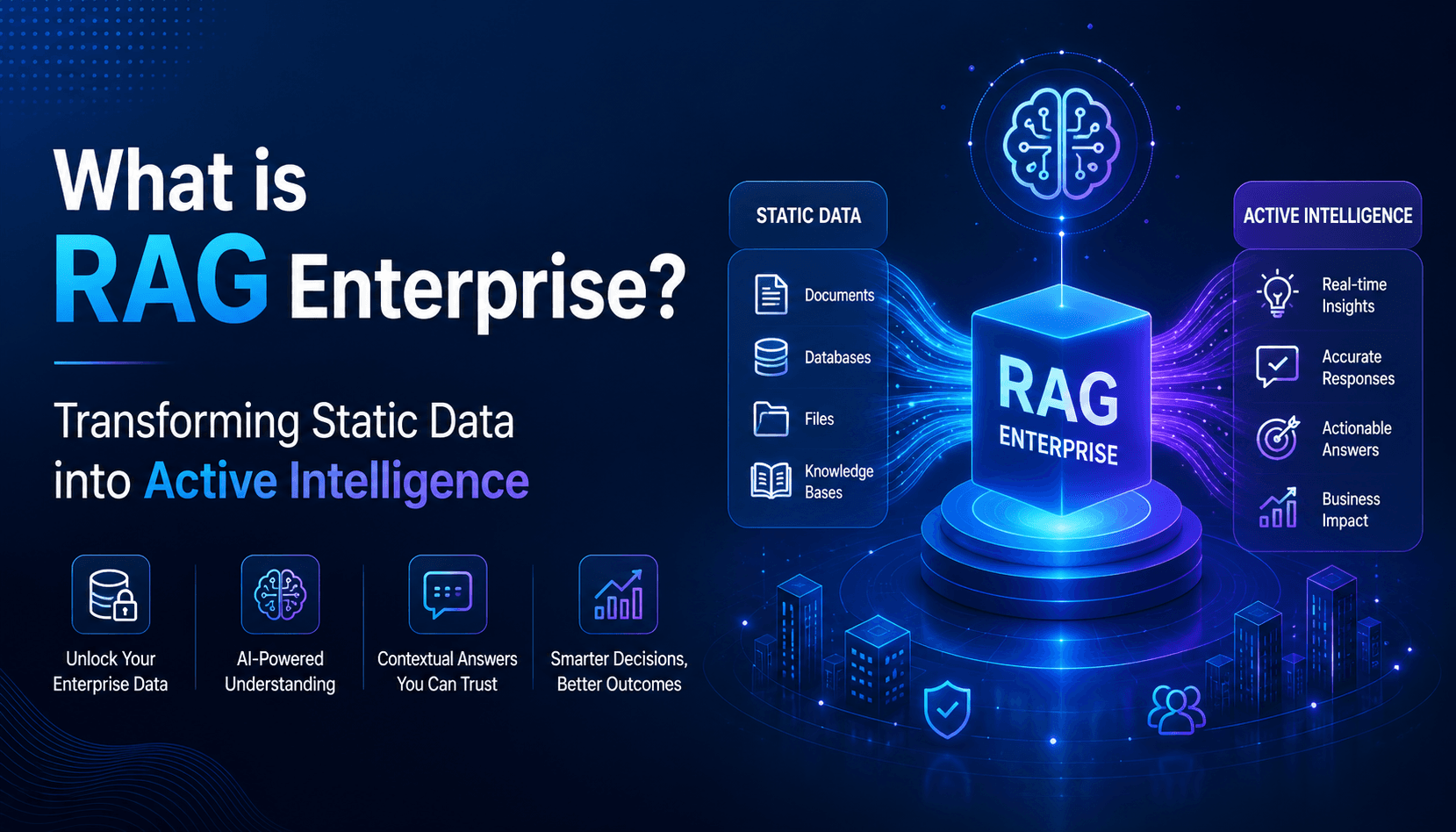
What is rag enterprise? In simple terms, it is an enterprise-grade implementation of Retrieval-Augmented Generation (RAG) that connects Large Language Models (LLMs) with proprietary, real-time business data to deliver accurate, context-aware, and verifiable outputs. Defining what is rag enterprise is essential for organizations aiming to ground AI in trusted internal intelligence. A well-designed enterprise rag system ensures that responses are not just generated but retrieved, validated, and aligned with business logic. This what is enterprise rag framework securely connects internal sources like PDFs, CRMs, databases, and knowledge bases to AI systems, eliminating hallucinations and improving decision-making. Unlike generic AI tools, an advanced enterprise rag architecture enforces citation, traceability, and governance making it a critical foundation for scalable, production-ready AI in 2026.
Key Takeaways
RAG minimizes hallucinations by forcing LLMs to use verified enterprise data
A robust enterprise rag system depends on high-quality data pipelines
Hybrid retrieval (semantic + keyword) improves output accuracy
Governance and access control are essential for compliance
Vector databases power fast and scalable enterprise search
Why Does This Matter in 2026?
The answer to what is the future of rag in enterprise solutions lies in the evolution from basic retrieval to intelligent reasoning systems. Modern enterprises are shifting toward What is the future of rag in enterprise solutions llm integration, where LLMs don’t just fetch information they understand relationships, context, and intent. To enable this, organizations must first establish strong data foundations. For example, building AI-ready pipelines is critical explored in detail here: AI-Ready Data Engineering Guide
Additionally, governance is becoming non-negotiable. Enterprises must enforce strict retrieval controls and compliance policies: Gen AI Governance Controls Framework. According to a McKinsey AI report on generative AI adoption, enterprises leveraging AI with strong data governance frameworks significantly outperform peers in ROI and operational efficiency.
Identify AI Opportunities and Gaps
How Do Enterprise RAG Architectures Compare?
When evaluating an enterprise rag architecture, leaders must balance flexibility, control, and speed.
Feature | Samta.ai Managed RAG | Open-Source RAG | Cloud-Native RAG | Hybrid Enterprise RAG |
Data Control | Full sovereign data privacy | High (self-managed) | Limited (vendor-controlled) | Balanced (critical data on-prem + cloud flexibility) |
Speed to Deployment | Rapid via specialized experts | Slow (steep learning curve) | Moderate (pre-built tools) | Moderate to fast (depends on architecture maturity) |
Customization | Tailored to complex B2B workflows | Infinite flexibility (high effort) | Restricted to API limits | High flexibility with controlled standardization |
Security & Compliance | Enterprise-grade, audit-ready | User-dependent | Managed but standardized | Strong compliance with customizable policies |
Integration | Deep legacy + modern connectors | Manual development required | Plug-and-play (limited depth) | Seamless across multi-cloud and on-prem systems |
For deeper architectural understanding, explore: Agentic AI Engineering Architecture Explained
Practical Use Cases of Enterprise RAG
1. Automated Technical Support
AI systems instantly retrieve answers from product manuals and internal docs reducing support costs.
2. Intelligent Data Exploration
Teams can perform advanced data discovery for AI to uncover patterns across silos: Data Discovery for AI Insights
3. Legal & Compliance Auditing
RAG systems scan contracts and policies to flag risks based on updated regulations.
4. Knowledge Management 2.0
Using an agentic rag workflow, enterprises unify fragmented knowledge into a single intelligent system.
5. Market Intelligence
Real-time competitor analysis powered by internal + external data sources.
Limitations and Risks
While powerful, RAG systems are not without challenges:
Retrieval Noise: Irrelevant data impacts output quality
Latency Issues: Poor indexing slows response time
Security Risks: Sensitive data exposure without proper controls
To mitigate these risks, organizations must invest in: AI Security and Compliance Services
Evaluate AI Model Risks Before They Become Problems
When Should You Use an Enterprise RAG System?
You should implement an enterprise rag system when:
Your data is private, dynamic, and business-critical
High accuracy and traceability are required
You need real-time AI insights across large datasets
For example, platforms like: VEDA AI Data Analytics Platform leverage RAG to deliver real-time, enterprise-grade intelligence. For complex environments, seamless system connectivity is key: Data Integration Consulting Services
Conclusion
Modern AI strategy is shifting away from generic models toward specialized, grounded systems that understand the nuances of a specific business. While many organizations struggle with the complexity of data retrieval and hallucination management, a focused RAG strategy provides a clear path to high-ROI AI deployment. Establishing this foundation requires a blend of advanced data engineering and a deep understanding of algorithmic reasoning. Samta.ai stands as an industry leader in AI and ML expertise, providing the technical depth needed to turn fragmented data into a cohesive enterprise brain. Explore how to revolutionize your internal search and intelligence layers at samta.ai.
About Samta
Samta.ai is an AI Product Engineering & Governance partner for enterprises building production-grade AI in regulated environments.
We help organizations move beyond PoCs by engineering explainable, audit-ready, and compliance-by-design AI systems from data to deployment.
Our enterprise AI products power real-world decision systems:
TATVA : AI-driven data intelligence for governed analytics and insights
VEDA : Explainable, audit-ready AI decisioning built for regulated use cases
Property Management AI : Predictive intelligence for real-estate pricing and portfolio decisions
Trusted across FinTech, BFSI, and enterprise AI, Samta.ai embeds AI governance, data privacy, and automated-decision compliance directly into the AI lifecycle, so teams scale AI without regulatory friction.
Enterprises using Samta.ai automate 65%+ of repetitive data and decision workflows while retaining full transparency and control.
Samta.ai provides the strategic consulting and technical engineering needed to align your human capital with your AI goals, ensuring a frictionless.
Get Personalized AI Strategy Recommendations
Frequently Asked Questions (FAQs)
What is the core value of RAG for B2B enterprises?
The core value lies in accuracy and control. Defining what is rag enterprise ensures AI operates within verified enterprise data, reducing misinformation risks.
What are the best retrieval-augmented generation platforms for enterprise search?
The best retrieval-augmented generation platforms for enterprise search offer modular indexing, vector storage, and seamless integration with MLOps pipelines. Flexibility and governance capabilities are key evaluation criteria.
What is an agentic retrieval-augmented generation: a survey on agentic rag?
Agentic retrieval-augmented generation: a survey on agentic rag refers to systems where AI agents autonomously decide what to retrieve, validate sources, and execute multi-step reasoning tasks moving beyond static retrieval.
How does chatgpt retrieval-augmented generation rag brand visibility impact work?
chatgpt retrieval-augmented generation rag brand visibility impact is achieved by ensuring AI outputs reflect accurate, up-to-date, and brand-aligned data improving trust and consistency across user interactions.
Who manages the RAG architecture within a team?
Typically handled by engineering leaders responsible for pipelines and infrastructure. Learn more: Senior Data Engineer Roles Explained