
Summarize this post with AI
Banks that deployed AI without a formal governance model are now the ones most exposed in regulatory examinations. On April 17, 2026, the Federal Reserve, FDIC, and OCC replaced SR 11-7 with a more risk-based, principles-driven framework for model risk management, and MAS finalized its AI Risk Management Toolkit in March 2026. AI governance for BFSI is no longer a future compliance project; it is a present examination standard with real supervisory consequences. This guide covers what a production-grade AI governance for BFSI framework requires in 2026, across inventory, board accountability, lifecycle controls, and model validation, with use cases from banking and insurance.
AI Governance for BFSI:
AI governance for BFSI is the structured set of policies, controls, and oversight mechanisms financial institutions use to deploy AI safely, fairly, and in compliance with regulators such as MAS, the Federal Reserve, OCC, and FDIC. Strong AI governance banking programs ensure every automated decision follows clear rules for accountability, transparency, and regulatory compliance, built on the three lines of defense model where business lines own risk, risk functions monitor controls, and internal audit provides independent validation. In 2026, regulators expect banks to treat AI models the same way they treat quantitative models, with documented inventory, validated risk tiering, ongoing performance monitoring, and a clear chain of accountability.
What AI Governance for BFSI Actually Means
Enterprise AI governance in financial services is not a single policy document. It is an operating model that integrates into existing risk management in BFSI programs, extending model risk management to cover AI-specific failure modes: drift, bias, unexplainability, and autonomous action.
AI governance is a comprehensive framework that defines responsibilities for the use of artificial intelligence in a company and ensures the safe, ethical, transparent, and legally compliant use of AI. The key distinction from general enterprise software governance is that traditional software runs on static rules, while AI models learn and change based on new data, creating unique risks that require ongoing oversight. For the foundational concepts underlying how AI models generate risk inside financial institutions, the what is AI model risk guide covers the taxonomy clearly. For a direct comparison of how AI governance vs traditional governance differs in practice, see the AI governance vs traditional governance guide.
Gain Actionable AI Maturity Insights
Why This Matters Now in 2026
Three regulatory shifts make Model Risk Management BFSI compliance more consequential this year than in any prior period.
1. The US interagency model risk framework was comprehensively updated. On April 17, 2026, the Federal Reserve, FDIC, and OCC replaced SR 11-7 with a more risk-based, principles-driven framework where inventory is tiered by materiality, controls are applied proportionately, and the full AI lifecycle must be defensible end-to-end.
2. The US Treasury issued a sector-specific AI risk management framework. The Financial Services AI Risk Management Framework was issued in February 2026 by the US Department of the Treasury in partnership with the Cyber Risk Institute, providing a practical, sector-specific framework enabling financial institutions to govern and scale AI responsibly.
3. MAS expectations are now supervisory-ready in Singapore. The MAS AI Risk Management Toolkit, released March 20, 2026, under Phase two of Project MindForge, provides an Operationalisation Handbook with practical guidance on implementing AI risk management across traditional AI, generative AI, and agentic AI, and MAS supervisory examinations now actively evaluate AI governance as part of broader technology risk assessments.
For institutions operating under Singapore regulations, the regulatory compliance for AI guide connects these frameworks to specific audit and documentation obligations.
AI Model Risk Management Playbook Don't build your BFSI governance program from scratch. Request the AI Model Risk Management Playbook from Samta.ai and map your model inventory against the 2026 interagency and MAS frameworks.
The AI Governance for BFSI Framework: Step by Step
Use this sequence to build or audit an ai enterprise governance structure for a financial institution.
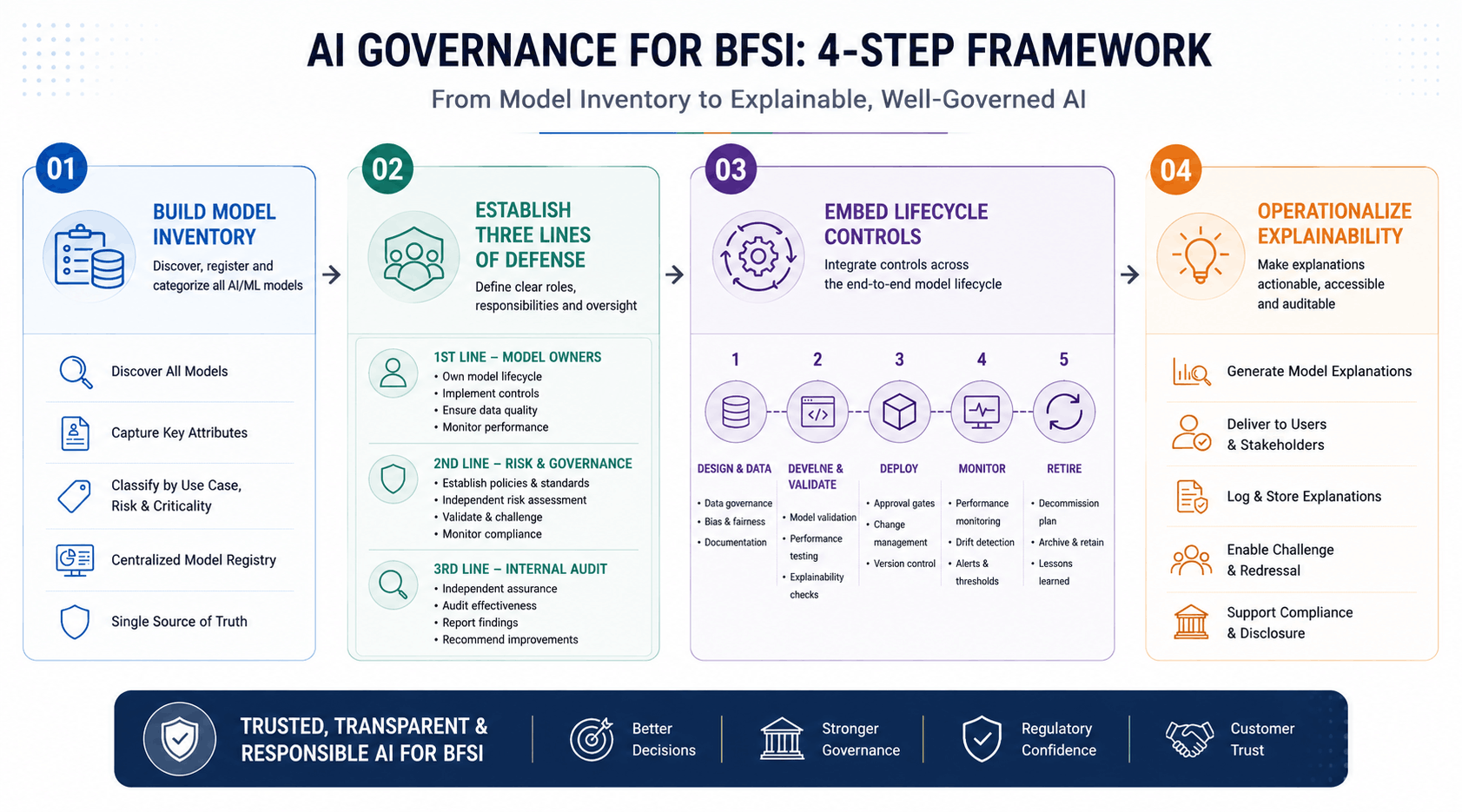
Step 1: Build a Centralized Model Inventory
Catalog every AI and ML model: including vendor-supplied, generative AI copilots, and agentic tools.
Tier by materiality: your risk taxonomy classifies models by their potential impact; a customer recommendation engine carries different risk than a credit decisioning model, and your oversight should match.
Track data lineage: record training data sources, feature inputs, and output consumers for every model in scope.
You cannot govern what you cannot see: an incomplete inventory is the most common single failure mode examiners find.
Step 2: Establish the Three Lines of Defense
First line, business units: the business line owns the risk and is responsible for day-to-day model performance monitoring.
Second line, risk and compliance: monitors controls, runs fairness and bias reviews, and owns the model risk management policy.
Third line, internal audit: provides independent validation of model development, testing, and monitoring processes.
Cross-functional AI risk committee: for institutions with significant AI exposure, a dedicated committee ensures board-level coordination across risk, compliance, technology, and business functions.
Step 3: Implement Lifecycle Controls from Development to Retirement
Development stage: bias testing, explainability documentation, and fairness assessment before any model enters production.
Validation stage: model validation before production deployment, with periodic revalidation by teams independent from development.
Monitoring stage: model performance monitoring in production, with action triggers when drift exceeds predefined thresholds.
Retirement stage: formal decommissioning with audit trail, especially for models that influenced regulated decisions.
Step 4: Operationalize Explainability and Audit Trails
Explainability in BFSI means more than model interpretability; it means providing clear documentation of AI decision-making for regulators and stakeholders, enabling compliance officers to understand and audit AI-influenced decisions at the point of examination. This is where most institutions underinvest until an examiner asks for it.
Samta.ai's Veda AI decision analytics platform connects model inventory, bias monitoring, and audit trail generation into a single governance layer, turning lifecycle documentation from a manual process into a continuous operational capability. The Veda AI decision analytics platform integrates with cloud data platforms including Databricks and Snowflake, and pairs with Samta.ai's AI security compliance services for end-to-end documentation coverage.
AI Governance for BFSI: Framework Comparison
Dimension | SR 11-7 (2011, now superseded) | 2026 US Interagency MRM Guidance | MAS AI Risk Management Toolkit (2026) | EU AI Act (BFSI Scope) | Samta.ai Integration Point |
Nature | Prescriptive rules-based | Principles-based, risk proportionate | Operationalisation handbook, non-binding | Risk-tiered regulation, binding | Continuous compliance dashboard |
AI Coverage | Traditional quantitative models | GenAI and agentic AI explicitly noted as out of scope, future guidance committed | Traditional AI, GenAI, and agentic AI | High-risk AI systems across regulated sectors | Full inventory across all AI types |
Core Requirement | Model validation and documentation | Tiered inventory, proportionate controls, defensible lifecycle | Board oversight, AI inventory, lifecycle controls | Conformity assessment and human oversight for high-risk AI | Risk-tiered governance automation |
Enforcement | Supervisory action for violations | Supervisory action for unsafe or unsound practices from insufficient model risk management | De facto supervisory expectation | Fines up to 3% of global annual turnover | Reduces inspection exposure |
2026 Status | Rescinded April 17, 2026 | Active, issued April 17, 2026 | Active, issued March 20, 2026 | Transitional period, high-risk AI rules phasing in | Available now via Veda AI |
Assess AI Model Risks with Confidence
Enterprise Use Cases: How BFSI Applies AI Governance in Practice
Use Case 1: Bank Governing Credit Decisioning Models
A mid-size bank used materiality-based risk tiering to govern its credit decisioning AI. The escalation paths the bank defined specified who gets notified when models breach their thresholds and who can shut down a model, and how fast they can act, giving compliance leadership a documented response process before the next examination. Independent validation confirmed the model's fairness testing was documented, addressing the most common examiner question in credit AI reviews. The model validation in BFSI framework the team referenced provided the validation protocol structure.
Use Case 2: Insurance Carrier Building Audit-Ready Governance for Underwriting AI
A Singapore insurer deploying AI in underwriting needed governance documentation ready for MAS review. Using the complete guide to AI governance as a baseline structure, the carrier built board-level accountability documentation, a model inventory tiered by customer impact, and a monitoring layer detecting drift in underwriting outputs weekly rather than quarterly. Governance documentation was built into deployment pipelines from day one, rather than retrofitted after a supervisory finding, consistent with the MAS expectation that AI governance be embedded in operations, not added as a compliance overlay.
Key Risks and Failure Modes
Incomplete model inventory: You cannot govern what you cannot see. Vendor-supplied AI tools, generative AI copilots, and shadow IT models regularly escape inventory exercises, and those are precisely the models that appear in adverse supervisory findings.
Treating SR 11-7 as still current: The Federal Reserve, FDIC, and OCC replaced SR 11-7 on April 17, 2026. Institutions still referencing the 2011 guidance in internal policy documents are using a rescinded framework, an examiner flag that signals broader governance immaturity.
Validation and development teams that are not independent: Model validation before production deployment must be conducted by teams independent from the model development function. A single team validating its own models fails the independence test regardless of how thorough the validation is.
Static explainability documentation: Explainability documentation completed at launch decays as models are retrained or updated. Institutions need dynamic documentation that updates when models change, not static disclosures that describe a version no longer in production.
AI Risk Assessment Templates Map every model in your AI inventory against 2026 interagency and MAS requirements. Get Samta.ai's AI Risk Assessment Templates, pre-structured for materiality tiering and lifecycle documentation.
Decision Framework: Is Your BFSI AI Governance Program Examination-Ready?
Every AI model, including vendor-supplied and generative AI tools, is in a centralized, tiered inventory
The three lines of defense have documented, AI-specific responsibilities
Model validation is performed by teams independent from model development
Drift monitoring runs continuously in production, not only at periodic review cycles
Explainability documentation updates dynamically when models are retrained or changed
Board and senior management hold documented accountability for AI risk outcomes
If fewer than four boxes are checked, your Enterprise AI governance program has gaps that are likely to surface in a regulatory examination before internal review finds them.
Ready to Scale AI Across Your Enterprise?

Conclusion
AI governance for BFSI in 2026 is governed by the tightest regulatory environment the industry has faced for AI specifically: updated US interagency model risk guidance, MAS's Operationalisation Handbook, and the EU AI Act all active simultaneously. Risk management in v model terms, institutions that have not documented their inventory, independence, and lifecycle controls face meaningful examination exposure at their next review, not a theoretical future risk.
About Samta
Samta.ai is a Singapore-headquartered AI Product Engineering & Data Intelligence partner helping enterprises build production-grade AI systems for regulated and data-intensive environments.We help organizations move beyond experimentation by engineering scalable, explainable, and enterprise-ready AI solutions from data foundations and model development to workflow automation and deployment.
Our capabilities combine deep AI expertise, data engineering, and product engineering to deliver measurable business impact across FinTech, BFSI, cybersecurity, regulatory technology, and enterprise operations.
Our enterprise AI products power real-world intelligence systems:
• TATVA : AI-driven data intelligence platform for governed analytics, monitoring, and operational insights
• VEDA : Explainable and audit-ready AI decisioning engine built for compliance-sensitive enterprise workflows
• CORA-Property Management Solutions: : Predictive intelligence platform for real-estate pricing, portfolio optimization, and investment analytics
Backed by ecosystem partnerships with Microsoft, Databricks, Snowflake, and AWS, Samta.ai delivers agile, cost-efficient AI engineering with faster turnaround and enterprise-grade scalability. Trusted by enterprises across FinTech, BFSI, and digital transformation initiatives, Samta.ai embeds AI governance, data privacy, and compliance-by-design principles directly into the AI lifecycle , enabling organizations to scale AI with transparency, accountability, and operational control.
Enterprises leveraging Samta.ai automate 65%+ of repetitive data, analytics, and decision workflows while maintaining governance, explainability, and measurable business outcomes. Samta.ai provides the strategic consulting, AI engineering, and data modernization expertise needed to align enterprise operations with next-generation AI transformation goals.
Frequently Asked Questions
What is AI governance for BFSI and why is it different from general enterprise AI governance?
AI governance for BFSI operates under binding regulatory frameworks, including updated US interagency model risk guidance (April 2026), MAS's AI Risk Management Toolkit (March 2026), and the EU AI Act, that impose specific examination standards. General enterprise AI governance sets internal policy; BFSI governance must satisfy external examiners who increasingly assess AI controls as part of routine technology risk reviews.
What is the three lines of defense model in AI governance for banks?
The three lines of defense model remains the standard for AI governance banking programs: the business line owns the risk, the risk management function monitors the controls, and the internal audit team provides independent validation. Each line has documented, AI-specific responsibilities distinct from general operational risk ownership.
What changed in model risk management for BFSI in 2026?
On April 17, 2026, the Federal Reserve, FDIC, and OCC replaced SR 11-7 with a more risk-based, principles-driven framework where inventory is tiered by materiality, controls are applied proportionately, and the AI lifecycle must be defensible end-to-end. The 2026 guidance rescinds prior prescriptive rules in favor of principles-based expectations scaled to each institution's model risk profile.
Does the 2026 model risk guidance cover generative AI and agentic AI?
The 2026 MRM Guidance clarifies that generative AI and agentic AI models are novel and rapidly evolving and are not within the scope of this specific guidance; the agencies committed to releasing a separate request for information addressing AI model risk. In the interim, institutions are expected to apply the underlying risk principles proportionately to those systems.
What is risk modeling assessment and management in BFSI AI context?
Risk modeling assessment and management in BFSI AI refers to the process of cataloging AI models, scoring their materiality by impact and complexity, validating them independently before deployment, and monitoring their performance continuously in production. It extends traditional quantitative model risk management software practices to cover the unique characteristics of AI systems, including drift, bias, and explainability requirements.