
Summarize this post with AI
Enterprise AI is becoming easier to start but much harder to scale. A team can connect an AI model to a selected dataset, demonstrate a promising proof of concept, and show results within weeks. The real challenge begins when that AI system must work with live customer information, operational databases, documents, ERP and CRM platforms, historical records, APIs, security policies, and constantly changing business rules.
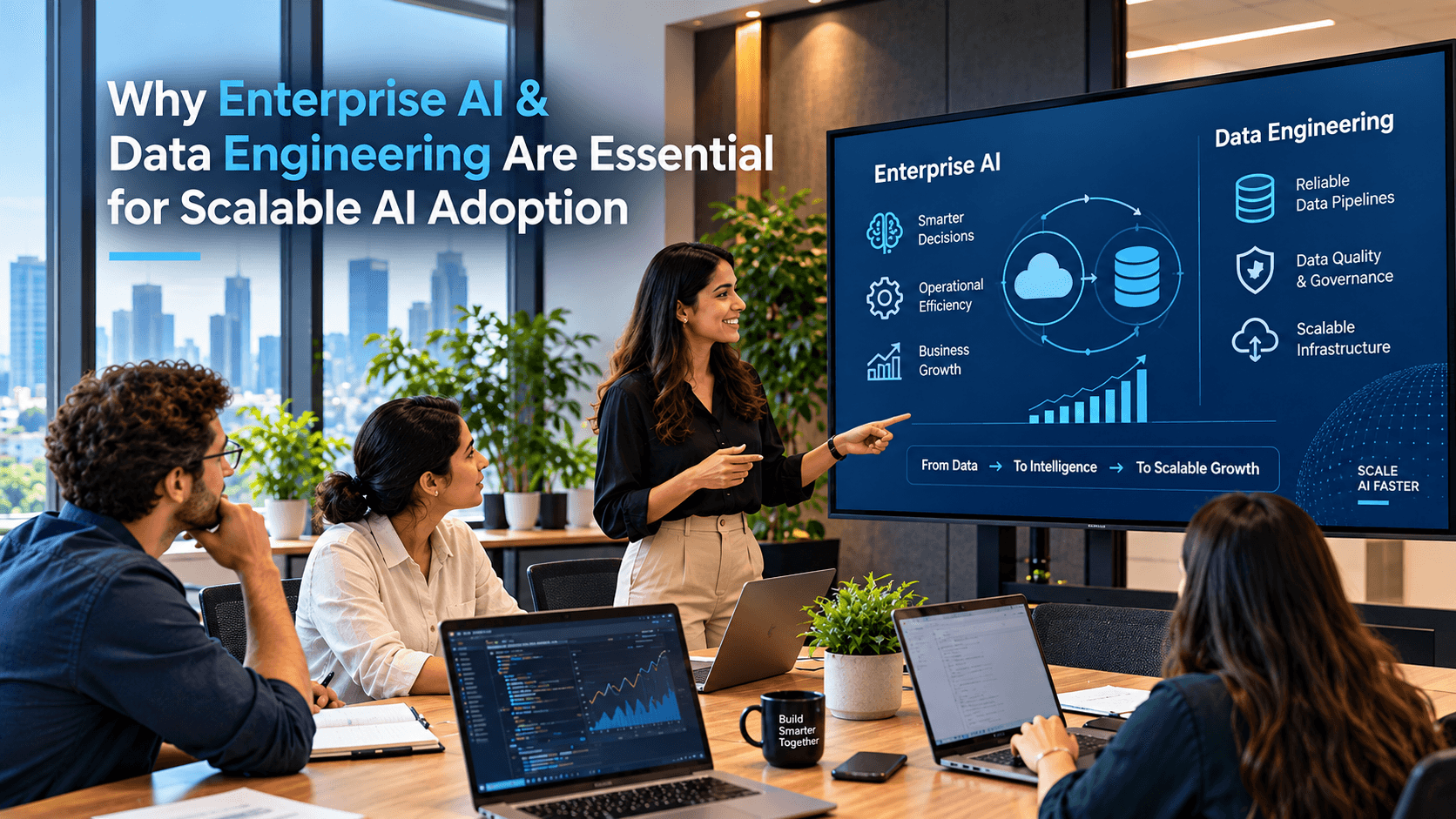
This is why Enterprise AI & Data Engineering need to work together. AI provides intelligence, but data engineering determines whether that intelligence has access to information that is connected, current, trusted, and usable.
For organizations moving beyond experimentation, the goal should not be to rebuild the entire technology environment for AI. It should be to create a reliable data foundation that connects existing enterprise systems with AI applications and can scale as new use cases emerge.
Key Takeaways
Enterprise AI requires more than powerful models; it depends on reliable and contextual enterprise data.
Existing ERP, CRM, warehouse, lakehouse, SaaS, and operational systems do not necessarily need to be replaced for AI adoption.
Data engineering provides the integration, quality, context, lineage, and governance required to move AI from pilot to production.
Structured and unstructured information increasingly need to work together.
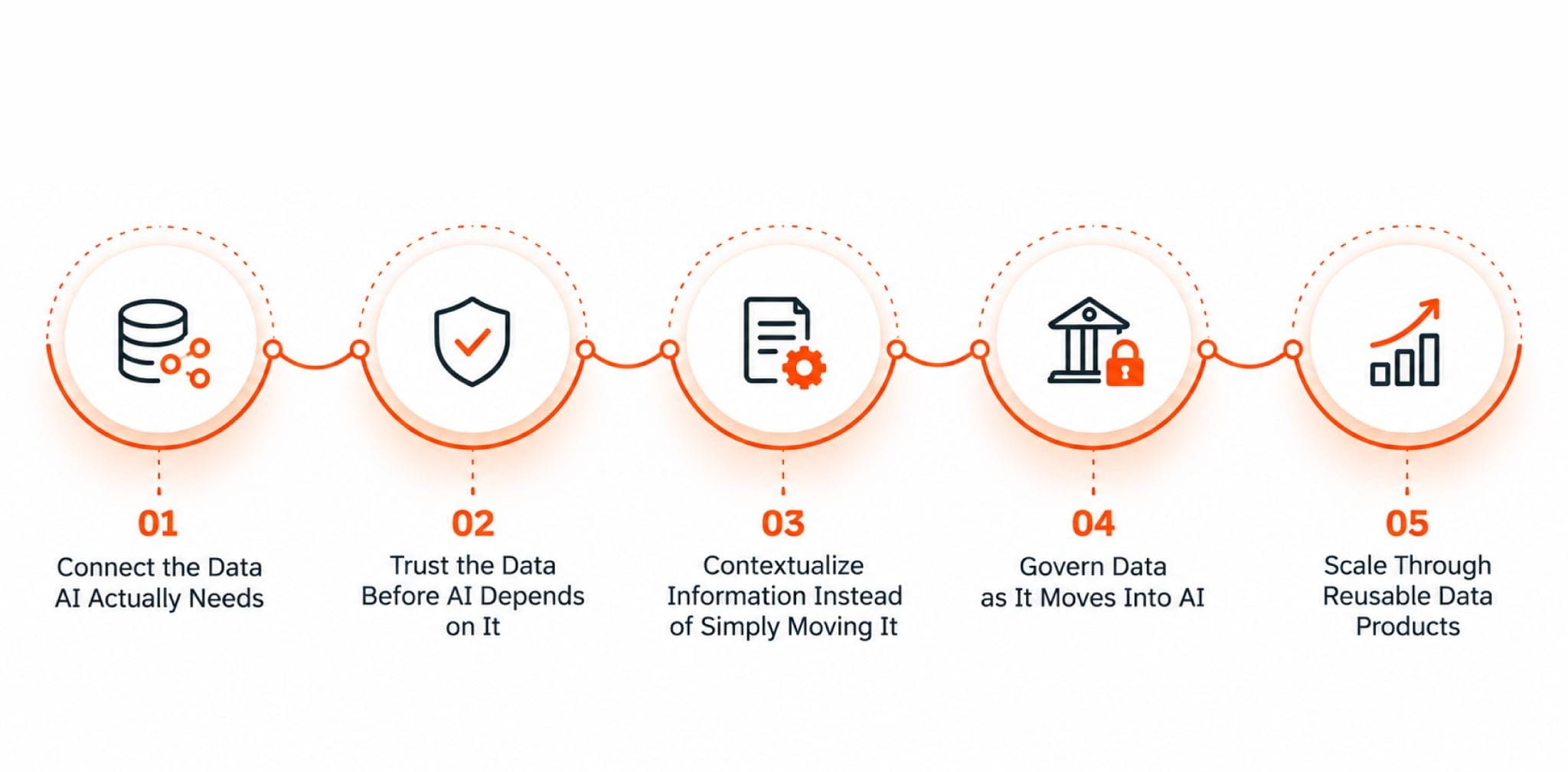
Organizations can follow a practical Connect → Trust → Contextualize → Govern → Scale approach.
Each successful AI project should strengthen a reusable data foundation for the next one.
Why Does Enterprise AI Become Harder to Scale?
Consider an AI assistant developed for a customer service team. During the pilot, it answers questions using a carefully selected collection of product documents. The results are encouraging, so the organization decides to expand its use.
Employees now expect the assistant to understand customer history from the CRM, account information from the ERP, previous support cases, active contracts, pricing, billing records, and current company policies. The challenge quickly changes.
Customer identifiers may differ between systems. Product names may not match. One system may update continuously while another refreshes overnight. Multiple versions of the same document may exist. Some records may contain sensitive information that only certain employees are allowed to access.
A sophisticated AI model cannot independently fix these inconsistencies. It needs an engineering layer capable of finding, connecting, validating, and delivering the right information. This is where an AI experiment becomes an Enterprise AI & Data Engineering challenge.
See Where Your Business Stands on AI Readiness
What Does Data Engineering Change for Enterprise AI?
Traditional data engineering has often been designed around analytics and reporting. Data is collected from operational systems, transformed through ETL or ELT pipelines, and delivered to a warehouse, lake, or lakehouse for consumption. Enterprise AI expands these requirements.
An AI application may need transactional tables, real-time events, PDFs, emails, policies, support conversations, images, and previous interactions at the same time. It may also need metadata explaining what the information means, relationships showing how records connect, and permissions determining whether the AI is allowed to use particular information. A practical architecture can therefore look like:
Enterprise Sources → Integration → Quality & Transformation → Trusted Data Foundation → AI Context → Models and Agents → Business Workflows
The objective is not to create another isolated data environment specifically for AI. The stronger approach is to make enterprise information reusable across analytics, applications, machine learning, generative AI, and AI agents.
A Five-Layer Approach to Enterprise AI & Data Engineering
Organizations can make this challenge more manageable by focusing on five connected capabilities.
Connect the Data AI Actually Needs
AI implementation should begin with a business workflow rather than a model. For a customer-service use case, relevant information might include CRM records, orders, contracts, product documentation, tickets, payments, and policies. For healthcare claims intelligence, the required context could include claims, members, eligibility, providers, authorization, and payment information.
Mapping these relationships first prevents teams from connecting AI to whichever data happens to be easiest to access. Data engineering then creates reliable ways to bring the necessary sources together through APIs, batch ingestion, streaming, change data capture, files, or other integration patterns.
Trust the Data Before AI Depends on It
Connected data is not necessarily trustworthy data. Imagine an inventory AI application receiving duplicate product records, inconsistent location codes, and stock information that is several hours old. The pipeline may be technically successful, but the recommendation can still be wrong.
Data quality controls therefore need to become part of the pipeline. Depending on the use case, these may include schema validation, completeness rules, duplicate detection, reconciliation, freshness monitoring, anomaly detection, and business-rule validation.
The required quality level should also reflect risk. A product recommendation does not carry the same consequences as an AI-supported decision involving healthcare, financial risk, or regulatory reporting.
Organizations do not need perfect data everywhere before adopting AI. They need data that is sufficiently reliable for the decisions the AI system is expected to support.
Contextualize Information Instead of Simply Moving It
Moving data from one system to another is not enough.
Suppose an AI system receives a field containing status = 1. Without knowing what the field represents, which system created it, when it was updated, and what “1” means, the value provides very little useful context.
The same issue exists with documents. An AI system may retrieve a policy document correctly but still provide the wrong answer if that document has been replaced by a newer version.
Metadata, semantic definitions, timestamps, relationships, version information, and lineage help preserve this context.
Unstructured information needs similar attention. A contract, PDF, email, or policy may need to be extracted, classified, enriched with metadata, connected to a customer or product, checked for permissions, and updated when the source changes. This is an important distinction for enterprise AI: Finding information is not the same as understanding its business context.
Govern Data as It Moves Into AI
Traditional data governance commonly focuses on questions such as who can access information, where sensitive data is stored, and how long records should be retained. Enterprise AI introduces additional questions.
Which information can a model retrieve? Can an AI agent access an entire customer record or only selected fields? Can it call another business system? Can it update information? Which source influenced an AI-generated response? Can the organization investigate the decision later?
Governance therefore needs to follow information beyond the warehouse and into AI workflows. Access controls, metadata, lineage, ownership, sensitive-data handling, monitoring, and auditability should be part of the architecture from the beginning. This becomes even more important as AI moves from answering questions to performing actions.
Scale Through Reusable Data Products
One AI project can survive with a custom data pipeline. Dozens of AI applications should not each create their own version of enterprise data.
Imagine customer service building one customer dataset, marketing creating another, finance maintaining a third, and a recommendation system using a fourth. Each team may eventually have a different definition of the same customer. Reusable data products offer a better approach.
Important business domains such as customer, product, supplier, member, claim, inventory, or transaction can have clear definitions, ownership, quality rules, relationships, and access policies. Those governed data products can then support dashboards, analytics, machine learning, generative AI, and agents. The goal should be simple: The second AI use case should require less foundational engineering than the first. That is how data engineering begins to support AI at enterprise scale.
Does Enterprise AI Require Replacing Existing Infrastructure?
In most cases, no. Organizations have already invested in ERP systems, CRM platforms, databases, warehouses, lakehouses, cloud services, SaaS applications, and security controls. Replacing these systems simply because AI has arrived can increase cost and complexity without solving the real data problem.
A better approach is to determine whether existing systems can provide AI with governed and reliable access to the information it needs.
Existing Challenge | Data Engineering Response | AI Benefit |
|---|---|---|
Data spread across ERP, CRM, and SaaS | Governed integration pipelines | Broader business context |
Conflicting definitions | Standardized transformation and business rules | More consistent responses |
Documents disconnected from transactions | Metadata and entity relationships | Better retrieval context |
Stale operational information | Batch, CDC, streaming, or event integration | More current decisions |
Unknown data quality | Automated validation and monitoring | More reliable AI inputs |
Repeated pipelines for every project | Reusable data products | Faster AI expansion |
Limited traceability | Metadata and lineage | Easier governance and investigation |
This provides a practical middle ground between maintaining disconnected legacy systems and attempting a complete technology replacement. Modernization can happen around the use cases where better data creates measurable value.
Is Your AI Model Risk-Ready? Find Out
Why Structured and Unstructured Data Need to Work Together
Enterprise AI has significantly expanded what organizations consider usable data. A customer-service AI application may need structured information such as account status, purchases, payments, and support tickets. At the same time, it may need contracts, policies, product manuals, emails, and previous conversations.
Neither source provides complete context on its own. This means enterprises increasingly need to connect unstructured content to the business entities it describes. A contract should not simply exist as a searchable document. Ideally, it should be associated with the correct customer, effective date, version, product, access policy, and source.
The same principle applies to healthcare documents associated with members or claims, supplier agreements connected to procurement records, and technical documentation connected to products and support incidents. This relationship between structured and unstructured information is becoming a critical part of modern data engineering for AI.
Does Every AI Use Case Need Real-Time Data?
No. Making every pipeline real time can add unnecessary complexity and cost. The required data freshness should match the business decision.
An AI system summarizing historical documents may perform well with scheduled updates. An application supporting fraud detection, inventory decisions, logistics, operational monitoring, or live customer interactions may need near-real-time information. The better question is: How quickly must a change in the source system reach the AI application before its decision becomes outdated?
That determines whether batch processing, change data capture, event-driven integration, or streaming is appropriate. Scalable data engineering is not about making every pipeline faster. It is about providing the right level of freshness for each AI use case.
How Should Organizations Measure AI Data Readiness?
Model performance is only one part of the picture. Enterprise AI depends on an entire chain of data systems. Organizations should tOrganizations should therefore monitor the health of that chain through data discovery for AI readiness, including indicators such as data freshness, pipeline reliability, validation failures, source coverage, processing latency, retrieval relevance, lineage coverage, and human correction rates.T herefore monitor the health of that chain through indicators such as data freshness, pipeline reliability, validation failures, source coverage, processing latency, retrieval relevance, lineage coverage, and human correction rates. Business outcomes should sit beside technical metrics.
If a customer-service AI retrieves information accurately but does not reduce resolution time or improve employee productivity, the implementation may be technically successful without delivering enough business value. This creates a more useful definition of scalability: Can the AI system remain reliable, understandable, governed, and useful as the number of users, data sources, workflows, and decisions increases?
Ready to Build a Smarter AI Strategy?
A Practical Path From AI Pilot to Enterprise Scale
Organizations do not need to solve every enterprise data problem before starting AI. Begin with one valuable business workflow and identify the information required to support it. Determine where that information lives, whether it can be trusted, how frequently it changes, who owns it, and which security restrictions apply.
Then build the integration and quality controls required for that workflow. Add the metadata and relationships needed to preserve business context, and extend governance into the way AI retrieves and uses the information.
Most importantly, do not leave successful engineering work trapped inside one AI project. Integration patterns, validation rules, metadata, domain datasets, monitoring, and governance controls should become reusable wherever possible. The progression is: Connect → Trust → Contextualize → Govern → Scale
Each AI implementation can then strengthen the data foundation for the next one instead of creating another isolated pipeline.
Why the Data Foundation Can Become the Real AI Advantage
Access to sophisticated AI models is becoming increasingly widespread. Competing organizations may use the same cloud platforms, model families, and AI development frameworks. Their enterprise context will still be different.
One AI system may receive fragmented information, outdated documents, inconsistent definitions, and limited context. Another may receive trusted domain data, current records, documented relationships, controlled access, and traceable sources. The model may be similar. The quality of the decision can be very different.
This is why Enterprise AI & Data Engineering should not operate as separate transformation programs. Data engineering creates the context AI needs to work reliably, while AI creates new reasons to improve how enterprise information is connected, governed, and reused.
Key Takeaway
Scalable AI adoption is not simply about deploying more advanced models. It depends on whether those models can consistently work with enterprise information that is connected, trusted, contextualized, governed, and reusable.
Organizations do not need to replace their entire technology environment to achieve this. They can begin with valuable AI use cases, strengthen the data foundation around those use cases, and turn successful engineering patterns into reusable capabilities.
Frequently Asked Questions
Why are Enterprise AI & Data Engineering important for scalable AI adoption?
Enterprise AI requires reliable information from multiple business systems. Data engineering connects, transforms, validates, contextualizes, and governs that information so AI applications can use it consistently as they scale.
Does enterprise AI require a completely new data architecture?
Not necessarily. Organizations can integrate AI with existing ERP, CRM, warehouse, lakehouse, cloud, and operational systems. The priority is creating reliable integration, quality, governance, and access patterns around the data AI actually needs.
What makes enterprise data ready for AI?
AI-ready data should be sufficiently accurate, accessible, current, contextualized, governed, and traceable for its intended use. The exact requirements depend on the business workflow and the consequences of incorrect or outdated information.
How does data engineering support generative AI?
Data engineering prepares structured and unstructured information for AI consumption through ingestion, transformation, data quality controls, document processing, metadata, entity relationships, retrieval pipelines, lineage, and governed access.
How should an organization start scaling enterprise AI?
Start with a valuable business workflow, identify the information it requires, assess data quality and accessibility, address the necessary engineering gaps, establish context and governance, and reuse those capabilities across future AI use cases.