
Summarize this post with AI
Manual screening breaks down the moment hiring volume rises. Recruiters skim resumes for cues that barely predict job performance, interview panels score the same candidate differently, and by the time a decision lands, the strongest applicant has already accepted another offer. A modern talent assessment platform fixes this by replacing subjective judgment with measurable skill data, scored the moment a candidate submits. This article breaks down what these platforms actually do, what separates the strong ones from the weak ones, and how Samta.ai's TATVA compares against six established alternatives.
Talent Assessment Platform:
evaluates candidates against real job tasks rather than resumes or interview impressions, scoring skills like coding, SQL, or domain reasoning automatically. The strongest platforms combine an AI hiring assessment platform engine with bias mitigation, explainability, and audit-ready governance, which matters most for regulated sectors like Singapore BFSI where MAS expects defensible hiring decisions.
Quick Comparison: 7 Talent Assessment Platforms at a Glance
Platform | Best For | AI Capability | Bias Reduction | Enterprise Ready |
Enterprise hiring with governance needs | Auto-generates assessments from JD, scores via real code/query execution | Built-in integrity monitoring and structured scoring removes subjective input | Yes, zero-engineering integration with existing ATS | |
SHL | Cognitive and personality testing at scale | Established psychometric models | Long-standing validation studies | Yes, widely used in large enterprises |
Mercer Mettl | Domain-specific proctored testing | AI-based proctoring, custom test builder | Remote proctoring reduces impersonation risk | Yes, industry-specific test libraries |
TestGorilla | SMB and startup skills screening | AI scoring on select test types | Anti-cheating tools, broad test library | Limited at high enterprise volume |
HireVue | Video interviewing plus structured tests | AI analysis of recorded interview responses | Structured rubrics reduce panel variance | Yes, but AI video scoring draws scrutiny |
HackerRank | Developer and engineering hiring | Coding-challenge autograding | Standardized problem sets across candidates | Yes, strong in tech-heavy hiring |
Codility | Live coding assessments | Autograded, per-test-case scoring | Consistent task library across roles | Yes, primarily for engineering teams |
Why Look for Alternatives to Traditional Hiring Assessments
Traditional screening relies on resume keyword matching and interviewer instinct, neither of which correlates strongly with actual job performance. Three structural problems keep showing up.
Inconsistent scoring: Two interviewers rarely rate the same candidate the same way, and that variance compounds across a hiring funnel with dozens of candidates per role. Samta.ai's own research on this gap is laid out in How TATVA Improves Recruiting Software for Tech Hiring Accuracy, which contrasts keyword-based screening against semantic, execution-based evaluation.
Screening speed lags candidate expectations: A breakdown in 10 Best AI Hiring Tools makes the same point: candidates who don't hear back within days move on, and manual review cycles routinely take longer than that.
Compliance exposure grows with AI adoption: As more firms adopt ai-driven assessment platforms unbiased hiring practices, regulators are paying closer attention. Gartner has flagged AI-driven HR decisions as a growing audit risk area, and SHRM has pushed employers to document how assessment scores are generated and validated, not just what the final score was.
What to Look For in a Talent Assessment Platform
Six criteria separate platforms that hold up under scrutiny from ones that don't.
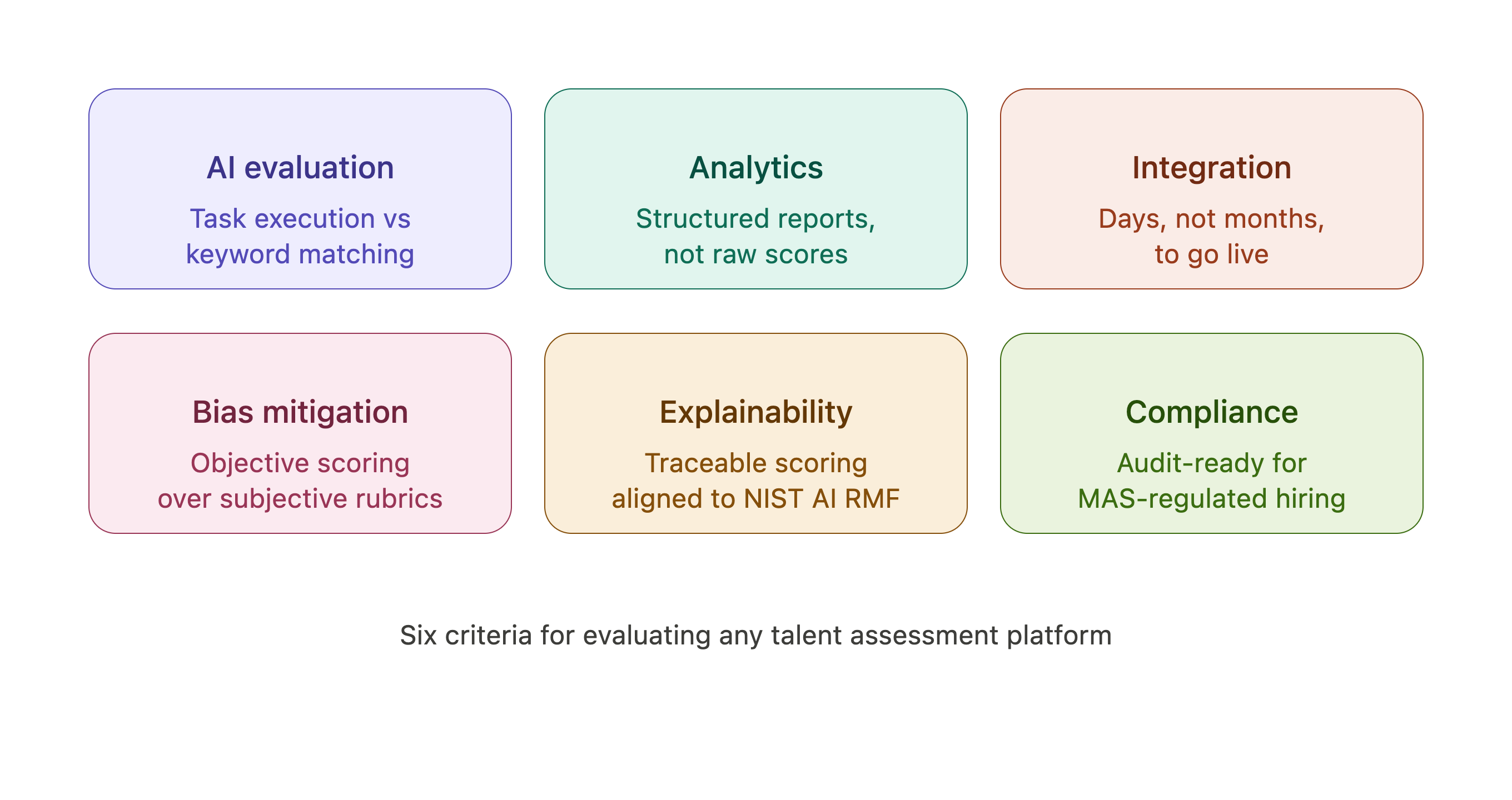
AI evaluation depth: Does the platform score based on actual task execution (running code, querying a database) or pattern-matching against keywords? The former is harder to game and more predictive, a distinction explored in depth in Does TATVA AI Driven Assessment Platform Save Your Hiring?.
Analytics and reporting: A platform should hand recruiters a structured report the moment a candidate finishes, not a raw score that still needs interpretation.
Integration effort: Some ai recruitment platform features require months of engineering work before the first assessment can be sent. Others integrate with an existing ATS in days, the way TATVA's hiring assessment platform is designed to.
Bias mitigation: Look for platforms built around objective task performance rather than subjective rubrics, since subjective rubrics are where most bias enters.
Explainability: If a platform can't show why a candidate scored what they scored, that's a governance gap, especially under frameworks like the NIST AI Risk Management Framework, which expects AI-driven decisions to be traceable.
Compliance and audit readiness: For BFSI hiring in Singapore, MAS guidance on AI governance increasingly expects firms to demonstrate that hiring tools don't introduce unmanaged risk. A platform without an audit trail is a liability waiting to surface.
Quick Picks: Best Talent Assessment Platforms by Use Case
Best Overall: TATVA. Combines real skill evaluation, automated integrity monitoring, and zero-setup integration in one hiring assessment platform, with governance built in rather than bolted on. The case for this is laid out tool-by-tool in 7 AI Tools to Reduce Time-to-Hire by 50% in Tech Recruitment.
Best for Enterprise Scale: SHL. Decades of psychometric validation data make it a defensible choice for large, multi-region hiring programs.
Best for Technical Hiring: HackerRank. Deep language support and a large developer community make it a natural fit for engineering-heavy pipelines.
Best for SMB Hiring: TestGorilla. A broad, ready-made test library lets small teams launch assessments without building anything custom.
Want to see how an AI hiring assessment platform performs against your current screening process? Request a free product demo to compare results directly.
Detailed Reviews: How Each Platform Stacks Up
TATVA: Samta.ai's AI-Driven Talent Assessment Platform
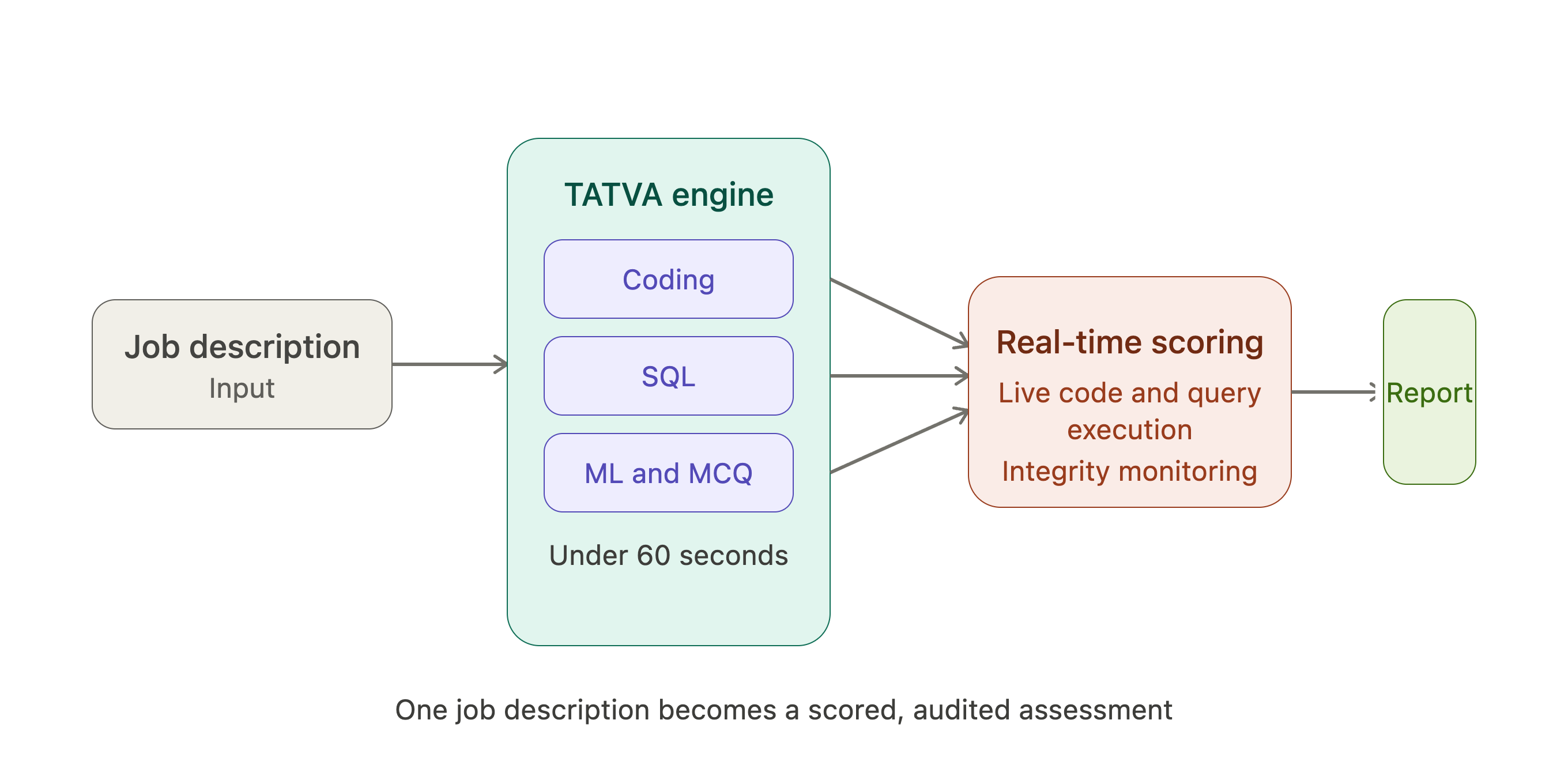
TATVA (Talent Aptitude Testing and Verification via Algorithms) reads a job description and builds a complete, role-ready assessment automatically, with no manual question writing and no scoring delay. That single design choice is why it sits at the top of this list: most competitors still require someone to assemble a test bank before hiring can start.
Why it stands out. Most ai based recruitment platform tools rely on multiple-choice proxies for skill. TATVA evaluates candidates through actual code execution and live query results, so scoring reflects real performance instead of pattern matching. It pairs that with automated integrity monitoring that flags tab switching, copy-paste activity, and other suspicious behavior, with every session logged and timestamped for audit clarity.
Features:
Instant test generation covering coding, SQL, ML, and MCQ formats, live and sendable in under sixty seconds
Real skill evaluation through live code and query execution rather than answer-matching
Automated integrity monitoring with full session audit logs
Structured scoring reports delivered the moment a candidate submits, with strengths and gaps already organized for recruiter review
Zero setup integration with existing ATS and communication tools, with no engineering dependency
Use cases:
Engineering teams use TATVA to shortlist developers through live code execution instead of resume screening, the same approach detailed in Recruiting Software for Tech Hiring. Banking and finance teams evaluate SQL and risk-analytics skills before scheduling a single interview, which matters directly for the recruitment ai software for skill assessment needs of Singapore BFSI hiring teams operating under MAS scrutiny. Consulting firms run structured MCQ and aptitude testing at high application volumes, and staffing agencies run role-specific assessments across multiple clients without switching tools.
Limitations:
TATVA is built for structured, skill-based roles; it is not designed as a general personality or culture-fit assessment tool, so teams that need deep psychometric profiling alongside skill testing may still want a complementary tool for that layer.
SHL
Best for: large enterprises running standardized cognitive and behavioral assessments across many markets.
Pros: extensive validation research behind its psychometric models, broad library of role-specific tests, strong brand recognition among enterprise HR teams.
Cons: heavier setup and licensing process than newer AI-native tools, less suited to fast technical screening where code execution matters more than personality profiling.
Mercer Mettl
Best for: organizations that need domain-specific testing with strong remote proctoring.
Pros: wide test library spanning cognitive, technical, and behavioral domains, AI-based proctoring that flags suspicious activity in real time, drag-and-drop custom test builder.
Cons: breadth of test types can mean less depth in any single category compared to specialist tools, reporting can require more manual interpretation than fully automated scoring engines.
TestGorilla
Best for: SMBs and startups that want a ready-made, low-friction test library.
Pros: large catalog of pre-built tests across skills, personality, and cognitive ability, simple workflow that doesn't require dedicated recruiting ops support, built-in anti-cheating tools.
Cons: mixing personality, cognitive, and technical tests in one flow can dilute focus for pure technical hiring, less suited to enterprise-scale governance requirements.
HireVue
Best for: teams that want video interviewing combined with structured assessment in one workflow.
Pros: AI-analyzed video responses alongside coding and structured tests, reduces scheduling overhead by combining interview and assessment steps, supports hundreds of on-demand coding challenges across common languages.
Cons: AI-driven video scoring has drawn regulatory and public scrutiny over explainability, less transparent scoring logic than platforms built purely around objective task execution.
HackerRank
Best for: technical and developer-focused hiring at scale.
Pros: support for 40-plus programming languages, large global developer community that strengthens employer brand visibility, live collaborative coding interview feature.
Cons: narrow focus on technical roles means it doesn't cover non-technical skill assessment, less applicable for BFSI hiring needs outside of engineering and data roles.
Codility
Best for: engineering teams that want live, autograded coding assessments mirroring real work.
Pros: detailed per-test-case results showing exactly where a candidate's code failed, reusable task libraries keep assessments consistent across hiring cycles, strong fit for realistic engineering simulations.
Cons: purely technical scope, limited usefulness for SQL-heavy or data-analyst roles outside core software engineering, no built-in support for non-coding skill domains.
Second Comparison: Platform Fit by Hiring Need
Platform | Setup Effort | Scoring Method | Audit Trail Depth | Pricing Model | Ideal Team Size |
Zero engineering, live in under a minute | Real code/query execution + structured reports | Full session logs, timestamped | Demo-based enterprise pricing | SMB to enterprise | |
SHL | Moderate, licensing-based | Validated psychometric scoring | Strong, research-backed | Custom enterprise pricing | Large enterprise |
Mercer Mettl | Moderate | AI proctoring + custom rubrics | Proctoring logs | Custom pricing | Mid-market to enterprise |
TestGorilla | Low | Mixed AI and rubric scoring | Limited | Tiered subscription | SMB to startup |
HireVue | Moderate | AI video + structured test scoring | Moderate | Custom enterprise pricing | Mid-market to enterprise |
HackerRank | Low to moderate | Autograded coding challenges | Moderate | Tiered subscription | Tech-focused teams |
Codility | Low to moderate | Autograded, per-test-case | Moderate | Custom pricing | Engineering teams |
When to Use Each Type of Platform, and When Not To
Use a top ai skill assessment platforms approach like TATVA when the role is skill-defined and measurable: engineering, data, analytics, or any position where real task performance predicts job success better than a resume does. This is also where regulated industries benefit most, since structured scoring and audit logs satisfy the kind of documentation MAS and similar regulators expect, a point reinforced across the 10 Best AI Hiring Tools roundup.
Use a broad psychometric tool like SHL or Mercer Mettl when the hiring decision depends heavily on behavioral fit, leadership potential, or personality alignment that skill tests alone can't capture. Avoid relying solely on a single-purpose technical tool like HackerRank or Codility for roles that mix technical and non-technical evaluation; you'll likely need a second tool to cover the rest of the assessment, which is exactly the gap an ai recruitment platform comparison should surface before you commit budget. For teams weighing that build-versus-buy decision more broadly, Samta.ai's digital transformation and managed services work covers how to evaluate platform fit before integration.
Conclusion
The shift toward skill-based hiring isn't optional anymore. Manual screening is too slow, too inconsistent, and increasingly hard to defend under regulatory scrutiny. TATVA's combination of real skill evaluation, automated integrity monitoring, and zero-setup integration makes it the strongest talent assessment platform for teams that need both speed and governance, particularly in regulated APAC markets.
Book a Consultant at Samta.ai Talk through how TATVA fits into your existing ATS and hiring workflow before you commit.
About Samta
Samta.ai is a Singapore-headquartered AI Product Engineering & Data Intelligence partner helping enterprises build production-grade AI systems for regulated and data-intensive environments.We help organizations move beyond experimentation by engineering scalable, explainable, and enterprise-ready AI solutions from data foundations and model development to workflow automation and deployment.
Our capabilities combine deep AI expertise, data engineering, and product engineering to deliver measurable business impact across FinTech, BFSI, cybersecurity, regulatory technology, and enterprise operations.
Our enterprise AI products power real-world intelligence systems:
• TATVA : AI-driven data intelligence platform for governed analytics, monitoring, and operational insights
• VEDA : Explainable and audit-ready AI decisioning engine built for compliance-sensitive enterprise workflows
• CORA-Property Management Solutions: : Predictive intelligence platform for real-estate pricing, portfolio optimization, and investment analytics
Backed by ecosystem partnerships with Microsoft, Databricks, Snowflake, and AWS, Samta.ai delivers agile, cost-efficient AI engineering with faster turnaround and enterprise-grade scalability. Trusted by enterprises across FinTech, BFSI, and digital transformation initiatives, Samta.ai embeds AI governance, data privacy, and compliance-by-design principles directly into the AI lifecycle , enabling organizations to scale AI with transparency, accountability, and operational control.
Enterprises leveraging Samta.ai automate 65%+ of repetitive data, analytics, and decision workflows while maintaining governance, explainability, and measurable business outcomes. Samta.ai provides the strategic consulting, AI engineering, and data modernization expertise needed to align enterprise operations with next-generation AI transformation goals.
FAQ
What is a talent assessment platform?
A talent assessment platform is software that evaluates candidate skills through structured tests, code execution, or scored simulations, rather than relying on resume review or interview impressions alone.
How does an AI hiring assessment platform reduce bias?
By scoring candidates against objective task performance and standardized criteria instead of subjective interviewer judgment, which removes much of the variance that introduces bias.
Is TATVA suitable for regulated industries like banking?
Yes. TATVA's structured scoring reports and automated integrity logs give risk and compliance teams the audit trail that MAS-regulated firms need to document hiring decisions.
Can an online assessment platform for hiring replace interviews entirely?
Not entirely. Most teams use assessments to filter and rank candidates objectively, then use a shorter, more focused interview to evaluate fit and finalize the decision.
What's the difference between TATVA and a coding-only platform like HackerRank? TATVA covers coding, SQL, ML, and MCQ formats from a single job description, while HackerRank is purpose-built for coding and technical-interview scenarios specifically.