
.jpg&w=3840&q=75)
Summarize this post with AI
Most SaaS and B2B companies don't have an AI problem. They have a data clarity problem, a prioritization problem, and a deployment problem, all disguised as an AI problem. By 2026, intelligent features ,auto-generated insights, dynamic pricing, self-healing workflows — are table stakes for enterprise SaaS buyers. Competitors who ship these features 12 months ahead of you will be extremely difficult to displace. Failure to adopt isn't a strategic option. Haphazard adoption creates technical debt that is equally damaging. The three blockers we see consistently: fragmented data siloed across CRM, data warehouse, and product analytics; unclear ROI calculations that stall board sign-off; and genuine confusion about what AI consulting for B2B companies actually costs and delivers. This guide addresses all three. It covers the full scope of AI consulting for SaaS process, cost, use cases, risks, and generative AI applications — so your leadership team can make a clear, confident decision. For companies already exploring verticals, see our deep-dives: AI consulting for SaaS, AI consulting for BFSI, and AI consulting for Retail.
Key Takeaways
AI consulting for SaaS and B2B companies addresses gaps in technical expertise, use case prioritization, and deployment scalability.
Engagement is justified when internal teams cannot move beyond proof-of-concept stages or ensure production-grade model performance.
Data infrastructure maturity directly impacts the success of AI initiatives; early consulting identifies foundational weaknesses.
AI consulting for enterprises includes compliance alignment, MLOps design, and change management planning.
Without external guidance, organizations risk investing in non-compliant, biased, or unsustainable AI systems.
Proactive engagement reduces time-to-value and aligns innovation with business KPIs.
What This Means in 2026
By 2026, AI is embedded in core SaaS functionality rather than treated as an add-on. Customers expect intelligent workflows such as auto-generated insights, dynamic pricing, or self-healing code—to be standard features. AI consulting has evolved into a strategic function that evaluates not only algorithmic performance but also integration complexity, ethical risk, and total cost of ownership. For B2B companies, especially those selling platform solutions, failure to adopt AI can result in market share erosion. However, haphazard implementation leads to technical debt and customer distrust. Enterprise AI adoption challenges include fragmented data sources, legacy API dependencies, and skill shortages in LLM engineering and prompt orchestration.Consultants now act as integrators aligning product, data science, and DevOps teams under a unified AI roadmap. They assess whether problems require generative models, classical ML, or simpler rule-based automation. For deeper context on differentiation strategies, see how AI consulting vs data consulting serves distinct purposes.
The AI Consulting Process for SaaS and B2B Companies
A credible AI consulting engagement is not a black box. Every phase has a measurable output. Here is what a production-grade engagement looks like end-to-end.
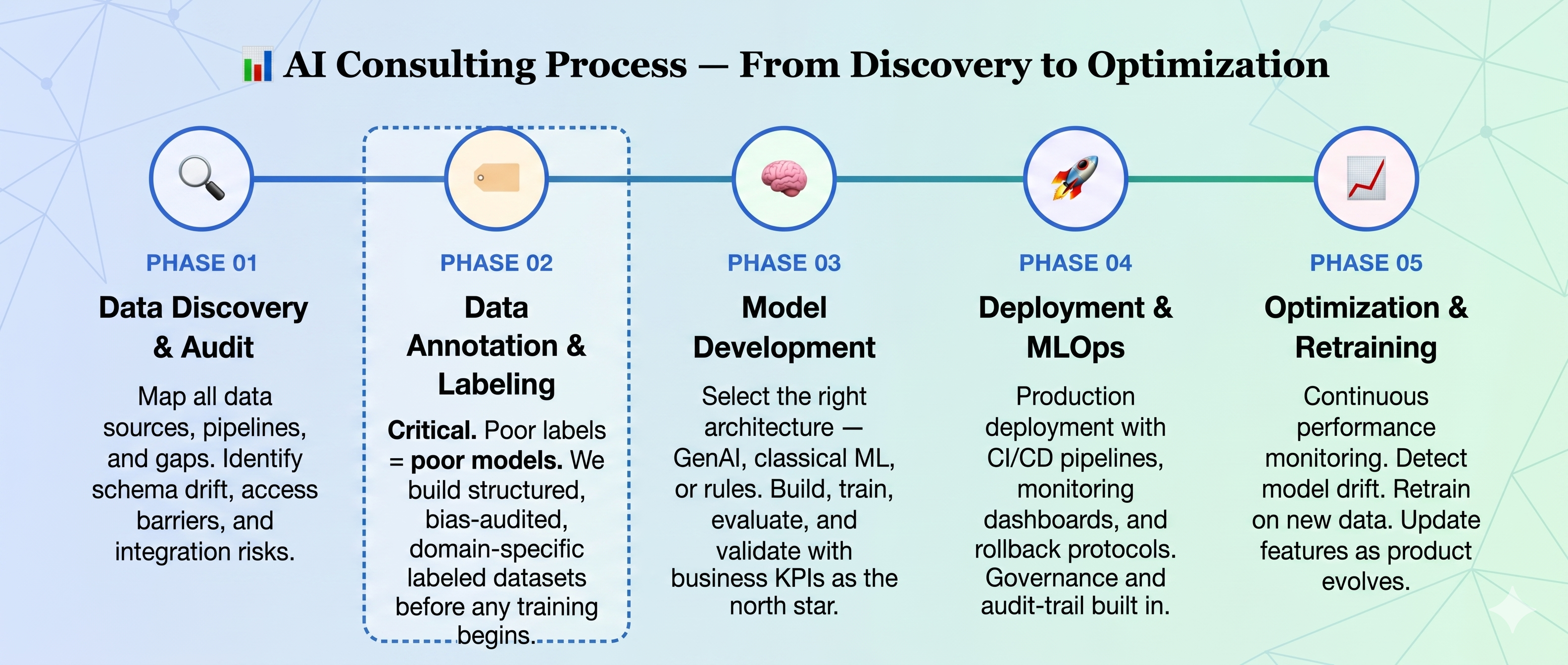
"The most common failure point is Phase 02. Companies skip structured data annotation to save cost upfront, then spend 3× more fixing model bias and accuracy issues post-deployment."
— Samta.ai Engineering Team
Want to see how this maps to your product? Our AI readiness assessment framework walks through each phase with self-scoring criteria. AI consulting frameworks
Get Your Free AI Assessment Report
Core Comparison / Explanation
Need | Requires AI Consulting | Can Be Handled Internally |
|---|---|---|
Building a real-time recommendation engine using behavioral signals | Yes – requires feature store setup, model training, and latency optimization | Only if ML engineers and data pipeline owners are available |
Enhancing CRM with AI-driven lead scoring | Yes – involves data enrichment, bias testing, and sales team feedback loops | No – exceeds typical IT scope |
Automating invoice processing with templates | No –RPA, not adaptive AI | Yes – within operations or low-code tooling reach |
Deploying a chatbot trained on proprietary documentation | Yes – needs NLP fine-tuning, grounding checks, and escalation logic | Rarely – without access to LLM ops tools |
Upgrading database indexing for faster queries | No –performance tuning | Yes – handled by DBAs |
Internal link: Explore specialized support via AI development services at Samta.ai and understand how organizations
scale with AI consulting in production environments.
Practical Use Cases
A B2B marketing SaaS platform used AI consulting to build a content generation module powered by domain-specific language models. The consultant ensured outputs aligned with brand voice and regulatory standards while minimizing hallucination risks.
A procurement software vendor engaged an ai workflow consultant to embed predictive contract renewal alerts. By analyzing historical negotiation patterns and usage metrics, the system improved retention forecasting accuracy by 41%.
A vertical SaaS provider in logistics worked with experts to automate freight audit disputes using computer vision and document parsing. The solution reduced manual review time by 70% and integrated seamlessly with existing billing APIs.
An HR tech firm leveraged AI consulting for enterprises to develop an inclusive job description generator. The model was audited for gendered language and calibrated against diversity benchmarks before rollout.
Related implementation insights available in identifying the best companies for AI partnerships.
Limitations & Risks
Engaging AI consultants does not eliminate execution risk. Projects fail when stakeholders provide ambiguous success criteria or withhold critical data assets.
Many organizations underestimate change management requirements. Even high-performing models are abandoned if end users do not understand their inputs or trust their outputs.
Data readiness for AI projects remains a top constraint. Inconsistent labeling, schema drift, or siloed access delay timelines and inflate budgets.
Third-party reliance introduces governance risks, particularly around IP ownership, model explainability, and audit trails.
Ethical concerns such as demographic bias or environmental impact (e.g., carbon cost of inference) may attract regulatory scrutiny post-launch, making AI consulting and compliance critical.
Long-term maintenance costs including monitoring, retraining, and version control—often exceed initial development investment.
Review responsible practices in scaling AI with governance.
Measure Your AI Model Risk Exposure
Decision Framework
Use AI consulting when:
You are developing AI-native features for a SaaS product, modernizing legacy platforms with intelligence, or responding to competitive threats requiring rapid prototyping. Ideal when your team lacks experience in MLOps, transformer architectures, or ethical AI frameworks.Also warranted when launching AI-driven pricing, churn prediction, or customer success automation at scale.
Do not use AI consulting when:
The problem can be solved with BI dashboards, static rules, or off-the-shelf tools. Avoid consultants for issues rooted in process inefficiency rather than analytical complexity.
Avoid engagement if leadership lacks commitment to data quality, cross-functional collaboration, or iterative delivery.
Early-stage startups should validate demand before investing in custom AI architecture.
For foundational guidance, read when do companies need AI consulting.
AI Consulting Use Cases: SaaS vs B2B Companies
The use cases that deliver fastest ROI differ significantly between SaaS product companies and B2B enterprises. Here is where AI consulting creates the most measurable value.
⚙️SaaS Companies
Churn prediction: Behavioral signals to surface at-risk accounts 30–60 days early
Product intelligence: Usage analytics → auto-generated recommendations and next-best-action prompts
Content generation: Domain-tuned LLMs for in-product AI writing, brand-voice-consistent outputs
Dynamic pricing: Real-time price optimization based on usage, segment, and competitive signals
Automated onboarding: AI-guided setup flows reducing time-to-value for new users
Support automation: NLP trained on product docs for tier-1 deflection at 70%+ accuracy
→ Explore AI consulting for SaaS in depth
🏢 B2B Enterprises
Sales intelligence: AI-powered lead scoring with intent signals and firmographic data enrichment
Contract analytics: Computer vision + NLP for automated contract review and renewal alerts
Supply chain optimization: Predictive models for inventory, freight, and vendor risk
Operations automation: Intelligent invoice processing, dispute resolution, audit matching
Risk scoring: Real-time credit and compliance risk models for BFSI and regulated sectors
HR & talent: Bias-audited job description generation and inclusive candidate ranking
→ See AI consulting outcomes in BFSI
AI Consulting for B2B Companies vs. Building an In-House Team
This is the most consequential decision in your AI journey. Neither answer is universally correct. Here is an honest comparison.
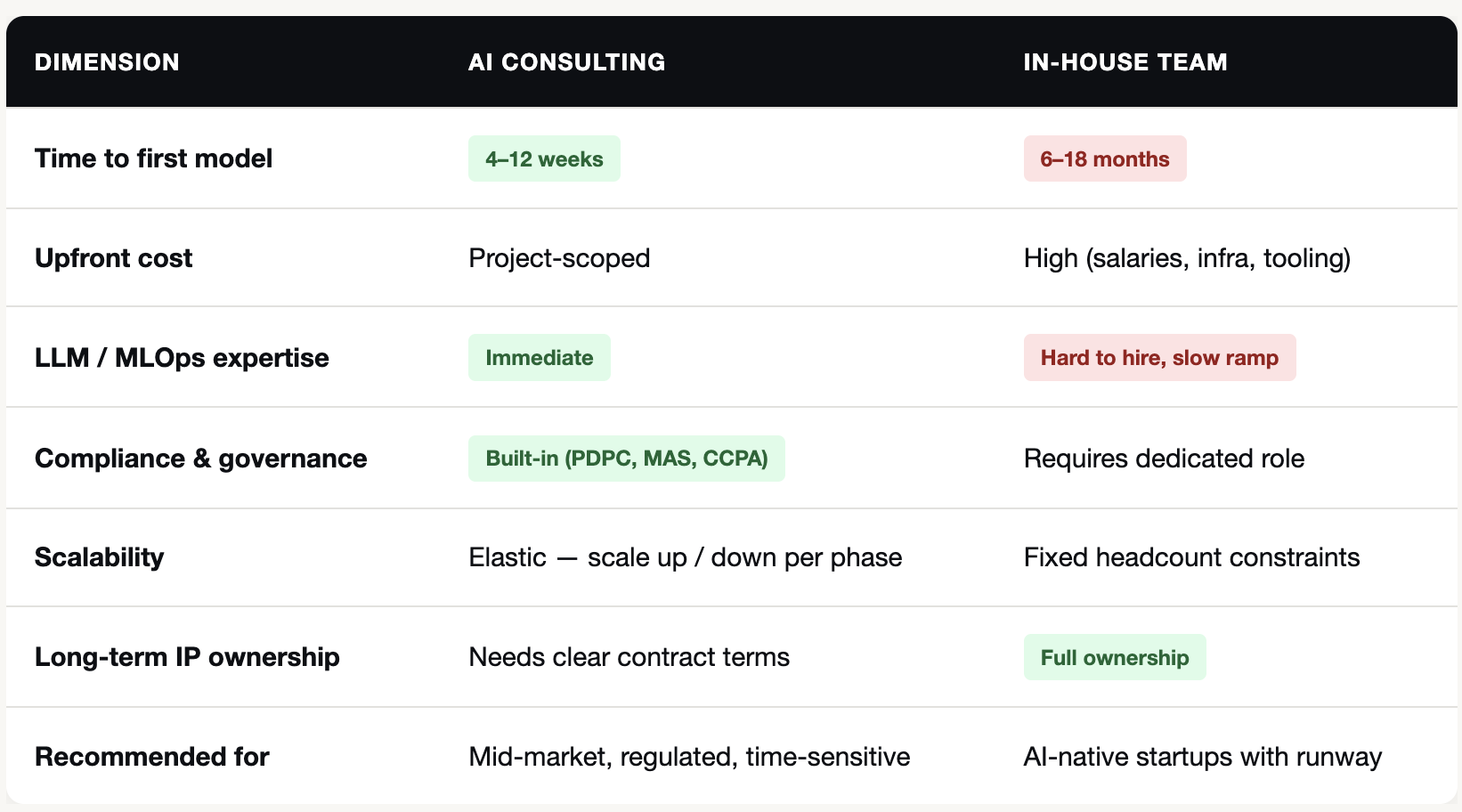
A hybrid model — consultants for discovery, architecture, and first deployment; internal team for ongoing optimization is the pattern we see succeed most consistently in mid-market SaaS and B2B.
Read our full breakdown: AI Consultant vs. In-House AI Team: Which Is Right for You?
Generative AI for Consulting: Beyond the Hype
Generative AI for consulting is not a trend , it is reshaping how both consulting firms and their clients operate. But most implementations fail because they chase novelty instead of targeting genuine bottlenecks. Here are the applications of generative AI for consulting that deliver measurable business value for SaaS and B2B companies in 2026.
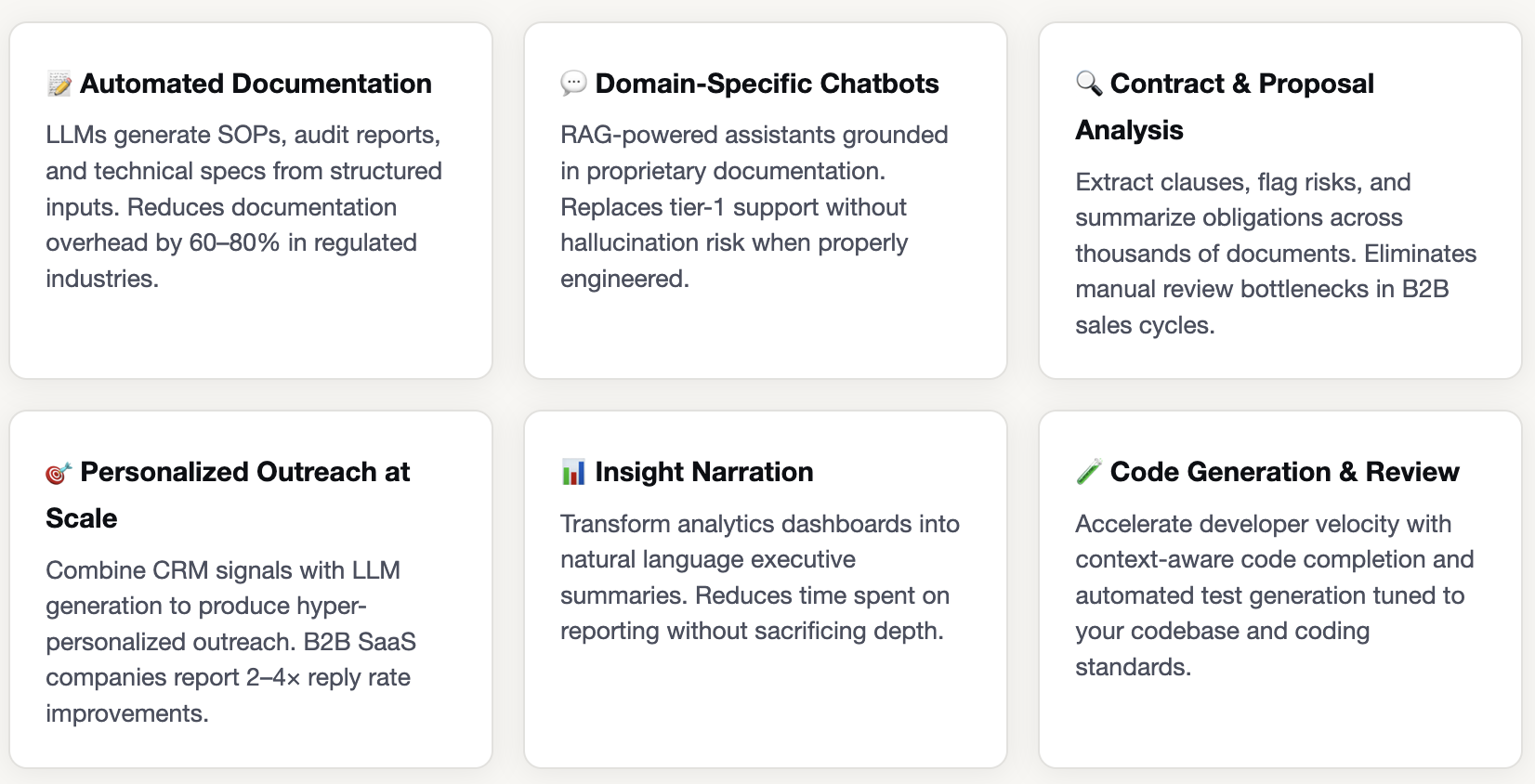
Read more: AI governance for generative AI deployments and AI consulting and compliance requirements by sector.
Section A: How US Enterprises Approach AI Consulting
US enterprises approach AI consulting with a strong focus on ROI, scalability, and competitive differentiation. Decision-making typically involves CTOs, Heads of AI, and product leaders who prioritize production deployment over experimentation. Consulting engagements often begin with use-case prioritization tied to revenue (e.g., churn prediction, pricing optimization), followed by MLOps architecture and integration with existing SaaS systems. Compliance is less centralized than in Singapore, but enterprises must still address data privacy (CCPA) and model explainability, especially in BFSI and healthcare. The key expectation: AI systems must move from pilot to production within defined timelines and deliver measurable business impact.
Section B: How Singapore Companies Handle AI Consulting
Singapore-based companies take a governance-first approach to AI consulting, influenced by regulatory frameworks such as PDPC and Monetary Authority of Singapore (MAS) guidelines. AI adoption is closely tied to risk management, auditability, and ethical deployment. Enterprises typically involve compliance teams early in the consulting process, ensuring that data handling, model decisions, and automation workflows meet regulatory standards. Compared to the US, there is a stronger emphasis on explainable AI and documentation. As a result, AI consulting engagements in Singapore often include governance architecture, audit trails, and compliance-by-design systems alongside core model development.
Explore the Right AI Strategy for Your Business
Conclusion
Determining AI consulting for SaaS and B2B companies hinges on product strategy, technical maturity, and market expectations. While not every enhancement requires artificial intelligence, misjudging the threshold results in missed opportunities or wasted capital. Successful adoption balances ambition with realism leveraging external expertise to accelerate innovation while building internal capacity. As AI becomes integral to software value propositions, the decision to consult should be strategic, not reactive. For trusted guidance, firms like Samta.ai offer proven methodologies in AI workflow design and scalable implementation.
Explore real-world outcomes in our case studies or begin scoping your initiative through consulting strategy services.
About Samta
Samta.ai is a Singapore headquartered AI product engineering and data intelligence partner helping enterprises build production grade AI systems for regulated and data intensive environments. We help organizations move beyond experimentation by engineering scalable, explainable, and enterprise ready AI solutions, from data foundations and model development to workflow automation and deployment.
Our capabilities combine deep AI expertise, data engineering, and product engineering to deliver measurable business impact across FinTech, BFSI, cybersecurity, regulatory technology, and enterprise operations.
Our enterprise AI products power real world intelligence systems:
TATVA: AI driven data intelligence platform for governed analytics, monitoring, and operational insights
VEDA: Explainable and audit ready AI decisioning engine built for compliance sensitive enterprise workflows
CORA Property Management Solutions: Predictive intelligence platform for real estate pricing, portfolio optimization, and investment analytics
Backed by ecosystem partnerships with Microsoft, Databricks, and Snowflake, Samta.ai delivers agile, cost efficient AI engineering with faster turnaround and enterprise grade scalability. Samta.ai embeds AI governance, data privacy, and compliance by design principles directly into the AI lifecycle, enabling organizations to scale AI with transparency, accountability, and operational control.
FAQs
Why do SaaS companies need AI consulting instead of hiring full-time staff?
AI consulting provides immediate access to niche skills like LLM fine-tuning or vector database optimization without long-term hiring costs. It enables fast validation before scaling internal teams.What are signs your company needs AI consulting?
Recurrent model failures, inability to deploy to production, lack of clear AI roadmap, or inconsistent stakeholder alignment signal a need for expert intervention.How does AI consulting for B2B companies differ from general IT advisory?
It focuses on adaptive systems, uncertainty quantification, and continuous learning pipelines—not just uptime or security. Success depends on outcome modeling, not infrastructure alone.Can small B2B firms benefit from AI consulting for enterprises?
Yes, if they operate in data-rich domains or serve clients demanding intelligent automation. Consultants tailor engagements to budget, timeline, and growth stage.What deliverables should be expected from AI consulting engagements?
Prioritized use cases, technical feasibility reports, prototype models, deployment architecture, and operational playbooks for monitoring and updates.Is enterprise AI adoption possible without external consultants?
Possible only with experienced data scientists, ML engineers, and product managers focused on AI lifecycle management. Most mid-market firms require interim support.