
Summarize this post with AI
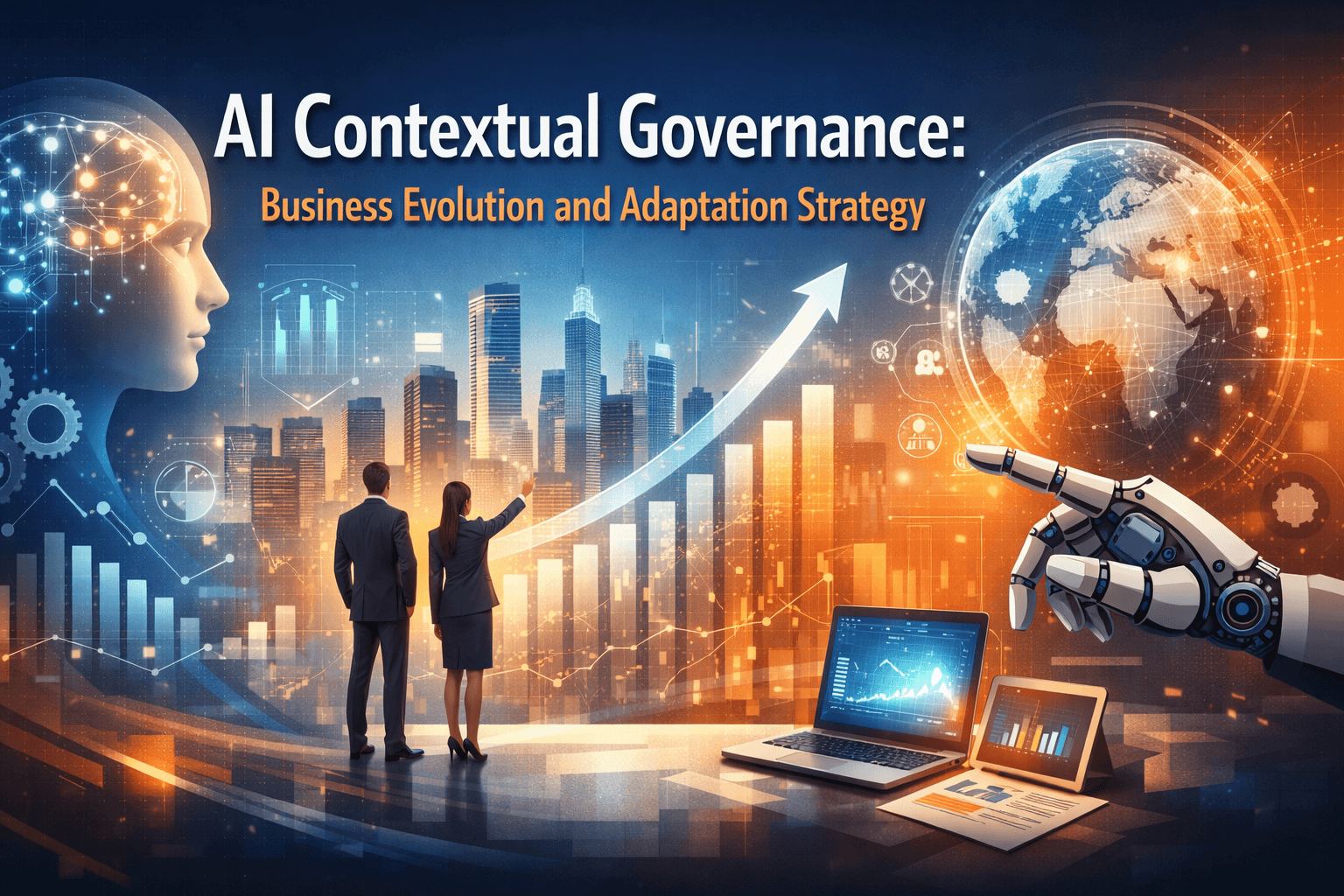
Implementing an ai contextual governance business evolution adaptation strategy is the definitive requirement for modern operational stability. As markets shift rapidly, relying on a rigid AI governance framework introduces severe vulnerabilities, making dynamic realignment essential for long-term viability. Organizations must actively engineer systems that prioritize ai governance contextual accuracy to ensure autonomous agents make decisions grounded in current corporate reality. This approach transitions basic compliance into a high-performance steering mechanism for digital growth. By embedding business-specific learning capabilities directly into the oversight architecture, enterprise leaders can effectively prevent model drift. This guarantees that non-deterministic outputs strictly adhere to verified institutional facts, securing intellectual property while accelerating intelligent automation across complex, globally distributed production environments.
Key Takeaways
Dynamic Alignment – Continuous oversight keeps AI systems aligned with evolving business operations and prevents data drift.
Structural Oversight – Compliance and governance layers integrate directly into machine learning architecture.
Risk Mitigation – Autonomous decisions remain grounded in verified institutional data.
Accountability Metrics – Deterministic guardrails ensure measurable AI model accountability across enterprise AI systems.
What This Means for Enterprises in 2026
Operational resilience in 2026 is defined by active governance rather than static oversight. Achieving true ai contextual governance business evolution adaptation requires organizations to continuously recalibrate AI decision boundaries as operational realities change.
This means autonomous systems must incorporate feedback from real-time business signals such as regulatory updates, operational policies, and organizational knowledge bases.
Organizations evaluating their readiness should benchmark their capabilities using established AI governance maturity models. Understanding maturity stages highlights the limitations of static policies and reinforces why enterprises must rethink AI governance vs traditional governance strategies for production-grade AI deployments.
For enterprises deploying generative AI, contextual governance becomes even more critical. Modern AI initiatives increasingly rely on specialized governance approaches designed for generative systems, as explained in this guide on AI governance for GenAI.
Find Out How AI-Ready Your Business Is
Core Comparison: Contextual Governance vs Static Oversight
Oversight Solution | Platform Focus | Adaptability Speed | Risk Mitigation Level | Ideal Implementation |
|---|---|---|---|---|
Contextual Governance Layer | Real-time enterprise context validation | Real-Time Recursive | Active Guardrails | AI-driven regulated operations |
Enterprise Governance Architecture | End-to-End oversight and monitoring | High / Continuous | Proactive Risk Controls | Enterprise-scale AI deployments |
Standard IT Audits | Policy documentation and compliance checks | Low / Annual | Reactive Alerts | Legacy operational governance |
Rule-Based SaaS Governance | Fixed thresholds and alert systems | Moderate | Deterministic Limits | Simple workflow automation |
Static governance often relies on infrequent audits or policy reviews. Contextual governance instead implements continuous verification systems that adapt as enterprise environments evolve.
Practical Use Cases of Contextual AI Governance
1. Financial Liquidity Management
Financial institutions deploy a contextual ai decision framework to ensure automated trading agents respond correctly to macroeconomic changes without breaching internal risk policies.
By continuously validating model outputs against organizational constraints, institutions prevent automated trading systems from making decisions based purely on probabilistic outputs.
2. Clinical Trial Data Verification
Healthcare organizations implement advanced governance architectures supported by AI governance learning loops to validate diagnostic models against evolving clinical protocols and hospital-specific guidelines.
These feedback loops continuously retrain or constrain AI outputs to ensure clinical decisions remain aligned with medical regulations and institutional standards.
3. Supply Chain Orchestration
Global logistics companies deploy contextual governance systems to manage procurement agents and inventory forecasting models.
By combining operational signals with governance checkpoints, procurement agents dynamically adjust purchasing decisions based on real-time shipping delays, port congestion, or inventory disruptions.
4. Legal Compliance Automation
Law firms implementing generative AI contract drafting must enforce strict oversight mechanisms. Reviewing governance practices from an AI governance case study helps firms understand how contextual validation ensures generated legal documents align with jurisdictional standards and firm-specific policies.
5. Manufacturing Systems Optimization
Industrial organizations deploy contextual oversight mechanisms to continuously refine AI-driven production models.
These systems implement continuous improvement in AI processes to update safety parameters and operational thresholds as production environments change. See how organizations implement this through continuous improvement in AI.
Limitations and Risks
Despite its advantages, contextual governance introduces several technical challenges.
Infrastructure Strain
Real-time contextual validation requires high-performance infrastructure capable of processing continuous governance checks without introducing latency.
Integration Complexity
Embedding contextual oversight layers into legacy systems requires advanced engineering expertise and cross-functional coordination between data, compliance, and infrastructure teams.
Data Dependency
The effectiveness of contextual governance depends heavily on the reliability and accuracy of enterprise data feeding governance models.
According to the NIST AI Risk Management Framework, governance systems must incorporate continuous monitoring and accountability mechanisms to mitigate AI-related risks in production environments.
Get Clarity on Your AI Model Risk
Decision Framework
When to Accelerate Deployment
Organizations should prioritize contextual governance implementation if:
They are deploying generative AI systems handling proprietary customer data or intellectual property.
Autonomous systems perform high-stakes decisions where operational errors could lead to financial or regulatory consequences.
Enterprise operations require strong AI governance lifecycle management across model deployment and monitoring stages.
For organizations building governance architecture from scratch, implementing an AI governance framework for enterprise systems provides a strong foundation.
When Implementation Can Be Delayed
Deployment may be postponed if:
AI usage is limited to isolated administrative tasks.
Systems do not interact with real-time operational environments or sensitive enterprise data.
Governance complexity would outweigh operational benefits.
Conclusion
Securing digital operations relies entirely on mastering ai contextual governance business evolution adaptation. Enterprises that fail to ground their autonomous systems in verified organizational reality expose themselves to unprecedented regulatory and financial risks. Transitioning from theoretical policy to rigorous, engineering-led oversight enables B2B leaders to harness automation safely. Integrating adaptive machine learning capabilities guarantees that your systems evolve simultaneously with your institutional goals. By partnering with samta, organizations access the specialized technical depth required to embed this truth directly into their architecture. Executing this strategy via samta.ai ensures your enterprise maintains complete command over its intelligent infrastructure.
About Samta
Samta.ai is a Singapore headquartered AI product engineering and data intelligence partner helping enterprises build production grade AI systems for regulated and data intensive environments. We help organizations move beyond experimentation by engineering scalable, explainable, and enterprise ready AI solutions, from data foundations and model development to workflow automation and deployment.
Our capabilities combine deep AI expertise, data engineering, and product engineering to deliver measurable business impact across FinTech, BFSI, cybersecurity, regulatory technology, and enterprise operations.
Our enterprise AI products power real world intelligence systems:
TATVA: AI driven data intelligence platform for governed analytics, monitoring, and operational insights
VEDA: Explainable and audit ready AI decisioning engine built for compliance sensitive enterprise workflows
CORA Property Management Solutions: Predictive intelligence platform for real estate pricing, portfolio optimization, and investment analytics
Backed by ecosystem partnerships with Microsoft, Databricks, and Snowflake, Samta.ai delivers agile, cost efficient AI engineering with faster turnaround and enterprise grade scalability. Samta.ai embeds AI governance, data privacy, and compliance by design principles directly into the AI lifecycle, enabling organizations to scale AI with transparency, accountability, and operational control.
Get Personalized AI Consulting for Your Business
FAQs
What drives business evolution adaptation in AI systems?
Business evolution adaptation occurs because enterprise environments constantly change. Implementing AI governance lifecycle management ensures AI systems remain aligned with operational policies, business objectives, and compliance requirements as organizations scale.
Why is a contextual ai decision framework critical?
Without contextual constraints, generative AI systems rely solely on statistical probabilities. A contextual ai decision framework ensures models verify decisions against enterprise data sources and institutional policies before executing actions.
How does contextual governance improve AI model accountability?
Contextual governance introduces deterministic checkpoints that record each AI action. These checkpoints enable auditors to trace decision pathways, strengthening AI model accountability across enterprise systems.
How can organizations refine existing governance strategies?
Organizations should first analyze the operational context feeding their AI models. Strengthening contextual boundaries ensures models reference relevant organizational knowledge before producing outputs. A deeper look at AI governance business context explains how organizations embed institutional knowledge into governance systems.