
Summarize this post with AI
Most enterprises underfund AI engineering by 40–60% because they budget for the model and forget everything around it. AI engineering services cost in Singapore is not one number it is a composite of data infrastructure, model development, MLOps, governance, integration, and ongoing operations, each with its own cost logic and escalation risk. This guide gives CIOs, CTOs, and procurement leads in BFSI and regulated enterprise sectors a complete 2026 pricing breakdown what each layer costs, what the Singapore market benchmarks are, and how to structure an engagement that delivers value without budget overrun.
AI Engineering Services Cost Singapore:
AI engineering services cost in Singapore ranges from SGD 80,000 for a scoped AI readiness assessment to SGD 3.5M for a full production program covering data infrastructure, model development, governance embedding, and knowledge transfer. AI engineering pricing is determined by four variables: data readiness, model complexity, regulatory compliance requirements, and commercial model structure. For BFSI and regulated enterprise buyers in 2026, MAS TRM-aligned governance and compliance tooling adds 25–35% to base engineering cost and must be budgeted from line one not added as a change request after deployment.
What AI Engineering Services Actually Include: The Six Cost Layers
The cost to build an AI system is routinely underestimated because enterprise buyers scope only the model development layer. A production-ready AI engineering program in Singapore covers six distinct cost components:
Data infrastructure: ingestion pipelines, quality remediation, warehousing on Snowflake or Databricks, and data lineage tracking
Model development: feature engineering, training, validation, and performance benchmarking
MLOps and deployment: CI/CD pipelines, containerisation, API development, and cloud infrastructure on Azure, AWS, or GCP
Governance and compliance: model cards, audit trails, explainability reporting, drift monitoring, and MAS TRM or RBI alignment documentation
Integration: connecting AI outputs to core banking systems, ERP platforms, CRM tools, and decisioning engines
Knowledge transfer: internal team training, model documentation, and hypercare support post-handover
Firms that quote only model development cost are quoting 30–40% of the real program cost. This is precisely why 70% of AI projects fail not because the models do not work, but because the surrounding infrastructure was never budgeted or built.
Benchmark Your Organization's AI Readiness
Why AI Engineering Costs Are Rising in Singapore in 2026
Three structural forces are driving AI engineering pricing upward across Singapore and the wider APAC market:
1. Talent scarcity is a permanent condition, not a cycle
ML engineers and AI architects in Singapore command SGD 120,000–220,000 base salaries rising 15–20% annually since 2023 (Source Required: Korn Ferry APAC Talent Report). Senior MLOps engineers with Databricks or Snowflake certification are among the most constrained technical profiles in the region. AI firms in Singapore competing for the same talent pool are absorbing these increases directly into their engagement rates.
2. Governance requirements have expanded the engineering scope permanently
MAS Technology Risk Management guidelines, PDPA obligations, and the EU AI Act's extraterritorial reach mean every production AI model deployed by a Singapore-regulated entity now requires governance infrastructure that did not exist as a standard engineering deliverable three years ago. That layer adds 25–35% to base engineering cost and singapore companies using ai in regulated sectors cannot legally avoid it.
3. GenAI complexity is inflating compute and integration costs
Large language model deployments require prompt engineering maintenance, hallucination risk management infrastructure, and output auditing. Cost of implementing AI for GenAI use cases runs 1.5–2x higher than equivalent traditional ML when enterprise-grade safety controls are included. Understanding how to build an AI system that is production-ready not just technically functional is the difference between a demo and a deployment.
2026 AI Engineering Pricing Models: Four Commercial Structures
There are four commercial models for AI engineering services in Singapore. Each carries different cost, risk, and accountability profiles:
Model 1: Fixed-Scope SOW (Recommended for Enterprise Buyers)
A defined set of deliverables, timelines, and payment milestones agreed upfront. Cost is predictable and accountability is tied to production outcomes — not hours logged.
Best for: First production use case, BFSI regulated deployments, board-approved programs with defined timelines
Typical range: SGD 400,000–2.5M depending on scope and data readiness
Risk: Scope creep if data readiness is lower than assessed; require a formal data audit clause before signing any SOW
Model 2: Time and Materials (T&M)
Hourly or daily rates for engineering resources billed monthly against actuals. No outcome accountability built into the structure.
Best for: Exploratory AI R&D, rapidly evolving scope, short-term specialist augmentation
Typical daily rate: SGD 1,400–3,200 per day depending on seniority and specialisation
Risk: Budget exposure without ceiling; T&M engagements routinely run 40–80% over initial estimates (Source Required: Gartner IT Services Benchmark)
Model 3: Managed AI Services Retainer
A monthly retainer for ongoing model monitoring, retraining, performance reporting, and governance maintenance. Typically follows an initial build engagement.
Best for: Post-production model operations for organisations without internal MLOps capability
Typical range: SGD 15,000–60,000 per month depending on model complexity and SLA requirements
Risk: Long-term dependency if knowledge transfer was not completed during the build phase
Model 4: AI Platform Licensing Plus Services
A SaaS or enterprise platform licence combined with professional services for configuration and deployment. Common for organisations using pre-built AI decision platforms.
Best for: Use cases that map to existing platform capability — credit decisioning, fraud detection, demand forecasting
Typical range: SGD 80,000–400,000 annually for platform licence plus SGD 150,000–500,000 for implementation services
Risk: Platform lock-in if proprietary data pipelines are used; require data portability clauses in every contract
Samta.ai's digital transformation managed services operate on a fixed-SOW primary model with an optional managed services layer post-deployment providing cost predictability during build and operational continuity after handover, without creating permanent dependency.
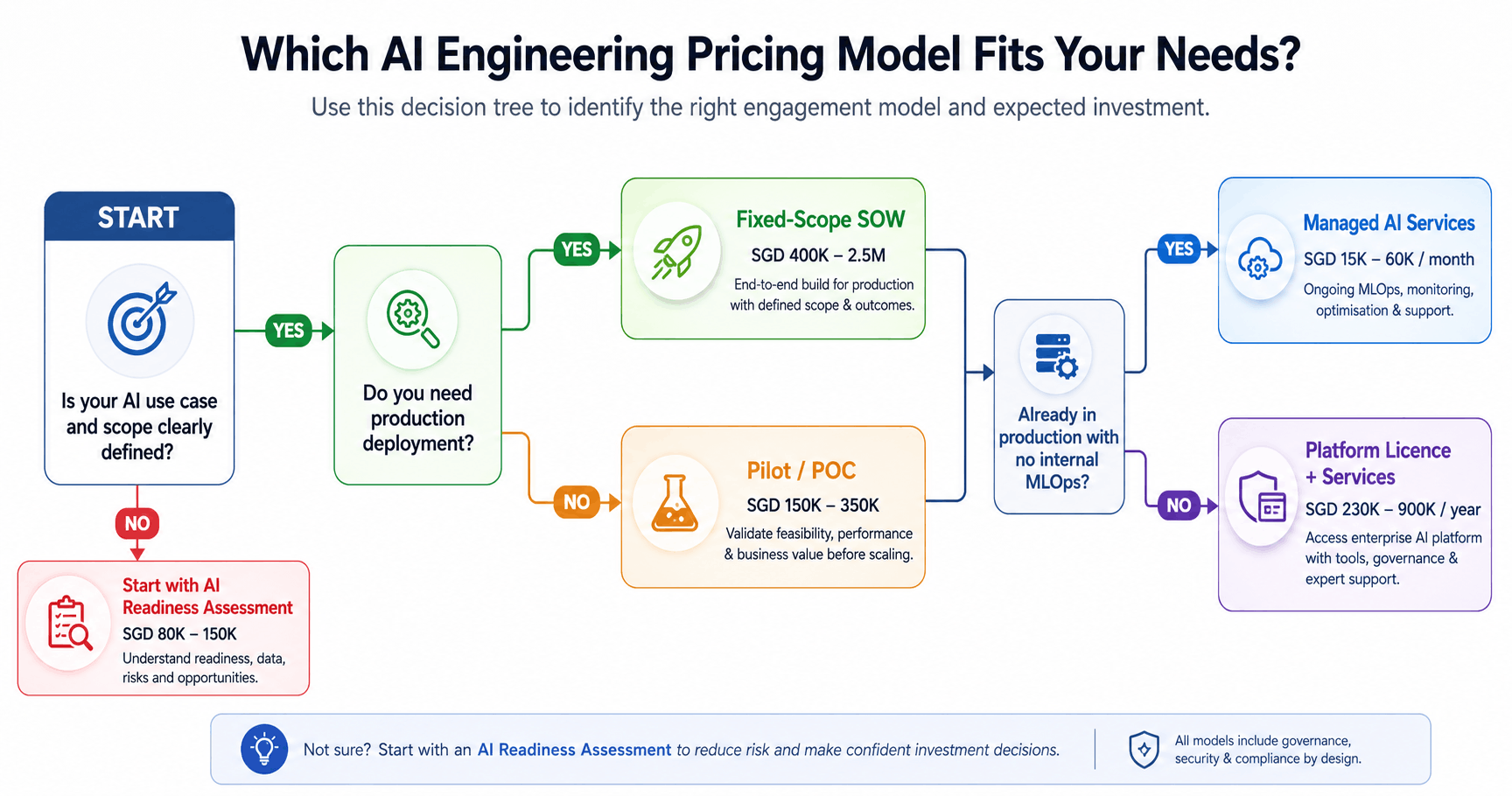
AI Engineering Services Cost Singapore: 5-Column Pricing Comparison
Engagement Type | Scope Covered | Typical SGD Range | Cost Predictability | Governance Included |
AI Readiness Assessment | Data audit, use case prioritisation, roadmap | SGD 80,000–150,000 | High — fixed deliverables | Framework only |
Pilot / Proof of Concept | Single use case, non-production | SGD 150,000–350,000 | Medium — scope evolves | Partial |
Full Production AI Program | Build, deploy, integrate, govern, transfer | SGD 800,000–2.5M | High — fixed SOW | Full MAS/RBI alignment |
GenAI Implementation | LLM deployment, RAG architecture, safety controls | SGD 400,000–1.8M | Medium — prompt engineering varies | Safety and audit layer |
Managed AI Operations | Monitoring, retraining, compliance reporting | SGD 15,000–60,000/month | High — SLA-backed retainer | Continuous drift monitoring |
See Where Your AI Models Need Stronger Controls
Real-World Cost Cases: What Enterprise AI Engineering Actually Delivered
Case 1: Credit Risk AI Deployment, Singapore Bank (BFSI)
A Singapore-licensed bank scoped an ML credit decisioning model to replace a rules-based credit scoring engine. The full engagement including Databricks data pipeline remediation, model development, MAS TRM governance documentation, and explainability tooling embedded via the VEDA AI Decision Analytics Platform came to SGD 1.85M on a fixed SOW with a 90-day hypercare period. The governance layer alone accounted for SGD 420,000 23% of total cost. That investment prevented an estimated SGD 1.2M in regulatory remediation costs that a peer institution incurred by deploying without embedded governance. AI engineering pricing for regulated BFSI use cases must treat governance as a core deliverable not an optional add-on. Structured data discovery for AI before model development reduced the data remediation component by approximately 30% in this engagement.
Case 2: Demand Forecasting AI, Regional Retailer (General Enterprise)
A regional retailer operating across Singapore, Malaysia, and Thailand deployed an AI demand forecasting model on a Snowflake data foundation. The fixed-SOW engagement was structured as follows: SGD 320,000 for data infrastructure, SGD 480,000 for model development and MLOps, SGD 95,000 for ERP integration, and SGD 55,000 for internal team training and handover documentation. Total: SGD 950,000. Year 1 inventory cost reduction: SGD 3.1M a 3.3x return before model improvements compounded in Year 2. Knowing how to measure AI outcomes from Month 1 of production allowed the retail team to demonstrate ROI to the board within the first quarter of deployment, securing Year 2 investment approval ahead of schedule. This outcome was enabled by following a structured AI consulting framework for SaaS and enterprise that sequences data, model, governance, and integration costs in the correct order rather than front-loading model development on unready data infrastructure.
Key Cost Risks That Blow AI Engineering Budgets in Singapore
Data readiness overestimation: the single most common budget breaker; data remediation routinely runs 2–3x initial estimates when organisations self-assess readiness without a formal audit; always require an independent data readiness score before committing to a build budget
Governance scope exclusion: budgets that exclude model cards, audit trails, and explainability tooling face mandatory cost addition when regulators or internal risk teams review deployment plans; the retrofitting premium is 2.5–4x the cost of embedding during build (Source Required: Deloitte AI Risk Report)
Compute cost underestimation: GenAI API costs scale with usage in ways that are difficult to model pre-deployment; build usage caps and automated cost alerts into the architecture from the start
Integration underscoping: connecting AI outputs to core banking systems, ERP, and CRM is consistently underestimated; budget 15–25% of total model development cost for integration as a baseline
Knowledge transfer omission: engagements without structured handover create permanent managed services dependency at SGD 15,000–60,000 per month; require knowledge transfer as a contractual deliverable, not a verbal commitment
Avoiding these failures requires structuring the engagement scope correctly from day one. Reviewing top product engineering practices for AI programs consistently shows that scope discipline during contracting is the strongest predictor of on-budget delivery.
Budget Decision Framework: How to Scope Your AI Engineering Investment
Scope a full production program (SGD 800K–2.5M) when:
A specific use case has been validated with a clear ROI hypothesis tied to a P&L line
Data readiness is 65% or above on a formal third-party assessment
Board approval for a 12–18 month investment horizon is in place
Regulatory obligations for the target use case have been fully mapped
Start with an AI readiness assessment (SGD 80K–150K) when:
No formal data quality audit has been completed internally or externally
Multiple use cases are under consideration and prioritisation is needed before budget commitment
The board requires a scoped cost estimate before approving a full program
It is unclear whether internal AI capability or a consulting partner is the right delivery model
Use managed AI services (SGD 15K–60K/month) when:
A production model is already deployed but internal MLOps capability does not exist
Ongoing MAS or RBI reporting requires continuous model monitoring and compliance documentation
The organisation wants AI operations continuity without committing to a permanent internal team
Get Practical Advice for Building Scalable AI Systems
Conclusion
AI engineering services cost in Singapore is not a single line in a budget — it is a six-layer investment that must be scoped correctly from the first board conversation. Data infrastructure, model development, governance embedding, integration, and knowledge transfer each carry distinct cost drivers that multiply when underestimated and multiply further when retrofitted under regulatory pressure.
The enterprises achieving the best AI engineering pricing outcomes in Singapore are those that scope fully, select fixed-SOW commercial structures, budget governance from day one, and measure ROI from the first 90 days in production. Cost without accountability is expenditure. Scoped, governed AI engineering is investment. Explore Samta.ai's AI consulting services to see how structured engagements are designed to deliver both.
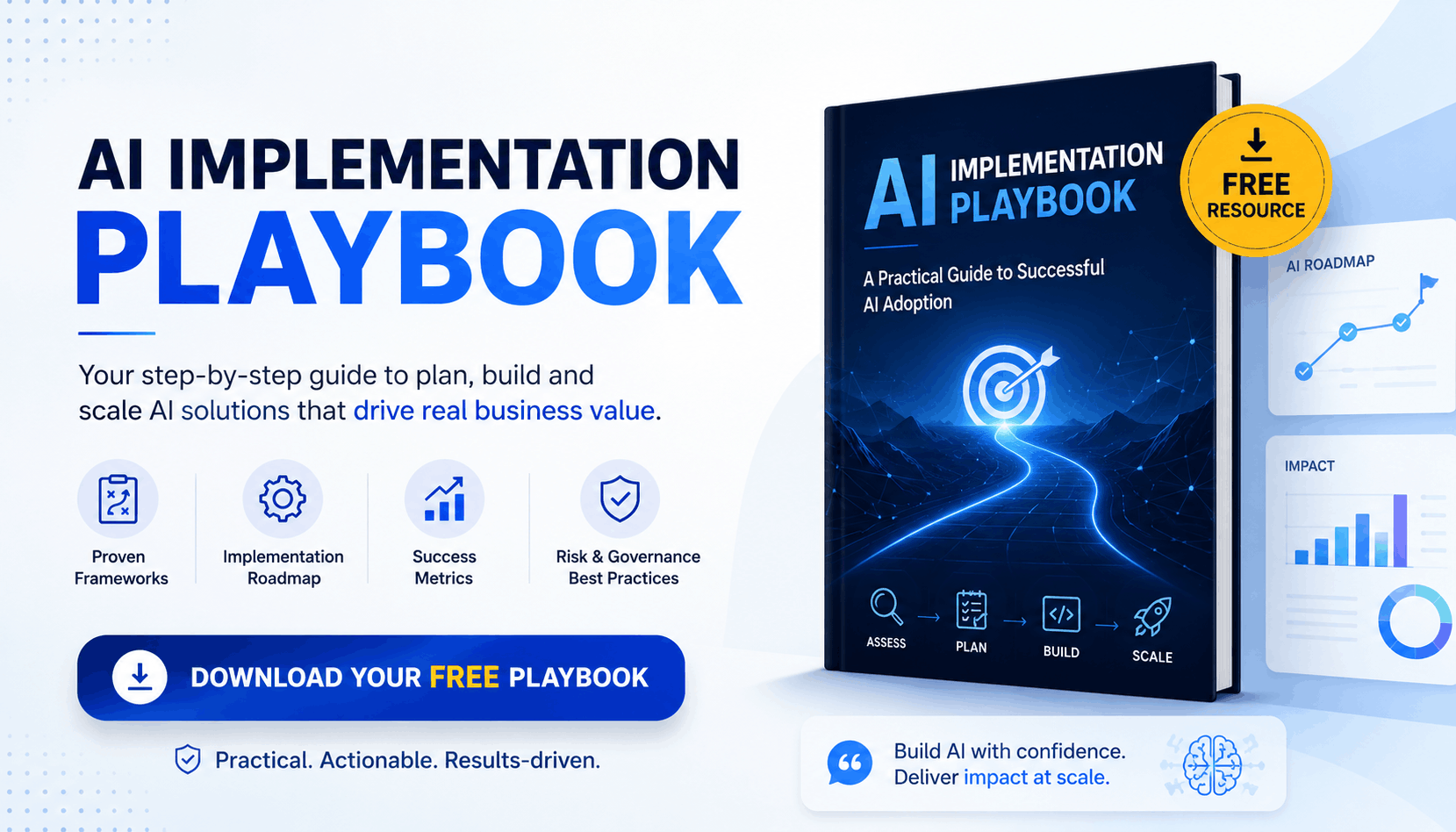
AI Implementation Playbook Get the complete enterprise AI budget framework including cost layer breakdowns, SOW templates, and governance budget calculators. Download free →
About Samta
Samta.ai is a Singapore-headquartered AI Product Engineering & Data Intelligence partner helping enterprises build production-grade AI systems for regulated and data-intensive environments.We help organizations move beyond experimentation by engineering scalable, explainable, and enterprise-ready AI solutions from data foundations and model development to workflow automation and deployment.
Our capabilities combine deep AI expertise, data engineering, and product engineering to deliver measurable business impact across FinTech, BFSI, cybersecurity, regulatory technology, and enterprise operations.
Our enterprise AI products power real-world intelligence systems:
• TATVA : AI-driven data intelligence platform for governed analytics, monitoring, and operational insights
• VEDA : Explainable and audit-ready AI decisioning engine built for compliance-sensitive enterprise workflows
• CORA-Property Management Solutions: : Predictive intelligence platform for real-estate pricing, portfolio optimization, and investment analytics
Backed by ecosystem partnerships with Microsoft, Databricks, Snowflake, and AWS, Samta.ai delivers agile, cost-efficient AI engineering with faster turnaround and enterprise-grade scalability. Trusted by enterprises across FinTech, BFSI, and digital transformation initiatives, Samta.ai embeds AI governance, data privacy, and compliance-by-design principles directly into the AI lifecycle , enabling organizations to scale AI with transparency, accountability, and operational control.
Enterprises leveraging Samta.ai automate 65%+ of repetitive data, analytics, and decision workflows while maintaining governance, explainability, and measurable business outcomes. Samta.ai provides the strategic consulting, AI engineering, and data modernization expertise needed to align enterprise operations with next-generation AI transformation goals.
Frequently Asked Questions
What is the typical AI engineering services cost in Singapore in 2026?
AI engineering services cost in Singapore ranges from SGD 80,000 for a scoped readiness assessment to SGD 2.5M or more for a full production program including data infrastructure, model development, governance embedding, and integration. The most common first-engagement range for mid-to-large BFSI and enterprise organisations is SGD 400,000–1.2M on a fixed-SOW basis. GenAI implementations add 1.5–2x cost versus equivalent traditional ML due to safety controls and output auditing requirements.
What drives the cost to build an AI system in Singapore?
The four primary cost to build an AI system drivers are: data readiness lower readiness means higher remediation cost before any model development begins; model complexity GenAI and deep learning models cost more than gradient boosting or rules-based systems; regulatory requirements MAS TRM and PDPA compliance adds 25–35% to base engineering cost in Singapore; and commercial model fixed SOW is more cost-predictable than T&M, which routinely overshoots initial estimates by 40–80%.
How do I know if AI engineering costs in a proposal are fair market value?
Benchmark against three parameters: daily rate for senior ML engineers in Singapore (SGD 1,400–3,200 per day); governance and compliance as a percentage of total cost (25–35% for regulated BFSI use cases); and total cost against the ROI hypothesis if cost exceeds 30% of Year 1 projected value, the use case scope needs review. Always require an itemised cost breakdown by layer data, model, MLOps, governance, integration, knowledge transfer before accepting any proposal.
How much does AI governance add to engineering cost in Singapore?
For BFSI and regulated sectors, AI governance infrastructure adds 25–35% to base model development cost. This covers model cards, audit trail infrastructure, explainability dashboards, drift monitoring, and MAS TRM alignment documentation. The alternative retrofitting governance post-deployment costs 2.5–4x more than embedding it during build. For singapore companies using ai in regulated sectors, this is not optional: MAS examination frameworks now include AI governance as a standard review component.
What is the ongoing cost of operating a production AI model in Singapore?
Managed AI operations for a single production model in Singapore typically run SGD 15,000–35,000 per month for a standard ML model and SGD 30,000–60,000 per month for a GenAI model requiring prompt engineering maintenance and output auditing. These costs cover drift monitoring, retraining cycles, performance reporting, compliance documentation, and SLA-backed incident response. Organisations that complete structured knowledge transfer during the build phase typically reduce managed services dependency by 40–60%.