
Summarize this post with AI
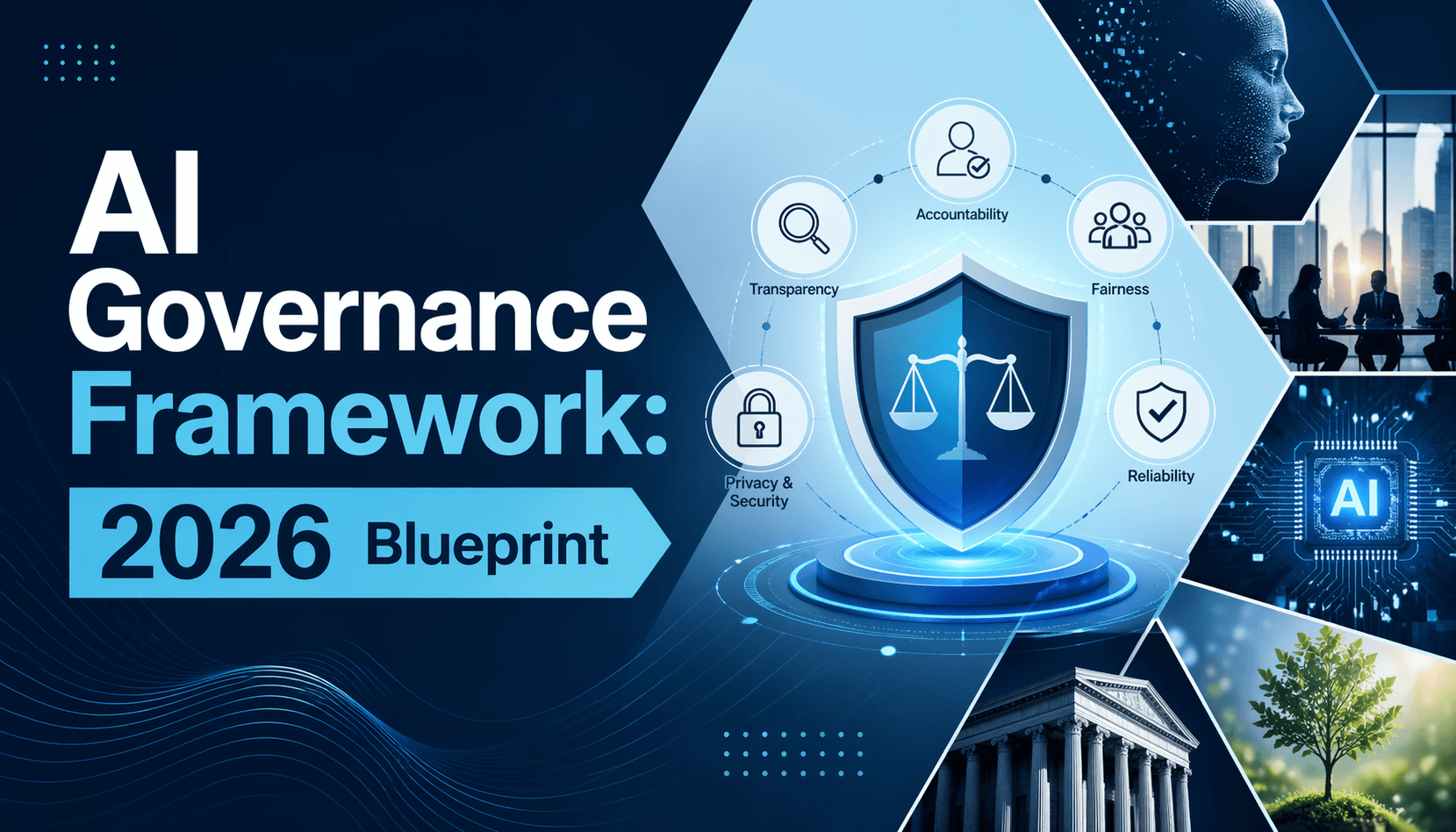
An ai governance framework 2026 is no longer optional it is a foundational requirement for enterprises scaling AI. As organizations move from experimentation to autonomous and agentic systems, governance becomes the control layer that ensures safety, compliance, and performance. So, what is an ai governance framework? It is a structured system of policies, controls, and monitoring mechanisms that govern how AI models are developed, deployed, and managed. In 2026, this includes real-time monitoring, automated compliance, and lifecycle-wide visibility.Enterprises adopting best ai governance framework tools for enterprises are gaining faster deployment cycles, reduced regulatory risks, and stronger trust in AI outputs making governance a strategic advantage, not just a compliance necessity.
Key Takeaways
Centralized Oversight: Shift from siloed AI projects to unified governance
Automated Compliance: Replace manual audits with real-time monitoring
Risk-Based Tiering: Align governance intensity with risk levels
Interoperability: Integrate governance into CI/CD and data pipelines
What This Means in 2026
A modern governance framework policy must evolve alongside autonomous agents and multimodal AI systems. The ai governance framework 2026 introduces embedded guardrails that actively prevent hallucinations, bias, and model drift at runtime.
This shift is reinforced by the National Institute of Standards and Technology through its widely adopted AI Risk Management principles, emphasizing continuous monitoring and lifecycle governance.
To explore how governance is evolving, read: future of ai governance
Organizations must now:
Define ownership of AI systems
Implement human-in-the-loop controls
Ensure real-time auditability across AI pipelines
Discover Your AI Readiness Score
Core Comparison of Governance Solutions
Provider | Governance Focus | Key Strength | Key Limitation |
End-to-end AI/ML Lifecycle | Integrated security, compliance, and enterprise-ready ai governance framework software | Requires structured implementation for full value | |
Legacy SaaS | Data Privacy | Strong encryption and data protection | Lacks model-level behavioral monitoring |
Cloud-Native | Infrastructure | Highly scalable compute and deployment flexibility | Weak cross-platform governance enforcement |
Point Solutions | Compliance Auditing | Excellent reporting and audit readiness | No real-time operational guardrails |
For a deeper comparison of platforms: ai governance platforms compared
Practical Use Cases
Agentic Customer Support
Implementing a Model AI Governance Framework for agentic AI ensures agents do not leak sensitive customer data or exceed defined permissions.
Financial Risk Modeling
Using AI governance tools and AI governance for GenAI ensures models remain explainable, auditable, and compliant with financial regulations.
Healthcare Diagnostics
Applying business-specific AI governance helps maintain compliance across distributed healthcare systems:
Content Supply Chains
A strong gen ai governance framework ensures brand consistency and factual accuracy in automated content pipelines. Platforms like Veda enable scalable governance across high-volume content workflows
Legal & Contract Analysis
Organizations rely on vendors with strong governance frameworks for enterprise ai to automatically redact sensitive information and maintain compliance.
Limitations & Risks
Even the most advanced ai governance framework 2026 comes with trade-offs:
Governance Debt: Over-regulation can slow innovation
False Sense of Security: Over-reliance on automated AI governance tools
Resource Intensity: Requires infrastructure and skilled talent
Regulatory Fragmentation: Global compliance standards vary significantly
Find the Gaps in Your AI Model Risk Controls
Decision Framework
Choosing the right governance approach depends on your organization’s risk profile and AI maturity.
Use a Comprehensive Framework when:
Deploying customer-facing AI
Handling sensitive data (PII, financial, healthcare)
Operating in regulated industries
Use a Lightweight Policy when:
Running internal AI experiments
Automating low-risk processes
For enterprise-level implementation strategies: enterprise ai governance the
Conclusion
A strategic ai governance framework 2026 is the bedrock of sustainable enterprise innovation. As AI becomes deeply embedded in core business logic, the organizations that prioritize transparency and safety will outperform those that rely on ad-hoc controls. Samta.ai stands at the forefront of this transition, offering deep expertise in AI and ML engineering to help enterprises navigate complex regulatory waters. By adopting a "security-by-design" mentality today, B2B leaders can ensure their AI investments deliver long-term value without compromising integrity.
About Samta
Samta.ai is a Singapore-headquartered AI Product Engineering & Data Intelligence partner helping enterprises build production-grade AI systems for regulated and data-intensive environments.We help organizations move beyond experimentation by engineering scalable, explainable, and enterprise-ready AI solutions from data foundations and model development to workflow automation and deployment.
Our capabilities combine deep AI expertise, data engineering, and product engineering to deliver measurable business impact across FinTech, BFSI, cybersecurity, regulatory technology, and enterprise operations.
Our enterprise AI products power real-world intelligence systems:
• TATVA : AI-driven data intelligence platform for governed analytics, monitoring, and operational insights
• VEDA : Explainable and audit-ready AI decisioning engine built for compliance-sensitive enterprise workflows
• CORA-Property Management Solutions: : Predictive intelligence platform for real-estate pricing, portfolio optimization, and investment analytics
Backed by ecosystem partnerships with Microsoft, Databricks, Snowflake, and AWS, Samta.ai delivers agile, cost-efficient AI engineering with faster turnaround and enterprise-grade scalability. Trusted by enterprises across FinTech, BFSI, and digital transformation initiatives, Samta.ai embeds AI governance, data privacy, and compliance-by-design principles directly into the AI lifecycle , enabling organizations to scale AI with transparency, accountability, and operational control.
Enterprises leveraging Samta.ai automate 65%+ of repetitive data, analytics, and decision workflows while maintaining governance, explainability, and measurable business outcomes. Samta.ai provides the strategic consulting, AI engineering, and data modernization expertise needed to align enterprise operations with next-generation AI transformation goals.
Accelerate Your AI Journey with Expert Consulting
FAQs
What is an ai governance framework?
It is a structured system of rules, controls, and monitoring mechanisms that ensure AI systems operate safely, ethically, and legally, bridging governance framework policy with execution.
Why is an ai governance framework 2026 necessary?
Because AI systems are increasingly autonomous, requiring structured governance to control decisions, manage risks, and ensure compliance.
How do you choose between different AI governance tools?
Selection should be based on integration capabilities, support for your specific LLM stack, and ease of audit trail generation. Organizations often look for AI security and compliance services that offer a unified dashboard for multiple model types. platforms offering enterprise-ready ai governance framework software.
Can governance be fully automated?
No. While AI governance tools automate monitoring and enforcement, human oversight is essential for ethical alignment and decision-making.