
Summarize this post with AI
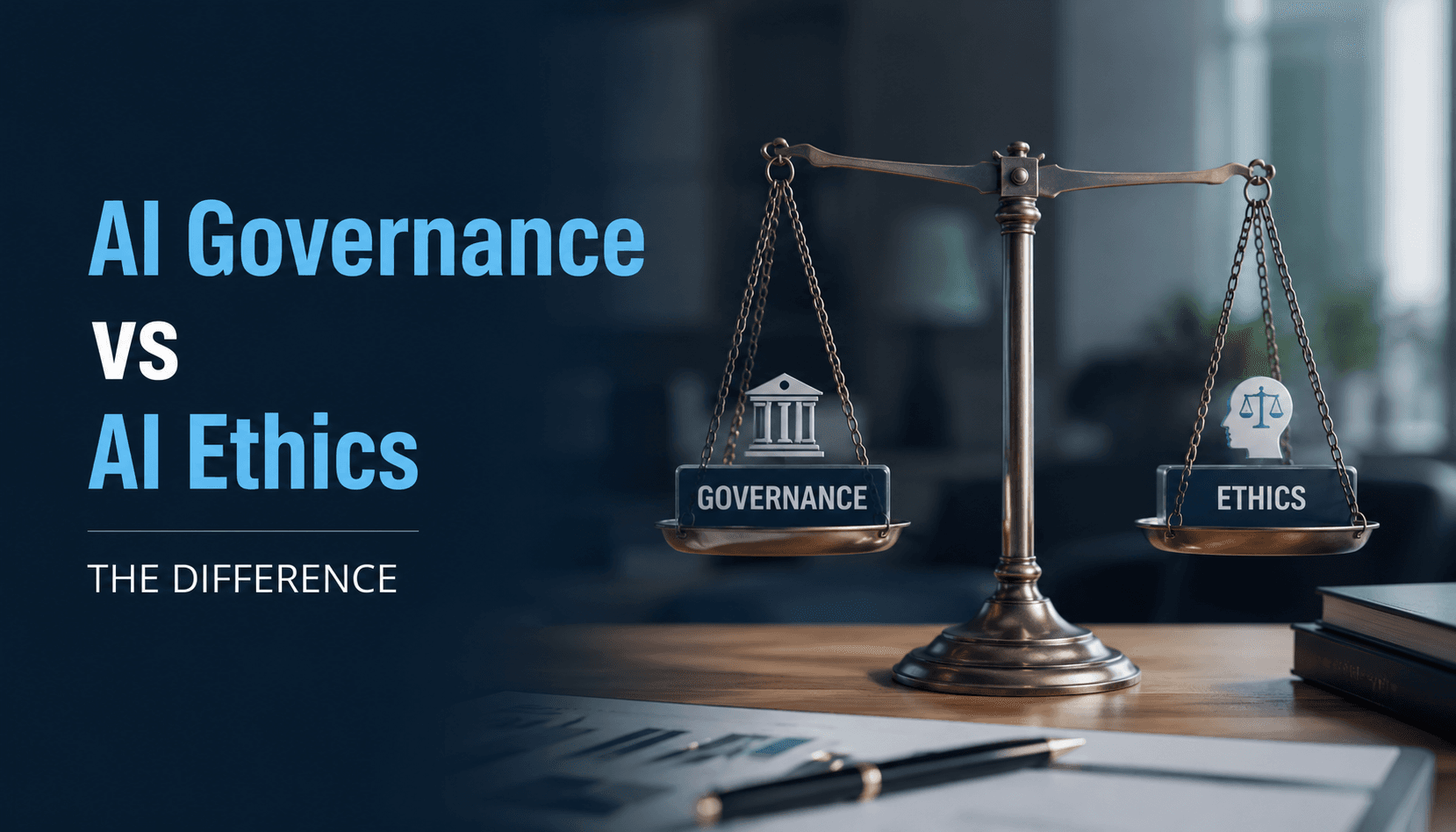
Understanding ai governance vs ai ethics is critical for enterprise leaders deploying machine learning at scale. In simple terms, AI ethics defines what should be done based on moral principles like fairness and transparency, while AI governance defines how it is enforced through policies, controls, and compliance systems. This distinction matters because organizations that rely only on ethics risk inconsistency, while those relying only on governance risk building compliant but harmful systems. The most effective enterprises integrate both aligning ethical intent with operational execution to ensure scalable, responsible AI adoption. The ethics and governance of ai must work together: ethics sets direction, governance ensures accountability. This combined approach strengthens trust, reduces bias, and enables long-term compliance across evolving regulatory landscapes.
Key Takeaways
AI ethics defines foundational values guiding AI systems
AI governance operationalizes those values through enforceable frameworks
Enterprises need both to scale AI responsibly
Governance transforms ethical intent into measurable compliance
Separating strategy (ethics) from execution (governance) improves clarity
What This Means in 2026
As regulatory pressure increases, the gap between ethics and execution is becoming more visible. Organizations are no longer judged only on intent but on measurable outcomes. AI ethics establishes the philosophical baseline, focusing on fairness, accountability, and transparency. This directly informs any ai ethics policy and governance initiative within enterprises.
On the execution side, governance introduces structure. Teams are adopting frameworks such as the Model AI Governance Framework for Generative AI to translate ethical intent into operational systems. For example, enterprises are increasingly aligning with structured approaches like the AI governance framework 2026 to standardize policies across departments. At the same time, implementing a robust AI risk management model ensures continuous monitoring and mitigation of risks. This shift is also reflected in hiring trends companies are actively seeking professionals with a masters in ai ethics and governance to lead responsible AI initiatives.
Start Your AI Transformation with a Free Assessment
AI Governance Vs AI Ethics: Core Comparison
Category | AI Ethics | AI Governance | Enterprise Implementation | Business Impact |
Primary Focus | Moral principles, fairness, societal values | Operational enforcement, risk mitigation, controls | AI strategy, policy definition, stakeholder alignment | Builds trust, ensures responsible AI adoption |
Key Output | Ethical guidelines, manifestos, policies | Auditable frameworks, technical protocols, compliance metrics | Implementation via structured models like AI governance framework 2026 | Enables scalable and compliant AI systems |
Target Audience | Board members, regulators, society, stakeholders | IT, legal, compliance, risk, and operations teams | Cross-functional governance teams and leadership | Improves accountability and transparency |
Measurement | Subjective assessment of intent and fairness | Objective tracking of compliance, risk, and performance | Continuous monitoring using an AI risk management model | Reduces regulatory and operational risks |
Role in Lifecycle | Defines what AI should do before development | Ensures how AI operates during and after deployment | Integrated into development, deployment, and audit phases | Drives long-term sustainability and AI maturity |
Practical Use Cases
1. Healthcare Diagnostics
Applying the ethics and governance of ai for health ensures patient dignity and fairness. Governance enforces strict data access, audit logs, and compliance protocols.
2. Financial Credit Scoring
Ethics prevents biased decision-making, while governance ensures traceability and auditability of credit models through enterprise frameworks like enterprise AI governance.
3. Workforce Automation
An ai ethics and governance specialist evaluates workforce impact, while governance systems track compliance and performance continuously.
4. Data Analytics Platforms
Ethics ensures unbiased data usage, while governance structures how platforms like the Veda AI Data Analytics Platform secure and process data.
5. Generative AI Systems
Ethics defines acceptable outputs, while governance applies guardrails through structured Gen AI governance controls.
Free AI Assessment Report
Identify vulnerabilities in your current machine learning infrastructure immediately. Claim your custom assessment to evaluate your risk exposure and compliance readiness.
Limitations & Risks
Relying only on ethics creates ambiguity. Without enforcement, ethical principles cannot scale across distributed systems or ensure consistent AI data governance. On the other hand, governance without ethics can lead to technically compliant but socially harmful systems especially in sensitive sectors like healthcare or finance.
According to a report by National Institute of Standards and Technology, organizations must align risk management with ethical principles to ensure trustworthy AI systems. This is why balancing ai ethics and regulations with operational frameworks is essential for long-term success.
Assess Your AI Models for Hidden Risks
Decision Framework: When to Use What
To navigate ai governance vs ai ethics, enterprises should follow a structured approach:
Step 1: Define Ethical Boundaries
Start with ethics. Establish what is acceptable, fair, and transparent before development begins.
Step 2: Build Governance Systems
Once ethical standards are clear, implement governance frameworks to enforce them at scale.
Step 3: Align with Modern AI Systems
As organizations compare AI governance vs traditional IT management, they must adapt to AI-specific risks and complexities.
Step 4: Ensure Continuous Compliance
Use governance models to monitor performance, audit decisions, and maintain regulatory alignment.
Conclusion
The future of enterprise AI depends on balancing intent with execution. Understanding ai governance vs ai ethics is not just theoretical it is a strategic necessity. Organizations that successfully integrate ethics with governance build systems that are not only compliant, but also trusted and scalable. By aligning principles with enforcement, enterprises can navigate complex regulatory environments, reduce risk, and unlock the full potential of AI responsibly.
Need expert guidance on aligning your AI systems with global compliance standards?
Reach out to our specialized consulting team to secure your enterprise operations today.
About Samta
Samta.ai is an AI Product Engineering & Governance partner for enterprises building production-grade AI in regulated environments.
We help organizations move beyond PoCs by engineering explainable, audit-ready, and compliance-by-design AI systems from data to deployment.
Our enterprise AI products power real-world decision systems:
TATVA : AI-driven data intelligence for governed analytics and insights
VEDA : Explainable, audit-ready AI decisioning built for regulated use cases
Property Management AI : Predictive intelligence for real-estate pricing and portfolio decisions
Trusted across FinTech, BFSI, and enterprise AI, Samta.ai embeds AI governance, data privacy, and automated-decision compliance directly into the AI lifecycle, so teams scale AI without regulatory friction.
Enterprises using Samta.ai automate 65%+ of repetitive data and decision workflows while retaining full transparency and control.
Samta.ai provides the strategic consulting and technical engineering needed to align your human capital with your AI goals, ensuring a frictionless.
Get Personalized AI Strategy Recommendations
FAQs
What is the main difference between AI ethics and governance?
AI ethics defines the moral principles behind AI systems, while governance ensures those principles are enforced through policies, controls, and measurable frameworks.
How does an ai ethics and governance specialist help?
They bridge the gap between theory and execution—translating ethical principles into enforceable systems that ensure compliance and accountability.
Why is AI Singapore relevant to enterprise operations?
The AI ethics and governance AI Singapore initiatives provide globally recognized frameworks that help organizations structure responsible AI systems effectively.
How do we secure our AI systems effectively?
By combining ethical standards with strong governance practices. Implementing structured AI security compliance ensures protection across data pipelines and models.
Where should a company start with AI implementation?
Start with defining ethical principles, then build governance frameworks to operationalize them. Exploring solutions viaSamta.ai helps accelerate this process.