
Summarize this post with AI
Selecting an AI hiring assessment platform based on a vendor demo is how enterprises end up with tools that score candidates accurately in controlled conditions and fail in production hiring cycles where role specificity, ATS integration, and regulatory compliance all matter simultaneously. The AI hiring assessment platform buyer's guide most CHROs need does not exist in vendor marketing material because it covers the criteria vendors least want buyers to scrutinise. This guide gives CHROs, talent acquisition heads, and HR technology leaders a structured, vendor neutral framework for evaluating, shortlisting, and selecting an AI hiring assessment platform that delivers measurable time to hire reduction and candidate quality improvement in 2026.
AI Hiring Assessment Platform Buyer's Guide:
Selecting the right AI hiring assessment platform in 2026 requires evaluating seven criteria that most vendor comparisons omit: adaptive versus static assessment methodology, PDPA and EEOC explainability compliance, ATS integration depth, candidate experience and drop off rate benchmarks, role specificity configuration capability, bias audit documentation, and knowledge transfer terms in the commercial agreement. For Singapore and APAC enterprise buyers, regulatory explainability requirements eliminate any platform that cannot produce criterion level scoring rationale for individual candidates on demand. How to choose an AI hiring assessment tool for regulated sectors requires governance to be a platform architecture feature, not a documentation add on.
What an AI Hiring Assessment Platform Actually Does
AI hiring platforms: are marketed under a broad umbrella that covers substantially different capabilities. Before evaluating vendors, CHROs need clarity on what the category actually contains:
Static AI assessment: applies a fixed test battery with AI scoring layered on top. The test content does not change based on role, seniority, or function. AI adds speed and automated ranking to what is fundamentally a standardised psychometric instrument.
Adaptive AI assessment: uses machine learning models that adjust question selection, difficulty, and evaluation criteria based on role, seniority, function, and regional hiring context. The assessment experienced by a credit analyst candidate differs materially from one experienced by a technology risk candidate, even within the same hiring program.
AI agents for recruiting: represent the emerging third category: autonomous AI systems that conduct initial candidate conversations, evaluate responses, and advance candidates through defined stages without human intervention at each step. The performance difference between these three categories is significant. Static assessment with AI scoring reduces screening time but does not improve shortlist acceptance rates. Adaptive assessment reduces screening time and improves shortlist quality simultaneously because the scoring reflects actual role requirements rather than generic aptitude norms. Review the AI driven assessment platform architecture guide to understand how these three categories differ at the technical level before vendor selection begins.
Gain Actionable Insights to Accelerate AI Adoption
Why Platform Selection Is More Consequential in 2026
Three market conditions have raised the stakes for getting this decision right:
1. PDPA and fair employment obligations require explainability
Singapore's PDPA and Tripartite Guidelines on Fair Employment Practices require that candidates can request the basis of employment decisions involving automated processing. Any AI hiring assessment platform that cannot produce criterion level explainability for individual candidates creates regulatory exposure for every hiring decision it processes. This is a procurement gate, not a nice to have feature (Source Required: Singapore Tripartite Guidelines on Fair Employment Practices).
2. Candidate drop off at assessment stage is destroying time to fill
Platforms with assessment batteries exceeding 45 minutes are experiencing candidate drop off rates of 35 to 55% among high demand technical and financial services candidates who have competing offers within 10 to 14 days of entering the market (Source Required: LinkedIn Talent Solutions Candidate Experience Report). A platform that screens efficiently but drives away qualified candidates extends time to fill rather than reducing it.
3. ATS integration determines whether efficiency gains are real
Talent assessment platform evaluation criteria that stop at assessment accuracy without evaluating ATS integration depth consistently produce tools that create new manual bottlenecks at the data transfer stage. Platforms without native ATS integration shift the work rather than eliminate it.
The 7 Criteria Framework for AI Hiring Assessment Platform Evaluation
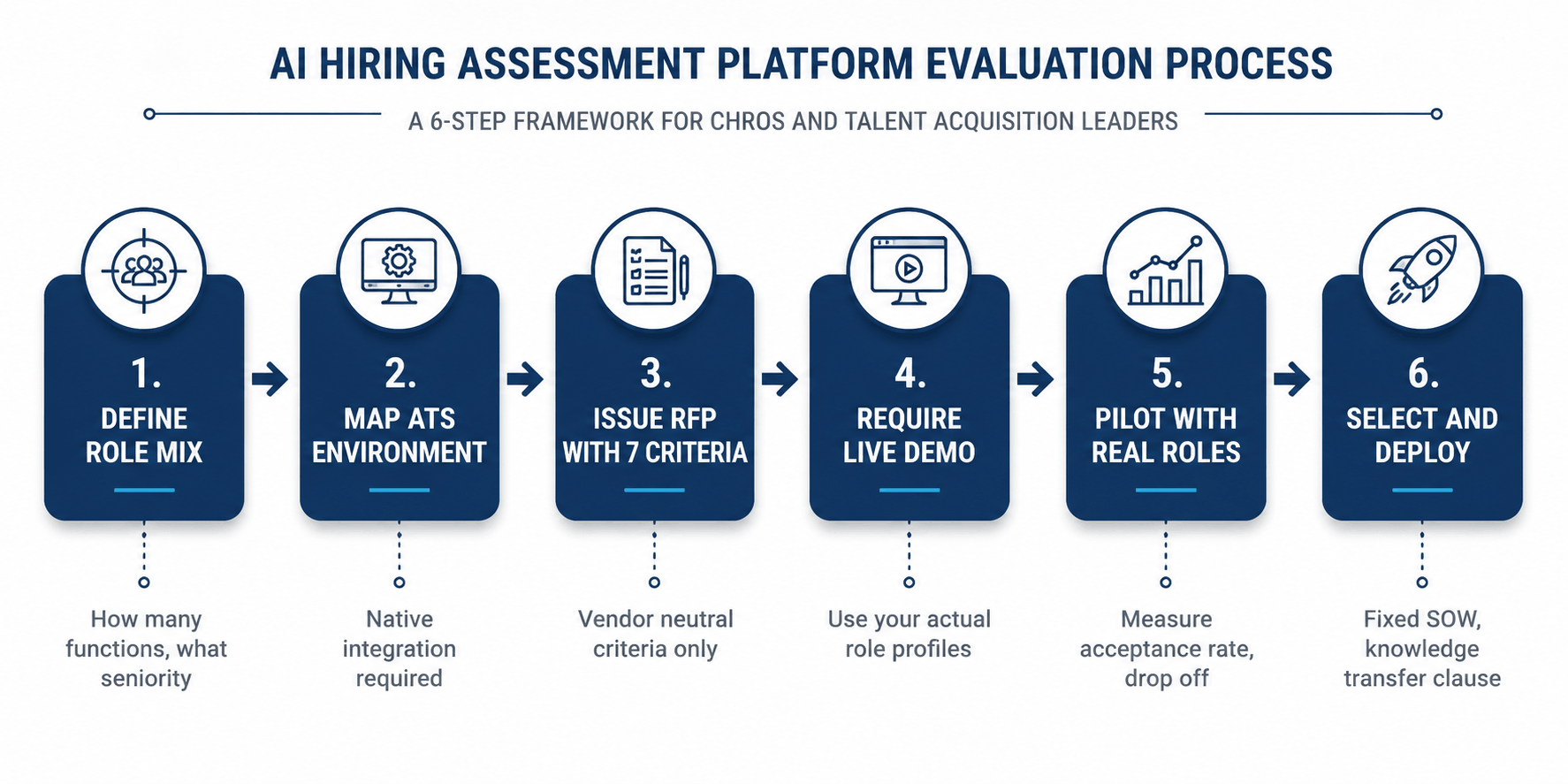
Use this framework as your talent assessment platform evaluation criteria structure when issuing any RFP or running a vendor shortlist:
Criterion 1: Assessment Methodology: Adaptive versus Static
Require vendors to demonstrate the mechanism by which assessment content adapts to role and seniority. Ask specifically: does the question selection algorithm use a static item bank with AI ranking, or does it apply a model that adjusts content based on role specific training data? The answer determines whether hiring managers trust the shortlist enough to act on it without additional manual review.
Criterion 2: PDPA and Regulatory Explainability
Require a live demonstration of criterion level explainability output for an individual candidate. The output must show which specific assessment criteria were applied, how the candidate performed against each, and how the final score was derived. Aggregate score transparency is not sufficient. Individual criterion level rationale is the standard PDPA and fair employment guidelines require. Samta.ai's TATVA Hiring Assessment Platform produces criterion level explainability for every assessed candidate as a standard output, not as an optional add on configured post deployment.
Criterion 3: ATS Integration Depth
Map the candidate data journey from assessment completion to hiring manager shortlist review. Count the number of manual steps required. Any manual data transfer, export, or copy paste step between the assessment platform and your ATS is a time to hire blocker and a data integrity risk. Require native API integration with your specific ATS as a go or no go procurement criterion. Samta.ai's workflow automation consulting practice implements the ATS integration layer as part of every TATVA deployment, ensuring candidate progression is automated end to end rather than at assessment stage only.
Criterion 4: Candidate Experience and Drop Off Benchmarks
Request vendor data on candidate completion rates segmented by role type, assessment length, and device type (mobile versus desktop). Completion rates below 70% for professional role assessments indicate a candidate experience problem that will extend time to fill for high demand roles. Require benchmark data from clients in your industry and geography, not aggregate platform averages.
Criterion 5: Role Specificity Configuration
Assess whether assessment content can be configured independently for each role in your hiring program, or whether the platform applies a single test to all roles with different scoring weights. True role specificity requires separate assessment models per function, not a shared item bank with adjusted threshold scores. Review how TATVA compares to traditional hiring platforms on role specificity depth to benchmark this criterion against legacy assessment approaches.
Criterion 6: Bias Audit Documentation
Require current bias audit reports covering disparate impact analysis across protected characteristics for the assessment models used in your hiring context. Reports should be dated within the last 12 months and cover the specific assessment content you will deploy, not a generic platform level audit. Platforms that cannot produce role specific bias audit documentation on request should not be deployed for regulated employer hiring programs.
Criterion 7: Knowledge Transfer and Commercial Terms
Require that the commercial agreement specifies: assessment configuration documentation delivered to your internal team, integration specifications in a format your team can maintain independently, and a defined transition period if you change platforms. Platforms that retain all configuration knowledge internally create vendor dependency that limits your negotiating position at renewal and increases switching costs indefinitely.
AI Hiring Assessment Platform:
Evaluation Criterion | What to Ask the Vendor | Red Flag Response | Strong Response | TATVA Standard |
Assessment Methodology | How does the assessment adapt to role and seniority? | Adjusted scoring weights on shared item bank | Role specific model trained on function data | Adaptive ML model per role and seniority level |
PDPA Explainability | Show criterion level explanation for one candidate | Score report with percentile ranking only | Criterion level rationale per candidate | Native criterion level explainability, standard output |
ATS Integration | Which ATS do you integrate with natively? | CSV export or manual API configuration | Native integration with major ATS platforms | Native integration with workflow automation layer |
Bias Audit | Provide your most recent bias audit report | Platform level aggregate from prior year | Role specific report within last 12 months | Role specific PDPA aligned bias documentation |
Commercial Terms | What is included in your knowledge transfer commitment? | Verbal commitment to support during contract | Documented configuration handover in SOW | Contractual knowledge transfer with completion criteria |
Find Hidden AI Risks Before They Impact Your Business
Real World Use Cases: AI Hiring Assessment Platform Selection in Practice
Use Case 1: Graduate Hiring Program, Singapore Financial Institution (BFSI)
A Singapore licensed financial institution needed to assess 2,200 graduate applicants across six analyst tracks within a 10 week hiring window. The previous platform used a single graduate aptitude test across all six tracks, producing shortlists that hiring managers reviewed and accepted at a 54% rate, meaning 46% of AI shortlisted candidates were manually rejected before interview.
Switching to an adaptive platform with track specific assessment models increased hiring manager shortlist acceptance to 81% while reducing total assessment administration time by 62%. The PDPA explainability requirement was satisfied from day one because criterion level rationale was generated automatically for every candidate, not produced manually for candidate requests after the fact. Explore how 10 best AI hiring platforms for regulated sector programs are evaluated against these criteria to benchmark your shortlist.
Use Case 2: Technology Talent Acquisition, Regional Enterprise
A regional enterprise technology company needed to hire 90 software engineers and machine learning engineers within 14 weeks across Singapore and Malaysia. The previous screening process required 6 to 8 recruiter hours per candidate in manual resume review and phone screening before a technical assessment was administered.
Deploying an adaptive AI assessment with native ATS integration reduced pre assessment recruiter time from 6 to 8 hours to under 40 minutes per candidate. Time to technical shortlist dropped from 31 days to 12 days. Candidate drop off at assessment stage was 18%, below the 35% threshold the talent acquisition team had set as acceptable. The platform's role specific configuration for software engineering versus machine learning engineering produced meaningfully different shortlists, which hiring managers confirmed reflected the actual skills gap between the two functions. Review recruiting software for tech hiring to understand how role specificity requirements differ between software engineering, data engineering, and AI engineering assessment contexts.
Key Risks When Selecting the Wrong AI Hiring Assessment Platform
Generic assessment applied to specialised roles: produces shortlists that hiring managers do not trust. When hiring manager shortlist acceptance rates fall below 60%, the AI assessment layer adds process friction rather than reducing it, because every AI shortlist requires a manual review layer on top of it.
Black box scoring in regulated employers: creates PDPA exposure for every hiring decision processed. The risk is not theoretical: Singapore's PDPC has issued guidance specifically on automated employment decisions, and candidates who experience adverse outcomes from automated assessment have a clear basis to request decision rationale.
ATS integration gaps: that require manual data transfer add 2 to 5 days to every hiring cycle and introduce data entry errors that corrupt candidate records in the ATS, creating downstream problems in offer management and onboarding.
Bias audit gaps: in assessment content used for high volume hiring programs create fair employment exposure that HR leadership typically does not discover until a candidate complaint or regulatory enquiry surfaces it.
Vendor lock in on configuration knowledge: means that platform switching costs are substantially higher than the licence fee comparison suggests, because the role specific configuration and bias testing embedded in the current deployment must be rebuilt from scratch on the new platform. Review the top 10 AI hiring platforms evaluation framework for a broader market view of how these risks are distributed across the platform category.
Decision Framework: Which AI Hiring Assessment Platform Fits Your Organisation
Select an adaptive AI assessment platform when:
Hiring spans multiple distinct role types requiring differentiated assessment criteria
Hiring volume exceeds 200 assessed candidates per quarter
PDPA or fair employment obligations require criterion level explainability for individual candidates
Hiring manager shortlist acceptance rates on current assessment are below 70%
A static AI assessment platform may be sufficient when:
Hiring is concentrated in a single role type with stable, well defined assessment criteria
Volume is low and manual review of all AI shortlists is feasible within your recruiter capacity
ATS integration is not a current requirement because hiring is managed through a single system
Delay platform selection and run a data audit first when:
No historical data exists on current shortlist acceptance rates, candidate drop off rates, or time to shortlist benchmarks
The ATS environment is changing within the next 6 months due to a system migration or M and A event
PDPA obligations for automated employment decisions have not been formally mapped for your organisation
Explore the 7 AI tools evaluation guide for a broader view of how AI hiring assessment platforms sit within the wider AI recruiting technology stack before making a standalone platform decision.
Choose an AI Hiring Platform That Fits Your Enterprise
Conclusion
The AI hiring assessment platform buyer's guide framework in this article is designed to surface the criteria that vendor demos are not designed to reveal: explainability architecture, ATS integration depth, bias audit currency, and commercial knowledge transfer terms. These are the dimensions that determine whether a platform reduces time to hire and improves shortlist quality in production, or whether it creates new bottlenecks in different parts of the hiring funnel. Evaluate on governance and integration as rigorously as you evaluate on assessment methodology. The platform that wins the demo and loses the production hiring cycle is the most expensive selection mistake in talent technology.
About Samta
Samta.ai is a Singapore-headquartered AI Product Engineering & Data Intelligence partner helping enterprises build production-grade AI systems for regulated and data-intensive environments.We help organizations move beyond experimentation by engineering scalable, explainable, and enterprise-ready AI solutions from data foundations and model development to workflow automation and deployment.
Our capabilities combine deep AI expertise, data engineering, and product engineering to deliver measurable business impact across FinTech, BFSI, cybersecurity, regulatory technology, and enterprise operations.
Our enterprise AI products power real-world intelligence systems:
• TATVA : AI-driven data intelligence platform for governed analytics, monitoring, and operational insights
• VEDA : Explainable and audit-ready AI decisioning engine built for compliance-sensitive enterprise workflows
• CORA-Property Management Solutions: : Predictive intelligence platform for real-estate pricing, portfolio optimization, and investment analytics
Backed by ecosystem partnerships with Microsoft, Databricks, Snowflake, and AWS, Samta.ai delivers agile, cost-efficient AI engineering with faster turnaround and enterprise-grade scalability. Trusted by enterprises across FinTech, BFSI, and digital transformation initiatives, Samta.ai embeds AI governance, data privacy, and compliance-by-design principles directly into the AI lifecycle , enabling organizations to scale AI with transparency, accountability, and operational control.
Enterprises leveraging Samta.ai automate 65%+ of repetitive data, analytics, and decision workflows while maintaining governance, explainability, and measurable business outcomes. Samta.ai provides the strategic consulting, AI engineering, and data modernization expertise needed to align enterprise operations with next-generation AI transformation goals.
Frequently Asked Questions
What is an AI hiring assessment platform buyer's guide and why do CHROs need one?
An AI hiring assessment platform buyer's guide is a structured evaluation framework that gives CHROs and talent acquisition leaders the criteria, questions, and red flags needed to select a platform that delivers measurable hiring outcomes rather than one that performs well in a controlled vendor demo and underperforms in production hiring cycles. Most vendor comparisons cover feature lists. A buyer's guide covers governance, integration, and commercial terms that determine real world platform performance.
How do I choose an AI hiring assessment tool for a regulated employer in Singapore?
How to choose an AI hiring assessment tool for Singapore regulated employers requires prioritising three criteria above all others: PDPA explainability at the individual criterion level, bias audit documentation specific to your role types and candidate population, and native ATS integration that eliminates manual data transfer. Any platform that cannot satisfy all three should not be deployed for production hiring in a Singapore regulated employer context, regardless of its assessment accuracy credentials.
What are the most important talent assessment platform evaluation criteria?
Talent assessment platform evaluation criteria that most buyers underweight relative to their importance: ATS integration depth (manual export adds 2 to 5 days per hiring cycle), hiring manager shortlist acceptance rate benchmarks from comparable clients (the true measure of shortlist quality), candidate completion rate by device type (mobile drop off rates differ significantly from desktop), and knowledge transfer terms in the commercial agreement (determines your switching cost when you eventually change platforms).
What are AI powered recruiting tools and how are they different from traditional assessment platforms?
AI powered recruiting tools use machine learning models to score, rank, and shortlist candidates based on learned patterns in historical hiring and assessment data, rather than applying fixed scoring algorithms to standardised test responses. The meaningful distinction is adaptivity: traditional assessment platforms apply the same instrument to all candidates and adjust thresholds; AI powered platforms adjust the assessment itself based on role, seniority, and function context, producing higher shortlist acceptance rates when correctly configured.
What should TATVA's platform page tell me before I book a demo?
The TATVA platform documentation covers adaptive assessment methodology, role specific configuration capability, PDPA explainability architecture, ATS integration specifications, and bias audit approach before a demo is required. CHROs and talent acquisition heads who review the platform documentation alongside the AI driven assessment platform technical guide arrive at demos with specific configuration and integration questions rather than general capability questions, which produces a faster and more useful evaluation process.