
Summarize this post with AI
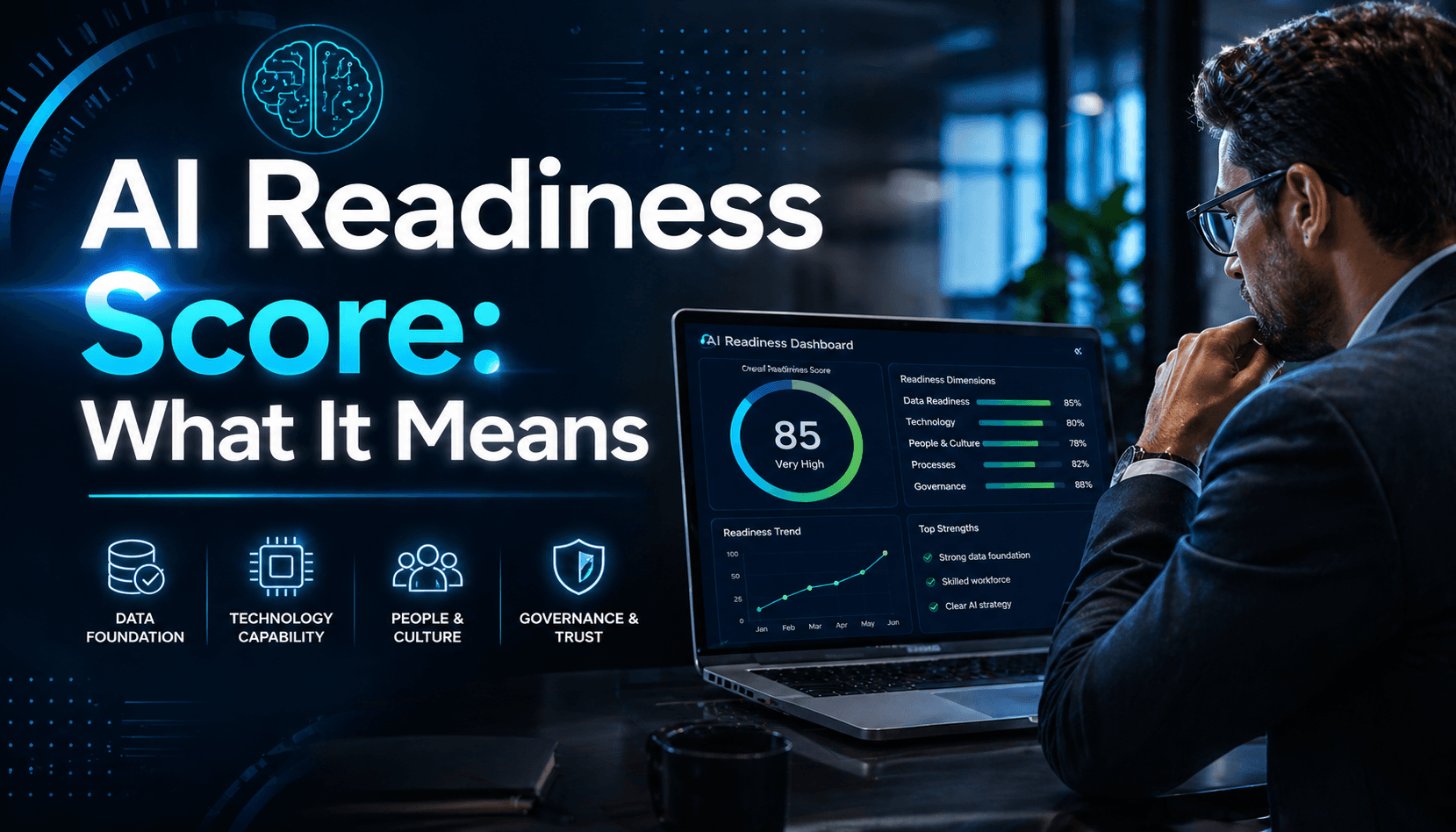
Before deploying machine learning models, enterprise leaders must determine their baseline operational capacity. An ai readiness score quantifies an organization's technical, structural, and cultural preparedness to implement artificial intelligence. It evaluates infrastructure maturity, security protocols, and talent availability to prevent expensive deployment failures. Understanding what is data readiness forms the core of this metric, verifying if corporate data is clean, accessible, and structured for algorithmic processing. Executing a formal AI readiness assessment translates these technical parameters into an actionable numeric value or tier. This empirical approach eliminates guesswork, allowing IT and operations teams to allocate resources precisely where infrastructure gaps exist, ensuring a stable foundation for autonomous workflows and advanced analytics.
Key Takeaways
An ai readiness score defines AI deployment feasibility and cost
Strong data systems prevent model failure scenarios
Standard diagnostics align IT and leadership strategy
Tools like enterprise ai readiness framework software ensure consistent tracking
Continuous evaluation improves enterprise ai maturity scorecard performance
What This Means in 2026
In 2026, launching AI without structured benchmarking is a serious operational risk. Frameworks like AI readiness for CTOs in 2026 emphasize that early diagnostics prevent costly rework and failed integrations. A structured AI readiness assessment helps organizations move from fragmented systems to unified architectures, as explained in AI readiness assessment methodology. To scale this process, enterprises rely on enterprise ai readiness framework software that standardizes evaluation and tracks progress. For external validation, McKinsey & Company reports that companies with strong data readiness significantly outperform peers in AI ROI.
Start Your AI Transformation with a Data-Driven Assessment
Core Comparison: Diagnostic Tools & Approaches
A structured comparison helps enterprises choose the right evaluation method:
Tool / Service | Core Function | Key Metrics Evaluated | Output / Benefit | Best Use Case |
End-to-end architecture assessment | Data pipelines, ETL, system integration | High: Detailed enterprise roadmap | Large-scale transformation projects | |
ai maturity scorecard | Organizational benchmarking | Culture, governance, adoption level | Medium: Identifies strategic gaps | Executive-level planning |
data infrastructure readiness tool | Data system diagnostics | Data quality, storage, pipelines | High: Strengthens data foundation | Pre-AI deployment validation |
ai integration diagnostic tool | Compatibility testing | APIs, legacy systems, interoperability | Medium: Reduces integration risk | Vendor onboarding |
enterprise ai readiness framework software | Continuous monitoring platform | Cross-functional readiness metrics | High: Scalable tracking & reporting | Enterprise-wide AI scaling |
For implementation support, data integration consulting services help translate these diagnostics into real infrastructure improvements.
Practical Use Cases
A well-defined ai readiness score enables:
1. Vendor Evaluation
An Ai readiness score calculator determines system compatibility with external AI tools.
2. Budget Allocation
Organizations can invest precisely where gaps exist instead of overspending broadly.
3. Data Pipeline Auditing
Use insights from enterprise data readiness evaluation to ensure pipelines support AI workloads.
4. Pre-Consulting Preparation
Running diagnostics before engaging experts as explained in AI readiness before hiring consultants ensures better outcomes.
5. Risk Management
A data infrastructure readiness tool and ai integration diagnostic tool identify compliance and security risks early.
Limitations & Risks
Despite its value, an ai readiness score has limitations:
Over-reliance on tools may ignore human and cultural readiness
High technical scores don’t guarantee adoption success
Poorly executed efforts to calculate ai data readiness can produce misleading results
As highlighted in why an AI readiness framework is critical, weak data foundations undermine AI success regardless of infrastructure.
Identify Hidden Risks Across Your AI Models
Decision Framework
When to Use
Before AI vendor selection
During infrastructure upgrades
When aligning cross-functional AI strategy
Solutions like VEDA AI Data Analytics Platform require strong data readiness to deliver value.
When Not to Use
Early-stage experiments without integration dependencies
Isolated proofs-of-concept
When Human Oversight is Required
Organizational readiness and change management
Ethical and governance considerations
Workforce capability assessment
Combining human expertise with AI readiness assessment ensures accurate and actionable insights.
Conclusion
Navigating the complexities of machine learning integration requires empirical baselines, not estimates. Establishing a precise ai readiness score provides the clarity necessary to modernize infrastructure efficiently and mitigate deployment risks. Organizations must prioritize robust diagnostic frameworks to ensure their data and systems can support autonomous operations. For comprehensive engineering support and to build scalable data architectures, enterprise teams can rely on the established AI and ML expertise at Samta.ai.
About Samta
Samta.ai is an AI Product Engineering & Governance partner for enterprises building production-grade AI in regulated environments.
We help organizations move beyond PoCs by engineering explainable, audit-ready, and compliance-by-design AI systems from data to deployment.
Our enterprise AI products power real-world decision systems:
TATVA : AI-driven data intelligence for governed analytics and insights
VEDA : Explainable, audit-ready AI decisioning built for regulated use cases
Property Management AI : Predictive intelligence for real-estate pricing and portfolio decisions
Trusted across FinTech, BFSI, and enterprise AI, Samta.ai embeds AI governance, data privacy, and automated-decision compliance directly into the AI lifecycle, so teams scale AI without regulatory friction.
Enterprises using Samta.ai automate 65%+ of repetitive data and decision workflows while retaining full transparency and control.
Samta.ai provides the strategic consulting and technical engineering needed to align your human capital with your AI goals, ensuring a frictionless.
Plan Your Next AI Move with Confidence
FAQs
What exactly is an ai readiness score?
It is a quantitative metric evaluating an organization's preparedness to adopt artificial intelligence. It measures data architecture, technical infrastructure, security protocols, and personnel capabilities. This score provides a definitive baseline, guiding IT leaders on necessary upgrades before initiating deployment.
How do we calculate ai data readiness?
Calculating this requires auditing data governance, accessibility, and quality. Teams must verify if data is siloed or unified and if existing pipelines support real-time processing. This process forms the foundation of any comprehensive ai maturity assessment framework.
Why use an enterprise ai readiness framework software?
This software automates the diagnostic process, providing standardized, repeatable evaluations across different departments. It replaces subjective estimations with empirical data, allowing B2B leaders to track progress accurately over time and justify specific technological investments.
When should CTOs conduct this evaluation?
CTOs must conduct evaluations before procuring new vendor solutions or restructuring data architectures. As outlined in theCTOs 2026 guide, early assessment prevents investing in advanced models that current legacy infrastructure cannot support or secure properly.