
Summarize this post with AI
Property management software that was built for US residential portfolios in 2006 and retrofitted with AI in 2025 is a fundamentally different product from a platform engineered from the ground up for APAC-regulated, enterprise-grade property operations. cora vs appfolio is not a close comparison when the primary selection criteria are data governance, explainability, and compliance documentation for regulated property portfolios in Singapore and Southeast Asia. For enterprises where those criteria dominate, CORA wins on architecture. For large US-based residential portfolios of 200 or more units where accounting depth and market presence matter most, AppFolio is the more established choice. This guide compares cora vs appfolio directly on AI governance, APAC fit, integration depth, and total cost of ownership so you can make the right platform decision for your portfolio and compliance context.
CORA vs AppFolio:
CORA by Samta.ai is an AI-driven property management platform built specifically for enterprise and APAC-regulated property portfolios, with governance, explainability, and audit trail documentation built into the platform architecture from day one rather than added as a premium tier feature. AppFolio is the number one rated property management software on G2's Spring 2026 Grid Report, built primarily for US residential rental operations managing 50 or more units, with agentic AI delivered through its Realm-X platform on Plus and Max plans, a 10-month ROI payback period, and a satisfaction score of 97. The comparison is fundamentally a question of portfolio context: CORA for APAC enterprise and regulated-industry deployments requiring governance and explainability; AppFolio for large US residential portfolios requiring accounting depth and agentic leasing automation.
What Is CORA: Samta.ai's AI-Driven Property Management Platform
CORA is Samta.ai's AI-driven property management platform, purpose-built for enterprise and regulated-industry property portfolios, particularly across APAC markets where governance, explainability, and regulatory compliance are first-order requirements.
CORA delivers four core capabilities that distinguish it from conventional property management ai software:
Predictive analytics: AI-powered forecasting for vacancy, rental yield, and portfolio performance across mixed-use and commercial assets
Real-time operational visibility: unified dashboards connecting property data, maintenance workflows, tenant interactions, and financial reporting in a single governed layer
Explainability by design: every AI-influenced decision, whether a rent recommendation, tenant screening outcome, or lease renewal flag, is documented with a scoring rationale available for internal audit or regulatory review on demand
Enterprise data integration: native connection to Databricks and Snowflake, enabling property analytics to feed directly into broader organizational governance and risk reporting stacks
CORA is engineered for enterprises where a property management platform must satisfy not just operational efficiency requirements but also compliance obligations under PDPA, MAS AI governance expectations, and IMDA frameworks. For a full comparison of what CORA delivers versus legacy approaches.
see the CORA vs traditional property management software comparison and the CORA AI-driven property management platform product page.
Get your Free AI Assessment Report
What AppFolio Is and Who It Serves
AppFolio is a cloud-based ai property management comparison platform used by over 19,000 property management companies, built primarily for US residential rental management. According to the G2 Grid Report for Property Management Spring 2026, AppFolio is ranked number one overall with a satisfaction score of 97 and a Net Promoter Score of plus 75. Its Realm-X AI suite delivers agentic automation including Lisa, an AI leasing assistant that responds to rental inquiries within five minutes, smart maintenance routing, and predictive rent pricing. Realm-X achieves a 79 percent rating for Autonomous Task Execution on G2 Spring 2026. AppFolio offers three plans: Core, Plus, and Max, with Realm-X AI features available on Plus and Max tiers behind a minimum of $960 per month. For APAC enterprises assessing their broader ai in real estate technology stack before any platform decision, the top proptech consultants guide and the proptech AI consulting services guide provide the market context this comparison assumes.
Why Platform Choice Matters More in 2026
Three developments make the ai property management comparison decision more consequential this year than in prior cycles.
1. APAC regulatory pressure on AI-driven property decisions is growing: Singapore's PDPA, MAS AI governance expectations, and IMDA frameworks all apply to AI systems processing personal data in property management contexts, including tenant screening, rent decisioning, and lease management. A platform built for US compliance frameworks does not automatically satisfy APAC regulatory requirements.
2. AppFolio's AI requires the Plus or Max plan, starting at $960 per month minimum: The Realm-X AI suite that differentiates AppFolio in 2026 is not available on the Core plan. According to AppFolio's own pricing analysis, enterprises evaluating AppFolio for AI-driven automation need to factor the Plus or Max minimum into their total cost of ownership calculation, not the per-unit Core price.
3. AI adopters in property management anticipate 31 percent portfolio growth compared to 12 percent for non-users: The platform that delivers AI with the right governance architecture for your market and portfolio type, not just the platform with the highest G2 score in a US-dominated review pool, is the one that captures that growth differential.
The Samta.ai proptech solutions page covers how APAC property enterprises are capturing this advantage today.
Get a structured assessment of your portfolio's AI governance requirements, data architecture, and platform fit before committing to any vendor. Request a Free AI Assessment Report from Samta.ai and enter platform evaluation conversations with verified requirements rather than vendor-supplied positioning.
How to Evaluate the Right Platform: Step by Step
Use this framework to structure the ai property management comparison decision for your specific portfolio and compliance context.
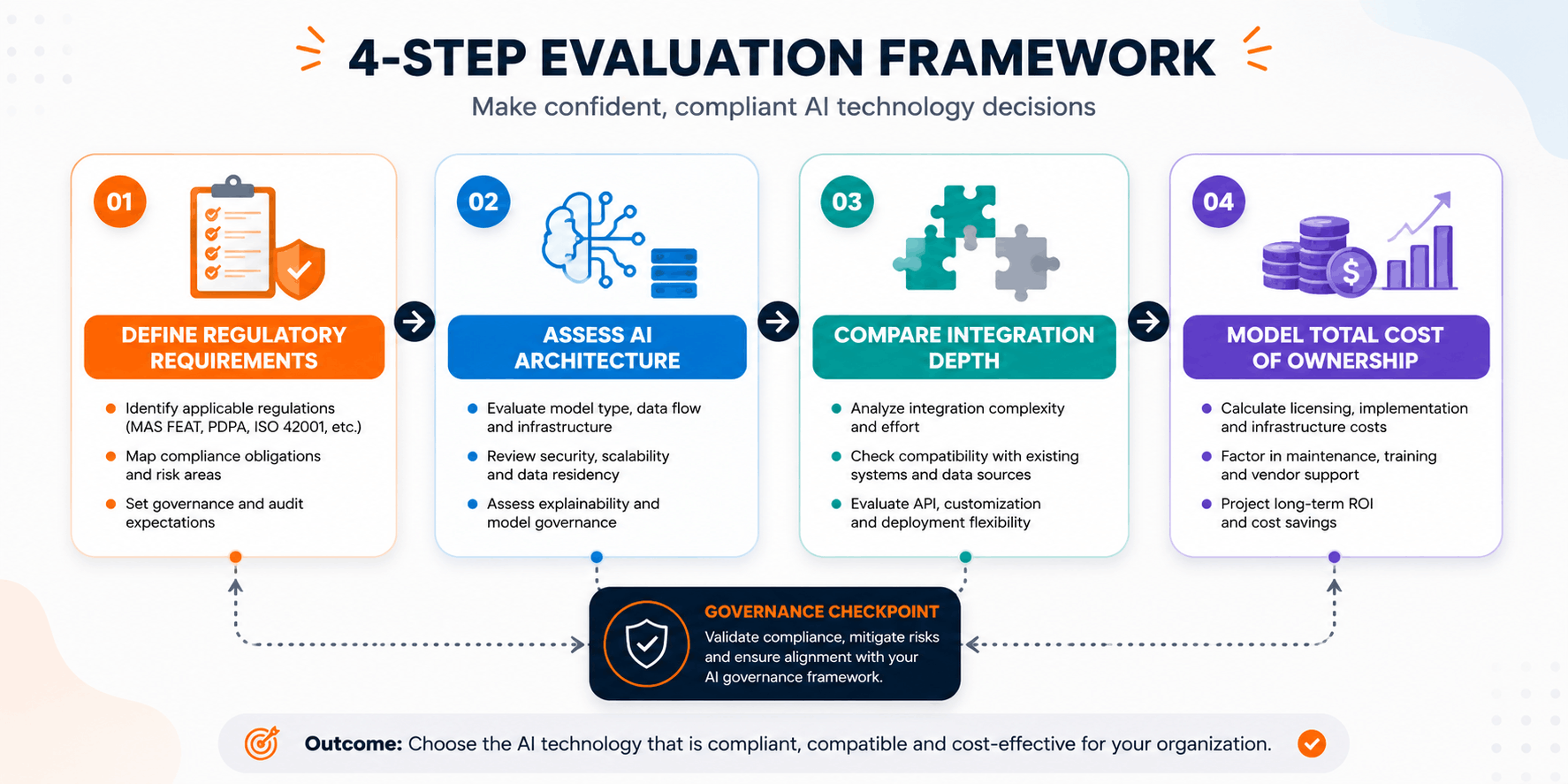
Step 1: Define Your Regulatory and Governance Requirements
APAC and regulated-industry portfolios: governance documentation, explainability of AI-influenced decisions, and PDPA or equivalent data protection compliance are non-negotiable. These require a platform where governance is architecture, not a settings menu.
US residential portfolios: AppFolio's established compliance tooling for HUD requirements and US residential frameworks, combined with its mature accounting layer, makes it the stronger operational fit.
Mixed international portfolios: assess whether a single platform can satisfy all jurisdictions or whether a best-of-breed approach with separate governance documentation is more defensible.
Step 2: Assess AI Architecture and Explainability
CORA's AI layer: built with explainability and audit trail documentation as platform primitives, supporting governance requirements for AI-influenced decisions in regulated contexts.
AppFolio's Realm-X: an agentic AI suite delivering automated workflows that handle complex decision trees without human intervention, achieving a 79 percent rating for Autonomous Task Execution on G2 Spring 2026. Powerful for leasing automation and maintenance routing in US residential operations; less documented for explainability standards required in APAC regulated contexts.
Transparency note: Samta.ai builds CORA. We applied the same evaluation criteria to both platforms and noted where AppFolio outperforms CORA.
Step 3: Compare Integration Depth and Data Architecture
CORA: native integration with Databricks and Snowflake, supporting enterprise data mesh architectures where property data feeds into broader organizational analytics and compliance layers.
AppFolio: strong integrations with US property market services including tenant screening, rent comparables, and vendor marketplaces, plus Zapier and API access on Premier investment management tiers.
The workflow automation consulting and digital transformation managed services teams can extend either platform's integration footprint for enterprises needing custom workflow connections beyond what each platform natively supports.
Step 4: Model the Total Cost of Ownership
AppFolio's per-unit pricing starts at $1.49 per unit per month on Core, but AI features require Plus or Max with a minimum floor of approximately $960 per month. Additional costs include tenant screening at $10 to $15 per application, electronic lease signing at $2 per lease, and payment processing fees. A 500-unit portfolio on Core runs approximately $745 per month; at Plus tier for AI features, costs rise significantly above this. CORA is enterprise-quoted based on portfolio scale and governance scope. Enterprises should request total cost of ownership modeling across a 24-month horizon before any comparison is complete.
Check Your AI Risk Exposure in Minutes →
CORA vs AppFolio: Head-to-Head Comparison
Dimension | Best Fit | Notable Limitation | APAC Fit | ||
Primary Strength | Governance, explainability, and APAC-regulated enterprise portfolio management | AI-native leasing automation and accounting depth for US residential portfolios, ranked number one on G2 Spring 2026 | CORA: regulated APAC enterprise; AppFolio: large US residential | CORA: smaller public test library vs US-market platforms; AppFolio: AI features gated behind Plus or Max plan | CORA: purpose-built; AppFolio: US-centric architecture |
AI Architecture | Explainability and audit trail built into platform from day one | Realm-X agentic AI with 79% Autonomous Task Execution; AI leasing assistant Lisa; predictive rent pricing | CORA for governance; AppFolio for leasing automation scale | AppFolio Realm-X requires Plus or Max at $960/month minimum | CORA: PDPA and MAS alignment; AppFolio: US compliance frameworks |
Data Integration | Native Databricks and Snowflake; enterprise data mesh architecture | Zapier, API access on Premier; strong US property market service integrations | CORA for enterprise data stack; AppFolio for US property ecosystem | AppFolio API access requires Premier tier; CORA custom-quoted | CORA: APAC data residency compatible |
Pricing Model | Custom enterprise quote by portfolio scale and compliance scope | Per unit per month: Core from $1.49/unit; Plus and Max from approximately $960/month minimum; additional per-transaction fees | AppFolio more transparent for US residential; CORA structured for enterprise governance budget | Both require TCO modeling beyond headline price | CORA: APAC contract structures supported |
Governance and Compliance | AI governance documentation built into platform architecture; audit trails for every AI-influenced decision | Strong US residential compliance tools (HUD, LIHTC); less documented for APAC regulatory explainability standards | CORA: APAC and regulated enterprise; AppFolio: US compliance | AppFolio governance depth for APAC contexts not publicly documented | CORA: clear advantage for Singapore and SEA regulated contexts |
Enterprise Use Cases: When CORA Wins and When AppFolio Wins
Use Case 1: Singapore Commercial Real Estate Portfolio Choosing CORA
A Singapore commercial real estate enterprise managing mixed-use assets across three APAC markets needed an AI platform that could document every rent recommendation, tenant screening outcome, and lease renewal decision for PDPA compliance and internal audit purposes. AppFolio's architecture, built for US residential operations, did not offer the governance documentation layer the compliance team required. CORA was selected for its explainability architecture and APAC data residency compatibility. The platform's integration with the enterprise's existing Snowflake data warehouse meant property analytics fed directly into the organization's broader governance and risk reporting, consistent with the enterprise data architecture approach covered in the top data science and AI guide. Governance documentation for every AI-influenced decision was available on demand for internal audit without any manual reconstruction.
Use Case 2: US Residential Portfolio Choosing AppFolio
A US-based property management company managing 800 residential units selected AppFolio for its mature accounting depth, AI-powered leasing automation through Lisa, and smart maintenance routing on the Plus plan. The 10-month ROI payback period verified by G2's Spring 2026 analysis, and the 89 percent user adoption rate, were the primary factors over competitors including Yardi Breeze at a 19-month payback. Early users of AppFolio's Realm-X Assistant and Messages were saving an average of 10.3 hours per week on task completion and 11.9 hours per week on communication-related tasks. For this portfolio profile, AppFolio is the correct choice. For Singapore or APAC regulated portfolios, CORA's governance architecture applies where AppFolio's US-centric design does not reach.
Key Risks and Failure Modes
Selecting AppFolio for APAC portfolios without governance validation: AppFolio was built for US residential compliance frameworks. Enterprises deploying it in Singapore or across ASEAN for AI-influenced decisions affecting tenants should validate PDPA compliance, explainability documentation, and data residency independently before deployment.
Underestimating AppFolio's true cost for AI-enabled tiers: The per-unit Core pricing does not include Realm-X AI features, which require Plus or Max at a minimum floor that can substantially exceed a Core-equivalent portfolio cost. Always model Plus or Max tier total cost of ownership when AI automation is the primary selection criterion.
Choosing on G2 score rather than portfolio fit: AppFolio's number one G2 ranking reflects its performance for the US residential portfolio market that dominates the G2 reviewer pool. That score is not directly applicable to APAC enterprise, commercial, or regulated-industry portfolios where governance and explainability are the primary selection criteria.
Treating platform selection as permanent: Both platforms involve significant data migration cost when switching. Building a 24-month total cost of ownership model, including migration, training, and integration rebuilds, before committing to either platform reduces the likelihood of a costly mid-program switch.
See how CORA has been applied in real APAC enterprise property portfolios. Read Samta.ai's case studies for documented governance and analytics outcomes before you compare vendor proposals.
Discover opportunities to maximize ROI and reduce risk. →
Decision Framework: CORA or AppFolio for Your Portfolio?
You manage property in Singapore, ASEAN, or another APAC regulated jurisdiction → CORA
PDPA, MAS, or equivalent AI governance compliance documentation is required → CORA
Your portfolio is US residential, 50 to 5,000 units, and leasing automation is the primary need → AppFolio Plus or Max
You need native integration with enterprise data platforms (Databricks, Snowflake) → CORA
Accounting depth, US market integrations, and the Realm-X AI leasing assistant are the primary decision criteria → AppFolio
You require explainability documentation for every AI-influenced tenant or pricing decision → CORA
If the compliance and APAC governance boxes are checked, CORA is the defensible choice. If the US residential operations boxes are checked, AppFolio is the more established option.
Conclusion
cora vs appfolio in 2026 is a context-dependent decision, not a universal ranking. AppFolio is the number one platform for large US residential property management, with proven accounting depth, agentic AI automation, and a 10-month ROI payback. CORA is the stronger choice for APAC enterprise and regulated-industry portfolios where governance documentation, explainability, and PDPA-aligned data architecture are the primary platform selection criteria. Property management ai software has matured enough in 2026 that the right platform depends entirely on your regulatory context and portfolio geography, not the platform's G2 score in a US-dominated review pool.
See CORA's governance, predictive analytics, and APAC compliance architecture against your actual portfolio and regulatory context. Request a Free Product Demo with Samta.ai and compare it directly against what AppFolio's Plus plan delivers before committing.
About Samta
Samta.ai is a Singapore-headquartered AI Product Engineering & Data Intelligence partner helping enterprises build production-grade AI systems for regulated and data-intensive environments.We help organizations move beyond experimentation by engineering scalable, explainable, and enterprise-ready AI solutions from data foundations and model development to workflow automation and deployment.
Our capabilities combine deep AI expertise, data engineering, and product engineering to deliver measurable business impact across FinTech, BFSI, cybersecurity, regulatory technology, and enterprise operations.
Our enterprise AI products power real-world intelligence systems:
• TATVA : AI-driven data intelligence platform for governed analytics, monitoring, and operational insights
• VEDA : Explainable and audit-ready AI decisioning engine built for compliance-sensitive enterprise workflows
• CORA-Property Management Solutions: : Predictive intelligence platform for real-estate pricing, portfolio optimization, and investment analytics
Backed by ecosystem partnerships with Microsoft, Databricks, Snowflake, and AWS, Samta.ai delivers agile, cost-efficient AI engineering with faster turnaround and enterprise-grade scalability. Trusted by enterprises across FinTech, BFSI, and digital transformation initiatives, Samta.ai embeds AI governance, data privacy, and compliance-by-design principles directly into the AI lifecycle , enabling organizations to scale AI with transparency, accountability, and operational control.
Enterprises leveraging Samta.ai automate 65%+ of repetitive data, analytics, and decision workflows while maintaining governance, explainability, and measurable business outcomes. Samta.ai provides the strategic consulting, AI engineering, and data modernization expertise needed to align enterprise operations with next-generation AI transformation goals.
Frequently Asked Question
What is the main difference between CORA and AppFolio in 2026?
cora vs appfolio is fundamentally a question of portfolio context and governance architecture. CORA is built for APAC enterprise and regulated-industry portfolios where explainability, audit trails, and PDPA-aligned governance are platform requirements. AppFolio is the number one ranked platform on G2 Spring 2026 for US residential property management, with agentic AI through Realm-X on Plus and Max plans. Both are AI-powered; they serve fundamentally different market contexts.
What is property management in singapore and what AI compliance does it require?
property management in singapore operates under PDPA data protection obligations for any AI processing tenant personal data, and increasingly under IMDA's AI governance frameworks. AI-influenced decisions including tenant screening outcomes, rent recommendations, and lease renewal offers must be explainable and auditable if challenged. US-built platforms do not automatically satisfy these requirements, making governance architecture a first-order platform selection criterion for Singapore property portfolios.
Does AppFolio work in Singapore or APAC markets?
AppFolio was built primarily for US residential property management and its compliance tooling reflects US regulatory frameworks including HUD and LIHTC requirements. While the platform is cloud-based and technically accessible internationally, its AI governance documentation for APAC-specific requirements including PDPA explainability and MAS AI risk management alignment is not publicly documented, making independent compliance validation necessary before deploying AppFolio for regulated APAC operations.
What are the ai tools for property management that differentiate CORA from AppFolio?
CORA's differentiating AI tools are explainability documentation built into every AI-influenced decision output, audit trail generation for governance and compliance review, and predictive analytics integrated with enterprise data platforms. AppFolio's differentiating AI tools are Realm-X, including Lisa the AI leasing assistant, smart maintenance routing matching vendors by performance and cost, and predictive rent pricing updating against market comparables. Both are genuine AI tools; they optimize for different outcomes.
Is CORA an AppFolio alternative for enterprise APAC portfolios?
Yes. CORA is purpose-built as an appfolio alternative specifically for enterprise and APAC-regulated property portfolios where AppFolio's US-centric governance architecture and residential-first product design do not satisfy local compliance requirements. For enterprises in Singapore or across ASEAN managing commercial, mixed-use, or regulated residential assets, CORA's governance documentation and APAC data residency compatibility make it the more defensible platform choice.