

Summarize this post with AI
Most enterprises hiring data and ai consulting help in India expect a strategy deck first and a working system much later. That sequencing is backwards, and it is a large part of why so many engagements stall. India's enterprise AI investment grew 119% in a single year, according to ServiceNow's 2026 Enterprise AI Maturity Index, yet only 22% of Indian enterprises have AI testing, auditing, and risk assessment processes in place. A well run engagement closes that gap inside its first 90 days, not across a year long roadmap, by moving from scoping to a working proof before governance and production planning begin. Here is what each phase should actually deliver.
Data and AI Consulting:
Data and ai consulting engagements that work follow three phases inside their first 90 days, discovery and assessment, architecture and a proof of concept, then build planning with governance handover, rather than a single long strategy phase before any system exists. Deloitte's 2026 State of AI in the Enterprise research found 40% of Indian respondents report significant or full AI usage against a global average of about 28%, meaning most Indian enterprises are past the experimentation stage and need delivery discipline, not another assessment deck. A 90 day structure forces each phase to produce evidence before the next one is funded.
What a data and AI consultancy engagement actually includes
What does a data and AI consulting engagement include? Five elements recur across almost every credible engagement, regardless of firm size.
A defined business use case, not a general ambition to adopt AI.
A data and system assessment, covering quality, integration, and governance maturity.
A scoped architecture plan, setting out data flows, integration approach, and delivery sequence.
A proof of concept on real data, testing the specific use case before a full build is funded.
A governance and handover plan, defining ownership once the engagement ends.
Our overview of enterprise AI consulting services covers this structure in more general terms, and the 90 day framing below shows how it actually plays out week by week.
Discover the Power of AI-Driven Decision Analytics With VEDA
Why the first 90 days matter more in India right now
Data and ai consultancy work in India carries a specific urgency this year, for three reasons.
ServiceNow's September 2026 India findings show AI now accounts for 16.6% of the average Indian IT budget, projected to reach 21.3% by 2027, while only 22% of enterprises have testing and auditing processes in place. Investment is clearly outrunning governance capability.
The same research found 54% of Indian organisations are deploying AI agents, but only 11% have moved to autonomous workflows, a gap that a disciplined first 90 days, rather than an open ended pilot, is specifically designed to close. Our guide to AI engineering consulting services covers how engineering delivery differs from advisory scoping once a use case moves past the proof stage.
India's regulatory environment has also become concrete enough to scope for directly. The Digital Personal Data Protection Act and its rules came into force in 2025, and AI Governance Guidelines were launched at the February 2026 AI Impact Summit, so a 90 day engagement now needs to plan for compliance from day one rather than retrofitting it later.
The first 90 days, phase by phase
What should the first 90 days of an AI consulting engagement deliver? The breakdown below shows what each phase is responsible for.
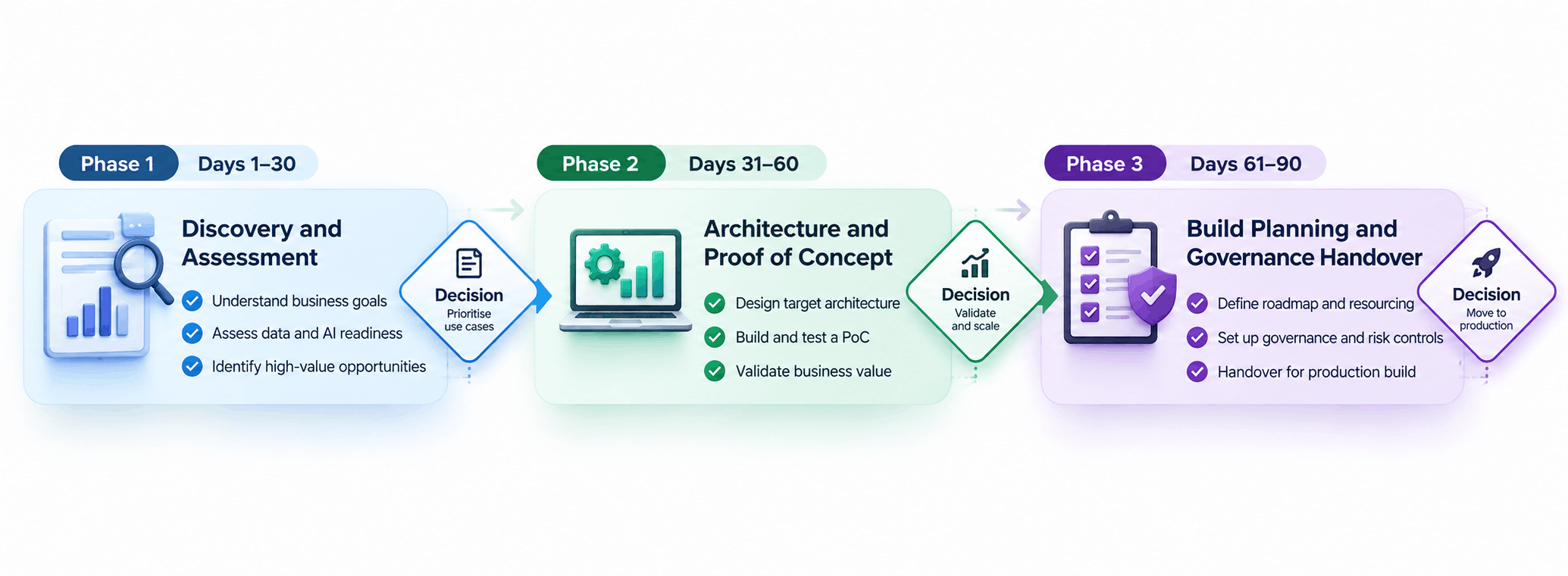
Days 1 to 30: discovery and assessment
The engagement opens by defining one specific business use case and success metric, not a broad transformation ambition. Data quality, system landscape, and governance maturity get assessed against that specific use case, surfacing the gaps that would otherwise derail a later build. Our guide on data discovery for AI covers what this assessment stage needs to produce before architecture work begins.
Integration readiness gets mapped during this same window, since a use case that depends on data from several disconnected systems needs that dependency identified early. Our overview of enterprise data integration engineering covers the technical groundwork this phase typically uncovers.
Days 31 to 60: architecture and proof of concept
With the assessment complete, the engagement moves to a target architecture and a bounded proof of concept tested on real data, not a sample dataset. Samta.ai's data integration consulting services connect the proof directly to existing Databricks, Snowflake, or Microsoft infrastructure during this phase, so the proof reflects production conditions rather than a sanitized demo environment.
Where the use case involves decision support or analytics specifically, the proof is often built directly on the VEDA AI decision analytics platform, since it is designed to connect to existing data without a separate warehouse build first.
Days 61 to 90: build planning and governance handover
The final phase turns proof results into a production build plan, with governance, security, and compliance built into the design rather than added afterward. Our AI implementation playbook covers what this build plan typically needs to specify before implementation funding is approved. The 90 day window closes with a named decision, continue to build, adjust scope, or stop, and a defined owner for what happens next, rather than an open ended continuation with no clear accountability.
Why the delivery platform matters as much as the consulting team
A proof built on a platform not designed for production use rarely survives the transition past day 90. Enterprises comparing delivery platforms should see how VEDA compares to other data intelligence platforms, since a platform built specifically for decision analytics behaves differently once a proof needs to scale into daily use. The VEDA platform is built to carry a proof of concept into production without a rebuild, which is part of why the architecture phase above specifies the delivery platform before the build phase begins, not after.
The first 90 days at a glance
Exact fees vary by firm, team composition, and scope, so the table below describes typical shape rather than a quoted price. Source Required for specific figures, most likely from vendor proposals or an independent consulting benchmark.
Phase | Days | What Gets Delivered | Who Is Involved | Success Criteria |
Kickoff and scoping | Days 1 to 10 | Defined use case, success metric, data access plan | Business sponsor, data engineering lead, consulting lead | A signed scope and a named business question |
Discovery and assessment | Days 11 to 30 | Data quality audit, system landscape map, governance gap list | Data engineering team, client IT, compliance | A documented current state and prioritized gap list |
Architecture and proof of concept | Days 31 to 60 | Target architecture, integration plan, a working proof on real data | Solution architects, data engineers, business sponsor | A proof that answers the defined business question |
Build planning and governance handover | Days 61 to 90 | Production build plan, governance structure, security controls | Engineering team, governance lead, security and compliance | A go, adjust, or stop decision with a named owner |
Day 90 and beyond | Ongoing | Managed operation, monitoring, continuous improvement | Client internal team, optional managed services provider | Defined ownership and a support model in place |
Get a Clearer Picture of Your AI Readiness
Real world enterprise use cases
BFSI: a lender scoping a credit decisioning proof in 90 days
A lender wanted to test whether an AI decisioning layer could reduce manual review time, but had no agreed architecture or governance plan. The engagement scoped a single use case, built a proof against real anonymized loan data by day 60, and used AI security and compliance services to design audit evidence and access controls into the build plan before day 90, rather than retrofitting them after launch.
General enterprise: a logistics firm testing route analytics in 90 days
A logistics firm wanted to know whether AI could improve route profitability visibility before committing to a larger platform rollout. The first 90 days delivered a proof answering that specific question using the firm's own operational data, giving leadership a concrete go or no go decision rather than an open ended pilot with no fixed endpoint.
Key risks and failure modes
Starting with a build before a proof. Committing to production work before testing the use case on real data is the pattern most likely to produce a system nobody trusts once it ships.
Treating 90 days as a strategy phase rather than a delivery phase. A 90 day engagement that ends with only a recommendations deck has not actually tested anything against real data or systems.
Skipping the data assessment to save time. Data quality and integration problems that are not surfaced in days 1 to 30 tend to appear during the build phase instead, at a far higher cost to fix.
Leaving governance to the end. With only 22% of Indian enterprises reporting testing and auditing processes in place, designing governance after day 90 rather than during the build plan is a common and avoidable gap.
No named decision point at day 90. An engagement that drifts past 90 days with no defined go, adjust, or stop decision loses the accountability the structure was meant to create.
When a 90 day engagement is the right structure
A 90 day structure is the right approach when:
You have, or can define within the first phase, one specific business use case
Your data and systems are accessible enough to assess within the first 30 days
You need a clear decision point before committing to a larger build
A different structure may fit better when:
You are evaluating a broad platform capability rather than one specific use case
Data access requires extensive internal approval that cannot clear within the first phase
Multiple stakeholder teams need to align before any single use case can be scoped
Reviewing Samta.ai's case studies alongside your own use case gives a useful sense of how other Indian enterprises have sequenced their first 90 days.
Get a Clear View of Your AI Model Risk Exposure
Conclusion
Data and ai consulting in India works best when the first 90 days are structured as delivery phases, not a single long strategy exercise. Enterprises that insist on a working proof by day 60 and a governed build plan by day 90 get evidence their investment is paying off, rather than a deck that explains why it might.
About Samta
Samta.ai is a Singapore-headquartered AI Product Engineering & Data Intelligence partner helping enterprises build production-grade AI systems for regulated and data-intensive environments.We help organizations move beyond experimentation by engineering scalable, explainable, and enterprise-ready AI solutions from data foundations and model development to workflow automation and deployment.
Our capabilities combine deep AI expertise, data engineering, and product engineering to deliver measurable business impact across FinTech, BFSI, cybersecurity, regulatory technology, and enterprise operations.
Our enterprise AI products power real-world intelligence systems:
• TATVA : AI-driven data intelligence platform for governed analytics, monitoring, and operational insights
• VEDA : Explainable and audit-ready AI decisioning engine built for compliance-sensitive enterprise workflows
• CORA-Property Management Solutions: : Predictive intelligence platform for real-estate pricing, portfolio optimization, and investment analytics
Backed by ecosystem partnerships with Microsoft, Databricks, Snowflake, and AWS, Samta.ai delivers agile, cost-efficient AI engineering with faster turnaround and enterprise-grade scalability. Trusted by enterprises across FinTech, BFSI, and digital transformation initiatives, Samta.ai embeds AI governance, data privacy, and compliance-by-design principles directly into the AI lifecycle , enabling organizations to scale AI with transparency, accountability, and operational control.
Enterprises leveraging Samta.ai automate 65%+ of repetitive data, analytics, and decision workflows while maintaining governance, explainability, and measurable business outcomes. Samta.ai provides the strategic consulting, AI engineering, and data modernization expertise needed to align enterprise operations with next-generation AI transformation goals.
Frequently asked questions
What does a data and AI consulting engagement include?
A typical engagement includes a defined business use case, a data and system assessment, a scoped architecture plan, a proof of concept tested on real data, and a governance and handover plan defining ownership once the engagement ends.
How long does a first AI project take?
A well scoped first project can move from kickoff to a working proof of concept within 60 days, with build planning and governance handover completing by day 90, though exact timelines depend on data readiness and use case complexity.
How much does data and AI consulting cost in India?
Pricing varies significantly by engagement model, team seniority mix, and scope, and no single verified benchmark applies across vendors. Enterprises should request itemized proposals naming the team, pricing structure, and deliverables rather than comparing headline rates alone.
Which data and AI consulting firms in India work with mid size enterprises?
Firm fit depends more on whether a vendor scopes to a specific use case and offers a bounded first engagement than on firm size alone. Mid size enterprises are generally better served by a phased 90 day structure than an open ended transformation programme.
What should the first 90 days of an AI consulting engagement deliver?
The first 90 days should deliver a defined use case and data assessment by day 30, a working proof of concept by day 60, and a production build plan with governance built in by day 90, ending in a named go, adjust, or stop decision.
Unlock Verifiable Insights Across All Data Stores
VEDA connects siloed data sources and empowers business leaders with real-time, governed AI decision analytics.
Explore VEDA Platform >