
Summarize this post with AI
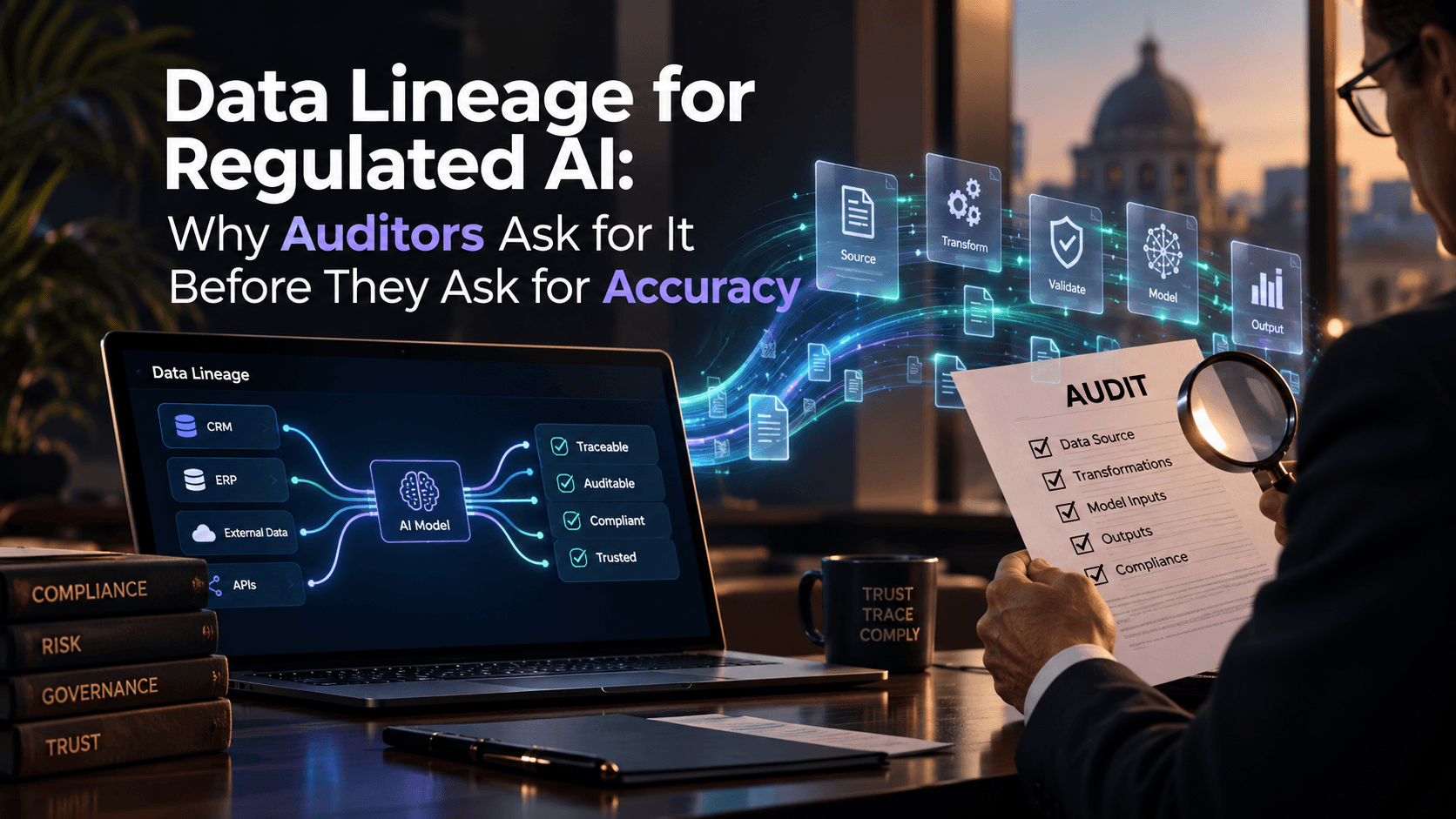
Most teams building data lineage into their AI programs treat it as a documentation afterthought, something to backfill once a model is already in production and performing well. Auditors do not see it that way. Before an examiner asks how accurate a model is, they ask where its data came from, what happened to it along the way, and who controlled each transformation. An accurate model built on untraceable data is not defensible, it is a number nobody can explain if it turns out to be wrong. Data lineage is the evidence trail that makes accuracy claims worth anything at all.
Data Lineage:
Data lineage is the traceable record of where data originated, how it was transformed, and which systems and controls touched it before reaching a report or model, and regulators check it first because accuracy without traceability cannot be independently verified. The Basel Committee's BCBS 239 principles, published in 2013, require banks to maintain end to end, attribute level lineage from source systems through to final risk reporting, and Singapore's systemically important banks are expected to align with this standard. The same lineage infrastructure that satisfies a BCBS 239 examiner increasingly answers the same questions for AI governance, which data an agent accessed, what quality signals were present, and which policies applied.
What data lineage actually means for regulated AI
Data lineage regulated ai teams need is more specific than a general data flow diagram. It requires column level, or attribute level, tracking from the moment data is captured through every transformation, aggregation, and system it passes through, ending at the report, model input, or AI agent decision that uses it.
This differs from a simple architecture diagram in one critical way, lineage needs to be reconstructable on demand, not documented once and left to go stale. Our guide on what data lineage actually is covers the technical distinction between lineage, provenance, and general data cataloging in more depth. Model auditability depends entirely on this distinction, since a model's fairness testing results mean little if the data underneath them cannot be traced back to a verified source.
Take the First Step Toward AI Transformation
Why auditors check lineage before accuracy in 2026
Data lineage for auditors has become the first question, not an afterthought, for three reasons.
BCBS 239 explicitly requires it, and MAS expects alignment. The Basel Committee's principles mandate complete, attribute level lineage from source to report, and MAS has indicated Singapore's domestic systemically important banks should align with this standard, not treat it as optional guidance.
AI governance and risk data lineage now require the same infrastructure. The column level granularity, end to end coverage, and audit history BCBS 239 demands for risk reporting are the same capabilities an examiner asks for when reviewing an AI model's data inputs or an agent's decision trail.
Nearly a decade after BCBS 239's implementation deadline, gaps remain widespread. The Basel Committee's own progress reports have repeatedly found that most banks still have not achieved full compliance, with data lineage cited specifically as an ongoing challenge in its most recent 2026 implementation review.
Our companion pieces on AI audit methodology and regulatory compliance for AI both cover how lineage evidence fits into the broader examination process an institution needs to prepare for.
How to build data lineage that survives an audit
How to make data lineage using ai tools has become part of the answer, since manual lineage documentation cannot keep pace with a modern data environment.
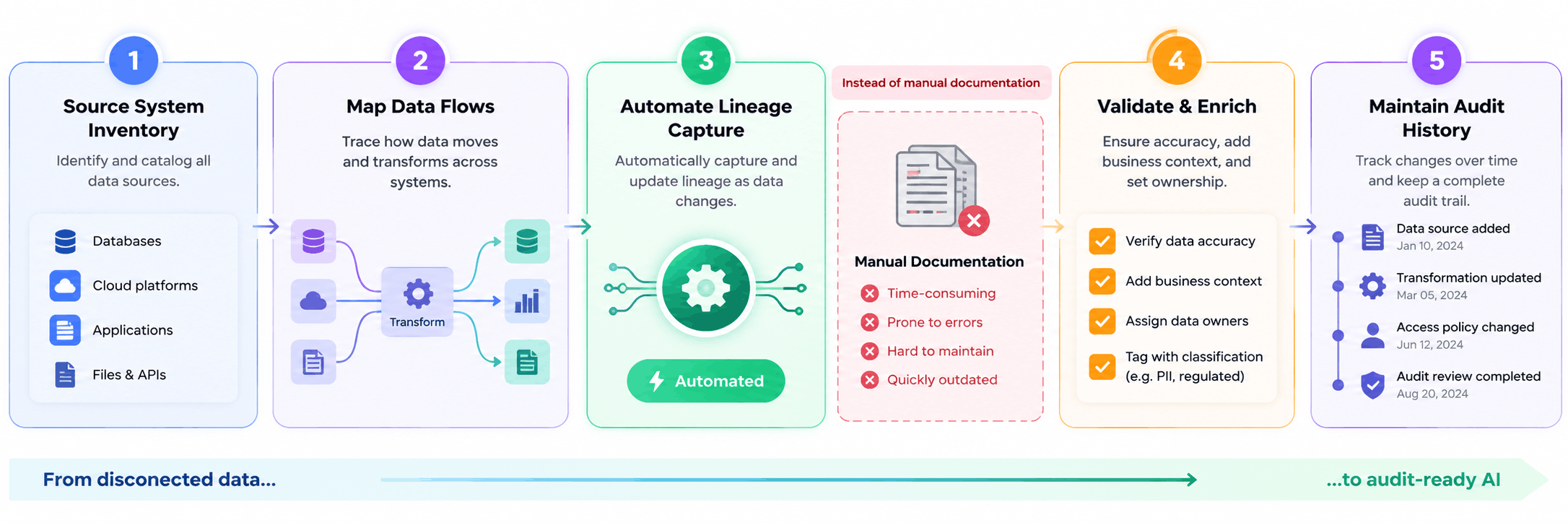
Inventory every source system feeding regulated reports or AI models. Lineage cannot start from an incomplete picture of where data actually originates.
Capture lineage at the attribute level, not the system level. Knowing that data flows from System A to System B is not sufficient, examiners expect to see which specific fields were used and how they were transformed.
Automate lineage capture rather than relying on static documentation. A diagram drawn once goes stale the moment a pipeline changes, which is the specific failure mode BCBS 239 progress reports keep flagging.
Extend lineage coverage to AI specific data dependencies. A model's training data, an agent's real time data access, and a report's underlying figures all need the same traceability standard applied consistently.
Maintain audit history alongside lineage itself. Examiners need to see not just where data came from, but when lineage was last verified and by whom.
This is where the engineering execution layer matters. Samta.ai builds automated lineage capture into the VEDA AI decision analytics platform, integrating with existing Databricks, Snowflake, or Microsoft data infrastructure through our data integration consulting services so lineage is captured continuously rather than reconstructed manually before each audit cycle. Institutions evaluating whether a general analytics tool can hold this evidence should see how VEDA compares to other data intelligence platforms, since most were not built to maintain attribute level lineage alongside AI governance evidence in one system. The VEDA platform treats lineage as a continuously maintained record, not a static diagram refreshed only when an audit is scheduled. Our guides on data engineering for BFSI and data discovery for AI cover the foundational work most institutions need before automated lineage capture becomes possible at all.
Data lineage maturity levels at a glance
Maturity Level | What Exists | What Is Missing | Audit Readiness | Typical Institution |
No Lineage | Data flows exist but are undocumented | Any traceable record of data origin or transformation | Cannot answer basic auditor questions | Early stage or legacy system heavy firms |
Manual Documentation | Static diagrams and spreadsheets mapping data flows | Real time accuracy, since diagrams go stale quickly | Slow, labor intensive audit preparation | Firms early in BCBS 239 alignment |
Partial Automated Lineage | Automated lineage for some systems or reports | End to end coverage across all source systems | Defensible for some reports, not others | Mid maturity institutions |
Column Level Automated Lineage | Attribute level tracking from source to report | Integration with AI specific model and agent lineage | Strong for traditional risk reporting | Advanced BCBS 239 aligned banks |
AI Integrated Lineage | Column level lineage extended to model and agent data dependencies | Little, this is the target state most institutions are working toward | Audit ready for both risk reporting and AI governance | Institutions treating data and AI governance as one system |
See How Exposed Your AI Models Are
Real world enterprise use cases
BFSI: a bank unable to trace an AI model's training data to source
A bank's model risk committee asked its data science team to trace the training data behind a credit risk model back to its original source systems, and discovered the lineage had only ever been documented at a high, system level summary, not the attribute level BCBS 239 already required for its risk reporting. Extending AI security and compliance services to cover model training data closed the gap using the same lineage standard the bank already applied to its regulatory reports.
General enterprise: a proptech firm scaling data pipelines faster than documentation
A proptech firm scaling its pricing and recommendation models across multiple new data sources found its lineage documentation, built manually early on, could no longer keep pace with how quickly new pipelines were added. Reviewing enterprise AI engineering in Singapore helped the firm move to automated lineage capture before an enterprise client's procurement audit asked for evidence the firm could not yet produce.
Key risks and failure modes
Treating lineage as a documentation deliverable rather than a living system. A lineage diagram filed after a project completes is out of date the moment the underlying pipeline changes.
Stopping lineage at the system level instead of the attribute level. Knowing data moved from one system to another does not answer which specific fields an examiner is asking about.
Building lineage for risk reporting but not for AI models. The same traceability standard BCBS 239 requires for a risk figure applies equally to the data behind a model's prediction or an agent's decision.
No audit trail for the lineage system itself. Examiners increasingly ask not just what the lineage shows, but when it was last verified and by whom.
Assuming manual sampling is sufficient during stable periods. Lineage built on manual sampling breaks down precisely when data landscapes change rapidly, which is when regulators scrutinize it most closely.
When to prioritize lineage automation now
Prioritize automation immediately when:
Your institution cannot currently trace a reported figure or a model's training data to its original source on demand
Manual lineage documentation has fallen behind the pace of new data pipelines being added
An upcoming examination or client audit is likely to request lineage evidence you cannot yet produce
Existing manual processes may hold for now when:
Data environments are genuinely stable with few new pipelines or sources being added
Lineage documentation, while manual, is current and has been recently verified
No AI models or agents currently depend on data sources outside your existing documented lineage
Reviewing Samta.ai's case studies alongside your own lineage documentation gives a useful benchmark for how other institutions have approached this transition.
Get Personalized AI Consulting for Your Business
Conclusion
Data lineage is the evidence an examiner checks before accuracy claims mean anything, and institutions that treat it as a living system rather than a documentation deliverable are the ones that can answer an auditor's questions on demand. Building attribute level, automated lineage for both risk reporting and AI models now closes a gap that manual documentation cannot keep pace with.
About Samta
Samta.ai is a Singapore-headquartered AI Product Engineering & Data Intelligence partner helping enterprises build production-grade AI systems for regulated and data-intensive environments.We help organizations move beyond experimentation by engineering scalable, explainable, and enterprise-ready AI solutions from data foundations and model development to workflow automation and deployment.
Our capabilities combine deep AI expertise, data engineering, and product engineering to deliver measurable business impact across FinTech, BFSI, cybersecurity, regulatory technology, and enterprise operations.
Our enterprise AI products power real-world intelligence systems:
• TATVA : AI-driven data intelligence platform for governed analytics, monitoring, and operational insights
• VEDA : Explainable and audit-ready AI decisioning engine built for compliance-sensitive enterprise workflows
• CORA-Property Management Solutions: : Predictive intelligence platform for real-estate pricing, portfolio optimization, and investment analytics
Backed by ecosystem partnerships with Microsoft, Databricks, Snowflake, and AWS, Samta.ai delivers agile, cost-efficient AI engineering with faster turnaround and enterprise-grade scalability. Trusted by enterprises across FinTech, BFSI, and digital transformation initiatives, Samta.ai embeds AI governance, data privacy, and compliance-by-design principles directly into the AI lifecycle , enabling organizations to scale AI with transparency, accountability, and operational control.
Enterprises leveraging Samta.ai automate 65%+ of repetitive data, analytics, and decision workflows while maintaining governance, explainability, and measurable business outcomes. Samta.ai provides the strategic consulting, AI engineering, and data modernization expertise needed to align enterprise operations with next-generation AI transformation goals.
Frequently asked questions
What is data lineage in the context of regulated AI?
Data lineage is the traceable record of where data originated, how it was transformed, and which systems and controls touched it before reaching a report, model, or AI agent decision, maintained at the attribute level rather than as a general system diagram.
Why do auditors ask for data lineage before accuracy?
Accuracy claims cannot be independently verified without traceability. An examiner needs to see how a number or model output was produced, not just what the final value is, since the underlying data's integrity determines whether the accuracy claim means anything at all.
Does BCBS 239 apply to AI models specifically?
BCBS 239 was written for risk data aggregation and reporting, not AI specifically, but the same attribute level, end to end lineage capability it requires is increasingly expected to extend to AI model training data and agent decision trails as well.
How is data lineage different from a data flow diagram?
A data flow diagram typically documents system level movement at a point in time. Data lineage requires attribute level tracking that can be reconstructed on demand, reflecting the current state of pipelines rather than a static snapshot that goes stale.
Can data lineage be built manually, or does it require automation?
Manual lineage documentation is possible but does not scale, since it goes stale as soon as pipelines change and cannot be reconstructed quickly during an audit. Automated lineage capture is what most institutions need to meet BCBS 239 and AI governance evidence standards consistently.