
Summarize this post with AI
Most Singapore financial institutions have data. Very few have data pipelines that can survive a MAS examination. Data engineering for BFSI Singapore is not the same discipline as general enterprise data engineering it requires lineage documentation, audit trail infrastructure, and quality controls embedded at the pipeline layer from day one, not added retrospectively when a regulator requests them. This guide gives Chief Data Officers, CTOs, and data engineering leads in Singapore's BFSI industry a structured framework for building pipelines that are both operationally reliable and examination-ready covering MAS TRM requirements, audit trail design, and the specific financial services data engineering patterns that separate compliant pipelines from expensive remediation projects.
Data Engineering for BFSI Singapore:
Data engineering for BFSI Singapore must satisfy requirements that general enterprise pipelines do not: documented data lineage from source to model inference, automated quality scoring with threshold alerting, PDPA-compliant consent tracking for customer data, and MAS TRM-aligned audit trail generation at every pipeline stage. Audit-ready data pipelines in Singapore financial services are built on governed platforms Snowflake, Databricks, or Microsoft Azure with lineage, quality, and access control infrastructure embedded during build, not retrofitted after examination findings. Institutions that treat data governance as a pipeline engineering requirement rather than a documentation exercise consistently pass MAS examinations with fewer remediation findings.
What BFSI Data Engineering Actually Means
What is the BFSI industry in data terms? Banking, Financial Services, and Insurance a sector where every data pipeline that feeds a customer-facing decision, a risk model, or a regulatory report carries obligations that consumer and enterprise pipelines do not.
Financial services data engineering covers six distinct pipeline categories, each with different governance requirements:
Transactional data pipelines: payment processing, settlement, and reconciliation feeds; require sub-second latency and complete audit trails for financial crime investigation
Credit and risk data pipelines: customer financial data, bureau data, and alternative data feeding credit scoring and risk models; require consent documentation and model lineage tracking
Regulatory reporting pipelines: MAS regulatory returns, FATF reporting, and Basel III capital adequacy feeds; require point-in-time data snapshots and versioned lineage
Customer analytics pipelines: behavioural and transactional data for customer segmentation and product recommendation; require PDPA consent management at the data layer
Fraud detection pipelines: real-time transaction monitoring feeds; require low-latency architecture with complete event logging for investigation replay
Model training and inference pipelines: data feeds for AI credit, fraud, and churn models; require feature lineage, training data versioning, and inference audit trails
Each category has different latency, quality, and governance requirements. Data in financial services cannot be treated as a uniform engineering problem pipeline design must reflect the regulatory and operational obligations of the specific data category. Review BFSI AI consulting services to understand how data engineering sits within the broader BFSI AI program structure.
Get a complimentary assessment of your BFSI data pipeline's audit readiness against MAS TRM and PDPA requirements
Why Audit-Ready Pipeline Design Is Non-Negotiable in 2026
Three regulatory developments have made audit ready data pipelines a baseline requirement rather than a best practice:
1. MAS TRM examinations now reach the pipeline layer
MAS Technology Risk Management examinations have expanded beyond policy review to include technical inspection of data pipeline architecture, access controls, and audit trail completeness. Institutions are receiving findings not for bad data but for pipelines with incomplete lineage, manual transformation steps with no logging, and access logs that do not satisfy MAS audit trail standards. Review the MAS technology risk notice requirements to understand exactly what pipeline-level documentation MAS now expects.
2. AI model governance requirements extend to training data
Every AI model deployed in Singapore BFSI is expected to have documented lineage for its training data under MAS TRM and FEAT requirements. This means the data pipeline feeding a credit scoring or fraud detection model is in scope for model risk governance not just the model itself. Institutions whose training data pipelines lack versioning and lineage documentation cannot satisfy model card requirements.
3. PDPA enforcement on data pipelines is increasing
The Personal Data Protection Commission has increased scrutiny of how financial institutions manage consent at the data pipeline layer specifically whether consent status is tracked and enforced as data moves through transformation and storage layers, not just at collection. Pipelines that collect consent at the application layer but lose that metadata in ETL transformation are creating PDPA exposure at scale. Understanding why AI model monitoring depends on pipeline integrity makes clear that data engineering quality is the upstream constraint on every downstream AI governance obligation.
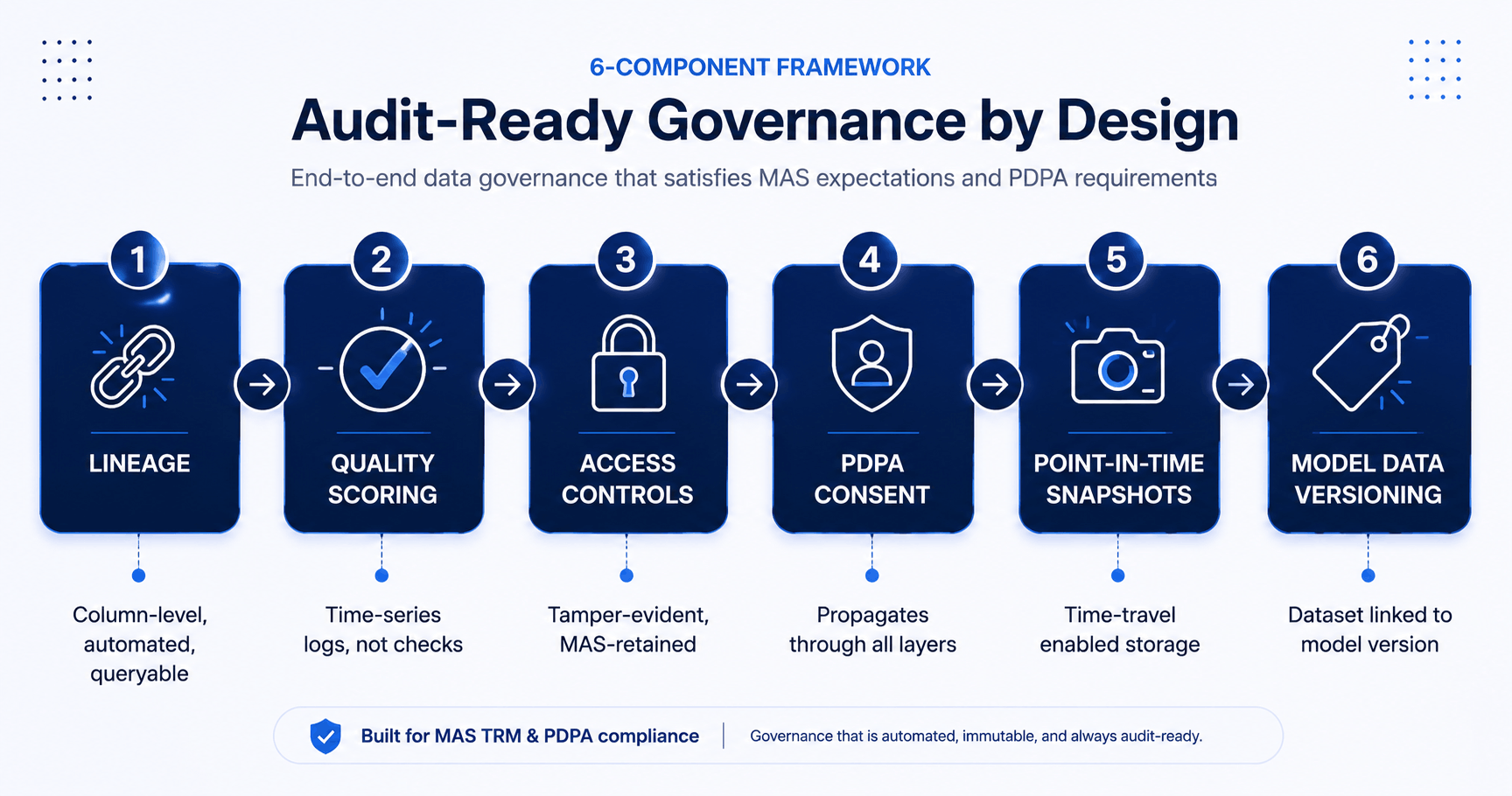
The 6-Component Framework for Audit-Ready BFSI Data Pipelines
Component 1: Data Lineage Infrastructure
Every pipeline must produce automated, queryable lineage from source system to final consumption layer covering every transformation, join, filter, and aggregation applied to the data. Lineage must be stored independently of the pipeline itself so that it survives pipeline failures and remains available for audit purposes even if the pipeline is modified or decommissioned. On Databricks, Unity Catalog provides automated lineage capture at the column level the granularity MAS examinations increasingly require. On Snowflake, Access History and Data Lineage views provide equivalent coverage. Manual lineage documentation in spreadsheets or data dictionaries does not satisfy MAS examination standards.
Component 2: Data Quality Scoring and Alerting
Every pipeline must include automated data quality scoring completeness, accuracy, consistency, and timeliness with defined thresholds and alerting for threshold breaches. Quality scores must be logged alongside the data they describe, creating a time-series quality record that can be produced during examination to demonstrate that data quality has been monitored continuously, not checked manually before reporting cycles. Samta.ai's data integration consulting services implement Great Expectations or Databricks Data Quality as the quality layer on every BFSI pipeline engagement producing the automated quality logs that MAS examiners request.
Component 3: Access Control and Audit Logging
Every pipeline must implement role-based access control with complete, tamper-evident logging of every data access event who accessed what data, when, from which system, and for what purpose. Access logs must be retained for the period specified in MAS TRM guidelines and be producible in a structured format during examination. On Microsoft Azure, Purview provides access governance and audit logging at the data asset level. On Snowflake, Query History and Access History logs satisfy MAS audit trail requirements when correctly configured and retained.
Component 4: PDPA Consent Tracking
For pipelines handling personal customer data, consent status must be tracked as a metadata attribute that propagates through every transformation layer. When a customer withdraws consent, the pipeline must be capable of identifying every downstream system and model that has consumed that customer's data and initiating the deletion or suppression workflow required by PDPA. This requires consent management infrastructure at the data catalogue layer, not just at the application layer. Institutions that track consent only in their CRM and not in their data platform cannot satisfy PDPA deletion obligations for data that has already been transformed and consumed by downstream models.
Component 5: Point-in-Time Snapshot Capability
Regulatory reporting pipelines must be capable of reproducing the exact data state that existed at any historical reporting date for MAS regulatory returns, capital adequacy calculations, and financial crime investigation replay. This requires versioned data storage either time-travel capability on Snowflake or Delta Lake time-travel on Databricks rather than overwrite-based storage patterns. Samta.ai's AI security and compliance services configure time-travel and snapshot infrastructure as a standard component of every regulated BFSI pipeline build.
Component 6: Model Training Data Versioning
For pipelines feeding AI models, every training dataset must be versioned and linked to the model version it produced. When a model is retrained, the new training dataset version must be documented enabling regulators and internal model risk teams to reconstruct exactly which data produced which model version at any point in the model's production lifecycle. The VEDA AI Decision Analytics Platform connects model version records to training data version records automatically providing the end-to-end model lineage that MAS model risk governance requires without manual documentation overhead.
Data Engineering for BFSI Singapore: 5-Column Compliance Comparison
Pipeline Component | Ungoverned Pipeline | Partially Governed | Fully Audit-Ready | Samta.ai Implementation |
Data Lineage | None — manual documentation only | Table-level lineage | Column-level automated lineage | Unity Catalog / Snowflake lineage, queryable by examiners |
Data Quality | Manual pre-reporting checks | Automated checks, not logged | Automated checks with time-series quality log | Great Expectations with examination-ready quality records |
Access Audit Trail | System logs only, not structured | Structured logs, partial coverage | Complete tamper-evident access log | Azure Purview / Snowflake Access History, MAS-retained |
PDPA Consent Tracking | Application layer only | Partial propagation | Full propagation through pipeline | Catalogue-level consent metadata with deletion workflow |
Model Training Versioning | None — notebooks only | Manual dataset snapshots | Automated dataset versioning linked to model version | VEDA-connected training data lineage, examination-ready |
Identify which of your BFSI data pipelines carry the highest regulatory examination risk before MAS does.
Real-World Use Cases: BFSI Data Pipeline Governance in Practice
Use Case 1: Credit Risk Data Pipeline, Singapore Bank
A Singapore-licensed bank's credit scoring model was flagged during an internal model risk review because the training data pipeline had no documented lineage — data scientists could not identify which source systems, transformation logic, or time periods had produced the training dataset for the current production model.
Rebuilding the pipeline on Databricks with Unity Catalog lineage, versioned Delta Lake training datasets, and automated quality scoring took 14 weeks. The rebuilt pipeline passed a subsequent MAS model risk examination without remediation findings. The retroactive rebuild cost SGD 340,000 estimated at 4x the cost of building with governance embedded from the start. This reflects the core tension in data systems software engineering for regulated institutions: the cheapest point to embed audit-ready design is during initial build, and the most expensive is during regulatory-mandated remediation. Explore how VEDA compares to other data intelligence platforms for this specific use case context.
Use Case 2: Regulatory Reporting Pipeline, Regional Insurer
A regional Singapore-based insurer needed to demonstrate point-in-time reproducibility of its MAS regulatory returns after a data quality incident caused a restatement in a prior quarter's submission. Its existing pipeline used overwrite-based storage with no time-travel capability making historical state reconstruction impossible without manual data recovery from backup systems. Migrating the regulatory reporting pipeline to Snowflake with time-travel enabled and structured Access History logging resolved the examination finding within 10 weeks. Every subsequent regulatory return is now producible at any historical date within the MAS retention window. The future of AI governance for financial institutions increasingly requires this level of pipeline auditability as standard not as a remediation capability.
Key Risks and Failure Modes in BFSI Data Pipeline Engineering
Lineage gaps at transformation boundaries: pipelines that track lineage within a single platform but lose it when data crosses system boundaries create the most common examination gap; lineage must span the entire data journey, not just within one tool
Quality checks without quality logs: running data quality checks before reporting without logging the check results and scores produces no audit evidence; examiners want to see time-series quality records, not current-state dashboards
Access logs that are not tamper-evident: access logs stored in systems that pipeline operators can modify do not satisfy MAS audit trail requirements; logs must be immutable and independently retained
Consent metadata lost in transformation: ETL pipelines that strip metadata during transformation create PDPA exposure for every downstream system; consent must propagate as a first-class pipeline attribute
Manual notebook-based model training: data scientists who train models in Jupyter notebooks with no versioning create a model governance gap that cannot be closed without rebuilding the training pipeline entirely
Applications of AI for BFSI consistently fail governance examination when they are built on top of ungoverned data pipelines because the model governance requirements extend upstream to the data layer. Review AI consulting for BFSI to understand how the most examination-ready BFSI AI programs structure data and model governance as a single integrated discipline.
Decision Checklist: Is Your BFSI Data Pipeline Examination-Ready?
Your pipeline is examination-ready when:
Column-level automated lineage is queryable from source to consumption for every regulated pipeline
Data quality scores are logged as time-series records, not checked only before reporting
Access logs are tamper-evident, structured, and retained for the full MAS-required period
PDPA consent metadata propagates through every transformation layer with deletion workflow capability
Regulatory reporting pipelines have point-in-time reproducibility via time-travel or versioned snapshots
Model training datasets are versioned and linked to the model versions they produced
Your pipeline has examination risk when:
Lineage exists only as manual documentation in a data dictionary or spreadsheet
Data quality is checked before reporting but results are not logged
Access logs are held in systems that pipeline operators can access and modify
Consent is tracked only at the application layer and not propagated through ETL
Model training is conducted in notebooks with no dataset versioning
Plan Your Compliance-Ready Data Platform Strategy

Conclusion
Data engineering for BFSI Singapore is not a technology choice it is a regulatory obligation that determines whether your AI models, regulatory reports, and customer data operations can survive examination. Audit-ready pipelines require lineage, quality logging, access controls, consent tracking, and model training versioning embedded during build not added when an examiner asks for them. The institutions that invest in examination-ready pipeline design now are avoiding the remediation costs and regulatory findings that ungoverned pipelines consistently produce. Build once, govern from day one, and make auditability a pipeline engineering requirement not a documentation afterthought.
About Samta
Samta.ai is a Singapore-headquartered AI Product Engineering & Data Intelligence partner helping enterprises build production-grade AI systems for regulated and data-intensive environments.We help organizations move beyond experimentation by engineering scalable, explainable, and enterprise-ready AI solutions from data foundations and model development to workflow automation and deployment.
Our capabilities combine deep AI expertise, data engineering, and product engineering to deliver measurable business impact across FinTech, BFSI, cybersecurity, regulatory technology, and enterprise operations.
Our enterprise AI products power real-world intelligence systems:
• TATVA : AI-driven data intelligence platform for governed analytics, monitoring, and operational insights
• VEDA : Explainable and audit-ready AI decisioning engine built for compliance-sensitive enterprise workflows
• CORA-Property Management Solutions: : Predictive intelligence platform for real-estate pricing, portfolio optimization, and investment analytics
Backed by ecosystem partnerships with Microsoft, Databricks, Snowflake, and AWS, Samta.ai delivers agile, cost-efficient AI engineering with faster turnaround and enterprise-grade scalability. Trusted by enterprises across FinTech, BFSI, and digital transformation initiatives, Samta.ai embeds AI governance, data privacy, and compliance-by-design principles directly into the AI lifecycle , enabling organizations to scale AI with transparency, accountability, and operational control.
Enterprises leveraging Samta.ai automate 65%+ of repetitive data, analytics, and decision workflows while maintaining governance, explainability, and measurable business outcomes. Samta.ai provides the strategic consulting, AI engineering, and data modernization expertise needed to align enterprise operations with next-generation AI transformation goals.
Frequently Asked Questions
What is data engineering for BFSI and how does it differ from general enterprise data engineering?
Data engineering for BFSI Singapore differs from general enterprise data engineering in four governance requirements: automated data lineage at the column level for MAS TRM compliance, PDPA consent tracking propagated through every transformation layer, point-in-time snapshot capability for regulatory reporting reproducibility, and model training data versioning for AI model governance. General enterprise pipelines optimise for reliability and performance; BFSI pipelines must optimise for all of those plus examination-ready auditability.
What does MAS TRM require from data pipelines in Singapore financial institutions?
MAS Technology Risk Management guidelines require Singapore financial institutions to maintain complete audit trails for data access, processing, and transformation — with logs retained for defined periods and producible in structured format during examination. For AI model-related pipelines, MAS also expects data lineage documentation that connects training data to model versions. Institutions should review the MAS technology risk notice requirements specifically for pipeline-level obligations.
What are audit-ready data pipelines and why do Singapore banks need them?
Audit ready data pipelines are data engineering systems with embedded lineage tracking, quality logging, access audit trails, and governance controls that can produce examination-ready documentation on demand without manual reconstruction. Singapore banks need them because MAS examinations increasingly inspect pipeline architecture directly, and the cost of retroactive remediation when pipelines fail examination is 3–4x the cost of building with governance embedded from the start.
What platforms are best for BFSI data engineering in Singapore?
The leading platforms for financial services data engineering in Singapore are Snowflake (for governed data warehousing with Access History and time-travel), Databricks with Unity Catalog (for lakehouse architecture with column-level lineage and Delta Lake versioning), and Microsoft Azure with Purview (for enterprise data governance and access audit trail management). The right choice depends on existing infrastructure, latency requirements, and the specific pipeline categories that need to be governed. All three can be configured to satisfy MAS TRM audit trail standards when implemented correctly.
How does PDPA affect data pipeline design for Singapore financial institutions?
PDPA requires that Singapore financial institutions can identify every system holding a specific customer's personal data and can execute deletion or suppression on request. For data pipelines, this means consent metadata must be tracked as a first-class pipeline attribute that propagates through every transformation, join, and aggregation layer. Pipelines that collect consent at the application layer but strip that metadata during ETL cannot satisfy PDPA deletion obligations for data that has flowed into downstream models and reports.