
Summarize this post with AI
A customer who gets approved for a loan can still vanish at the video call. That single step is where most digital onboarding programs quietly lose their best customers. Digital kyc onboarding in India fails less often on eligibility and more often on friction, a slow video queue, a bandwidth drop, a form that assumes English. This piece maps exactly where drop offs happen and what actually fixes each one.
Digital KYC onboarding:
Digital KYC onboarding in India combines Aadhaar eKYC, video based customer identification and document verification to open accounts remotely, governed by the RBI's Master Direction on Know Your Customer. The highest drop off typically happens at the video KYC stage itself, where industry benchmarking from HyperVerge's 2026 Digital Onboarding Benchmark Report found savings account approval rates as low as 37 percent once network and queue related failures are included. Fixing this requires addressing friction before the video call, not just during it, through pre fill, liveness checks optimised for low bandwidth, and vernacular onboarding support.
What is digital KYC onboarding?
Digital kyc onboarding is the process of verifying a new customer's identity and opening an account remotely, without a physical branch visit, using digital identity verification methods.
This differs from a narrower video kyc process, which is one specific stage within the broader onboarding journey, typically the final verification step before an account is approved.
Related terms include ekyc onboarding, which specifically refers to Aadhaar based electronic verification, and customer onboarding automation, the broader practice of removing manual steps across the full account opening journey, not just the identity verification piece.
For a deeper breakdown of how AI fits into this process, see KYC automation and AI and how this compares against a traditional approach in AI KYC versus traditional KYC.
Benchmark Your Enterprise AI Readiness
Why this matters now for Indian banks and NBFCs
Three developments make fixing onboarding drop off urgent in 2026.
The regulatory framework itself has matured significantly: The RBI's Master Direction on Know Your Customer, most recently updated August 2025, formally defines the CKYC registry and video based customer identification, giving institutions a clear compliance structure to build onboarding around.
Drop off at the video stage remains the single biggest leak: Industry benchmarking in HyperVerge's 2026 Digital Onboarding Benchmark Report, drawn from over 10 million video KYC verifications, found savings account approval rates as low as 37 percent, with a meaningful share of drop off attributable to network issues alone rather than ineligibility.
Identity infrastructure keeps expanding, but friction has not disappeared with it: UIDAI's Aadhaar authentication ecosystem now supports biometric, OTP and offline paperless eKYC, yet onboarding programs that do not design around real world bandwidth and language conditions still lose customers at the same rate as programs built years ago.
See how this plays out for a BFSI consulting engagement in AI consulting for BFSI and the broader AI adoption picture in how AI is used in BFSI.
A five step framework to find and fix drop off
Here is the sequence that identifies exactly where customers are leaving, rather than guessing.
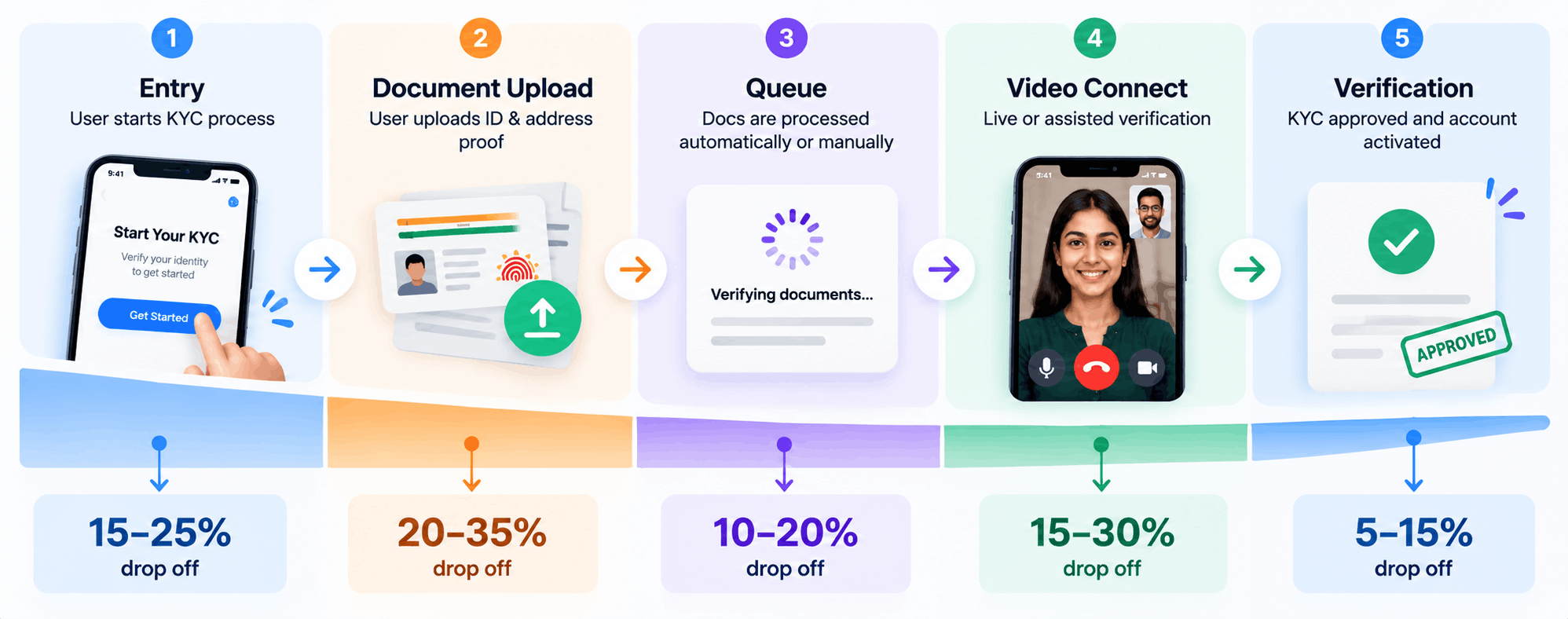
Map the full funnel stage by stage. Entry, document upload, queue wait, video connect, and final verification each have distinct drop-off rate patterns, and treating the funnel as one number hides which specific stage is bleeding customers.
Reduce friction before the video call starts. Pre filling customer details through Aadhaar eKYC and CKYC lookups before the video stage begins removes steps that cause early abandonment, since customers who have already typed their details once are far less likely to abandon a pre filled confirmation.
Build for low bandwidth, not ideal conditions. A significant share of savings account drop off is attributable to network issues, so a liveness check and video flow that degrades gracefully under poor connectivity directly reduces this category of loss.
Support regional languages throughout. Vernacular onboarding removes a quiet but significant source of abandonment for customers more comfortable outside English, particularly in tier two and tier three markets where digital account growth is fastest.
Monitor and iterate continuously. A funnel fixed once and never revisited drifts back toward its original drop off rate as customer demographics and network conditions shift. Workflow automation consulting supports institutions building this ongoing monitoring discipline directly, and Samta.ai's onboarding and KYC platform and the underlying onboarding KYC product serve this layer as the engineering execution point once the funnel gaps are identified.
Comparing five approaches to digital KYC onboarding
Approach | Drop off rate | Completion time | Vernacular support | Best fit |
Physical branch only | Lowest at the verification stage, but high pre branch abandonment | Days, requires a visit | Natural, in person | Rural or low digital literacy segments |
Basic digital form plus manual video KYC | High, often 50 to 70 percent at video stage | 8 to 10 minutes per call, plus queue wait | Limited, usually English only | Institutions early in digital adoption |
Standard video KYC platform, not optimised | Medium to high, significant network related loss | 5 to 8 minutes per call | Limited | Mid sized NBFCs with basic digital infrastructure |
AI powered KYC with pre fill and liveness check | Lower, pre fill reduces early abandonment | 2 to 4 minutes per call | Varies by vendor | Banks and NBFCs scaling digital acquisition |
Vernacular AI KYC platform optimised for low bandwidth | Lowest, addresses network and language friction together | Under 2 minutes per call in good conditions | Strong, multiple regional languages | High volume digital lenders and neobanks |
The last row addresses the two largest drop off causes, network friction and language barriers, together rather than separately. For named case examples of this kind of improvement, see Samta.ai's case studies.
Assess Your AI Model Risk with Confidence
Real world use cases
Regulated bank: video KYC drop off cut through pre fill and bandwidth design
A private sector bank's browser based video KYC setup saw drop off approaching 70 percent at the video stage, driven by agents juggling separate systems and calls stretching past eight minutes. Customers were leaving mid process despite strong top of funnel demand. Pre-filling customer details before the video call began and building the video flow to work reliably across browsers and low bandwidth conditions brought completion rates up substantially, alongside a meaningful reduction in cost per KYC call.
General enterprise: NBFC losing high intent borrowers to a rigid funnel
A digital lending NBFC found that borrowers with stronger credit profiles were dropping off at similar rates to weaker applicants, because the standard onboarding journey treated every applicant identically regardless of risk profile or likely approval. Pre qualification was happening too late in the funnel to matter. Restructuring the journey to pre qualify earlier, with Aadhaar based verification reducing per customer onboarding cost significantly compared to manual verification, reduced drop off among the bank's highest value segment specifically.
Key risks and failure modes
Treating video KYC drop off as a single number. Entry stage, document upload and video connect each fail for different reasons, and a blended drop off rate hides which specific fix matters most.
Designing for ideal network conditions only. Standard video setups that freeze or drop audio under modest packet loss lose a meaningful share of savings account customers to network issues alone.
Treating compliance steps as pure friction to minimise. RBI's KYC requirements, properly designed into the journey rather than bolted on, do not have to be the primary driver of abandonment.
Ignoring vernacular needs. A customer who cannot complete the journey comfortably in their preferred language abandons quietly, often without generating a support ticket that would flag the problem.
No pre qualification before onboarding begins. Running every applicant through the full journey regardless of likely approval wastes effort and increases abandonment among applicants who would never have been approved anyway.
Measuring once and never re measuring. Drop off patterns shift as customer demographics, device mix and network conditions change, so a funnel audited a year ago may no longer reflect current reality.
When to invest in fixing onboarding drop off, and when not to
Invest now if:
Your video KYC completion rate sits meaningfully below industry benchmark figures
You are scaling digital account acquisition into tier two or tier three markets without vernacular support
A significant share of your drop off data shows network related failure rather than ineligibility
You have not pre filled customer details using Aadhaar eKYC or CKYC lookups before the video stage
Hold off, or start smaller, if:
Your current onboarding volume is too low to justify a full funnel rebuild yet
You operate primarily through branch based onboarding with no near term digital scaling plan
You have not yet instrumented your funnel to measure stage by stage drop off, in which case measurement comes before any fix
Talk to an AI Expert About Your Business Needs

Conclusion
The customer who drops off at the video call was not lost on eligibility, they were lost on friction that was preventable. Fixing digital KYC onboarding means finding that specific stage, not rebuilding the whole funnel blindly. Pre-fill before the video step, design for real network conditions, and support the languages your customers actually use. The next step is finding out exactly where your own funnel is losing people.
About Samta
Samta.ai is a Singapore-headquartered AI Product Engineering & Data Intelligence partner helping enterprises build production-grade AI systems for regulated and data-intensive environments.We help organizations move beyond experimentation by engineering scalable, explainable, and enterprise-ready AI solutions from data foundations and model development to workflow automation and deployment.
Our capabilities combine deep AI expertise, data engineering, and product engineering to deliver measurable business impact across FinTech, BFSI, cybersecurity, regulatory technology, and enterprise operations.
Our enterprise AI products power real-world intelligence systems:
• TATVA : AI-driven data intelligence platform for governed analytics, monitoring, and operational insights
• VEDA : Explainable and audit-ready AI decisioning engine built for compliance-sensitive enterprise workflows
• CORA-Property Management Solutions: : Predictive intelligence platform for real-estate pricing, portfolio optimization, and investment analytics
Backed by ecosystem partnerships with Microsoft, Databricks, Snowflake, and AWS, Samta.ai delivers agile, cost-efficient AI engineering with faster turnaround and enterprise-grade scalability. Trusted by enterprises across FinTech, BFSI, and digital transformation initiatives, Samta.ai embeds AI governance, data privacy, and compliance-by-design principles directly into the AI lifecycle , enabling organizations to scale AI with transparency, accountability, and operational control.
Enterprises leveraging Samta.ai automate 65%+ of repetitive data, analytics, and decision workflows while maintaining governance, explainability, and measurable business outcomes. Samta.ai provides the strategic consulting, AI engineering, and data modernization expertise needed to align enterprise operations with next-generation AI transformation goals.
Frequently asked questions
Why do customers drop off during digital KYC?
Customers most often drop off at the video KYC stage, driven by queue wait times, network instability, and forms that require re-entering information already provided earlier in the journey. A smaller but consistent share is also abandoned due to language barriers, when the journey does not support their preferred regional language throughout.
How does AI improve KYC onboarding?
AI improves onboarding by pre-filling customer details from Aadhaar eKYC or CKYC lookups before the video call, reducing redundant data entry that causes early abandonment. AI powered liveness checks and document verification also speed up the verification stage itself, while AI driven video flows can be built to degrade gracefully under poor network conditions rather than freezing entirely.
What is the vernacular KYC?
Vernacular KYC is a digital onboarding journey that supports regional Indian languages throughout the process, not just in marketing materials but in the actual verification flow, prompts and instructions. It directly addresses a quiet but significant source of drop off among customers more comfortable outside English, particularly important as digital account growth increasingly comes from tier two and tier three markets.
Best AI KYC onboarding solutions for Indian NBFCs
There is no single verified ranking of AI KYC solutions for Indian NBFCs, since rankings vary by methodology and update frequently. Evaluate based on whether a solution addresses pre fill, liveness checks optimised for low bandwidth, and vernacular support together, since these three factors address the largest documented sources of drop off rather than any one in isolation.
How to reduce drop off in digital account opening
Start by mapping drop off stage by stage rather than treating it as one number, since entry, document upload and video connect each fail for different reasons. Pre-fill customer details using Aadhaar eKYC or CKYC before the video stage, build the video flow to work under low bandwidth conditions, and add vernacular support throughout. Monitor the funnel continuously, since drop off patterns shift as customer demographics and network conditions change.