
Summarize this post with AI
Most banks can produce a full kyc ai governance audit trail for a credit scoring model in minutes, and cannot produce the same evidence for the AI that approved or rejected a new customer's onboarding application last week. That gap is not a technicality. MAS's AI Risk Management Guidelines define AI by what a system does, generating a prediction, recommendation, or decision through learning or inference, not by which department deployed it. An onboarding model rejecting a legitimate customer, or missing a genuine risk signal, carries the same regulatory and reputational weight as a flawed credit decision. Here is why the audit trail gap exists, and what closes it.
KYC AI Governance Audit Trail:
A kyc ai governance audit trail should meet the same standard as a credit scoring model's audit trail, model inventory listing, fairness testing, attribute level data lineage, documented explainability, and ongoing monitoring, because MAS's AI Risk Management Guidelines define AI scope by function rather than business use case. An onboarding or KYC model that screens identity documents, scores fraud risk, or flags sanctions exposure generates a decision through learning or inference the same way a credit model does, which means the proportionate, risk materiality based approach AIRG applies to credit models applies equally to onboarding models.
What KYC automation actually is, and why its governance gap exists
What is kyc compliance? It is the set of checks, identity verification, sanctions and politically exposed person screening, and risk profiling, financial institutions must run before onboarding a customer. Customer onboarding ai now automates most of this, using models to verify documents, score fraud risk, and flag cases needing manual review.
The governance gap exists for a structural reason, not a deliberate oversight. Credit scoring models sit inside a bank's established model risk function, built specifically to govern lending decisions for decades. Onboarding AI more often arrives through a vendor procurement process, treated as operational tooling rather than a model requiring the same lifecycle governance. Our guide on KYC automation in Singapore covers how quickly this category has grown, and our overview of why AI governance for financial institutions increasingly extends past credit models covers this shift in more depth.
Benchmark Your Enterprise AI Readiness
Why this gap matters more in 2026 than it did before
Ai onboarding model governance has become urgent for three specific reasons.
AIRG defines AI by function, not department. A model generating predictions, recommendations, or decisions through learning or inference qualifies under AIRG's scope regardless of whether it sits in the credit team or the onboarding team.
Onboarding decisions carry real, documented harm potential. A wrongful rejection at onboarding denies a legitimate customer access to financial services, while a missed risk signal exposes the institution to money laundering risk, both outcomes a fairness or accuracy failure in a credit model would trigger equally serious scrutiny for.
Data lineage expectations converging from risk reporting now extend to onboarding data too. The same attribute level lineage standard BCBS 239 established for risk reporting is increasingly expected for the identity and document data feeding onboarding decisions. Our guide on data lineage for regulated AI covers this convergence directly.
Our overview of AI governance and compliance covers how institutions are closing this specific gap between credit and onboarding model governance.
The audit trail framework onboarding models need
Closing this gap means applying the same five part discipline credit models already follow.
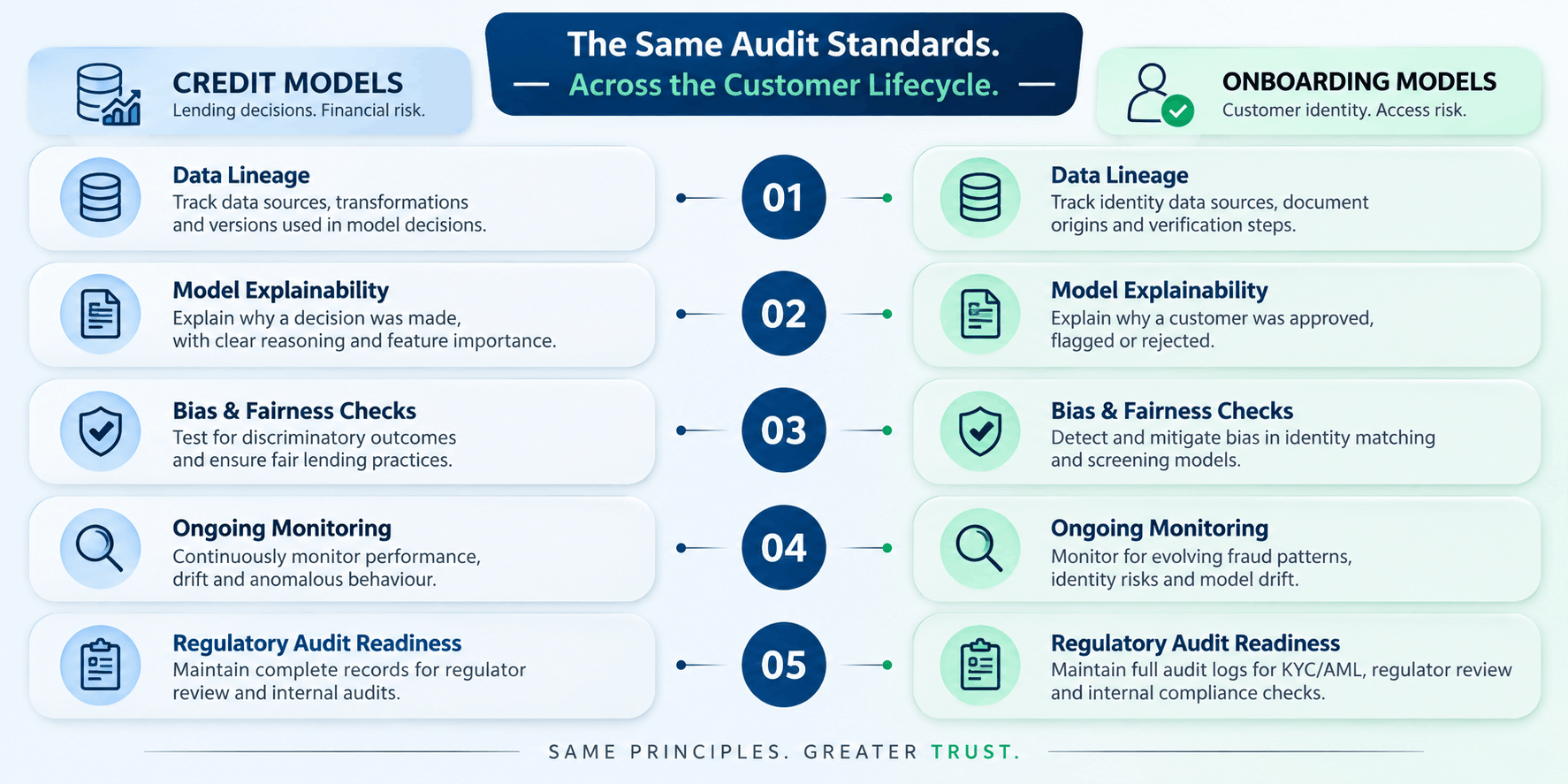
Add every onboarding and KYC model to the formal AI inventory. If a system scores fraud risk, verifies documents, or flags sanctions exposure using learning or inference, it belongs in the same inventory as credit models, not a separate operational tooling list.
Run fairness testing against acceptance and rejection rates. Onboarding models need the same demographic fairness testing credit models undergo, since wrongful rejection patterns can replicate the same bias risk FEAT was written to catch.
Establish attribute level data lineage for identity and document data. Lineage needs to trace from the original document or data source through every transformation to the final onboarding decision, not stop at a system level summary.
Document explainability for every automated rejection. A customer or examiner asking why an application was rejected needs a documented reason, not a reference to a vendor's proprietary scoring logic.
Apply the same ongoing monitoring cadence as credit models. An onboarding model retrained or reconfigured needs re assessment, since its behavior has changed the same way a retrained credit model's would.
This is where the engineering execution layer matters. Samta.ai's ONBO onboarding and KYC platform is built specifically to hold this audit trail, model inventory status, fairness testing results, lineage records, and explainability documentation in one system, rather than leaving onboarding governance as an afterthought bolted onto a vendor tool. Institutions comparing this approach against a standard KYC vendor should see how AI powered KYC compares to traditional KYC processes, and the underlying ONBO platform treats every onboarding decision as an auditable event by default. Our AI risk management model governance committee guide covers how this committee structure should formally extend its remit to cover onboarding models specifically, not just credit and fraud.
Credit models versus KYC and onboarding models: the governance gap
Governance Requirement | Credit Scoring Models | KYC and Onboarding Models | Why It Applies to Both | Common Gap |
Model Inventory | Logged with owner and risk tier | Often absent from the formal AI inventory entirely | AIRG defines AI by function, not business use case | Onboarding models treated as operational tooling, not AI |
Fairness Testing | Tested against protected group outcomes | Rarely tested for demographic bias in acceptance or rejection rates | Wrongful rejection at onboarding is as material as unfair credit denial | Fairness testing built for credit, not replicated for onboarding |
Data Lineage | Attribute level lineage expected under BCBS 239 aligned practice | Identity and document data often lacks the same lineage standard | An examiner expects the same evidence trail regardless of decision type | Lineage stops at the document, not the decision itself |
Explainability | Documented reason codes for adverse decisions | Rejection reasons often generated by a vendor black box | Customers and examiners can ask why for either decision type | No documented rationale for an automated rejection |
Ongoing Monitoring | Continuous validation tied to risk tier | Often validated once at vendor onboarding, never again | A retrained onboarding model changes behavior the same way a retrained credit model does | No re assessment cadence for onboarding specifically |
Assess Your AI Model Risk with Confidence
Real world enterprise use cases
BFSI: a bank discovering its onboarding model had no fairness testing history
A bank's model risk committee, reviewing its full AI inventory for the first time under a broader AIRG readiness exercise, discovered its onboarding fraud scoring model had never been fairness tested, despite three years in production and a documented history of manual review escalations. Extending AI security and compliance services to cover the onboarding model closed the gap using the same fairness methodology already applied to the bank's credit models.
General enterprise: a proptech firm building tenant screening automation
A proptech firm automating tenant screening realized its scoring model functioned identically to a credit decisioning model in structure, an automated accept or reject decision based on financial and identity data, even though it had never been governed as one. Reviewing enterprise AI engineering in Singapore helped the firm apply the same audit trail discipline to its screening model before a client procurement review asked for evidence it did not yet have.
Key risks and failure modes
Treating onboarding AI as a vendor tool rather than a governed model. A vendor's compliance certification does not substitute for the institution's own fairness testing and audit trail documentation.
No fairness testing for acceptance and rejection rate disparities. Onboarding models can replicate the exact bias patterns FEAT was written to prevent in credit decisions, just in a different part of the customer journey.
Lineage that stops at the document rather than the decision. Knowing a document was received is not the same as tracing how its data influenced an automated onboarding outcome.
No documented explanation for automated rejections. A rejected applicant or an examiner asking why receives no answer beyond a reference to the vendor's proprietary scoring model.
Assuming a model validated once at onboarding never needs revisiting. A vendor's periodic model updates change behavior, and the original due diligence does not reflect the current system.
When to prioritize this audit trail gap now
Prioritize immediately when:
Your onboarding or KYC model is not currently listed in your formal AI model inventory
No fairness testing has ever been run against onboarding acceptance and rejection rates
Rejected applicants or examiners cannot be given a documented reason for an automated decision
A lighter review is enough when:
The onboarding model is already logged and reviewed alongside credit models under the same governance committee
Fairness testing and lineage documentation already exist and only need a periodic refresh
The model has a defined re assessment cadence tied to vendor updates
Reach out through Samta.ai to scope which of the five requirements above needs attention first for your onboarding models specifically.
Need Help Scaling AI Across Your Enterprise?

Conclusion
A kyc ai governance audit trail should never be a lighter version of what a credit model already provides. AIRG's function based definition of AI puts onboarding and credit models under the same governance standard, and institutions that close this specific gap now will not be explaining its absence during an examination later.
About Samta
Samta.ai is a Singapore-headquartered AI Product Engineering & Data Intelligence partner helping enterprises build production-grade AI systems for regulated and data-intensive environments.We help organizations move beyond experimentation by engineering scalable, explainable, and enterprise-ready AI solutions from data foundations and model development to workflow automation and deployment.
Our capabilities combine deep AI expertise, data engineering, and product engineering to deliver measurable business impact across FinTech, BFSI, cybersecurity, regulatory technology, and enterprise operations.
Our enterprise AI products power real-world intelligence systems:
• TATVA : AI-driven data intelligence platform for governed analytics, monitoring, and operational insights
• VEDA : Explainable and audit-ready AI decisioning engine built for compliance-sensitive enterprise workflows
• CORA-Property Management Solutions: : Predictive intelligence platform for real-estate pricing, portfolio optimization, and investment analytics
Backed by ecosystem partnerships with Microsoft, Databricks, Snowflake, and AWS, Samta.ai delivers agile, cost-efficient AI engineering with faster turnaround and enterprise-grade scalability. Trusted by enterprises across FinTech, BFSI, and digital transformation initiatives, Samta.ai embeds AI governance, data privacy, and compliance-by-design principles directly into the AI lifecycle , enabling organizations to scale AI with transparency, accountability, and operational control.
Enterprises leveraging Samta.ai automate 65%+ of repetitive data, analytics, and decision workflows while maintaining governance, explainability, and measurable business outcomes. Samta.ai provides the strategic consulting, AI engineering, and data modernization expertise needed to align enterprise operations with next-generation AI transformation goals.
Frequently asked questions
Does KYC automation need the same governance as credit scoring AI?
Yes. MAS's AI Risk Management Guidelines define AI by function, generating a prediction, recommendation, or decision through learning or inference, not by department, meaning KYC and onboarding models qualify for the same governance as credit scoring models.
What audit trail does an AI based onboarding system need?
It needs a model inventory entry with a named owner, fairness testing against acceptance and rejection rates, attribute level data lineage for identity and document data, documented explainability for rejections, and an ongoing monitoring cadence, the same five elements a credit model requires.
What is ONBO?
ONBO is Samta.ai's onboarding and KYC platform, built to hold the audit trail evidence, inventory status, fairness testing, lineage, and explainability documentation, onboarding models need to meet the same governance standard as credit models.
Why do onboarding models often lack the governance credit models already have?
Credit models typically sit inside an established model risk function built over years, while onboarding AI more often arrives through a vendor procurement process and gets treated as operational tooling rather than a governed model requiring the same lifecycle oversight.
Can a vendor's KYC compliance certification replace an institution's own audit trail?
No. A vendor's certification reflects the vendor's own practices, while MAS expects the institution itself to document fairness testing, lineage, and explainability for its own specific use of that vendor's onboarding model.