
Summarize this post with AI
Over 60% of enterprise AI pilots never reach production. The models are not the problem. The AI infrastructure, data pipelines, and governance structures were never built to support them. AI-ready enterprise operations are a present-day engineering decision that separates organizations extracting real business value from AI and those accumulating expensive technical debt. This guide covers what it takes to build that foundation across three interdependent layers: data engineering, workflow automation, and AI governance and how BFSI and regulated enterprises across APAC are doing it today.
AI-Ready Enterprise Operations:
AI-ready enterprise operations require three integrated capabilities built in parallel: clean, governed data pipelines on cloud platforms such as Databricks or Snowflake; end-to-end business process automation with AI decision triggers; and a formal AI governance framework aligned to NIST AI RMF or MAS FEAT. Organizations that build all three simultaneously reduce AI deployment timelines by 30–50% (Source Required: Gartner) and achieve verifiable compliance posture before regulatory deadlines. In APAC regulated industries, this is rapidly becoming a competitive baseline, not a differentiator.
What AI-Ready Enterprise Operations Actually Means
AI-ready enterprise operations describes an organization's capacity to deploy, scale, and govern AI systems across production environments without ad hoc remediation. It is built on three pillars. Data readiness means unified, lineage-tracked data accessible to AI models in real time. Process readiness means intelligent workflows capable of triggering from and returning outputs to AI systems. Governance readiness means documented policies, audit trails, bias monitoring, and explainability controls embedded into operations. Organizations that treat these as separate initiatives consistently fail at the integration layer. Building an AI-ready foundation and enterprise data integration engineering must be co-designed from day one not bolted together after a failed proof of concept.
Why This Matters in 2026: Regulatory and Competitive Pressure in APAC
Three forces are converging to make enterprise AI implementation consulting urgent rather than optional for APAC CTOs and CIOs.
1. MAS FEAT and regional AI regulation. Singapore's Monetary Authority guidelines on Fairness, Ethics, Accountability, and Transparency now inform procurement decisions and board-level risk appetite across Southeast Asia's BFSI sector. Non-compliance is no longer a theoretical risk.
2. Agentic AI proliferation. As organizations move from single-model deployments to agentic, multi-step AI systems, those without stable data engineering services and automation infrastructure face compounding technical debt with every new deployment. Understanding what it means to be truly AI-ready is the first step to closing that gap.
3. Cloud cost accountability. Cloud data platforms like Snowflake and Databricks have matured to the point where enterprises paying for them without a governance layer are generating their auditors' top findings in IT risk reviews.
For regulated industries, AI risk management is a board-level risk item in 2026. Responsible AI frameworks that were aspirational in 2023 are now operationally required.
Free AI Assessment Report Not sure where your organization stands?
Get your Free AI Assessment Report from Samta.ai and identify your highest-priority gaps across data, automation, and governance in five business days.
The Three-Layer Framework for AI-Ready Operations
Building AI-ready enterprise operations is a parallel process across three layers. Below is how enterprise teams should approach each one and where data integration consulting services and the Veda AI data analytics platform accelerate execution across all three.
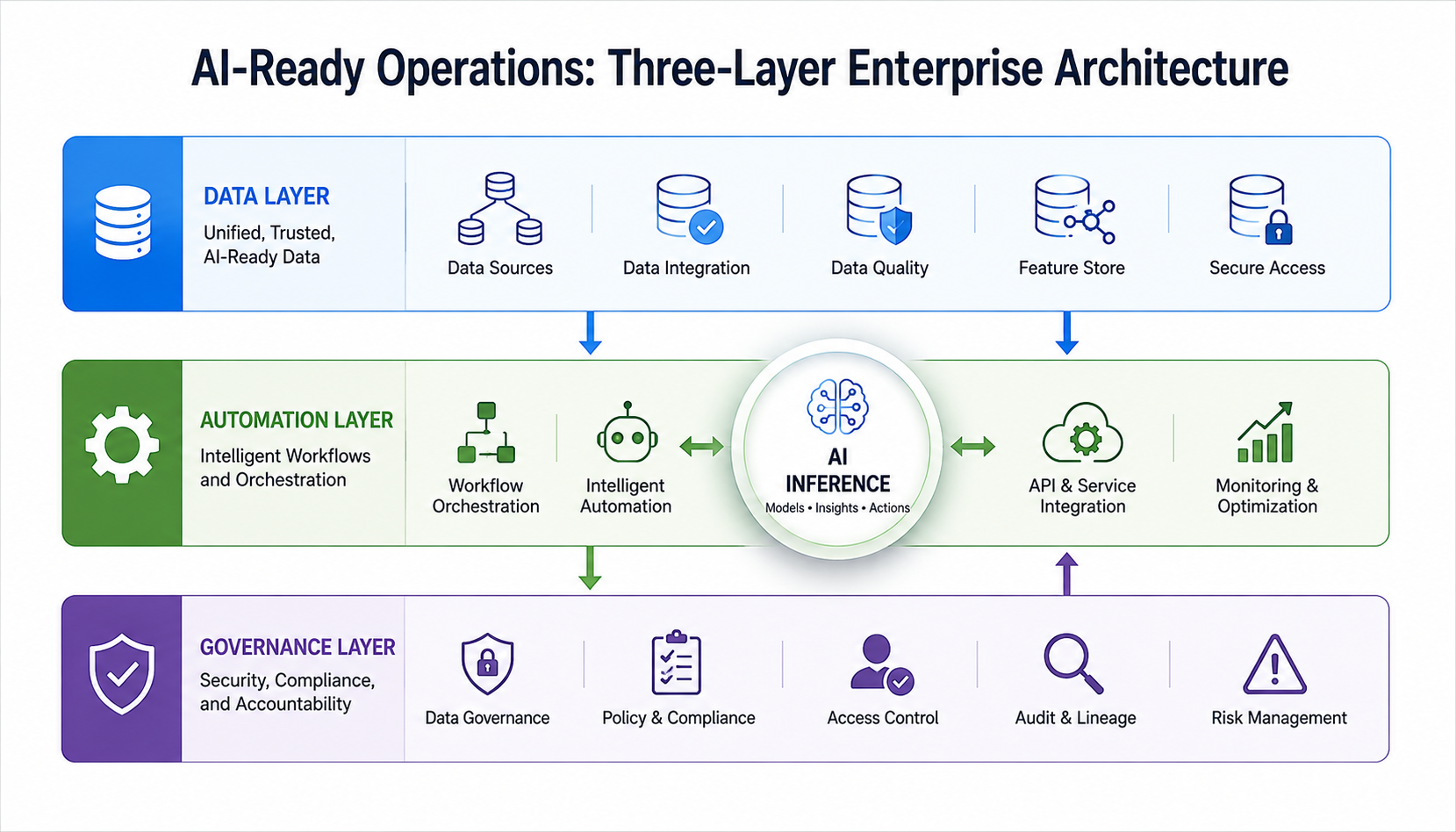
Layer 1: Data Engineering Foundation
Audit the current data estate: catalog sources, assess quality, and map lineage gaps across ERP, CRM, and core systems.
Modernize pipelines: migrate to a cloud data platform (Databricks Lakehouse, Snowflake) with automated quality checks via dbt. Refer to enterprise data integration engineering best practices to structure this phase correctly.
Implement real-time streaming: Apache Kafka or Azure Event Hubs for low-latency AI feature serving.
Enable self-serve analytics: expose clean datasets to business teams via the Veda AI data analytics platform so AI models and business users share the same trusted data layer.
Layer 2: Workflow Automation and Intelligent Process Design
Map high-volume, rule-based processes: identify automation candidates using process mining before deploying any AI model.
Deploy RPA plus AI hybrid triggers: automate document processing, compliance checks, and customer triage with AI model outputs as decision nodes. How AI-powered workflow automation is reshaping this layer for APAC enterprises is well documented.
Build orchestration layers: use API-first enterprise software solutions to connect AI models to ERP, CRM, and core banking systems without point-to-point integrations.
Monitor intelligent workflows: implement SLA dashboards and anomaly detection on automated process chains from day one of go-live.
Layer 3: AI Governance and Compliance Infrastructure
Adopt a recognized framework: NIST AI RMF or ISO/IEC 42001 for AI governance framework design; MAS FEAT for APAC BFSI-specific requirements.
Build an AI risk register: catalog every model in production with risk tier, data lineage, and explainability method. See enterprise AI governance implementation guidance for a full register template.
Automate compliance reporting: connect model monitoring outputs to MAS FEAT or equivalent regional standards via AI security compliance tooling.
Establish continuous model monitoring: drift detection, fairness audits, and human-in-the-loop escalation for every high-stakes automated decision.
Comparing the Three Pillars: A Side-by-Side View
Dimension | Data Engineering | Workflow Automation | AI Governance | Samta.ai Integration Point |
Core Function | Ingest, transform, and serve enterprise data | Orchestrate and automate business processes end-to-end | Policy, audit, and compliance controls for AI systems | Veda AI unifies pipelines across all three layers |
Primary Tools / Standards | Databricks, Snowflake, dbt, Apache Spark | RPA platforms, API orchestration, low-code triggers | NIST AI RMF, MAS FEAT, ISO/IEC 42001 | Pre-built connectors and governance templates for APAC |
Key Outcome | Clean, trusted, real-time data for AI models | Reduced manual effort; consistent, auditable workflows | Accountable, explainable, and compliant AI deployments | Faster time-to-value across regulated industries |
Common Failure Mode | Siloed data lakes with no lineage or quality checks | Automation without governance creates shadow IT risk | Checkbox compliance without operational integration | Mitigated via unified observability and audit trails |
Maturity Indicator | Unified data mesh or lakehouse architecture in production | Intelligent workflows trigger directly from AI model outputs | AI risk register and bias monitoring live in production | Full-stack AI-ready operations across BFSI and enterprise |
Enterprise Use Cases: How BFSI and Large Enterprises Apply This
Use Case 1: Automated Credit Risk Decisioning in BFSI
A regional bank in Southeast Asia had credit decisioning models ready in the lab but blocked from production by inconsistent loan application data across four legacy systems. The data engineering services engagement built a unified borrower data product on Snowflake, with automated quality scoring and field-level lineage tracking. AI-powered workflow automation routed approved applications directly into core banking, cutting manual review time by 65%. An AI governance framework aligned to MAS FEAT documented every model decision for regulator audit, with exportable compliance logs available on demand.
Use Case 2: Intelligent Document Processing in Insurance
A large APAC insurance carrier needed to automate claims intake across three product lines with different document formats and policy structures. Using business process automation with document AI, claims were extracted, validated against policy data in a Databricks lakehouse, and routed to adjusters with pre-populated summaries. AI risk management controls flagged anomalous claim patterns for human review. Processing time dropped from four days to under six hours. Governance logs were exportable for compliance audit without any manual effort precisely the outcome a robust enterprise AI governance model is designed to deliver.
Key Risks and Failure Modes
Data debt masquerading as readiness. Organizations with large data lakes often assume they have data modernization covered. Without lineage, quality scoring, and access governance, those lakes are liabilities. Review enterprise data integration engineering standards before assuming your data estate is AI-ready.
Automation without AI governance. Deploying intelligent workflows before establishing explainability standards creates audit exposure especially in BFSI, healthcare, and insurance. Regulators in 2026 expect organizations to explain every automated decision.
Treating governance as a project, not a capability. One-time compliance exercises decay rapidly. AI governance must be embedded in the AI deployment roadmap as continuous operational infrastructure with a named owner and an annual review cycle.
Underinvesting in the integration layer. The failure point in enterprise AI programs is rarely the AI model itself. It is almost always the data integration consulting services gap between source systems and the AI inference layer the plumbing that was never built to handle real-time model inputs.
Request a Free Product Demo See how Veda AI unifies your data, automation, and governance layers on a single platform. Request a Free Product Demo with Samta.ai and see it against your actual data environment.
Decision Framework: Is Your Enterprise Ready?
Use this checklist before committing to a full AI implementation roadmap. If you prefer a structured approach, start with the 5-step AI readiness assessment before allocating budget.
Data pipelines produce lineage-tracked, quality-scored datasets for AI model inputs
Business process owners can identify three or more automation candidates with clear ROI
A named AI risk owner exists at senior leadership level
A formal AI governance framework (NIST, ISO/IEC 42001, or MAS FEAT-aligned) is documented
Cloud data platform is live and owned by a data engineering team, not a single vendor contract
Model performance and drift monitoring are in production not planned
If fewer than four boxes are checked, complete the 5-step AI readiness assessment before committing enterprise digital transformation budget.
Conclusion
Building AI-ready enterprise operations is not a single initiative. It is a sustained commitment across data, automation, and governance — executed in parallel, not in sequence. Organizations that get the order wrong pay for it in failed deployments, compliance gaps, and delayed ROI. Enterprise AI and data engineering partners that operate across all three layers are the fastest path to production for regulated industries across APAC.
Book a Consultant Ready to build your AI adoption strategy from the ground up? Book a Consultant at Samta.ai and receive your AI deployment roadmap within five business days mapped to your industry, your data estate, and your compliance obligations.
About Samta
Samta.ai is a Singapore-headquartered AI Product Engineering & Data Intelligence partner helping enterprises build production-grade AI systems for regulated and data-intensive environments.We help organizations move beyond experimentation by engineering scalable, explainable, and enterprise-ready AI solutions from data foundations and model development to workflow automation and deployment.
Our capabilities combine deep AI expertise, data engineering, and product engineering to deliver measurable business impact across FinTech, BFSI, cybersecurity, regulatory technology, and enterprise operations.
Our enterprise AI products power real-world intelligence systems:
• TATVA : AI-driven data intelligence platform for governed analytics, monitoring, and operational insights
• VEDA : Explainable and audit-ready AI decisioning engine built for compliance-sensitive enterprise workflows
• CORA-Property Management Solutions: : Predictive intelligence platform for real-estate pricing, portfolio optimization, and investment analytics
Backed by ecosystem partnerships with Microsoft, Databricks, Snowflake, and AWS, Samta.ai delivers agile, cost-efficient AI engineering with faster turnaround and enterprise-grade scalability. Trusted by enterprises across FinTech, BFSI, and digital transformation initiatives, Samta.ai embeds AI governance, data privacy, and compliance-by-design principles directly into the AI lifecycle , enabling organizations to scale AI with transparency, accountability, and operational control.
Enterprises leveraging Samta.ai automate 65%+ of repetitive data, analytics, and decision workflows while maintaining governance, explainability, and measurable business outcomes. Samta.ai provides the strategic consulting, AI engineering, and data modernization expertise needed to align enterprise operations with next-generation AI transformation goals.
Frequently Asked Questions
What is AI-ready enterprise operations and why does it matter for large enterprises?
AI-ready enterprise operations is the organizational capability to deploy, scale, and govern AI systems in production without structural remediation. It matters because most enterprise AI pilots fail in production not due to model quality, but because the AI infrastructure, data quality, and process architecture were not built to support live AI workloads. Building this capability upfront reduces deployment risk, cuts time-to-production, and directly improves AI ROI.
How long does it take to build a data engineering foundation for AI?
For a mid-size enterprise with three to ten core data sources, a foundational data engineering services engagement typically takes 12 to 20 weeks to deliver a production-grade data pipeline on Snowflake or Databricks. This includes data quality frameworks, lineage tooling, and API-ready data products. Timeline depends on legacy system complexity and the availability of internal engineering capacity to support the program.
What is the difference between workflow automation and AI-powered process automation?
Workflow automation consulting traditionally covers rule-based processes if X happens, do Y. AI-powered process automation introduces model outputs as dynamic decision nodes within those workflows. An AI model classifying document intent can trigger entirely different downstream processes in real time. This distinction matters because AI-driven workflows require AI governance frameworks and continuous monitoring that standard RPA implementations do not include by default.
When should an enterprise engage an AI transformation partner versus build in-house?
Build in-house when your team has deep data engineering services capability, active model deployment experience, and a working AI governance framework already in production. Engage an AI transformation partner when any of the following apply: no prior production AI deployment, compliance deadlines within 12 months, limited cloud platform expertise, or a need to scale across multiple business units simultaneously. Enterprise AI implementation consulting delivers the highest return in the first 18 months of a transformation program.
What is the real cost of skipping AI governance during the build phase?
The cost is measurable. Singapore's PDPA enforcement is active and increasing in scope. One major APAC bank estimated that AI risk management retrofitting cost four times more than embedding governance into the AI deployment roadmap from the start (Source Required: Gartner). The operational and reputational cost of a single high-profile model failure in a regulated industry typically exceeds the full cost of a governance implementation. Responsible AI is not a premium it is the baseline cost of operating AI in regulated markets.