
Summarize this post with AI
Singapore financial institutions are no longer choosing whether to comply with AI governance expectations. In November 2025, MAS released AI Risk Management Guidelines built on the FEAT principles, establishing comprehensive AI governance requirements for banks, insurers, and fintechs. This mas feat compliance checklist breaks down exactly what examiners now expect, and how to operationalize it before your next supervisory review. If your AI inventory, model documentation, and oversight structure are not mapped to these expectations today, your institution carries unmanaged regulatory exposure.
MAS FEAT Compliance Checklist
A mas feat compliance checklist for 2026 must cover four areas: AI system visibility and inventory, board level oversight with three lines of defense, full lifecycle controls from development to retirement, and governance extending to third party AI tools. These guidelines apply to all MAS regulated financial institutions including banks, insurers, fintechs, and payment providers, and are supported by the AI Risk Management Toolkit published by MAS in March 2026, centered on the AI Risk Management Operationalisation Handbook.
What MAS FEAT Compliance Actually Means in 2026
MAS FEAT Principles trace back to 2018, when MAS launched four principles, Fairness, Ethics, Accountability, and Transparency, forming the foundation of its AI governance approach, requiring financial institutions to ensure AI systems are not biased, are used responsibly, have clear ownership and oversight, and are explainable.
What changed in 2025 and 2026 is enforcement posture. The new Guidelines deconstruct the abstract spirit of the FEAT principles into an operational and auditable risk management system, starting with what regulators call Visibility. Financial institutions' first obligation is to establish a mechanism to identify and see their AI systems.
This is no longer a voluntary framework. For the full breakdown of the original four principles, see the MAS FEAT principles complete guide. A mas feat compliance checklist today must map directly to supervisory inspection criteria, not just internal ethics guidelines.
Get Your Enterprise AI Assessment
Why This Matters Now: From Principles to Supervisory Expectations
Three shifts make 2026 a turning point for Singapore BFSI AI governance.
Toolkit publication formalizes expectations. In March 2026, MAS published an AI Risk Management Toolkit, with the Operationalisation Handbook detailing concrete, non binding recommendations that financial institutions are expected to consider as they adopt and scale AI use.
Routine inspections now include AI governance. Together, the Guidelines and Handbook mark a shift from principles based guidance to supervisory ready expectations, increasing the likelihood that MAS will assess AI governance as part of routine inspections and thematic reviews.
Third party AI is explicitly in scope. Institutions cannot delegate governance to vendors, third party AI tools are covered under the guidelines. If your bank uses vendor supplied credit scoring models, fraud detection APIs, or generative AI copilots, those systems require the same documentation as in house models.Institutions can strengthen this baseline with dedicated AI security and compliance services built for cross-jurisdiction operations.
For Singapore banks, the monetary authority of singapore act and its associated guidelines now function as an operational compliance baseline, not aspirational best practice. Institutions reviewing their broader technology risk posture should also reference the MAS technology risk management notice, which covers infrastructure and operational resilience requirements alongside AI governance.
AI Risk Assessment Templates Don't start your AI inventory from a blank page. Download Samta.ai's AI risk assessment templates, pre mapped to MAS FEAT and the 2026 Operationalisation Handbook.
The MAS FEAT Compliance Framework: Step by Step
Use this sequence to build or audit your AI governance program against the mas feat compliance checklist.
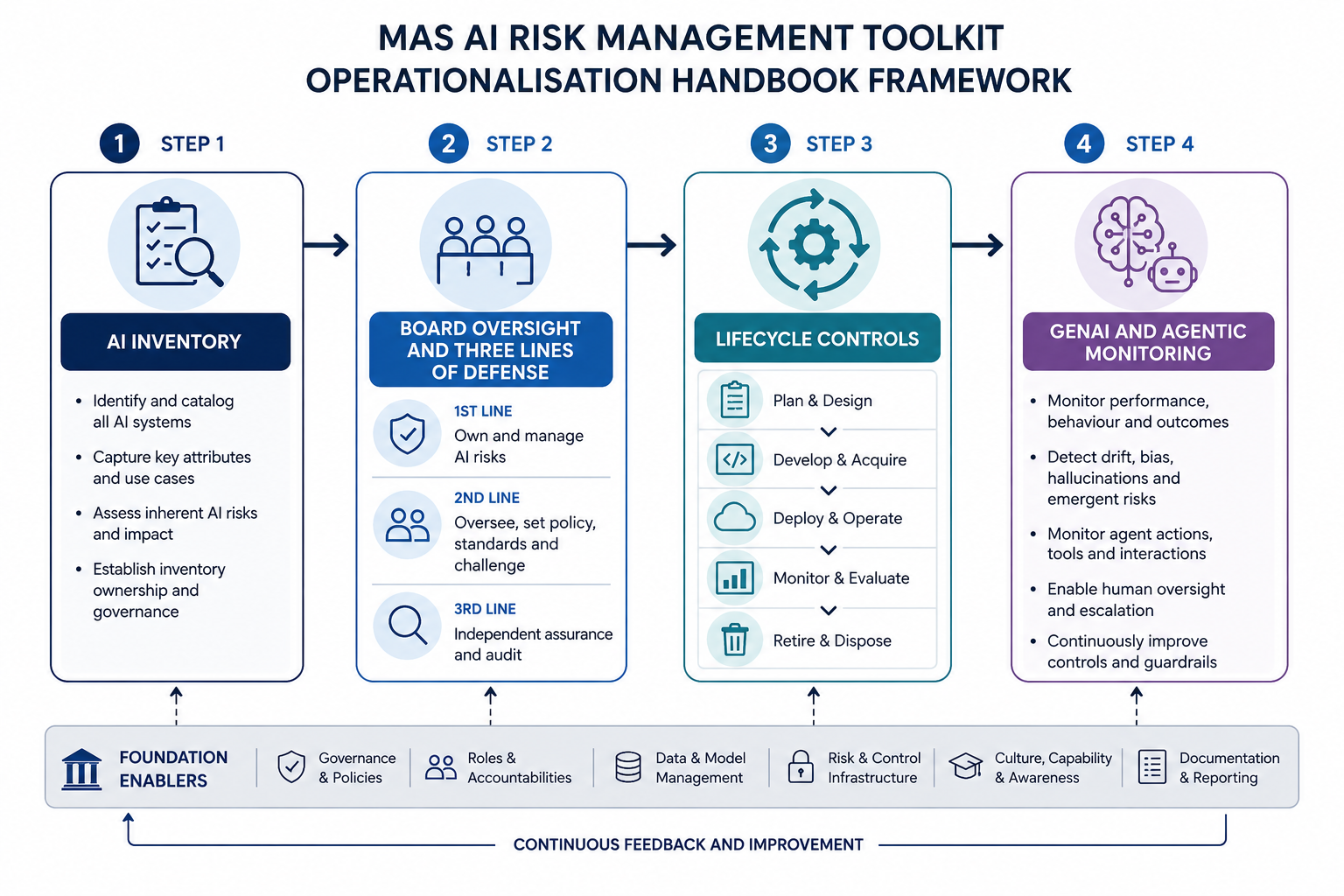
Step 1: Build a Complete AI System Inventory
Catalog every AI system, including generative AI, traditional ML models, and agentic AI tools, whether built in house or vendor supplied.
Tag third party tools separately. Third party AI tools are explicitly covered; vendor ownership does not remove the institution's governance obligation.
Record risk tier per system, mapping each AI use case to a risk classification (low, moderate, high) based on the impact of an incorrect or biased output.
Document data lineage for each system, recording what data feeds it and where that data originates.
Step 2: Establish Board Level Oversight and Three Lines of Defense
Assign a board level AI risk owner. The guidelines require board level AI oversight as a core expectation.
Build three lines of defense, business units (first line), risk and compliance functions (second line), and internal audit (third line), each with defined AI specific responsibilities.
Integrate AI risk into existing enterprise risk frameworks. Don't create a parallel AI governance silo; connect it to your existing monetary authority of singapore regulations compliance structure.
Step 3: Implement Full Lifecycle Controls
Development stage, fairness testing, bias audits, and explainability documentation before any model reaches production.
Deployment stage, pre launch sign off from risk and compliance functions, documented in the AI inventory.
Monitoring stage, ongoing monitoring of agentic AI systems for manipulation, prompt injection, or other techniques used to induce the system to reveal information or perform unintended actions.
Retirement stage, a formal decommissioning process with audit trail, especially for systems handling customer data.
Step 4: Operationalize Generative AI and Agentic AI Controls
The MindForge AI Risk Management Toolkit provides resources for managing AI related risks across traditional AI, generative AI, and emerging agentic AI technologies. For agentic systems specifically, institutions should add AI related data to culture reporting dashboards and ensure AI governance teams work closely with non AI specific risk teams.
This is where execution matters most. The NIST AI risk management framework guide offers a useful cross reference for institutions aligning MAS expectations with international standards. Samta.ai's Veda AI platform supports this stage by unifying model inventory tracking, lineage documentation, and continuous monitoring dashboards on a single layer connected to cloud data platforms such as Databricks and Snowflake. The Veda AI data analytics platform turns the Operationalisation Handbook's recommendations into a live, auditable system rather than a static spreadsheet.
MAS FEAT Compliance: Framework Comparison
Dimension | FEAT Principles (2018) | MAS AI Risk Management Guidelines (2025) | AI Risk Management Toolkit (2026) | Samta.ai Integration Point |
Nature | Principles based, advisory | Supervisory expectations | Operational handbook with concrete actions | Maps each layer into one governance dashboard |
Scope | General responsible AI use | All MAS regulated FIs: banks, insurers, fintechs, payment providers | Traditional AI, GenAI, agentic AI | Full lifecycle model inventory across all AI types |
Core Requirement | Fair, ethical, accountable, transparent AI systems | Board oversight, three lines of defense, AI inventory | Visibility, establish a mechanism for AI identification | Automated inventory and lineage tracking |
Third Party Coverage | Not explicitly addressed | Third party AI tools covered; cannot delegate governance to vendors | Vendor and enterprise risk integration support | Connector based vendor model tracking |
Supporting Body | Veritas Initiative, fairness metrics, assessment templates | MAS supervisory teams | Consortium of 24 banks, insurers, and capital market firms | AI security compliance services |
Measure Your AI Model Risk Before It Becomes a Business Risk
Enterprise Use Cases: How Singapore BFSI Applies This
Use Case 1: Mid Size Bank Building Its First AI Inventory
A mid size Singapore bank had over a dozen AI and ML systems in production, fraud detection, credit scoring, and a customer service chatbot, with no centralized inventory. Using the mas feat compliance checklist framework, the bank's risk team catalogued every system, tagged three as vendor supplied, and assigned risk tiers based on customer impact. The credit scoring model was reclassified as high risk after the lineage audit revealed it consumed data from an undocumented third party enrichment service. This single finding triggered a vendor governance review consistent with the requirement that institutions cannot delegate AI governance obligations to vendors.
Use Case 2: Insurance Carrier Operationalizing GenAI Controls
A Singapore based insurer deployed a generative AI claims assistant and needed to demonstrate compliance ahead of a thematic MAS review. Following the Step 4 framework above, the carrier implemented continuous monitoring for prompt injection attempts and unintended information disclosure, with results feeding into existing risk culture dashboards. This aligned the GenAI deployment with the broader MindForge toolkit's guidance on managing generative AI risk alongside traditional and agentic AI systems, giving the compliance team a single audit trail to present to examiners. Reviewing detailed examples in the AI governance compliance guide can help teams structure similar audit trails for their own GenAI deployments.
Key Risks and Failure Modes
Treating FEAT as a 2018 artifact: The original four principles remain the foundation, but the 2025 to 2026 Guidelines and Operational Handbook represent supervisory ready expectations. Institutions still citing only the 2018 principles in policy documents are behind current examiner expectations.
Excluding vendor supplied AI from the inventory: Third party AI tools are explicitly covered, and governance cannot be delegated to vendors. Any AI inventory that stops at internally built models has a compliance gap.
No board level ownership: Board level AI oversight and three lines of defense are core requirements. Institutions where AI risk sits only within a technology team, without board visibility, are not aligned with current guidance.
Static documentation instead of continuous monitoring: Agentic AI systems require ongoing monitoring for manipulation and prompt injection. A one time risk assessment at deployment does not satisfy lifecycle monitoring expectations.
47 Control Checklist Map your AI program against MAS's complete expectations. Get the AI security compliance assessment from Samta.ai, covering inventory, oversight, lifecycle, and vendor governance in a 47 control checklist.
Decision Framework: When Is Your Bank Ready for an MAS AI Review?
Every AI system, internal and vendor supplied, is logged in a central inventory with risk tier assigned
Board level AI risk owner is named and AI risk is reported in board materials
Three lines of defense have documented, AI specific responsibilities
Lifecycle controls exist for development, deployment, monitoring, and retirement
GenAI and agentic AI systems have continuous monitoring for prompt injection and data leakage
Vendor AI tools have governance documentation equivalent to in house models
If fewer than four boxes are checked, this is the time to act, not after your next examination cycle.
Drive Measurable AI Business Outcomes
Conclusion
The shift from FEAT principles to enforceable MAS AI Risk Management Guidelines means Singapore banks face genuine supervisory exposure for ungoverned AI systems, including vendor tools. A complete mas feat compliance checklist covering inventory, board oversight, lifecycle controls, and continuous monitoring is no longer optional preparation. It is the baseline examiners now expect during routine reviews.
AI Model Risk Management Playbook Get the complete operational blueprint. Request the AI Model Risk Management Playbook from Samta.ai, built around the 2026 MAS Operationalisation Handbook and Veda AI's monitoring layer.
About Samta
Samta.ai is a Singapore-headquartered AI Product Engineering & Data Intelligence partner helping enterprises build production-grade AI systems for regulated and data-intensive environments.We help organizations move beyond experimentation by engineering scalable, explainable, and enterprise-ready AI solutions from data foundations and model development to workflow automation and deployment.
Our capabilities combine deep AI expertise, data engineering, and product engineering to deliver measurable business impact across FinTech, BFSI, cybersecurity, regulatory technology, and enterprise operations.
Our enterprise AI products power real-world intelligence systems:
• TATVA : AI-driven data intelligence platform for governed analytics, monitoring, and operational insights
• VEDA : Explainable and audit-ready AI decisioning engine built for compliance-sensitive enterprise workflows
• CORA-Property Management Solutions: : Predictive intelligence platform for real-estate pricing, portfolio optimization, and investment analytics
Backed by ecosystem partnerships with Microsoft, Databricks, Snowflake, and AWS, Samta.ai delivers agile, cost-efficient AI engineering with faster turnaround and enterprise-grade scalability. Trusted by enterprises across FinTech, BFSI, and digital transformation initiatives, Samta.ai embeds AI governance, data privacy, and compliance-by-design principles directly into the AI lifecycle , enabling organizations to scale AI with transparency, accountability, and operational control.
Enterprises leveraging Samta.ai automate 65%+ of repetitive data, analytics, and decision workflows while maintaining governance, explainability, and measurable business outcomes. Samta.ai provides the strategic consulting, AI engineering, and data modernization expertise needed to align enterprise operations with next-generation AI transformation goals.
Frequently Asked Questions
What is the MAS FEAT compliance checklist and who needs to follow it?
A mas feat compliance checklist maps an institution's AI governance program to MAS's FEAT principles and the 2025 AI Risk Management Guidelines. It applies to all MAS regulated financial institutions, banks, insurers, fintechs, and payment providers. Any institution deploying AI in customer facing or risk relevant processes needs this mapping in place ahead of supervisory reviews.
What are the four FEAT principles and do they still apply in 2026?
The four FEAT principles, Fairness, Ethics, Accountability, and Transparency, launched in 2018, remain the foundation of MAS's AI governance approach. They now sit underneath the more operational 2025 Guidelines and the 2026 AI Risk Management Toolkit, which translate these principles into auditable controls.
Does the MAS AI Risk Management Toolkit replace the FEAT principles?
No. The Toolkit and its Operationalisation Handbook detail actions to implement the principles set out in the Guidelines, which themselves are built on FEAT. The Toolkit operationalizes FEAT, it does not replace it. Institutions should reference both in their mas feat compliance checklist.
Are third party and vendor AI tools covered under MAS guidelines?
Yes. Third party AI tools are explicitly covered, and institutions cannot delegate governance to vendors. Any AI system used by your institution, regardless of who built it, must appear in your AI inventory with documented risk tier and oversight.
How does MAS expect institutions to handle generative AI and agentic AI risk?
The MindForge AI Risk Management Toolkit provides resources for managing risks across traditional AI, generative AI, and emerging agentic AI. For agentic AI specifically, institutions must monitor for manipulation, prompt injection, and unintended information disclosure, with findings reported through existing risk culture channels.