
Summarize this post with AI
The MAS technology risk notice AI compliance landscape changed materially in 2024 when the Monetary Authority of Singapore expanded its binding directives to explicitly cover AI-driven systems in financial institutions. Banks, insurers, and payment service providers now face dual obligations: meeting the existing MAS technology risk management controls and embedding AI-specific governance across the model lifecycle. Failure to do so is not a procedural gap it is a breach of a legally enforceable Notice. This guide maps every critical obligation, explains what regulators are auditing, and provides a clear path to demonstrable compliance in 2026.
Key Takeaways
The MAS Technology Risk Notice is a binding directive, not guidance; non-compliance triggers supervisory action.
AI systems touching credit decisions, fraud detection, or customer data are explicitly in scope from 2024 onwards.
Banks must maintain a documented MAS technology risk management checklist with audit-ready evidence for each control.
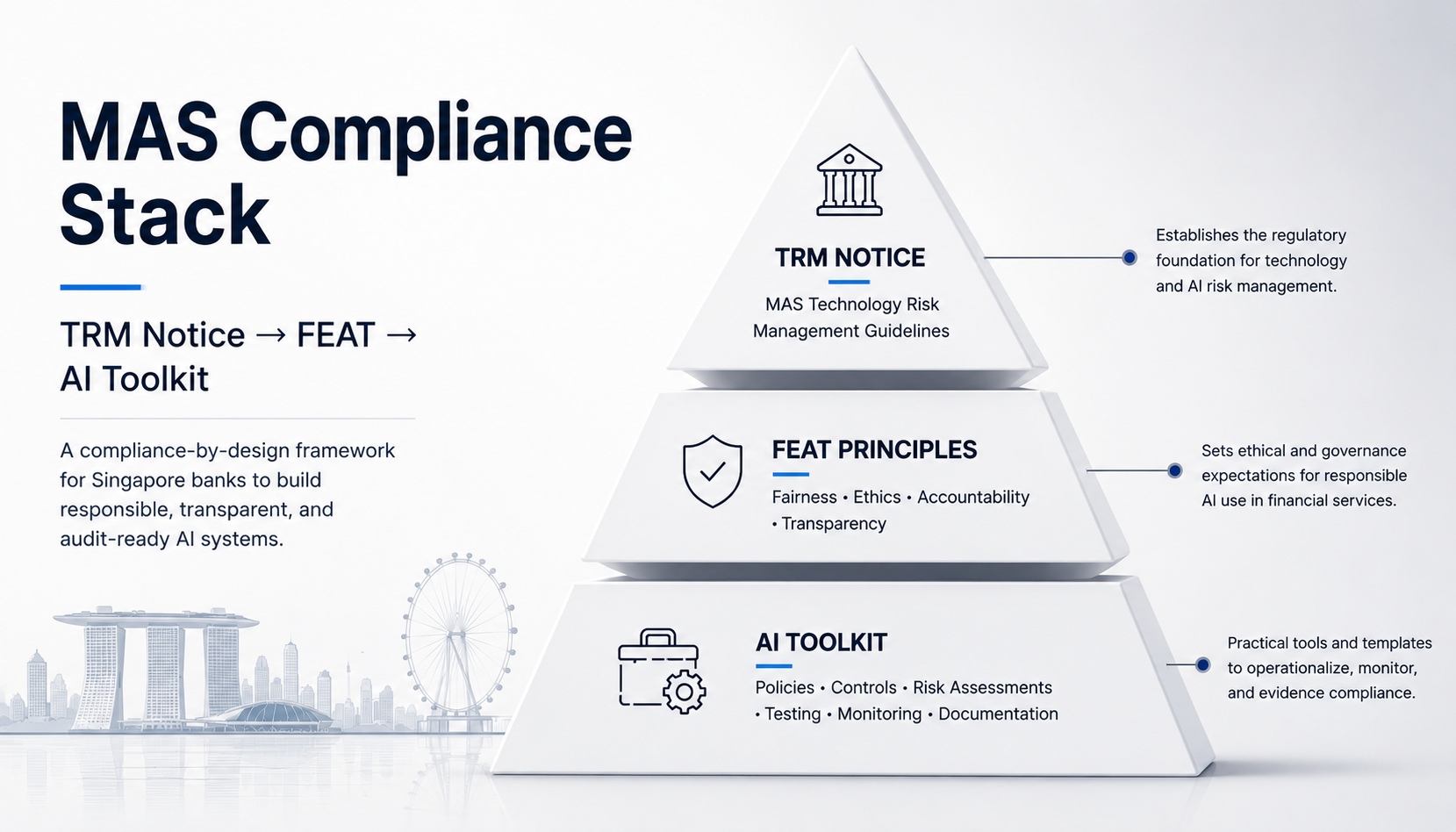
The MAS FEAT principles (Fairness, Ethics, Accountability, Transparency) form the ethical layer on top of the Notice's operational controls.
Third-party and cloud AI vendors are not exempt institutions remain accountable for all outsourced AI risk.
MAS inspection cycles have shortened; annual reviews are now the minimum cadence for high-risk AI systems.
What Does MAS Technology Risk Notice AI Compliance Mean in 2026?
The MAS Technology Risk Notice (TRM Notice) is a legally binding instrument under Section 58 of the Banking Act. Unlike advisory guidelines, violations carry mandatory remediation timelines and potential financial penalties. In 2026, two developments have sharpened its teeth for AI teams.
First, MAS formally incorporated AI risk into the definition of "significant technology risk," bringing model drift, algorithmic bias, and explainability failures within the Notice's breach-reporting obligations. Second, the regulator aligned the Notice with the broader MAS AI Risk Management Toolkit a set of supervisory benchmarks that map directly to the FEAT principles and to international standards such as the NIST AI Risk Management Framework.
Read our in-depth explainer on the NIST AI Risk Management Framework to understand how international and Singapore-specific standards overlap a critical input for institutions operating across jurisdictions.
For compliance officers, this means AI governance is no longer a separate workstream from technology risk management. Both must be evidenced in the same audit pack. The MAS Guidelines for Artificial Intelligence (AI risk management) published alongside the toolkit provide the specific testing and documentation standards examiners use.
AI governance and compliance frameworks built on generic international standards are insufficient on their own Singapore-specific controls must be layered on top.
Evaluate Your AI Strategy with Confidence
MAS AI Compliance Vendor Comparison: How Samta.ai Compares
The table below compares five approaches to implementing MAS technology risk management for AI systems. Capability ratings reflect documented feature availability, not marketing claims.
Capability | Generic GRC Platform | Big-4 Consulting | In-House Build | |
MAS TRM Notice control mapping | ✔ Native | ⚠ Partial | ⚠ Manual | ✗ Custom dev required |
MAS FEAT / AI governance layer | ✔ Built-in | ✗ Not covered | ⚠ Add-on engagement | ✗ Not available |
AI model risk monitoring (drift, bias) | ✔ Automated | ✗ Not available | ⚠ Project-based | ⚠ High effort |
47-control audit checklist | ✔ Pre-built | ⚠ Generic only | ⚠ Bespoke cost | ✗ Manual build |
Time to first compliance report | 2–4 weeks | 8–12 weeks | 12–20 weeks | 6–12 months |
Practical Use Cases: Where MAS Technology Risk Management Applies to AI
The following scenarios are drawn from MAS supervisory findings and industry submissions. Each maps to specific control obligations under the Notice.
1. Credit Scoring Model Governance
A retail bank deploys an ML-based credit scoring model. Under MAS technology risk management, the bank must document model validation methodology, define acceptable performance thresholds, and log all production changes with a pre-approved change management process. Unexplained output changes trigger a significant incident report.
2. Fraud Detection System Drift
A payment firm's AI fraud engine begins flagging legitimate transactions after a data pipeline change. MAS requires the firm to detect, contain, and report the drift within defined RTO/RPO windows. Absence of real-time monitoring is itself a control failure, independent of the business impact.
3. Customer Service Chatbot Compliance
A chatbot trained on internal data must satisfy both data governance requirements under PDPA and explainability requirements under the MAS AI governance framework. If the chatbot influences product recommendations, additional suitability and bias-testing obligations apply. See our regulatory compliance for AI guide for product-specific obligations.
4. Third-Party AI Vendor Risk
Outsourcing AI decisions to a vendor does not transfer regulatory liability. Banks must include AI risk clauses in vendor contracts, conduct periodic audits, and retain override capabilities all documented against the examples of technology risk MAS registers. Explore AI risk assessment templates to standardize vendor due diligence.
5. Regulatory Reporting Automation
AI systems that generate or pre-populate MAS regulatory returns require a human-in-the-loop review step and a full audit trail. Any model change affecting output must trigger a version-controlled review before the next submission cycle.
AI Risk Assessment Templates Pre-built templates mapped to MAS TRM Notice controls, ready for immediate use by compliance and risk teams. Download and deploy in your next audit cycle without starting from scratch. Access Templates →
Limitations and Risks in Meeting the Notice's AI Obligations
Compliance with the MAS Technology Risk Notice is not a one-time project. Three structural risks consistently cause institutions to fall short during inspections.
Scope creep in AI deployments
AI tools adopted by business units outside formal IT procurement often bypass technology risk assessment entirely. Shadow AI is the leading source of unregistered risks in MAS examinations.
Vendor documentation gaps
Cloud AI APIs and third-party ML services rarely provide the audit-trail depth MAS examiners require. Institutions cannot rely on vendor SOC 2 reports as a substitute for MAS-specific risk assessments.
Static checklist thinking
A MAS technology risk management checklist completed at deployment is necessary but not sufficient. Controls must be tested on a defined cadence; evidence must be dated, version-controlled, and mapped to the current model in production not a legacy version.
The future of AI governance is moving toward continuous, automated monitoring rather than periodic manual reviews an architectural shift banks need to plan for now.
Identify Hidden Risks in Your AI Models
Decision Framework: When to Prioritize Which MAS AI Control
Not every AI system carries equal regulatory weight. The framework below helps compliance leads allocate resources against actual risk exposure.
Apply full TRM Notice controls when:
AI is used in credit, fraud, or AML decisions
Models produce customer-facing outputs
Systems are linked to regulatory reporting
Third-party AI involves data-sharing agreements
Any model is updated more than quarterly
Apply calibrated controls when:
The system is an internal analytics dashboard with no decision outputs
Tools handle document summarization only
Automation is confined to low-risk back-office functions
Models operate in sandbox or development environments with no production data
For institutions building their governance register from scratch, the Veda AI Data Analytics Platform from Samta.ai automates model cataloguing and maps each asset to its applicable MAS control tier eliminating the manual classification burden. Learn more about structuring your governance approach in the AI governance compliance guide.
47-Control MAS Technology Risk Checklist Every mandatory control from the TRM Notice, structured with evidence requirements and owner fields. Audit-ready format, updated for 2026 supervisory expectations download and assign ownership in under an hour. Get the Checklist →
Conclusion
MAS has made its position unambiguous: AI systems in Singapore financial institutions are subject to the same rigorous oversight as any other critical technology. The Notice is not a framework to aspire to it is a set of controls to evidence, test, and maintain continuously. Institutions that treat AI governance as a separate workstream from technology risk will face structural gaps that surface exactly when examiners audit.
The 2026 compliance environment rewards institutions that have automated their control monitoring, maintained living audit registers, and built AI governance into model development workflows not bolted it on afterwards.
Samta.ai brings deep expertise in AI, machine learning, and data intelligence to help Singapore financial institutions translate MAS requirements into operational reality. From pre-built compliance templates to the Veda AI Data Analytics Platform and dedicated AI security and compliance services, Samta.ai provides the tooling and expertise to make audit readiness a continuous state not a pre-examination scramble.
Ready to close your MAS AI compliance gaps?
Samta.ai's specialists provide a structured gap assessment against the TRM Notice within 5 business days. Speak to a compliance expert and receive a prioritized remediation roadmap tailored to your AI portfolio. Contact Samta.ai →
About Samta
Samta.ai is a Singapore-headquartered AI Product Engineering & Data Intelligence partner helping enterprises build production-grade AI systems for regulated and data-intensive environments.We help organizations move beyond experimentation by engineering scalable, explainable, and enterprise-ready AI solutions from data foundations and model development to workflow automation and deployment.
Our capabilities combine deep AI expertise, data engineering, and product engineering to deliver measurable business impact across FinTech, BFSI, cybersecurity, regulatory technology, and enterprise operations.
Our enterprise AI products power real-world intelligence systems:
• TATVA : AI-driven data intelligence platform for governed analytics, monitoring, and operational insights
• VEDA : Explainable and audit-ready AI decisioning engine built for compliance-sensitive enterprise workflows
• CORA-Property Management Solutions: : Predictive intelligence platform for real-estate pricing, portfolio optimization, and investment analytics
Backed by ecosystem partnerships with Microsoft, Databricks, Snowflake, and AWS, Samta.ai delivers agile, cost-efficient AI engineering with faster turnaround and enterprise-grade scalability. Trusted by enterprises across FinTech, BFSI, and digital transformation initiatives, Samta.ai embeds AI governance, data privacy, and compliance-by-design principles directly into the AI lifecycle , enabling organizations to scale AI with transparency, accountability, and operational control.
Enterprises leveraging Samta.ai automate 65%+ of repetitive data, analytics, and decision workflows while maintaining governance, explainability, and measurable business outcomes. Samta.ai provides the strategic consulting, AI engineering, and data modernization expertise needed to align enterprise operations with next-generation AI transformation goals.
Get Personalized AI Consulting
Frequently Asked Questions
What is the MAS Technology Risk Notice?
It is a legally binding directive under the Banking Act requiring Singapore financial institutions to maintain specific cybersecurity, operational resilience, and technology governance controls. Unlike advisory guidelines, breach of the Notice can trigger mandatory remediation orders and supervisory escalation.
Does the Notice explicitly cover AI and machine learning models?
Yes. Since 2024, MAS has confirmed that AI systems forming part of critical IT infrastructure or influencing regulated activities fall within the Notice's scope. Model governance, explainability, and drift monitoring are all examinable control areas. See the MAS FEAT principles guide for the ethical governance layer.
What are the most common examples of technology risk MAS examiners cite?
Examiners most frequently cite: undocumented AI model changes, absence of real-time monitoring for production models, inadequate third-party vendor risk assessments, and missing incident response procedures for AI failures. Each maps to a specific control in the MAS technology risk management guidelines consultation documentation.
How does the MAS AI Risk Management Toolkit relate to the Notice?
The Toolkit provides implementation-level guidance testing standards, documentation templates, and benchmarks that operationalises the Notice's requirements for AI-specific risks. It is the primary reference document for evidencing AI control compliance during inspections.
What is the MAS technology risk management checklist and who owns it?
It is a structured register mapping every control obligation to an accountable owner, evidence artifact, and review date. Ownership typically sits with the CISO or Chief Risk Officer, with AI-specific controls jointly owned by model risk and IT teams. Explore AI risk assessment templates to build yours efficiently.