
Summarize this post with AI
Most Singapore financial institutions can recite the FEAT principles, but few can explain how to actually test an AI model against them. That gap is exactly what the mas veritas framework was built to close. The Monetary Authority of Singapore, the country's central bank and integrated financial regulator, created Veritas as the practical assessment methodology sitting underneath its 2018 FEAT principles. If your institution has FEAT in a policy document but no assessment methodology in production, this article explains what the mas veritas framework actually requires.
MAS Veritas Framework:
The mas veritas framework is a Monetary Authority of Singapore initiative that enables financial institutions to evaluate their AI and Data Analytics, or AIDA, driven solutions against the Fairness, Ethics, Accountability, and Transparency principles MAS co-created with industry in 2018. The current version, Veritas Toolkit 2.0, provides assessment methodologies covering all four FEAT pillars, expanding beyond the original fairness-only focus of Veritas Toolkit 1.0. For Singapore banks and insurers, Veritas functions as the operational bridge between FEAT's principles and a documented, auditable AI testing process.
What Is the MAS Veritas Framework
The Monetary Authority of Singapore, or MAS, is Singapore's central bank and financial regulator. Veritas is one of its flagship AI governance initiatives, distinct from FEAT itself. Veritas is part of Singapore's National AI Strategy and was highlighted by the Deputy Prime Minister of Singapore at the Singapore FinTech Festival in 2019 and 2020. It is best understood as the testing methodology, while FEAT is the underlying set of principles. In 2020, MAS created a consortium of 27 companies to develop the FEAT assessment methodology and apply it to selected industry use cases. This collaborative, multi-phase structure is what distinguishes the mas veritas framework from a typical regulatory checklist. For background on the principles Veritas operationalizes, see why these MAS FEAT principles were created in the first place and how Veritas became their practical extension.
Why the Veritas Framework Matters Now in 2026
Three developments make the veritas framework mas bank 2026 conversation more urgent than in prior years.
1. Veritas now operates alongside binding AI guidelines. MAS published a Consultation Paper proposing Guidelines on AI Risk Management for Financial Institutions in November 2025, building on years of foundational work including the FEAT Principles and the Veritas Initiative's industry collaboration on fairness assessment. Once finalized in 2026, these guidelines will be considered supervisory expectations, meaning MAS will evaluate compliance during inspections. The complete MAS FEAT principles guide walks through how these foundational principles connect to the newer guidelines.
2. Generative AI and AI agents are explicitly in scope. The proposed AI guidelines aim to complement the FEAT Principles with specific supervisory expectations for responsible AI use, including Generative AI and AI agents.
3. Third party AI risk is a growing focus area. As the share of AI capability sourced externally continues to grow, third party risk management will increasingly define the quality of an institution's overall AI governance posture.
Institutions still treating Veritas as a one time fairness check, rather than an ongoing methodology connected to the newer monetary authority of singapore regulations, are operating with an outdated compliance model. The MAS FEAT compliance checklist maps these newer expectations in full, and the NIST AI risk management framework guide is a useful cross reference for institutions also aligning to international standards.
AI Model Risk Management Playbook Don't guess how Veritas applies to your AI inventory. Request the AI Model Risk Management Playbook from Samta.ai and map your models against Veritas methodology step by step.
The Veritas Assessment Framework: Step by Step
Use this sequence to apply the mas veritas framework to an AI or AIDA system inside your institution.
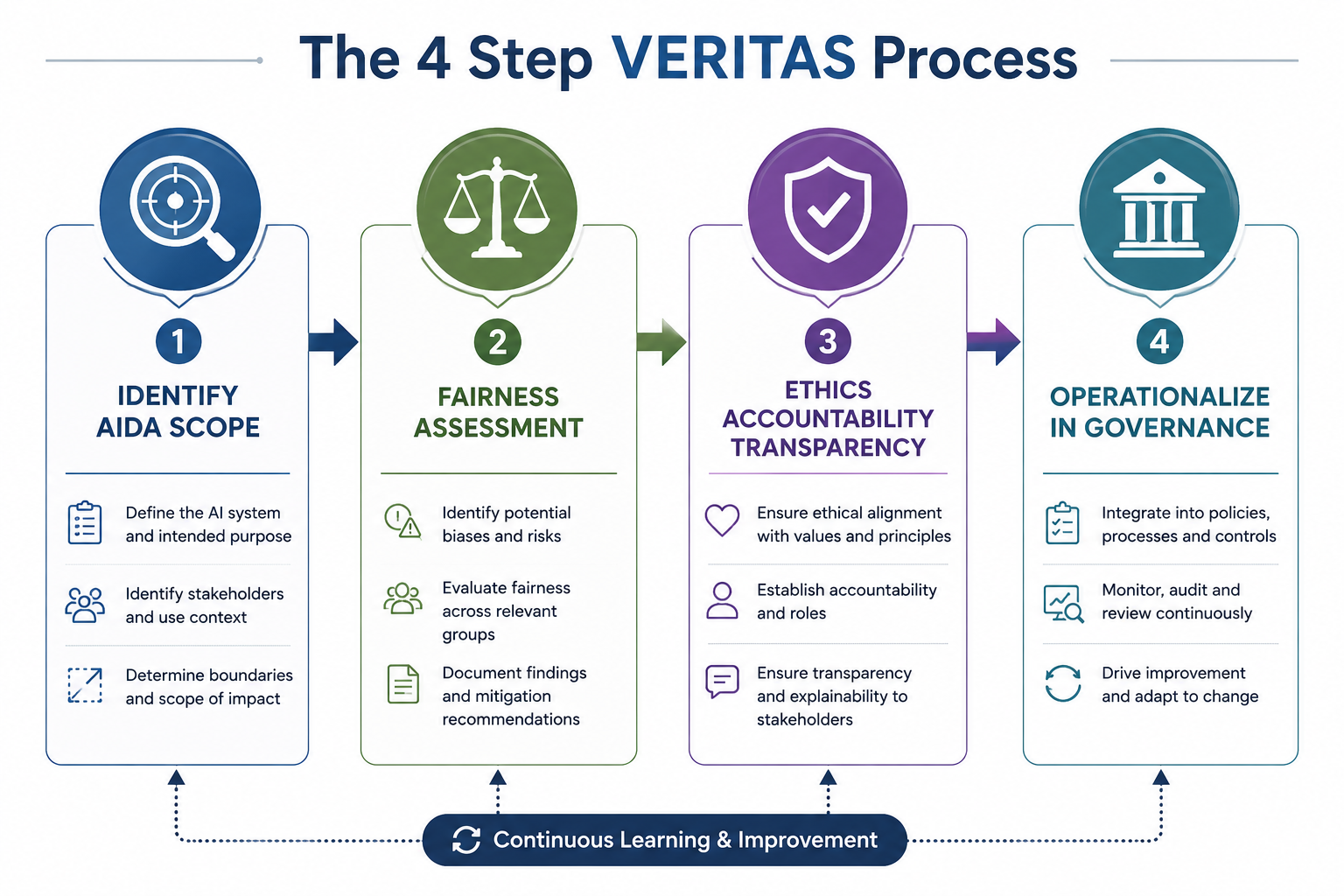
Step 1: Identify the AIDA System Scope
Catalog the AI and Data Analytics, or AIDA, system under review, including its business use case and customer impact.
Confirm applicability, Veritas applies most directly to AIDA driven decisions affecting individuals or groups, such as credit scoring or claims processing.
Step 2: Apply the Fairness Assessment Methodology
Test for disparate impact across protected or sensitive customer attributes.
Document data inputs and feature selection to confirm no proxy variables introduce unintended bias.
Reference the Veritas Fairness Assessment Methodology and Toolkit, the most mature component of Veritas, for structured testing steps.
Step 3: Apply Ethics, Accountability, and Transparency Assessments
Ethics, confirm the AIDA system's use case aligns with the institution's stated risk appetite and customer treatment standards.
Accountability, Veritas Toolkit 2.0 introduced, for the first time, assessment methodologies for Ethics, Accountability, and Transparency, expanding beyond the fairness only focus of the first toolkit version.
Transparency, document model logic and decision rationale in a form that can be explained to both regulators and affected customers.
Step 4: Operationalize Veritas Inside Existing AI Governance
This is where most institutions struggle. Some financial institutions have piloted internal frameworks inspired by the Veritas methodology, where model validation teams and data ethics committees jointly assess AI systems throughout their lifecycle. Reviewing the broader AI governance compliance guide can help structure this lifecycle review process inside your existing risk function.
Samta.ai's Veda AI platform supports this step by connecting Veritas style fairness and transparency testing outputs to a continuous model inventory, rather than a static, point in time assessment. This turns Veritas from a one off exercise into a living component of your monetary authority of singapore compliance posture, integrated with cloud data platforms such as Databricks and Snowflake. The Veda AI data analytics platform is built for exactly this kind of continuous assessment workflow, and pairs naturally with Samta.ai's AI security compliance services for institutions needing end to end documentation.
MAS Veritas Framework: Comparison Across Related Initiatives
Dimension | FEAT Principles | Veritas Framework | Proposed AI Risk Guidelines (2025 to 2026) | Samta.ai Integration Point |
Nature | Principles based standard | Assessment methodology and toolkit | Supervisory expectations | Continuous monitoring layer |
Launched | November 2018 | 2019 to 2020, multi phase collaborative project | Consultation paper November 2025 | Ongoing, model lifecycle aligned |
Core Focus | Fairness, Ethics, Accountability, Transparency in AIDA use | Practical assessment methodologies for all four FEAT pillars | AI identification, inventory, and risk materiality assessments | Inventory plus fairness testing automation |
Who Built It | MAS in collaboration with industry | Consortium of 27 companies | MAS supervisory teams | Samta.ai engineering layer |
2026 Status | Foundational, still referenced | Toolkit 2.0 active and in use | Expected to be finalized in 2026 | Available now via Veda AI |
Enterprise Use Cases: How Singapore FIs Apply Veritas
Use Case 1: Bank Applying Veritas to a Credit Scoring Model
A Singapore bank used the Veritas Fairness Assessment Methodology to test its credit scoring model for disparate impact across customer segments. The assessment surfaced a proxy variable correlated with a sensitive attribute, prompting the bank to retrain the model with that feature removed. This kind of structured fairness testing is precisely the responsibility each financial services institution holds to identify and address unfair outcomes from AIDA systems, ensuring decisions do not systematically treat individuals or groups unfairly.
Use Case 2: Insurer Building a Joint Review Process
A Singapore insurer adopted a Veritas inspired internal process where model validation teams and data ethics committees jointly assess AI systems throughout their lifecycle, rather than relying on a single team's sign off. This joint structure gave the insurer's board clearer visibility into AI risk, ahead of the anticipated 2026 supervisory guidelines.
Key Risks and Failure Modes
Treating Veritas as fairness only: Veritas Toolkit 1.0, released in February 2022, covered only fairness; Toolkit 2.0 added Ethics, Accountability, and Transparency assessment methodologies. Institutions still running fairness only assessments are using an outdated version of the methodology.
No connection to the newer AI risk guidelines: Veritas was designed in 2018 to 2020. The 2025 to 2026 proposed Guidelines build directly on Veritas and FEAT, extending into AI identification, inventory, and risk materiality assessments. Running Veritas in isolation, without mapping to the newer guidelines, leaves a compliance gap.
Underestimating third party AI exposure: As more AI capability is sourced externally, third party risk management increasingly defines the quality of an institution's overall AI governance posture. Veritas assessments that only cover in house models miss this growing risk surface.
One time assessment instead of lifecycle review: Institutions that run Veritas once at model launch, rather than continuously, fall short of the joint, ongoing review model some financial institutions have already piloted internally.
AI Risk Assessment Templates Apply Veritas methodology without building it from scratch. Get Samta.ai's AI Risk Assessment Templates, pre mapped to Veritas Fairness, Ethics, Accountability, and Transparency assessments.
Decision Framework: Is Your Institution Applying Veritas Correctly?
AIDA systems affecting individual or group outcomes are identified and catalogued
Fairness testing covers disparate impact and proxy variable analysis
Ethics, Accountability, and Transparency assessments are documented, not just Fairness
Model validation and data ethics functions jointly review AI systems, not a single team
Veritas outputs are mapped to the newer proposed AI risk management guidelines
Third party and vendor sourced AI models are included in the assessment scope
If fewer than four boxes are checked, your mas veritas framework application has gaps worth closing before your next supervisory cycle.
Conclusion
The mas veritas framework remains the most practical bridge between FEAT's four principles and a documented, defensible AI testing process. With monetary authority of singapore guidelines moving from proposal to supervisory expectation in 2026, institutions that have only implemented Veritas's fairness component, or applied it as a one time exercise, face a widening compliance gap.
Free AI Assessment Report See exactly where your AI governance program stands against Veritas and the newer MAS guidelines. Request your Free AI Assessment Report from Samta.ai today.
About Samta
Samta.ai is a Singapore-headquartered AI Product Engineering & Data Intelligence partner helping enterprises build production-grade AI systems for regulated and data-intensive environments.We help organizations move beyond experimentation by engineering scalable, explainable, and enterprise-ready AI solutions from data foundations and model development to workflow automation and deployment.
Our capabilities combine deep AI expertise, data engineering, and product engineering to deliver measurable business impact across FinTech, BFSI, cybersecurity, regulatory technology, and enterprise operations.
Our enterprise AI products power real-world intelligence systems:
• TATVA : AI-driven data intelligence platform for governed analytics, monitoring, and operational insights
• VEDA : Explainable and audit-ready AI decisioning engine built for compliance-sensitive enterprise workflows
• CORA-Property Management Solutions: : Predictive intelligence platform for real-estate pricing, portfolio optimization, and investment analytics
Backed by ecosystem partnerships with Microsoft, Databricks, Snowflake, and AWS, Samta.ai delivers agile, cost-efficient AI engineering with faster turnaround and enterprise-grade scalability. Trusted by enterprises across FinTech, BFSI, and digital transformation initiatives, Samta.ai embeds AI governance, data privacy, and compliance-by-design principles directly into the AI lifecycle , enabling organizations to scale AI with transparency, accountability, and operational control.
Enterprises leveraging Samta.ai automate 65%+ of repetitive data, analytics, and decision workflows while maintaining governance, explainability, and measurable business outcomes. Samta.ai provides the strategic consulting, AI engineering, and data modernization expertise needed to align enterprise operations with next-generation AI transformation goals.
Frequently Asked Questions
What is the MAS Veritas framework in simple terms?
The mas veritas framework is a Monetary Authority of Singapore initiative providing the practical testing methodology for the FEAT principles. It enables financial institutions to evaluate their AI and Data Analytics driven solutions against Fairness, Ethics, Accountability, and Transparency. Where FEAT sets the principles, Veritas provides the assessment process.
Is the Veritas framework mandatory for Singapore banks?
Veritas itself began as a voluntary, collaborative methodology. However, the proposed 2025 to 2026 AI Risk Management Guidelines, which build directly on Veritas and FEAT, are expected to become supervisory expectations once finalized, meaning compliance will be assessed during MAS inspections regardless of Veritas's original voluntary status.
How does the Veritas framework relate to the Monetary Authority of Singapore Act?
The monetary authority of singapore act establishes MAS's statutory authority to regulate and supervise financial institutions in Singapore. Veritas is a supervisory initiative issued under that broader authority, rather than a standalone piece of legislation. It sits within the suite of guidance MAS issues using its powers under the Act.
Who developed the Veritas assessment methodology?
In 2020, MAS created a consortium of 27 companies to develop the FEAT assessment methodology and apply it to selected industry use cases. This consortium based, collaborative development model is part of what makes Veritas distinct from a regulator issued checklist.
Does Veritas cover generative AI and AI agents?
Veritas in its original form predates the generative AI wave. However, the proposed AI Guidelines complementing FEAT explicitly extend supervisory expectations to Generative AI and AI agents, and institutions should expect Veritas style assessment principles to be extended or referenced as these newer guidelines are finalized in 2026.