.jpeg&w=3840&q=75)
Summarize this post with AI
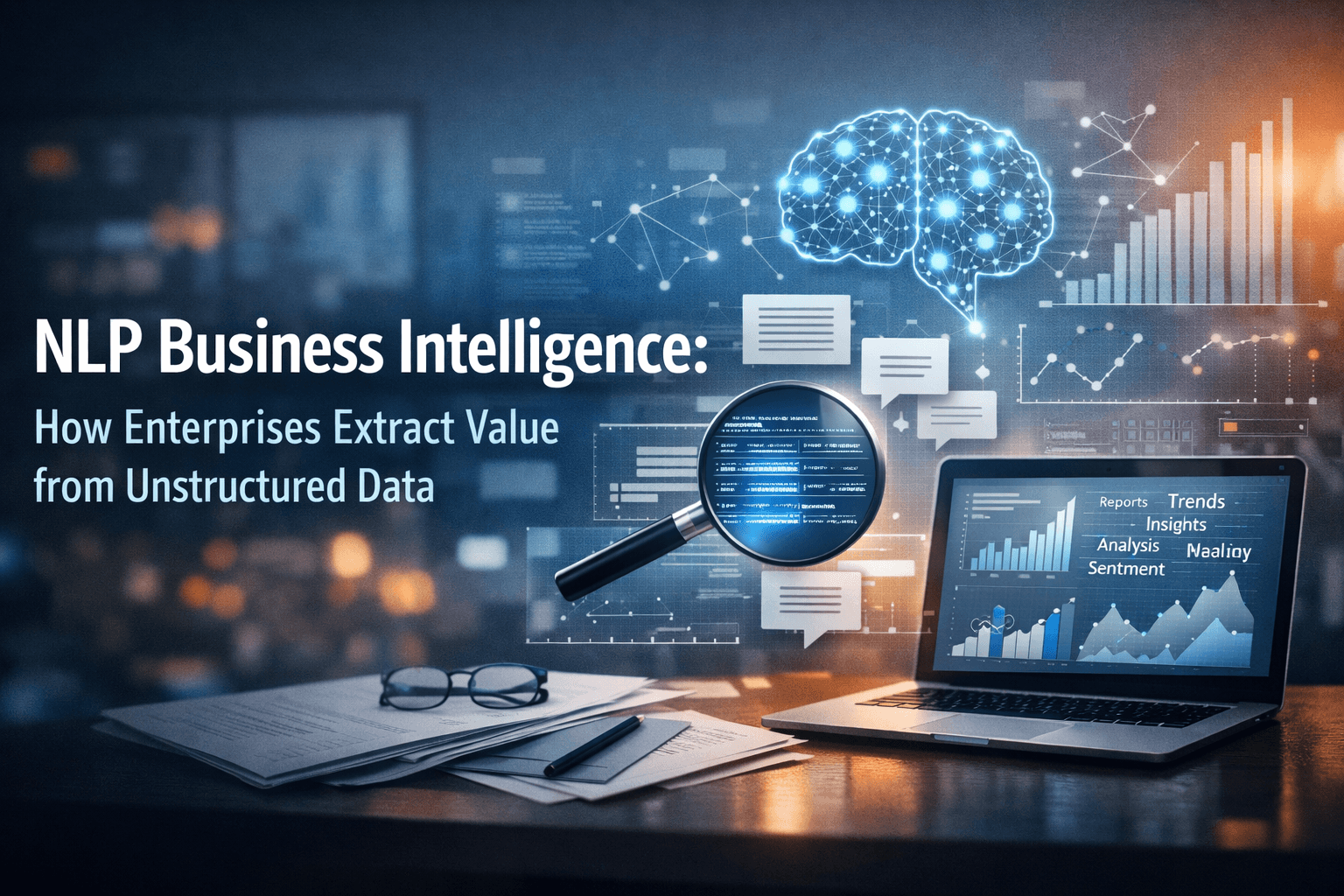
Natural Language Processing (NLP) Business Intelligence represents the shift from manual data entry to automated, semantic understanding of enterprise information. By deploying nlp tools for data intelligence and business analytics, organizations can now process millions of documents, emails, and call transcripts in real-time. This capability allows leaders to identify market trends and operational bottlenecks that traditional structured databases often miss. Integrating NLP for enterprise data insights ensures that qualitative data becomes a quantitative asset. At samta.ai, our expertise in building high-performance LLM pipelines allows firms to bridge the gap between raw text and strategic execution.
Why NLP Business Intelligence Matters Today
NLP Business Intelligence marks a shift from static dashboards to dynamic, language-driven decision-making. Traditional BI tools rely heavily on structured data, leaving vast amounts of unstructured information unused.
By combining machine learning for business intelligence with NLP capabilities, enterprises can:
Process millions of text-based data points in seconds
Identify patterns across disconnected data sources
Automate insight generation with minimal human intervention
According to the IBM Global AI Adoption Index, organizations using AI-driven analytics outperform competitors in both speed and decision accuracy highlighting the urgency of adopting NLP-powered systems.
Key Takeaways
Automated Synthesis: NLP converts unstructured text into structured, queryable data
Sentiment Analysis: Real-time understanding of customer and market behavior
Cost Reduction: Reduces manual processing efforts by up to 70%
Competitive Advantage: Identifies early signals from niche datasets
Scalability: Handles data volumes beyond human capacity
Assess Your AI Readiness Before You Scale
What Does NLP Business Intelligence Mean in 2026?
In 2026, NLP Business Intelligence has evolved from simple keyword matching to deep contextual understanding.
Modern systems now:
Interpret intent, tone, and context
Validate insights against historical datasets
Trigger actions through autonomous workflows
This evolution aligns closely with concepts explored in autonomous business processes, where systems not only analyze but also act on insights.
To ensure accuracy, enterprises rely on strong data foundations supported by data integration consulting services ensuring NLP models receive clean and relevant data streams.
Core Comparison: Intelligence Solutions
Feature | Samta.ai Managed Solutions | Traditional BI Tools | Open-Source NLP Libraries | Enterprise Impact |
Data Handling | Full Unstructured + Structured | Mostly Structured | Unstructured (Manual Setup) | Broader data coverage leads to deeper insights |
Implementation | End-to-End Veda Integration | Plug-and-play (Limited) | High Development Effort | Faster deployment and reduced time-to-value |
Accuracy | Enterprise-Grade Fine-tuning | Low (Rule-based) | Variable | Higher confidence in decision-making |
Support | Hire data engineers enterprise AI experts | Software Support Only | Community Only | Reduced operational and technical risks |
Scalability | Built for enterprise-scale NLP workloads | Limited scalability | Depends on infrastructure | Enables long-term, sustainable growth |
For organizations evaluating modern BI stacks, exploring best conversational BI platforms can further enhance decision intelligence capabilities.
How Does NLP Extract Insights from Data in Practice?
Understanding how nlp extracts insights from data becomes clearer when applied to real business scenarios. NLP automates interpretation, identifies patterns, and enables proactive decision-making across functions.
1. Financial Risk Assessment
NLP systems analyze earnings calls, regulatory filings, analyst reports, and real-time news streams to detect subtle shifts in sentiment and language. Using AI and NLP for predictive analytics, organizations can identify early warning signals such as negative tone changes or emerging risk keywords before they impact financial performance. According to the IBM Global AI Adoption Index, organizations using AI-driven analytics outperform competitors in decision speed and accuracy. This enables finance teams to act proactively rather than reactively.
2. Customer Support Optimization
By integrating NLP with systems like AI for customer support, businesses can classify tickets, detect intent, and identify recurring issues automatically. This reduces resolution time, improves customer satisfaction, and helps teams fix root causes faster.
3. Contract Analysis
Legal teams use NLP to scan thousands of agreements and identify key clauses, risks, and compliance gaps. This significantly reduces manual effort while improving accuracy in high-stakes environments.
4. Supply Chain Monitoring
NLP monitors global news, supplier communications, and geopolitical developments to identify potential disruptions. Businesses can proactively adjust sourcing and logistics strategies based on real-time insights.
5. Employee Feedback Analysis
Using conversational BI, HR teams analyze surveys and internal communications to uncover sentiment trends, engagement levels, and recurring concerns enabling data-driven workforce decisions.
Understand Your Enterprise AI Risk Exposure
Limitations & Risks
Data Privacy: Handling sensitive unstructured text requires strict PII (Personally Identifiable Information) masking protocols.
Contextual Nuance: NLP may struggle with heavy sarcasm, industry-specific jargon, or localized slang without proper fine-tuning.
Model Drift: As language and business terms evolve, NLP models require periodic retraining to maintain accuracy levels.
High Compute Costs: Processing massive volumes of unstructured data can be expensive without optimized infrastructure.
Decision Framework: When to Implement NLP
Use NLP When:
Your team spends 10+ hours weekly analyzing text-heavy data
Real-time decision-making is critical
Compliance and audit tracking require document-level insights
Avoid NLP When:
You are working only with structured numerical datasets
Simpler BI dashboards can solve the problem
For cost-effective options, explore affordable AI analytics software before scaling advanced NLP implementations.
Section A: How US Enterprises Approach Natural Language Processing
US enterprises adopt Natural Language Processing (NLP) with a strong focus on ROI, scalability, and integration with business intelligence systems. CTOs and Heads of AI prioritize NLP machine learning models that can process large volumes of unstructured data—customer feedback, documents, and operational logs. Organizations leverage advanced NLP techniques such as sentiment analysis, entity recognition, and predictive analytics to drive faster decision-making. Vendor selection is heavily KPI-driven, with emphasis on deployment speed, model accuracy, and measurable business outcomes within 6–12 months.
Section B: How Singapore Companies Handle Natural Language Processing
Singapore enterprises approach Natural Language Processing (NLP) with a strong emphasis on compliance, precision, and governance. Organizations align NLP initiatives with regulatory expectations from the Monetary Authority of Singapore and Personal Data Protection Commission, especially when handling sensitive data. Companies focus on implementing NLP machine learning solutions that ensure auditability, transparency, and secure data processing. The use of structured NLP techniques is often paired with governance frameworks to minimize risk while enabling scalable AI adoption.
Conclusion
Natural Language Processing (NLP) Business Intelligence is no longer optional it is a competitive necessity for enterprises dealing with massive volumes of unstructured data. The ability to extract meaning from text and act on it in real time is what differentiates modern, data-driven organizations. By combining NLP for enterprise data insights with scalable infrastructure and expert implementation, businesses can transform raw information into strategic advantage. Platforms like samta.ai enable organizations to bridge the gap between data and execution ensuring long-term growth and resilience.
Explore the Right AI Strategy for Your Business
About Samta
Samta.ai is a Singapore-headquartered AI Product Engineering & Data Intelligence partner helping enterprises build production-grade AI systems for regulated and data-intensive environments.We help organizations move beyond experimentation by engineering scalable, explainable, and enterprise-ready AI solutions from data foundations and model development to workflow automation and deployment.
Our capabilities combine deep AI expertise, data engineering, and product engineering to deliver measurable business impact across FinTech, BFSI, cybersecurity, regulatory technology, and enterprise operations.
Our enterprise AI products power real-world intelligence systems:
• TATVA : AI-driven data intelligence platform for governed analytics, monitoring, and operational insights
• VEDA : Explainable and audit-ready AI decisioning engine built for compliance-sensitive enterprise workflows
• CORA-Property Management Solutions: : Predictive intelligence platform for real-estate pricing, portfolio optimization, and investment analytics
Backed by ecosystem partnerships with Microsoft, Databricks, Snowflake, and AWS, Samta.ai delivers agile, cost-efficient AI engineering with faster turnaround and enterprise-grade scalability. Trusted by enterprises across FinTech, BFSI, and digital transformation initiatives, Samta.ai embeds AI governance, data privacy, and compliance-by-design principles directly into the AI lifecycle , enabling organizations to scale AI with transparency, accountability, and operational control.
Enterprises leveraging Samta.ai automate 65%+ of repetitive data, analytics, and decision workflows while maintaining governance, explainability, and measurable business outcomes. Samta.ai provides the strategic consulting, AI engineering, and data modernization expertise needed to align enterprise operations with next-generation AI transformation goals.
FAQ
How does NLP improve business analytics?
NLP bridges the gap between human language and machine-readable data. It enables businesses to analyze sentiment, intent, and themes alongside traditional metrics creating a more complete view of performance.
Why should we hire data engineers enterprise AI teams?
To hire data engineers enterprise AI specialists ensures scalable, secure NLP systems. They manage complex data pipelines and prevent poor data quality from affecting insights.
What is the role of machine learning in NLP?
Machine learning for business intelligence powers NLP by enabling systems to learn patterns, adapt to new language, and continuously improve accuracy.
Can NLP assist in predictive analytics?
Yes. AI and NLP for predictive analytics identify early signals in text data helping businesses anticipate trends before they appear in structured reports.
Unlock Verifiable Insights Across All Data Stores
VEDA connects siloed data sources and empowers business leaders with real-time, governed AI decision analytics.
Explore VEDA Platform >