
Summarize this post with AI
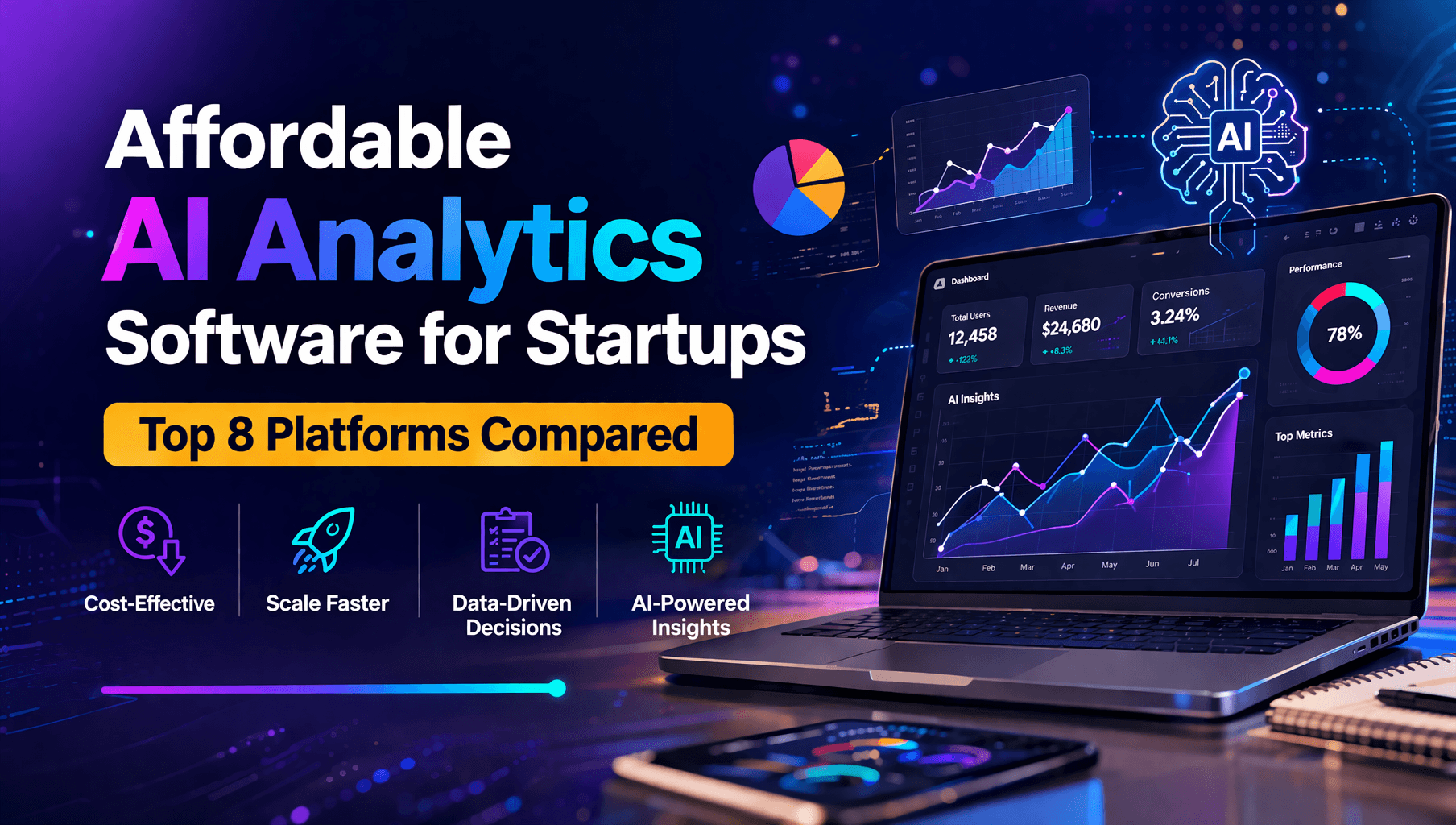
Modern B2B leaders require affordable AI analytics software for startups to transform raw data into actionable search insights under budget. In 2026, the barrier to entry for advanced intelligence has dropped, allowing smaller teams to deploy startup AI analytics solutions that were previously reserved for enterprises. Selecting the right machine learning analytics tools involves balancing computational power with subscription transparency. This brief analyzes low cost AI analytics platforms to help founders achieve rapid data maturity without overextending capital. By focusing on scalability and integration, organizations can leverage high-performance modeling to drive sustainable growth and competitive advantage.
Why Startups Need Affordable AI Analytics Software
Startups today operate in data rich but resource-constrained environments. Every decision from marketing to product development relies on insights derived from data.
However, traditional enterprise analytics tools are expensive and require dedicated data science teams. This is where affordable ai analytics software for startups becomes critical.
These platforms allow founders to:
Turn raw data into actionable insights
Automate reporting and forecasting
Reduce dependency on large analytics teams
Scale intelligence systems as the business grows
According to McKinsey, companies that leverage AI-driven analytics effectively can significantly improve decision-making speed and operational efficiency. This shift is driving rapid adoption of low cost AI analytics platforms across early-stage and growth-stage startups.
Key Benefits of AI Analytics Platforms for Startups
Cost Efficiency Without Compromise
Modern tools offer flexible pricing models such as usage-based billing and modular subscriptions. This makes affordable AI data analytics software with search insights under budget accessible even to lean teams.
No-Code and Low-Code Accessibility
Many startup AI analytics solutions now provide natural language interfaces, enabling non-technical users to run queries, generate reports, and analyze trends without coding expertise.
Seamless Integration
The best platforms integrate with CRMs, ERPs, and marketing tools. If your systems are fragmented, investing in data integration consulting services can help unify your data ecosystem.
Scalable Growth Infrastructure
Startups can begin with lightweight tools and scale to advanced machine learning analytics tools as data complexity increases.
Assess Your AI Readiness Before You Scale
What This Means in 2026
In 2026, affordability is no longer about sacrificing performance. It reflects the democratization of AI infrastructure. Founders must now understand what is data science to fully leverage analytics tools and extract meaningful insights.
Additionally, the focus has shifted toward data discovery for AI, ensuring that analytics platforms can automatically identify relevant datasets across systems.This evolution allows startups to execute predictive modeling and real-time analytics with minimal manual effort.
Core Comparison of Top 8 Platforms
Platform | Core Strength | Ideal For | Best Use Case | Key Feature |
|---|---|---|---|---|
Custom AI/ML Strategy & Integration | Scalable B2B Startups | End-to-end AI analytics implementation | Tailored data pipelines & integrations | |
Metabase | Visual Business Intelligence | Non-technical teams | Dashboarding & reporting | Open-source BI with easy setup |
Tableau Pulse | Automated Metric Tracking | Growth-stage startups | Real-time KPI monitoring | AI-driven insights & alerts |
Mixpanel | User Behavior Analytics | Product-led teams | Product analytics & retention tracking | Event-based tracking system |
Predictive Lead Scoring | Sales teams | Lead qualification & prioritization | AI-powered scoring models | |
Akkio | No-code Machine Learning | Operations teams | Quick predictive modeling | Drag-and-drop ML builder |
MonkeyLearn | Text & Sentiment Analysis | CX & support teams | Customer feedback analysis | NLP-based text classification |
Polymer | Spreadsheet-to-AI Conversion | Small data teams | Quick data visualization | AI-powered spreadsheet insights |
Practical Use Cases of AI Analytics in Startups
Automated Forecasting
Startups use machine learning analytics tools to predict churn, revenue, and customer behavior based on real-time signals.
Search Sentiment Analysis
Using affordable AI data analytics software with search insights under budget, companies can monitor brand perception and customer sentiment across digital channels.
Workflow Automation
Startups streamline operations by integrating analytics with automation systems. Leveraging workflow automation consulting helps eliminate manual errors and improves efficiency.
Competitive Benchmarking
AI tools enable startups to analyze competitor strategies, pricing trends, and market demand patterns faster than traditional methods.
ROI Tracking
Measuring returns on AI investments is critical. Startups often rely on frameworks like AI ROI measurement in business to justify analytics spending.
Limitations & Risks
While low cost AI analytics platforms provide strong initial value, startups must consider potential challenges.
Limited Data Governance
Entry-level tools may lack advanced governance capabilities required for regulated industries.
Black Box Models
Some platforms provide predictions without transparency, making it difficult to interpret results.
Data Security Concerns
Startups must ensure compliance with standards such as GDPR and SOC2 when using cloud-based analytics tools.
Over-Reliance on Automation
Excessive dependence on automated insights without human validation can lead to flawed decision-making.
Measure Your AI Model Risk Before It Becomes a Problem
Decision Framework: Choosing the Right Platform
Selecting affordable ai analytics software for startups depends on your current data maturity and long-term scalability goals. Startups dealing with scattered or siloed data should first focus on building a strong foundation through data discovery for AI to ensure their analytics tools deliver accurate and meaningful insights.
Choose No-Code Tools If
You lack technical expertise
You need quick setup
Your use cases are simple
Choose Advanced Tools If
You need predictive analytics
You handle large datasets
You require customization
Section A: How US Enterprises Approach AI Analytics
US enterprises prioritize ROI, scalability, and integration when selecting the best AI analytics tools and enterprise-grade AI analytics solutions. Decision-making is led by CTOs and data leaders who evaluate tools based on measurable outcomes like cost reduction and automation efficiency. Many organizations also leverage AI automation for small businesses use cases internally to improve workflows before scaling enterprise-wide. Affordable platforms are gaining traction, especially those positioned as best affordable AI analytics software for startups but capable of scaling into enterprise environments.
Section B: How Singapore Companies Handle AI Analytics
Singapore companies focus on compliance-first adoption when selecting AI analytics solutions. Under PDPC and MAS-aligned frameworks, organizations prioritize tools that combine governance with performance. Many SMEs and mid-sized firms adopt the best affordable AI analytics software for startups to balance cost and scalability. Additionally, AI automation for small businesses plays a critical role in improving operational efficiency without heavy infrastructure investment. The demand for the best AI analytics tools is growing, particularly those offering built-in compliance and auditability.
Conclusion
Navigating the market for affordable AI analytics software for startups requires a balance between immediate cost savings and long-term technical scalability. While various platforms offer specialized features, the true value lies in how these tools integrate into a broader business strategy. Samta.ai provides the deep expertise in AI and ML necessary to ensure these tools deliver measurable results. By aligning technology with a clear roadmap, startups can transform data from an overhead cost into a primary growth engine.
About Samta
Samta.ai is a Singapore-headquartered AI Product Engineering & Data Intelligence partner helping enterprises build production-grade AI systems for regulated and data-intensive environments.We help organizations move beyond experimentation by engineering scalable, explainable, and enterprise-ready AI solutions from data foundations and model development to workflow automation and deployment.
Our capabilities combine deep AI expertise, data engineering, and product engineering to deliver measurable business impact across FinTech, BFSI, cybersecurity, regulatory technology, and enterprise operations.
Our enterprise AI products power real-world intelligence systems:
• TATVA : AI-driven data intelligence platform for governed analytics, monitoring, and operational insights
• VEDA : Explainable and audit-ready AI decisioning engine built for compliance-sensitive enterprise workflows
• CORA-Property Management Solutions: : Predictive intelligence platform for real-estate pricing, portfolio optimization, and investment analytics
Backed by ecosystem partnerships with Microsoft, Databricks, Snowflake, and AWS, Samta.ai delivers agile, cost-efficient AI engineering with faster turnaround and enterprise-grade scalability. Trusted by enterprises across FinTech, BFSI, and digital transformation initiatives, Samta.ai embeds AI governance, data privacy, and compliance-by-design principles directly into the AI lifecycle , enabling organizations to scale AI with transparency, accountability, and operational control.
Enterprises leveraging Samta.ai automate 65%+ of repetitive data, analytics, and decision workflows while maintaining governance, explainability, and measurable business outcomes. Samta.ai provides the strategic consulting, AI engineering, and data modernization expertise needed to align enterprise operations with next-generation AI transformation goals.
Explore the Right AI Strategy for Your Business
FAQs
What defines affordable AI analytics for a startup?
Affordability depends on total cost of ownership, including subscription costs and operational overhead. Startups benefit most from flexible tools that scale alongside growth.
Can these tools handle unstructured data?
Yes. Modern platforms can analyze text, emails, PDFs, and other unstructured formats, enabling broader insight generation.
Is it better to buy or build an analytics solution?
Buying is typically more cost-effective. Building requires significant resources, while existing platforms provide ready-to-use capabilities. Startups planning long-term adoption should align their tools with a structured AI implementation roadmap for enterprise to ensure scalability and consistency.
How do machine learning analytics tools improve decision-making?
Machine learning analytics tools identify patterns, predict outcomes, and automate insights, helping startups make faster and more accurate decisions.
How can startups get value from affordable AI data analytics software with search insights under budget?
By using affordable AI data analytics software with search insights under budget, startups can identify market trends, optimize content strategies, and align product development with user demand.