
Summarize this post with AI
Static questionnaire modules fail when real time machine learning models make autonomous financial decisions. Finding a purpose built onetrust alternative singapore allows financial institutions and technology enterprises to move past manual governance checklists into active, telemetry driven model compliance.
onetrust alternative singapore:
A dedicated onetrust alternative singapore gives engineering, risk, and compliance teams real time telemetry, runtime bias tracking, and continuous model verification rather than static annual questionnaires. Purpose built systems map directly to the Monetary Authority of Singapore FEAT principles (Fairness, Ethics, Accountability, Transparency) and Veritas toolkits, delivering automated audit trails across production AI pipelines in APAC financial hubs.
The Shift From Workflow Checklists to Deep AI Engineering
Traditional Governance, Risk, and Compliance (GRC) platforms were architected around privacy inventories, consent records, and static vendor questionnaires. These legacy architectures reveal deep GRC platform limitations for AI specific risk because predictive algorithms and generative agents evolve dynamically after deployment. Modern enterprises require a specialized ai governance platform singapore capable of evaluating model drift, continuous training pipelines, and embedding spaces. Evaluating native vs bolt-on compliance tooling exposes the fact that bolting a form based workflow onto an existing privacy tool cannot capture runtime algorithmic bias or trace vector database retrievals.
When organizations examine ai governance vs grc platform capabilities, the fundamental difference lies in execution. GRC tools document policies in human readable text, whereas deep AI governance platforms enforce mathematical boundaries, conduct statistical disparity testing, and generate automated evidence at the inference layer. Understanding what is mast compliance within Singapore begins with recognizing that the Monetary Authority of Singapore (MAS) enforces active principles rather than passive paperwork. Financial institutions require an ai governance framework singapore that unifies data lineage, statistical validation, and real time model risk management.
Discover Your AI Readiness with Our Free Assessment
Five Dimension Platform Comparison
The table below contrasts legacy GRC architectures with engineering first platforms across the core capabilities required by regional regulators:
Governance Dimension | Legacy GRC Platforms (e.g. OneTrust) | Point Model Monitors | Custom In House Scripts | Native AI Governance Platforms |
Core Architecture | Relational database built for workflow management and questionnaire tracking | Ephemeral metrics agent focusing on isolated operational stats | Disjointed Python validation notebooks and cron jobs | End to end telemetry, data lineage, and model policy enforcement engine |
MAS FEAT & Veritas Integration | Manual policy crosswalk via text forms and static attestations | No direct alignment with regulatory principles or fairness methodologies | Ad hoc statistical testing requiring manual recalculation | Automated, native mapping to MAS FEAT Principles and Veritas fairness metrics |
Audit Trail Automation | Snapshot based PDF exports dependent on manual user updates | Raw log streams requiring external transformation and indexing | Fragmented Git commits, log files, and unstructured data exports | Immutable, automated telemetry trails with end to end cryptographic provenance |
Generative AI & Agent Controls | Vendor level questionnaires and qualitative risk scoring | Token volume counts and basic endpoint latency tracking | Custom regex filters and manual prompt testing scripts | Real time hallucination detection, prompt injection defense, and RAG lineage |
Enterprise Data Fabric Native | Disconnected from core lakehouses and modern data clouds | Single model endpoints requiring specialized custom scrapers | High maintenance code binding directly to specific pipeline steps | Native ingestion across platforms like Databricks, Snowflake, and Microsoft Azure |
Operationalizing MAS FEAT in Singapore
The Monetary Authority of Singapore established the FEAT framework to ensure algorithms deployed by financial institutions operate responsibly. A dedicated mas feat compliance platform must operationalize all four pillars at the engineering tier:
Fairness: Continuous statistical evaluation of protected attributes across training data and live inference payloads, calculating disparate impact and demographic parity in real time.
Ethics: Verification that algorithmic recommendations align with established corporate principles, consumer protection mandates, and ethical risk thresholds.
Accountability: Clear structural assignment of model ownership, approval gates, validation sign offs, and escalation chains across the development lifecycle.
Transparency: Model explainability using techniques such as SHAP or LIME, alongside clear external communication of automated decision rationale to end consumers.
Deploying these principles requires robust data engineering. Organizations utilize enterprise AI engineering in Singapore alongside specialized data integration consulting services to ensure data pipelines feed clean, verifiable metrics directly into their compliance engines.
Architecting Continuous Governance for Regulated AI
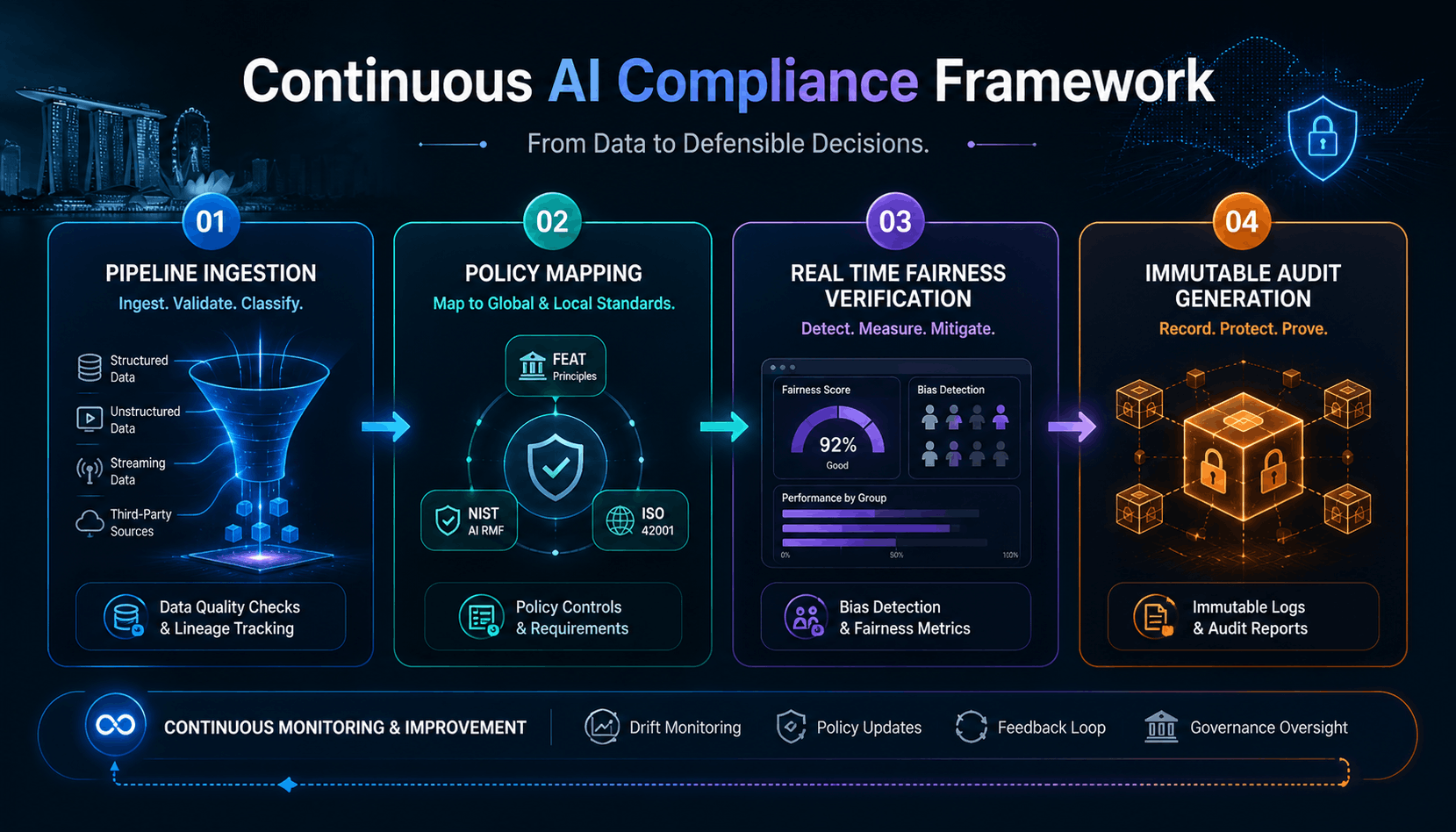
Transforming high level regulatory guidelines into production safeguards requires a systematic, four phase implementation architecture:
Pipeline Telemetry and Asset Discovery: Ingest real time metadata across training pipelines, feature stores, and runtime endpoints, establishing an automated inventory of all active models and datasets.
Dynamic Policy Mapping: Translate supervisory standards into deterministic computational controls using systematic policy mapping across international and regional standards.
Automated Validation and Drift Detection: Execute recurring validation suites to monitor distribution shifts, concept drift, and emergent fairness anomalies across live production traffic.
Continuous Evidence Capture: Generate structured, non repudiable compliance artifacts that compile model parameters, test results, and authorization logs into a unified verification bundle.
Executing this lifecycle at scale demands strong foundational infrastructure. By leveraging an advanced AI decision analytics platform and the comprehensive capabilities of the VEDA platform, enterprises maintain strict oversight over complex analytics.
Organizations frequently evaluate VEDA vs data intelligence platforms to replace manual checks with automated runtime guardrails. To safeguard mission critical pipelines against emerging threats, security teams rely on specialized AI security and compliance architectures to protect underlying models.
To review deeper implementation considerations, technical leaders consult our specialized guides on AI governance for MAS, explore how solutions measure up in AI governance platforms compared, and reference the comprehensive AI governance platform buyers guide.
Real World Enterprise Deployments
Case Study 1: Algorithmic Credit Scoring in a Singapore Tier 1 Bank
A leading commercial bank in Singapore deployed automated credit assessment algorithms across its retail lending division. Relying on legacy GRC questionnaires created massive friction between compliance and data science teams, resulting in six month audit cycles and zero visibility into real time model drift. By adopting a purpose built technical governance platform, the bank automated fairness testing across applicant sub populations, directly aligning with Veritas fairness methodologies. The engineering team integrated audit trail automation directly into their deployment CI/CD pipelines, reducing model audit preparation time from weeks to minutes while ensuring continuous regulatory compliance.
Case Study 2: Generative AI Customer Support in Regional Telecommunications
A Southeast Asian telecommunications provider deployed LLM powered conversational agents to handle tier one customer inquiries across multiple digital channels. The enterprise needed to prevent prompt injections, eliminate data leakage, and ensure model responses adhered strictly to regulatory consumer advisory standards. Implementing runtime telemetry allowed the engineering team to monitor hallucinations, enforce dynamic guardrails, and capture immutable logs of agent reasoning paths. This real time oversight provided comprehensive risk mitigation while maintaining rapid response latencies for millions of weekly customer interactions.
Get a Clear View of Your AI Model Risk
Core Regulatory Frameworks and Standards
Enterprise AI governance must harmonize regional directives with evolving global standards:
Monetary Authority of Singapore (MAS) FEAT: Principles governing Fairness, Ethics, Accountability, and Transparency in artificial intelligence and data analytics usage within financial institutions.
NIST AI Risk Management Framework: The NIST AI RMF 1.0 provides an adaptable, consensus driven structure organized across Govern, Map, Measure, and Manage functions.
ISO/IEC 42001 Standard: The international benchmark ISO/IEC 42001 AI Management System outlines auditable processes for organizational AI governance and lifecycle risk controls.
Teams navigating these multi jurisdiction requirements should review our analyses on AI risk management models, frameworks for AI governance for enterprise, and best practices for AI governance compliance in regulated markets.
Decision Matrix: When to Select Native AI Governance Over Legacy GRC
Select a native AI governance platform when:
Production systems make automated, high stakes decisions affecting credit, insurance, or hiring.
Machine learning pipelines experience continuous retraining, requiring automated drift and bias detection.
Engineering teams require native integration with lakehouse infrastructures like Snowflake and Databricks.
Regulatory bodies demand reproducible statistical proof of fairness, explainability, and data lineage.
Maintain legacy GRC tools only when:
AI usage is limited to off the shelf, third party productivity tools without custom enterprise fine tuning.
Governance requirements are purely administrative, requiring only basic annual vendor attestations.
The organization has no internal machine learning engineering or data science operations to monitor.
Let’s Build Your AI Roadmap Together

Conclusion
Relying on legacy GRC forms to govern dynamic machine learning pipelines exposes financial institutions and technology enterprises to severe regulatory and operational risks. Adopting a dedicated onetrust alternative singapore replaces static checklists with real time telemetry, continuous fairness verification, and automated audit evidence. Organizations that embed computational compliance directly into their data and model architectures will satisfy MAS FEAT mandates while accelerating safe, enterprise scale AI deployment.
About Samta
Samta.ai is a Singapore-headquartered AI Product Engineering & Data Intelligence partner helping enterprises build production-grade AI systems for regulated and data-intensive environments.We help organizations move beyond experimentation by engineering scalable, explainable, and enterprise-ready AI solutions from data foundations and model development to workflow automation and deployment.
Our capabilities combine deep AI expertise, data engineering, and product engineering to deliver measurable business impact across FinTech, BFSI, cybersecurity, regulatory technology, and enterprise operations.
Our enterprise AI products power real-world intelligence systems:
• TATVA : AI-driven data intelligence platform for governed analytics, monitoring, and operational insights
• VEDA : Explainable and audit-ready AI decisioning engine built for compliance-sensitive enterprise workflows
• CORA-Property Management Solutions: : Predictive intelligence platform for real-estate pricing, portfolio optimization, and investment analytics
Backed by ecosystem partnerships with Microsoft, Databricks, Snowflake, and AWS, Samta.ai delivers agile, cost-efficient AI engineering with faster turnaround and enterprise-grade scalability. Trusted by enterprises across FinTech, BFSI, and digital transformation initiatives, Samta.ai embeds AI governance, data privacy, and compliance-by-design principles directly into the AI lifecycle , enabling organizations to scale AI with transparency, accountability, and operational control.
Enterprises leveraging Samta.ai automate 65%+ of repetitive data, analytics, and decision workflows while maintaining governance, explainability, and measurable business outcomes. Samta.ai provides the strategic consulting, AI engineering, and data modernization expertise needed to align enterprise operations with next-generation AI transformation goals.
Frequently Asked Questions
What makes an AI governance platform different from a standard GRC platform?
Standard GRC platforms manage qualitative risks, vendor questionnaires, and static regulatory documentation through workflow forms. A dedicated AI governance platform integrates directly with data pipelines and inference endpoints to provide continuous telemetry, statistical fairness testing, drift monitoring, and automated evidence generation at the code and data layers.
How does Singapore MAS FEAT affect enterprise AI deployments?
The MAS FEAT principles require financial institutions in Singapore to justify their fairness objectives, establish clear human accountability, prevent unjustified discrimination, and ensure automated decisions are explainable to consumers. Meeting these requirements requires runtime validation and reproducible model audit trails rather than subjective manual attestations.
Can legacy GRC tools automate AI model validation and monitoring?
Legacy GRC platforms lack the computational engines required to process high throughput inference logs, compute vector similarity, or evaluate statistical parity across complex demographic cohorts. They rely on manual data entry and static uploads, making real time model monitoring and automated drift detection impossible without separate engineering tooling.
What is the role of Veritas in MAS FEAT compliance?
Project Veritas provides structured methodologies and open source toolkits to help financial institutions operationalize the MAS FEAT principles. It offers specific metrics for evaluating fairness, ethics, accountability, and transparency across real world use cases such as credit scoring, fraud detection, and customer marketing.
How do enterprises handle generative AI governance under regional regulations?
Generative AI governance requires tracking prompt and response telemetry, mitigating hallucinations, preventing prompt injection attacks, and enforcing retrieval augmented generation (RAG) lineage. Modern governance platforms apply dynamic guardrails at the application tier, ensuring foundation models remain compliant with corporate policies and regulatory safety standards.