
Summarize this post with AI
Most Singapore financial institutions still treat AI governance as guidance they can adopt at their own pace. That window has closed. MAS's November 2025 Guidelines and March 2026 Toolkit mark a shift from principles-based guidance to supervisory-ready expectations, increasing the likelihood that MAS will assess AI governance as part of routine inspections. ai governance mas regulated organisations now face genuine examination risk, not just reputational pressure, if their AI controls are undocumented or informal. This guide explains exactly what ai governance mas regulated institutions need in place in 2026, and how the board, risk, and technology functions divide responsibility for it.
AI Governance MAS Regulated
ai governance mas regulated organisations need a documented MAS AI governance framework covering board-level oversight, a centralized AI inventory, proportionate lifecycle controls, and independent model validation. The MAS AI Risk Management Toolkit, released 20 March 2026, includes an Operationalisation Handbook with practical guidance for implementing AI risk management, developed under Phase two of Project MindForge. Once the underlying Guidelines are finalized, MAS will evaluate financial institutions' compliance during inspections and supervisory reviews, with non-compliance potentially resulting in supervisory action.
What AI Governance Means for MAS-Regulated Organisations
A governance framework for ai in the MAS context is not a single document. It is a structured set of controls spanning the entire AI lifecycle, from initial risk assessment through retirement. In March 2026, MAS released the AI Risk Management Toolkit, and the Association of Banks in Singapore separately published the Handbook on Generative AI Guardrails in Banking, both aimed at guiding financial institutions toward responsible AI adoption. These sit on top of the longstanding FEAT principles. For the foundational fairness component specifically, see the MAS FEAT fairness deep dive, and for the broader compliance checklist connecting all of this together, see the MAS FEAT compliance checklist.
Why This Matters Now in 2026
Three developments make ai governance mas regulated compliance materially more urgent this year.
1. Supervisory expectations are no longer hypothetical. MAS supervisory examinations increasingly evaluate AI governance practices as part of broader technology risk assessments, and institutions that have not formalized their approach will find themselves at a significant disadvantage during those reviews.
2. Agentic AI introduces a new risk category regulators are watching closely. MAS recognized that the next compliance challenge is not simply AI that drafts, predicts, or recommends, but AI that can take autonomous actions in business processes such as fraud detection, credit decisioning, and customer service. The Toolkit explicitly covers traditional AI, generative AI, and emerging agentic AI technologies.
3. Proportionality does not mean exemption. MAS applies a principle of proportionality, where smaller, less complex institutions can implement a lighter governance framework, but all MAS-regulated entities, regardless of size, are expected to have basic AI governance in place if they use AI for material business functions.
For institutions still treating technology risk and AI governance as separate workstreams, the MAS technology risk management notice makes clear these obligations increasingly overlap, particularly around audit trails and incident response.
AI Risk Assessment Templates Don't build your AI inventory from scratch. Get Samta.ai's AI Risk Assessment Templates, pre-mapped to MAS's Operationalisation Handbook and proportionality principle.
The MAS AI Governance Framework: Step by Step
Use this sequence to build or audit a governance framework for ai aligned to current MAS expectations.
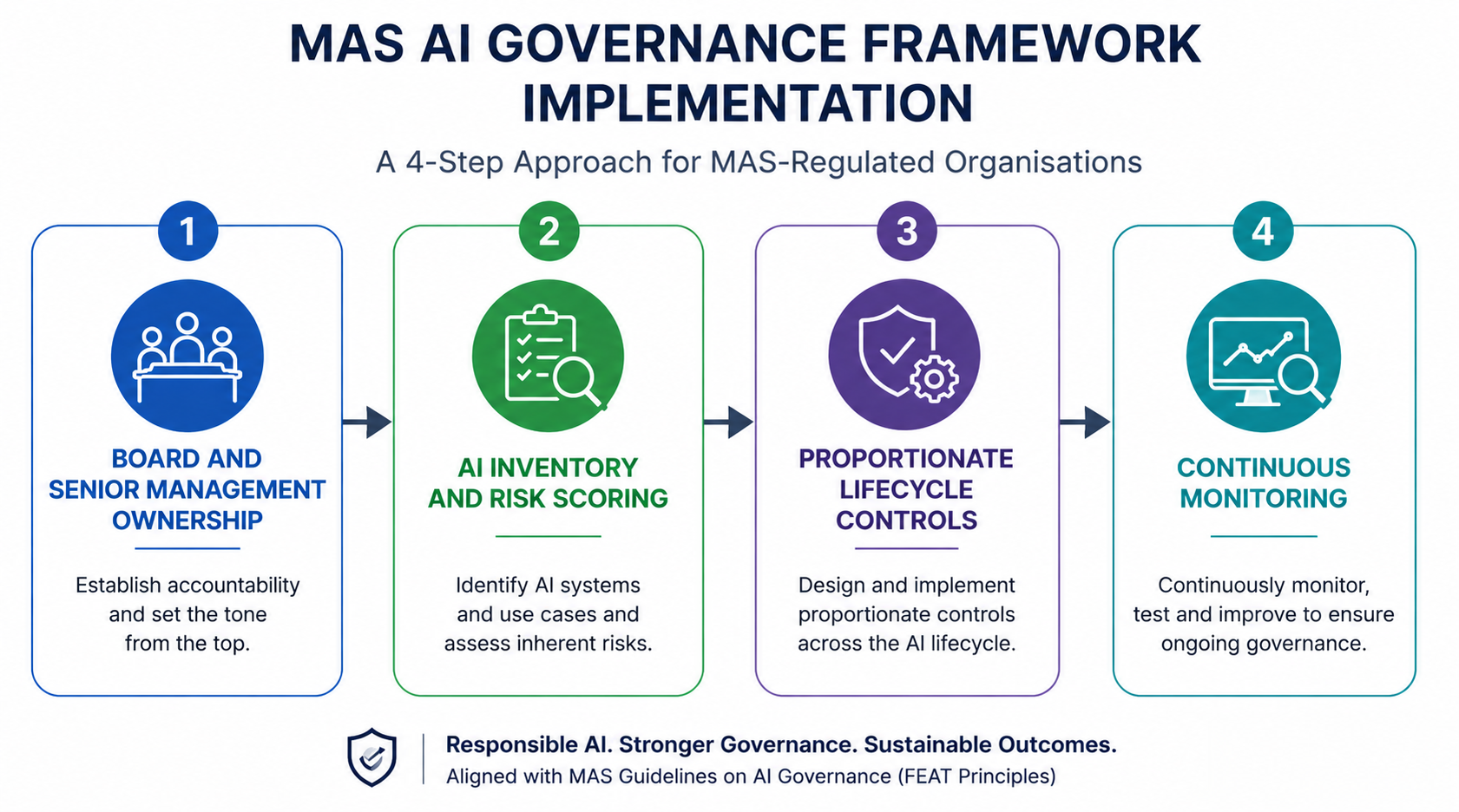
Step 1: Establish Board and Senior Management Ownership
Assign ultimate accountability to the board: the Guidelines repeatedly emphasize that the board of directors and senior management are the ultimate gatekeepers of AI risks and must assume primary and ultimate responsibility for the oversight of the entire AI risk management framework.
Form a cross-functional AI risk committee: for institutions with significant AI exposure comprising experts from risk, compliance, technology, and business functions to achieve coordinated, proactive management of AI risks.
Step 2: Build a Centralized AI Inventory with Risk Materiality Scoring
Catalog every AI system: including vendor-supplied and agentic tools.
Score risk materiality by impact, complexity, and reliance: centralised AI inventories and risk materiality methodologies should be built around criteria of impact, complexity, and reliance.
Apply differentiated governance by risk tier: a high-impact, highly complex AI system used for reviewing loan applications requires the most stringent governance, while a lower-risk application such as code completion assistance requires less stringent compliance measures.
Step 3: Embed Proportionate Lifecycle Controls
Strengthen data governance, fairness, and explainability controls: embed proportionate lifecycle controls and ensure AI risks are monitored, documented, and managed consistently across the full lifecycle.
Apply proportionality correctly: if an AI use is an integrated part of the institution's business process, the full four-area risk management framework should apply; otherwise, basic policies commensurate with AI adoption level suffice.
Document independent model validation reviews: conducted by teams separate from model development.
Step 4: Operationalize Continuous Monitoring and Capability Building
This is where most institutions underinvest. Boards, management, and risk teams need the knowledge to oversee AI effectively, fostering a risk-aware culture that balances innovation with control and accountability.
Samta.ai's Veda AI platform supports this step by connecting AI inventory, risk materiality scoring, and lifecycle monitoring into a single dashboard, turning the Operationalisation Handbook's recommendations into a live system rather than a static spreadsheet. The Veda AI data analytics platform integrates with cloud data platforms such as Databricks and Snowflake, and pairs with Samta.ai's AI security compliance services for full audit documentation aligned to the NIST AI risk management framework where institutions need international standard cross-referencing.
MAS AI Governance Framework: Comparison Across Components
Dimension | FEAT Principles | November 2025 Guidelines | March 2026 AI Risk Management Toolkit | Samta.ai Integration Point |
Nature | Principles-based foundation, launched 2018 | Proposed supervisory expectations | Practical implementation handbook | Continuous compliance dashboard |
Core Focus | Fairness, ethics, accountability, transparency | Lifecycle AI risk management framework, board accountability | Traditional AI, generative AI, and agentic AI risk management | Unified inventory and risk scoring |
Scope Principle | General responsible AI use | Proportionate to size, nature, and risk profile of the FI | Developed with banks, insurers, capital market firms | Risk-tiered governance automation |
2026 Status | Foundational, still referenced | Expected to be finalized in 2026 as supervisory expectations | Released 20 March 2026, Phase two of Project MindForge | Available now via Veda AI |
Enforcement Risk | Reputational | Supervisory action upon finalization | Non-binding but de facto expected | Reduces inspection exposure |
Enterprise Use Cases: How MAS-Regulated Institutions Apply This
Use Case 1: Bank Applying Risk-Tiered Governance to Credit Models
A Singapore bank used the impact, complexity, and reliance scoring methodology to categorize its AI portfolio. Its loan application risk control model was classified as high-impact and highly complex, triggering the most stringent governance and control measures, while a developer code-completion tool received lighter-touch oversight, consistent with proportionality.
This differentiated approach let the bank's risk committee focus board attention precisely where MAS examiners would focus theirs, rather than spreading governance effort evenly across systems with very different risk profiles.
Use Case 2: Insurer Building Agentic AI Oversight for Fraud Detection
A Singapore insurer deploying agentic AI for fraud monitoring needed governance addressing autonomous action, not just output accuracy. Recognizing that the next compliance challenge involves AI taking autonomous actions in processes like fraud detection, not just AI that drafts or recommends, the insurer built human checkpoint approvals for any agent-initiated account freeze or claim escalation, directly aligned with the Toolkit's agentic AI guidance.
Key Risks and Failure Modes
Treating proportionality as an exemption: All MAS-regulated entities, regardless of size, are expected to have basic AI governance in place if they use AI for material business functions. Smaller institutions still need a documented baseline, just a lighter one.
No board-level accountability chain: The board and senior management must assume primary and ultimate responsibility for AI risk oversight. Governance owned only within a technology team falls short of current expectations.
Treating guidance as optional because it is non-binding: Financial institutions should treat these expectations as de facto requirements even when framed as guidance, since the window for treating AI governance as voluntary best practice has effectively closed.
Ignoring agentic AI's distinct risk profile: Agentic AI's risk lies in autonomous action, not just inaccurate output, which means governance built only for generative AI hallucination risk misses the more consequential failure mode.
AI Model Risk Management Playbook Build risk-tiered governance without starting from zero. Request the AI Model Risk Management Playbook from Samta.ai, mapped to MAS's impact, complexity, and reliance scoring.
Decision Framework: Is Your AI Governance MAS-Ready?
Board and senior management hold documented, ultimate accountability for AI risk
A centralized AI inventory exists with risk materiality scored by impact, complexity, and reliance
Lifecycle controls scale proportionately, not uniformly, across risk tiers
Independent model validation occurs separately from development teams
Agentic AI systems have distinct governance addressing autonomous action risk
Risk and compliance teams have the capability and training to oversee AI effectively
If fewer than four boxes are checked, your MAS AI governance framework has gaps an examiner is likely to find before you do.
Conclusion
ai governance mas regulated institutions can no longer treat AI oversight as a future compliance project. With supervisory examinations already evaluating AI governance and the underlying Guidelines expected to formalize into binding supervisory expectations, the institutions documenting board accountability, risk-tiered controls, and agentic AI oversight now will face materially less friction at their next inspection than those starting from zero.
Book a Consultant Get a gap assessment against MAS's current AI governance expectations. Book a Consultant at Samta.ai and map your governance maturity in one session.
About Samta
Samta.ai is a Singapore-headquartered AI Product Engineering & Data Intelligence partner helping enterprises build production-grade AI systems for regulated and data-intensive environments.We help organizations move beyond experimentation by engineering scalable, explainable, and enterprise-ready AI solutions from data foundations and model development to workflow automation and deployment.
Our capabilities combine deep AI expertise, data engineering, and product engineering to deliver measurable business impact across FinTech, BFSI, cybersecurity, regulatory technology, and enterprise operations.
Our enterprise AI products power real-world intelligence systems:
• TATVA : AI-driven data intelligence platform for governed analytics, monitoring, and operational insights
• VEDA : Explainable and audit-ready AI decisioning engine built for compliance-sensitive enterprise workflows
• CORA-Property Management Solutions: : Predictive intelligence platform for real-estate pricing, portfolio optimization, and investment analytics
Backed by ecosystem partnerships with Microsoft, Databricks, Snowflake, and AWS, Samta.ai delivers agile, cost-efficient AI engineering with faster turnaround and enterprise-grade scalability. Trusted by enterprises across FinTech, BFSI, and digital transformation initiatives, Samta.ai embeds AI governance, data privacy, and compliance-by-design principles directly into the AI lifecycle , enabling organizations to scale AI with transparency, accountability, and operational control.
Enterprises leveraging Samta.ai automate 65%+ of repetitive data, analytics, and decision workflows while maintaining governance, explainability, and measurable business outcomes. Samta.ai provides the strategic consulting, AI engineering, and data modernization expertise needed to align enterprise operations with next-generation AI transformation goals.
Frequently Asked Questions
What does AI governance mean for MAS-regulated organisations specifically?
For ai governance mas regulated institutions, governance means a documented framework spanning board oversight, AI inventory, risk-tiered lifecycle controls, and independent validation. Together, MAS's recent Guidelines and Toolkit mark a shift from principles-based guidance to supervisory-ready expectations that examiners now actively assess.
Is the MAS AI Risk Management Toolkit mandatory?
The Toolkit and its Operationalisation Handbook provide non-binding, practical guidance. However, financial institutions should treat these expectations as de facto requirements, since MAS supervisory examinations increasingly evaluate AI governance as part of broader technology risk assessments.
How does proportionality work under the MAS AI risk management guidelines?
The Guidelines emphasise that application of their principles must be proportionate, commensurate with the size and nature of the FI's activities, its risk profile, and its specific AI uses. All regulated entities still need basic governance for material AI use, regardless of size.
What is Project MindForge and how does it relate to MAS AI governance?
The AI Risk Management Toolkit was released under Phase two of Project MindForge, developed with contributions from banks, insurers, and capital market firms. It represents the practical implementation layer sitting above the proposed Guidelines.
Does agentic AI require different governance than generative AI under MAS rules?
Yes. MAS recognized that the next compliance challenge is AI taking autonomous actions in business processes such as fraud detection and credit decisioning, not simply AI that drafts or recommends. The Toolkit explicitly addresses traditional AI, generative AI, and emerging agentic AI as distinct risk categories.