
Summarize this post with AI
95% of HR leaders report budget pressure to automate hiring by 2026—yet 60% still rely on manual resume screening. How AI is transforming human resources isn't theoretical anymore; it's operational necessity. Organizations implementing AI-driven digital transformation in talent workflows reduce hiring cycles by 40% and improve quality-of-hire by 35%, according to Gartner. But most enterprises deploy AI reactively, chasing quick wins rather than building scalable governance frameworks. This article maps the exact mechanics of how is AI used in human resources, reveals what separates winners from laggards, and provides a decision framework for enterprise HR leaders navigating transformation.
Executive Summary
How AI is transforming human resources:
AI is transforming human resources through intelligent candidate sourcing, bias-reduction in screening, real-time skill assessment, and predictive attrition modeling reducing hiring costs 30–40% while improving retention. Organizations implementing benefits of ai in hr report faster time-to-hire, better diversity metrics, and lower cost-per-hire when paired with structured governance frameworks like NIST AI RMF. The shift from resume-parsing to agentic talent evaluation (where AI continuously learns hiring patterns) marks the 2026 inflection point for APAC enterprises competing for talent.
Take the First Step Toward AI Success
What AI in HR Actually Means (Not Resume Bots)
AI-driven digital transformation in HR spans five distinct layers:
Candidate Intelligence: AI parsing resumes + LinkedIn profiles → structured skill inventories
Assessments & Validation: Automated technical, behavioral, and culture-fit evaluations (learn more about best talent assessment practices)
Predictive Analytics: Attrition forecasting, promotion readiness, retention risk scoring
Workflow Automation: Offer generation, onboarding sequencing, compliance documentation
Governance & Bias Audit: Fairness testing, regulatory compliance (GDPR, MAS guidelines), audit trails
Most vendors claim "AI recruiting" they mean layer 1 only. Enterprise-grade implementations span layers 2–5. This is where AI-driven assessment platforms differentiate from basic resume screeners.
Why AI in HR Matters Now (2026 Context)
Three forces converge:
Talent Scarcity: APAC unemployment sits at historic lows. Manual hiring workflows can't compete for speed. Discover top hiring trends reshaping recruitment in 2026.
Regulatory Pressure: Singapore's PDPA, India's emerging AI governance frameworks, and corporate ESG mandates demand explainable hiring decisions.
Data Maturity: Enterprise applicant tracking systems now hold 5–10 years of hiring + performance data, enabling predictive models with 85%+ accuracy.
Businesses ignoring this: Extended hiring cycles (4+ months), poor diversity outcomes, and high regret hires. Organizations driving digital transformation with ai: Standardized, faster pipelines with measurable quality gains. Organizations implementing how AI is used in human resources systematically see immediate ROI.
Core Framework: The AI-Enabled HR Stack
Step-by-Step AI Integration Model
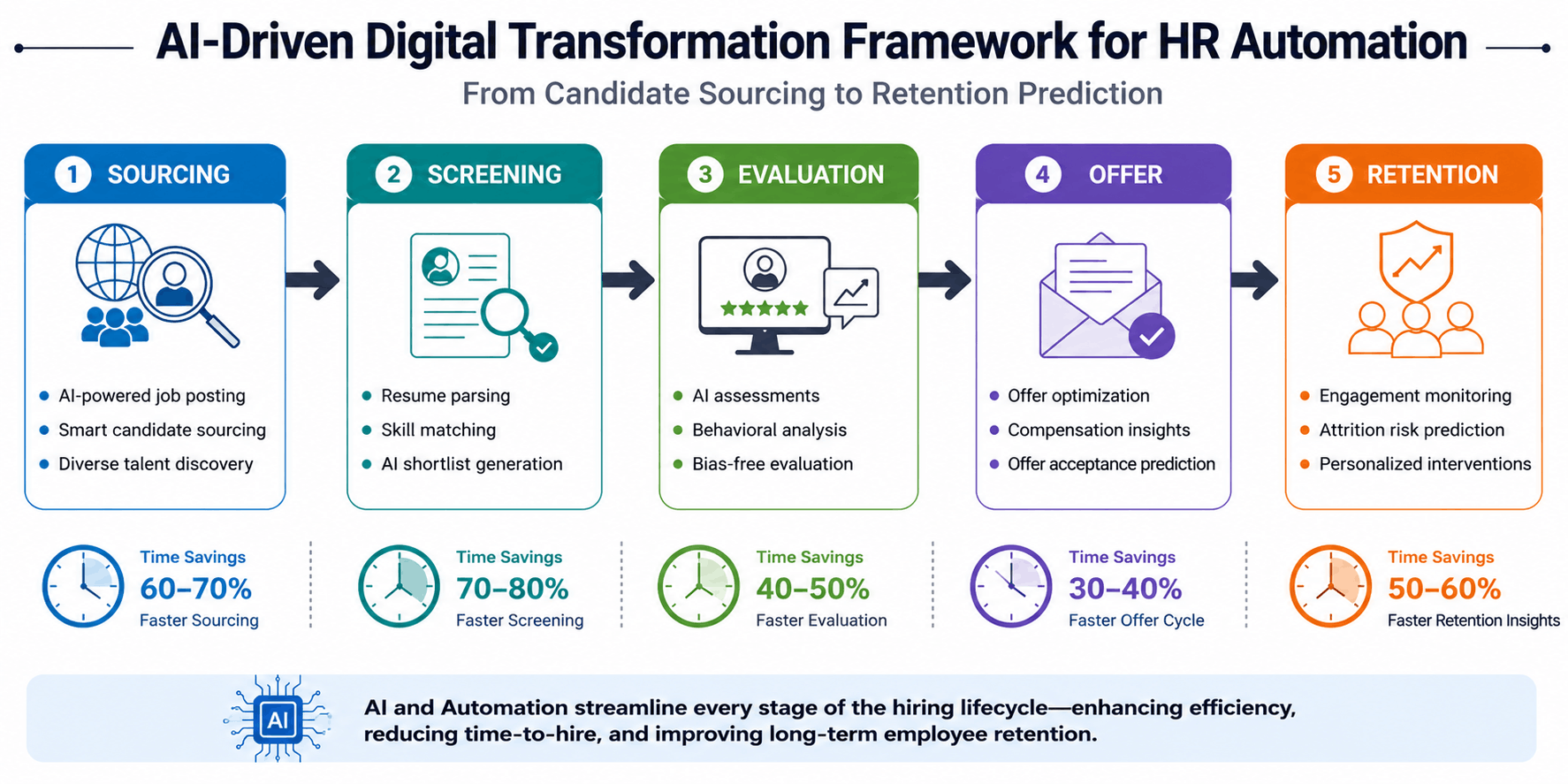
HR Process Layer | Legacy Approach | AI-Enhanced Approach | Output | Maturity Level |
Sourcing | Manual job boards, recruiter networks | AI-powered candidate mining + skill graph matching | 3x pipeline in half the time | Stage 2 |
Screening & Assessment | Resume review + phone screen (human time: 6–10 hrs/hire) | Automated skill validation, code tests, behavioral simulations | Unbiased candidate ranking; 70% time saved | Stage 3 |
Evaluation | Panel interviews (subjective scoring) | Structured interviews + AI-scored consistency metrics | Standardized, bias-audited decisions | Stage 4 |
Offer & Negotiation | Manual salary benchmarking + offer docs | Predictive modeling + dynamic offer generation | Data-driven offers; compliance automated | Stage 3 |
Retention & Development | Annual reviews, gut-feel promotions | Continuous skill tracking + AI-predicted flight risk | Proactive retention; data-driven development | Stage 2 |
Engineering Execution: The TATVA hiring assessment platform integrates directly into ATS ecosystems (Workday, SuccessFactors, BambooHR) as the assessment + governance engine, eliminating manual data mapping. Complement this with Digital Transformation Managed Services to handle change management, stakeholder alignment, and audit compliance across your entire HR stack. Together, they enable organizations to operationalize AI-driven digital transformation without disruption.
Download the AI Implementation Playbook Step-by-step guide for deploying AI and digital transformation in your HR stack without process disruption.
Real-World Enterprise Use Cases
Case 1: BFSI / Regulated Industry
A Tier-1 bank in Singapore needed to cut hiring time from 12 weeks to 6 weeks while improving diversity. Benefits of AI in HR: Deployed AI-driven assessments across 15,000 annual hires. Result: 50% faster pipeline, diversity hire percentage increased 18%, and regulatory audit trails automated. This case exemplifies how autonomous business processes transform recruitment at scale. Learn how AI is used in human resources in fintech contexts.
Case 2: Enterprise SaaS (High-Growth)
A 500-person B2B SaaS firm scaling to 1,000 lacked repeatable hiring standards. AI and digital transformation implementation: Standardized skill rubrics + AI-assisted panel scoring. Result: Quality-of-hire improved 28%, regret hire rate dropped from 12% to 4%, hiring cost-per-employee fell 32%.
Identify Hidden AI Model Risks
Key Risks & Failure Modes
Risk | Why It Happens | Mitigation |
Bias Amplification | Legacy hiring data reflects old biases; AI learns them faster | Fairness testing + synthetic diversity injection before deployment. Platforms like TATVA include built-in fairness audits. |
Over-Automation | HR assumes "AI = remove humans"; actually need more skilled recruiters | Plan for recruiter role shift to relationship + strategy work |
Compliance Breakage | AI systems operate as black boxes; regulators demand explainability | Build audit trails; use interpretable models (NIST AI RMF compliant). Digital Transformation Managed Services ensure regulatory alignment. |
Data Quality Collapse | Garbage in, garbage out incomplete applicant records tank accuracy | Clean data + validation rules before model training |
Implementation Decision Framework
When to Adopt AI HR Solutions:
Annual hiring volume > 500 roles
Turnover costs measurable; retention = business metric
Existing ATS with 2+ years of data history
Regulatory scrutiny demands audit trails
Diversity goals set but not met by current process
When NOT to:
Hiring volume < 100/year (ROI too low)
No structured job requirements (AI can't assess what's undefined)
Hiring managers resist data-driven decisions
Budget locked into legacy platforms for 3+ years
Conclusion
How AI is transforming human resources is no longer optional it's competitive necessity. Organizations implementing AI-driven digital transformation frameworks now recruit 40% faster, hire higher-quality talent, and meet regulatory standards automatically. The risk isn't AI in hiring; it's hiring without AI while competitors scale. The next 12 months will separate enterprises with intelligence-driven hiring from those stuck in manual workflows.
Request a Free Product Demo See how Samta.ai's TATVA platform integrates AI-driven digital transformation services into your ATS.
Explore the Right AI Strategy for Your Business
About Samta
Samta.ai is a Singapore-headquartered AI Product Engineering & Data Intelligence partner helping enterprises build production-grade AI systems for regulated and data-intensive environments.We help organizations move beyond experimentation by engineering scalable, explainable, and enterprise-ready AI solutions from data foundations and model development to workflow automation and deployment.
Our capabilities combine deep AI expertise, data engineering, and product engineering to deliver measurable business impact across FinTech, BFSI, cybersecurity, regulatory technology, and enterprise operations.
Our enterprise AI products power real-world intelligence systems:
• TATVA : AI-driven data intelligence platform for governed analytics, monitoring, and operational insights
• VEDA : Explainable and audit-ready AI decisioning engine built for compliance-sensitive enterprise workflows
• CORA-Property Management Solutions: : Predictive intelligence platform for real-estate pricing, portfolio optimization, and investment analytics
Backed by ecosystem partnerships with Microsoft, Databricks, Snowflake, and AWS, Samta.ai delivers agile, cost-efficient AI engineering with faster turnaround and enterprise-grade scalability. Trusted by enterprises across FinTech, BFSI, and digital transformation initiatives, Samta.ai embeds AI governance, data privacy, and compliance-by-design principles directly into the AI lifecycle , enabling organizations to scale AI with transparency, accountability, and operational control.
Enterprises leveraging Samta.ai automate 65%+ of repetitive data, analytics, and decision workflows while maintaining governance, explainability, and measurable business outcomes. Samta.ai provides the strategic consulting, AI engineering, and data modernization expertise needed to align enterprise operations with next-generation AI transformation goals.
Frequently Asked Questions
Will AI Replace Recruiters?
No. AI removes screening admin; skilled recruiters move upstream to relationship-building, sourcing, and strategic workforce planning. The SHRM found that 73% of HR leaders increased recruiter headcount after AI deployment—redirecting them to higher-value work. Read about top hiring trends to understand the recruiter role evolution in 2026.
How Do We Avoid Biased Hiring?
AI-driven digital transformation services now include fairness audits as standard. Reputable platforms (like TATVA) test models against protected attributes, report adverse impact ratios, and flag outliers. Transparency requirement: document which features drive decisions.
What's the Typical ROI Timeline?
Most mid-market enterprises see cost savings (reduced screening time + lower regret hires) within 3–6 months, quality-of-hire improvements by month 6, and full attrition prediction ROI by month 12.
Do We Need a New ATS?
No. AI HR layers integrate with incumbent systems (Workday, SuccessFactors, BambooHR). Ask vendors for "native API connectors" and avoid rip-and-replace projects. Platforms like TATVA are built to work alongside your existing stack. Explore Samta.ai's integration capabilities to see compatibility with your current ATS.
Is Generative AI Safe in Hiring?
Large-language models (GPT, Claude) excel at summary writing and pattern finding—not core hiring decisions. Use them for interview note synthesis, not candidate ranking. Structured scoring beats generative judgment.