
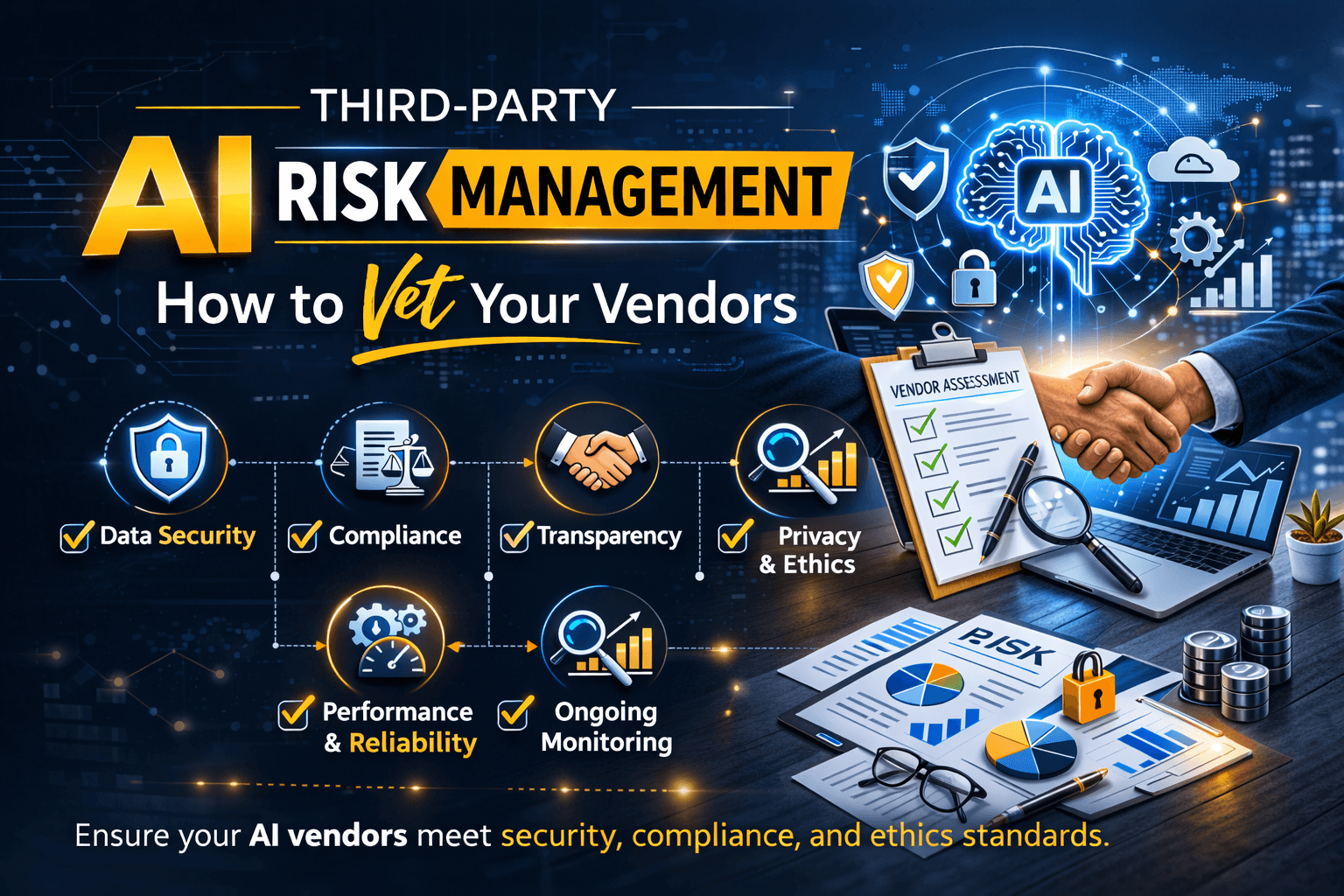
Summarize this post with AI
Third party AI risk assessment has become a strategic priority for enterprises deploying external AI systems. Organizations increasingly depend on third-party vendors for predictive models, decision engines, generative AI APIs, and analytics tools. However, vendor risk now extends beyond cybersecurity into explainability gaps, bias exposure, regulatory non-alignment, and governance blind spots. A structured risk assessment for AI vendor selection must evaluate supplier transparency, model lifecycle controls, audit readiness, and ethical AI procurement policies. Enterprises that fail to operationalize vendor risk management expose themselves to compliance penalties, reputational damage, and systemic AI governance failures.
Key Takeaways
Third party AI risk assessment is essential in regulated industries
Vendor risk includes bias, explainability, and lifecycle governance
AI procurement must align with AI governance frameworks
Continuous monitoring reduces long-term compliance exposure
Governance automation strengthens third-party oversight
What This Means in 2026
By 2026, regulators expect enterprises to demonstrate active oversight of third-party AI systems. Static vendor questionnaires are no longer sufficient.
Organizations must implement:
Risk classification for AI vendors
Ongoing model monitoring
Explainability documentation
Bias testing verification
Alignment with AI governance frameworks
As discussed in the future of AI governance, regulatory expectations are shifting toward lifecycle accountability rather than one-time vendor audits. Enterprises expanding into Europe must also align third-party AI deployments with the obligations outlined in EU AI Act readiness, where responsibility extends to external AI components integrated into internal systems.
Vendor oversight must be embedded within broader enterprise governance, similar to the governance transition explained in AI governance vs traditional governance, where AI introduces dynamic risk variables not covered by legacy IT models.
See Where Your Business Stands with AI
Core Comparison / Explanation
Enterprise Third-Party AI Risk Assessment Models
Service / Platform | Vendor Risk Evaluation | Governance Automation | Continuous Monitoring | Regulatory Alignment | Best Fit |
Structured third party AI risk assessment | End-to-end governance architecture | Lifecycle monitoring integration | Multi-jurisdiction alignment | Enterprises scaling AI | |
Explainability validation for external AI | Automated audit logs | Real-time risk tracking | High-risk AI systems | BFSI & regulated sectors | |
Internal Procurement Teams | Basic AI supplier security checks | Manual reporting | Limited | Varies | SMEs |
Traditional IT Audit Teams | Infrastructure-focused checks | Static controls | Periodic reviews | Cybersecurity-centric | Legacy IT environments |
Enterprises using consulting and strategy services embed structured third party AI risk assessment directly into AI procurement workflows. Instead of reactive due diligence, governance becomes part of vendor onboarding and lifecycle oversight.
For financial institutions and regulated enterprises, VEDA enables automated explainability tracking and compliance documentation across third-party AI integrations, reducing audit preparation burden.
Practical Use Cases
1. Financial Services Vendor Validation
Banks integrating external scoring or underwriting models must validate algorithmic bias mitigation, decision transparency, and model lifecycle management. These controls are aligned with principles outlined in the complete guide to AI model risk management, where third-party models amplify systemic risk.
2. Generative AI API Procurement
Enterprises procuring generative AI systems must conduct AI supplier security checks that evaluate hallucination exposure, training data transparency, and regulatory compliance alignment. Real-world consequences of insufficient oversight are highlighted in data breaches caused by AI systems, where vendor misconfigurations led to regulatory investigations.
3. Enterprise AI Procurement Governance
Procurement teams must integrate ethical AI procurement policies into risk assessment frameworks. Structured evaluation tools discussed in AI risk assessment templates provide downloadable AI deployment risk checklists adaptable for vendor vetting.
Limitations & Risks
Over-reliance on vendor certifications
Limited visibility into model training data
Lack of continuous monitoring
Contractual compliance without operational validation
Bias and drift in third-party AI systems
Vendor AI failures often surface after deployment, increasing remediation costs and regulatory exposure.
Assess Your AI Model Risk Exposure
Decision Framework
Conduct Third Party AI Risk Assessment When:
AI vendors influence financial or customer decisions
External models process sensitive personal data
Cross-border regulatory obligations apply
AI decisions impact pricing, credit, hiring, or healthcare
Enterprises aligning procurement with structured governance maturity approaches, similar to those discussed in AI governance compliance in enterprises, reduce systemic AI vendor risk.
Hybrid model recommendation:
Governance architecture via consulting and strategy services
Continuous explainability monitoring via VEDA
This approach converts vendor oversight into measurable AI risk governance.
Conclusion
Third party AI risk assessment is a governance necessity, not a procurement checkbox. By evolving from static vendor evaluations to dynamic lifecycle monitoring and explainability validation, enterprises can insulate themselves from the inherent unpredictability of external models. As AI adoption accelerates across regulated sectors, third-party oversight will determine whether organizations scale AI responsibly or face compliance disruption. Structured governance architecture, supported by platforms and advisory frameworks from samta.ai, combined with automated monitoring ensures AI vendor ecosystems remain transparent, accountable, and regulation-ready.
About Samta
Samta.ai is a Singapore-headquartered AI Product Engineering & Data Intelligence partner helping enterprises build production-grade AI systems for regulated and data-intensive environments.We help organizations move beyond experimentation by engineering scalable, explainable, and enterprise-ready AI solutions from data foundations and model development to workflow automation and deployment.
Our capabilities combine deep AI expertise, data engineering, and product engineering to deliver measurable business impact across FinTech, BFSI, cybersecurity, regulatory technology, and enterprise operations.
Our enterprise AI products power real-world intelligence systems:
• TATVA : AI-driven data intelligence platform for governed analytics, monitoring, and operational insights
• VEDA : Explainable and audit-ready AI decisioning engine built for compliance-sensitive enterprise workflows
• CORA-Property Management Solutions: : Predictive intelligence platform for real-estate pricing, portfolio optimization, and investment analytics
Backed by ecosystem partnerships with Microsoft, Databricks, Snowflake, and AWS, Samta.ai delivers agile, cost-efficient AI engineering with faster turnaround and enterprise-grade scalability. Trusted by enterprises across FinTech, BFSI, and digital transformation initiatives, Samta.ai embeds AI governance, data privacy, and compliance-by-design principles directly into the AI lifecycle , enabling organizations to scale AI with transparency, accountability, and operational control.
Enterprises leveraging Samta.ai automate 65%+ of repetitive data, analytics, and decision workflows while maintaining governance, explainability, and measurable business outcomes. Samta.ai provides the strategic consulting, AI engineering, and data modernization expertise needed to align enterprise operations with next-generation AI transformation goals.
Get Personalized AI Consulting for Your Business
FAQs
What is third party AI risk assessment?
A third party AI risk assessment evaluates AI vendors for compliance readiness, bias risk, model transparency, and governance alignment. It ensures vendor systems meet enterprise AI procurement and regulatory requirements. For a structured start, organizations often utilize AI risk assessment templates to standardize these evaluations.
How is AI vendor risk different from traditional vendor risk?
Traditional vendor risk focuses on cybersecurity and infrastructure. AI vendor risk includes algorithmic bias, explainability gaps, hallucination risk, and lifecycle monitoring challenges. These differences are explored deeply in our breakdown of AI governance vs traditional governance.
How do AI security incidents increase vendor liability?
AI security incidents involving third-party systems can trigger regulatory enforcement and financial penalties. Examples of such incidents are detailed in data breaches caused by AI systems, where governance failures led to significant compliance exposure.
Can governance platforms automate third-party oversight?
Yes. Platforms likeVEDA integrate explainability tracking, audit logs, and continuous monitoring into AI lifecycle governance frameworks, allowing for real-time risk mitigation.