
Summarize this post with AI
Most lists of artificial intelligence consulting firms rank by brand recognition or headcount, neither of which predicts whether the firm will deliver production AI that your organisation can operate, govern, and defend to a regulator. Singapore's AI consulting market has grown significantly since 2023, and with that growth has come a proliferation of firms positioning as AI consulting services providers without the engineering execution or regulatory depth that BFSI and enterprise buyers actually require. This guide gives CTOs, CIOs, and digital transformation leads a structured evaluation framework for comparing artificial intelligence consulting firms in Singapore based on the criteria that determine real program outcomes in 2026.
Artificial Intelligence Consulting Firms:
The leading artificial intelligence consulting firms in Singapore in 2026 are distinguished by three capabilities that generic IT consultancies lack: production AI deployment track record in regulated APAC industries, MAS TRM and FEAT aligned governance engineering embedded at the model layer rather than documented at the policy layer, and a commercial model that ties delivery milestones to production outcomes rather than consulting days billed. AI consultants Singapore buyers should evaluate on APAC regulatory fluency, data engineering depth on Databricks and Snowflake, knowledge transfer contractual terms, and references from production deployments in BFSI or regulated enterprise sectors, not on firm size or global brand recognition.
What AI Consulting Services Actually Include
Artificial intelligence consulting service offerings in Singapore span a wide range of capability depth that the same job title often conceals:
Strategy only firms: deliver AI readiness assessments, use case roadmaps, governance framework documents, and technology selection recommendations. They do not build or deploy. Their value is highest in the pre investment phase when an organisation needs to decide what to build before committing engineering budget.
AI consulting for enterprises with engineering execution: deliver strategy through to production deployment in a single engagement. They own data pipeline engineering, model development, MLOps infrastructure, governance embedding, and integration layer build. Their value is highest when time to production is the primary constraint.
Enterprise AI platform solutions vendors: deliver AI capability through a proprietary platform, with professional services for configuration and deployment. Their value is highest when the organisation's use cases map closely to existing platform capability, reducing custom engineering cost.
What is an AI consultant: in the context of regulated Singapore enterprise: a specialist who can simultaneously navigate MAS TRM documentation requirements, configure Databricks or Snowflake data pipelines to produce examination ready lineage, and translate business use case requirements into model architecture decisions that a risk team can validate. Firms whose consultants cannot do all three are not BFSI grade AI consulting services providers regardless of their marketing. Understanding how to choose the right AI consulting firm for your specific regulatory context and use case portfolio is the prerequisite step before any RFP or shortlisting process begins.
Evaluate Your AI Readiness with Expert Insights
Why Firm Selection Is More Consequential in 2026
Three market conditions have raised the stakes for getting this decision right:
1. MAS examination depth has reached the engineering layer
MAS technology risk examinations now inspect individual model documentation, data lineage records, and drift monitoring configuration rather than enterprise level AI governance policy. An AI consultancy Singapore that delivers strategy and governance frameworks without engineering controls behind them creates regulatory exposure at the model level regardless of how well written the policy documents are (Source Required: MAS Technology Risk Management Guidelines).
2. The GenAI capability claim proliferation requires deeper due diligence
The number of firms claiming enterprise AI solution provider Singapore credentials has tripled since 2023, driven largely by GenAI feature additions to existing service offerings. Differentiating genuine production deployment depth from surface level GenAI positioning requires structured due diligence using criteria that go beyond capability claims.
3. Failed AI programs are measurably expensive
Gartner estimates that 85% of AI proof of concept programs never reach production, and the cost of a stalled AI program including sunk engineering cost, delayed competitive advantage, and regulatory exposure from ungoverned shadow AI consistently exceeds the cost of the original engagement (Source Required: Gartner AI Deployment Research). The firm selection decision is the primary variable that determines which side of that statistic your program lands on.
The 7 Criteria Framework for Evaluating AI Consulting Firms in Singapore
Use this framework when issuing any RFP or conducting a firm shortlist:
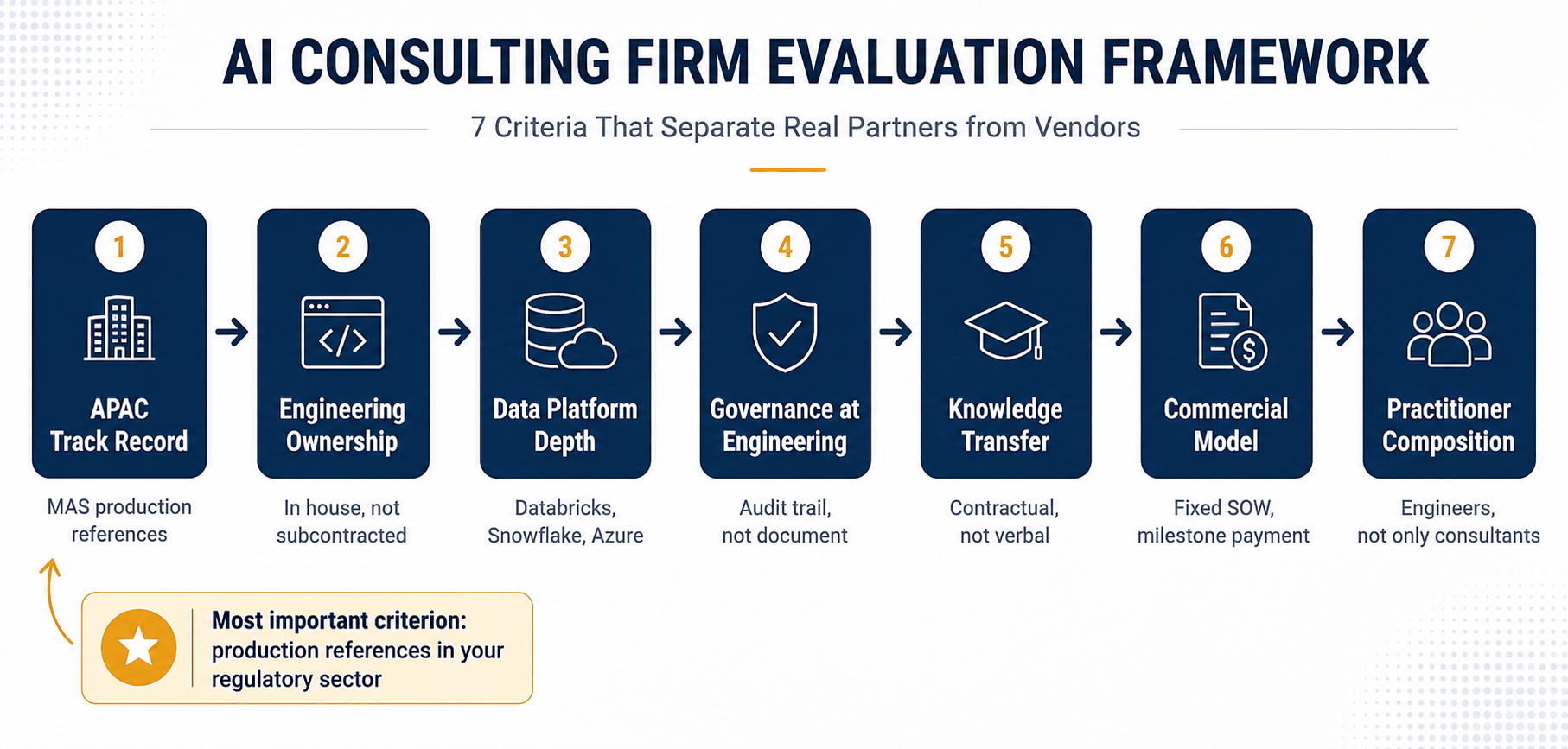
Criterion 1: APAC Regulatory Track Record
Has the firm deployed production AI models in MAS regulated institutions in Singapore or comparable APAC regulatory environments? Ask for two named references with production deployment evidence, not pilot or POC references. References from other geographies do not demonstrate MAS TRM or FEAT alignment capability.
Criterion 2: Engineering Execution Ownership
Does the firm own engineering execution internally, or does it subcontract to system integrators or offshore delivery teams? Firms that subcontract engineering create handover gaps where governance documentation does not translate into engineering controls. Require confirmation of in house data engineering, MLOps, and model risk engineering capability with named practitioners, not generic capability statements.
Criterion 3: Data Platform Depth
Does the firm have certified engineers on Databricks, Snowflake, and Microsoft Azure, or is its data engineering capability limited to a single platform or generic SQL? Production AI for BFSI requires governed data pipeline engineering that most strategy only firms cannot deliver internally. Review enterprise AI engineering in Singapore to understand what data engineering depth for regulated AI programs actually requires at the technical level.
Criterion 4: Governance at the Engineering Layer
Can the firm demonstrate that governance controls including audit trails, explainability APIs, drift monitoring, and model cards are embedded as engineering deliverables rather than produced as documentation annexes? Ask for a sample model card from a previous engagement and a live demonstration of explainability API output. Firms that cannot produce either do not have engineering layer governance capability. Samta.ai's AI security and compliance services embed governance controls at the engineering layer across every AI engagement as a standard delivery component, not as a separate compliance workstream. The VEDA AI Data Analytics Platform provides embedded audit trail generation, explainability output, and drift monitoring that satisfied MAS examination requirements without post deployment retrofit.
Criterion 5: Knowledge Transfer Model
Does the firm's standard commercial agreement include contractual knowledge transfer with defined completion criteria, or is knowledge transfer a verbal commitment during sales that disappears from the SOW? Require the following as contractual deliverables: all model code delivered to client repositories, model cards and documentation for every deployed model, minimum number of internal staff trained to retrain and operate the model, and a 90 day hypercare period post handover.
Criterion 6: Commercial Model Transparency
Does the firm offer fixed scope SOW engagements with milestone based payment tied to production deliverables, or time and materials billing with no outcome accountability? Time and materials engagements routinely run 40 to 80% over initial estimates for AI programs where data quality issues extend timelines. Fixed SOW with defined production milestones transfers cost risk accountability to the firm rather than the buyer.
Criterion 7: AI Consultant vs AI Engineer Capability
AI consultant vs AI engineer in firm composition: strategy firms employ primarily consultants with AI advisory backgrounds; engineering execution firms employ primarily ML engineers, data engineers, MLOps engineers, and AI architects. For production AI programs, the composition of the delivery team is as important as the firm's strategic reputation. Ask for CV summaries of the practitioners who will work on your program, not just the partners who will pitch it. Compare how AI compares to traditional development companies on these composition and delivery model dimensions before finalising your shortlist.
Artificial Intelligence Consulting Firms Singapore: 5 Column Comparison Framework
Evaluation Criterion | Global Strategy Firm | Regional Boutique | Technology Vendor | |
APAC Regulatory Track Record | Broad but generic, MAS alignment varies by practice | Strong in 1 to 2 regulated sectors | Product focused, limited regulatory advisory | BFSI specialist, MAS TRM and FEAT native |
Engineering Execution Ownership | Subcontracted to system integrators | Varies, often limited internal engineering | Own platform only | In house data, ML, MLOps, and governance engineering |
Data Platform Depth | Multi platform, generic depth | Varies by firm | Own stack only | Databricks, Snowflake, Azure, production certified |
Governance at Engineering Layer | Policy documentation, controls subcontracted | Partial, documentation focus | Product governance, not custom governance | Engineering embedded audit trail, explainability, drift monitoring |
Commercial Model | Complex T and M or fixed fee with scope exclusions | Fixed SOW, smaller scope | License plus services | Milestone based fixed SOW, governance included |
Strengthen AI Governance with a Risk Assessment
Real World Use Cases: AI Consulting Firm Selection in Practice
Use Case 1: BFSI AI Program Firm Selection, Singapore Bank
A Singapore licensed bank shortlisted three artificial intelligence consulting firms for a credit risk AI program covering scorecard redevelopment, model governance infrastructure, and drift monitoring deployment. The shortlisting criteria included MAS TRM track record, data engineering capability on Snowflake, and fixed SOW commercial structure. Two of the three firms could not demonstrate individual applicant level FEAT explainability capability from previous engagements. One had no production credit risk AI references in Singapore. The bank selected Samta.ai on the basis of two production credit scorecard references in Singapore BFSI, Snowflake data engineering certification, and a fixed SOW that tied payment milestones to production deployment with embedded governance. Explore similar program outcomes in Samta.ai case studies and review AI transformation consulting Singapore for the engagement structure that produced examination ready results.
Use Case 2: Enterprise AI Consulting Procurement, Regional Conglomerate
A regional conglomerate operating across five APAC markets needed an AI business consultant and engineering partner for a demand forecasting and workflow automation program spanning logistics, retail, and financial services subsidiaries. The procurement requirement was a single partner covering both the strategy and engineering layers across all three business units. The evaluation process used all seven criteria from the framework above. Strategy only firms were eliminated in Criterion 2 (no internal engineering execution). Platform vendors were eliminated in Criterion 1 (no APAC multi sector regulatory references). The selected firm demonstrated engineering capability on Databricks across all three business unit data environments and a knowledge transfer plan that included training four internal data engineers by program end. Review identifying the best companies for AI program delivery to understand how enterprise procurement teams are applying structured evaluation criteria rather than brand preference in 2026 firm selection processes.
Key Risks When Selecting the Wrong AI Consulting Firm
Selecting on brand recognition without production references: is the most common procurement mistake. Global firm brand recognition does not transfer to MAS TRM aligned production deployment capability in Singapore BFSI. Require named production references in your regulatory context.
Accepting strategy deliverables as the engagement endpoint: leaves the organisation with a roadmap it cannot implement internally. Every strategy engagement must include a defined transition to engineering execution, either internally or through the same partner.
Knowledge lock in without contractual transfer terms: means switching costs are higher than the licence or engagement fee comparison suggests. All model configuration, training data, and deployment scripts must be contractually transferred to the client at engagement end.
Time and materials commercial structure without outcome gates: creates budget exposure that consistently runs 40 to 80% over initial estimates when data quality issues extend engineering timelines. Fixed SOW with milestone based payment is the only structure that aligns firm and client interests on time to production.
Governance documentation without engineering controls: is the highest risk outcome for regulated sector buyers. A firm that produces model cards and audit trail documentation as Word documents rather than as automated engineering outputs leaves the institution exposed at MAS examination despite having invested in governance engagement. Review top AI transformation consulting practices and AI engineering consulting services to understand how leading firms structure governance as an engineering deliverable rather than a documentation exercise.
Decision Framework: Which Type of AI Consulting Firm Does Your Organisation Need
Engage a strategy only firm when:
No formal AI strategy or use case prioritisation exists and board investment has not been approved
Multiple competing use cases require prioritisation before any engineering budget is committed
Regulatory obligation mapping (MAS TRM, PDPA, FEAT) has not been completed for the target use cases
Engage an engineering execution firm when:
A validated architecture specification and data readiness confirmation exist and engineering capacity is the only remaining gap
Time to production is the primary constraint and sequential strategy then engineering would add 6 to 12 months
Regulatory examination is imminent and governance must be embedded at the engineering layer before the examination cycle begins
Engage an integrated strategy and engineering partner when:
Time to production and regulatory compliance must both be achieved within a single program timeline
The organisation lacks both strategic AI leadership and production engineering capability simultaneously
A single point of accountability for governance, engineering, and production outcome is required commercially
Samta.ai's data integration consulting services and digital transformation managed services operate within the integrated model, combining data engineering, AI development, governance embedding, and workflow automation in a single fixed SOW engagement with milestone based accountability.
Make Better AI Decisions with Expert Support
Conclusion
Selecting artificial intelligence consulting firms in Singapore based on brand recognition, pitch quality, or fee level is how enterprises end up with strategy deliverables they cannot implement and AI programs that stall between pilot and production. The seven criteria framework in this guide evaluates what actually determines program success: APAC regulatory track record, engineering execution ownership, data platform depth, governance at the engineering layer, knowledge transfer terms, commercial model transparency, and practitioner composition. Apply all seven criteria to every firm on your shortlist. Weight production references in your regulatory sector above all other criteria. And require contractual knowledge transfer from engagement day one, not as a phase two commitment.
About Samta
Samta.ai is a Singapore-headquartered AI Product Engineering & Data Intelligence partner helping enterprises build production-grade AI systems for regulated and data-intensive environments.We help organizations move beyond experimentation by engineering scalable, explainable, and enterprise-ready AI solutions from data foundations and model development to workflow automation and deployment.
Our capabilities combine deep AI expertise, data engineering, and product engineering to deliver measurable business impact across FinTech, BFSI, cybersecurity, regulatory technology, and enterprise operations.
Our enterprise AI products power real-world intelligence systems:
• TATVA : AI-driven data intelligence platform for governed analytics, monitoring, and operational insights
• VEDA : Explainable and audit-ready AI decisioning engine built for compliance-sensitive enterprise workflows
• CORA-Property Management Solutions: : Predictive intelligence platform for real-estate pricing, portfolio optimization, and investment analytics
Backed by ecosystem partnerships with Microsoft, Databricks, Snowflake, and AWS, Samta.ai delivers agile, cost-efficient AI engineering with faster turnaround and enterprise-grade scalability. Trusted by enterprises across FinTech, BFSI, and digital transformation initiatives, Samta.ai embeds AI governance, data privacy, and compliance-by-design principles directly into the AI lifecycle , enabling organizations to scale AI with transparency, accountability, and operational control.
Enterprises leveraging Samta.ai automate 65%+ of repetitive data, analytics, and decision workflows while maintaining governance, explainability, and measurable business outcomes. Samta.ai provides the strategic consulting, AI engineering, and data modernization expertise needed to align enterprise operations with next-generation AI transformation goals.
Frequently Asked Questions
How do I choose between enterprise AI consulting firms in Singapore?
How do I choose between enterprise AI consulting firms in Singapore: evaluate on seven criteria rather than brand or fee. Require two named production AI references in MAS regulated institutions, confirmation of in house data engineering capability on Databricks or Snowflake, a live demonstration of engineering layer governance output (audit trail or explainability API), contractual knowledge transfer terms, and a fixed scope SOW with milestone based payment tied to production deployment. Firms that cannot satisfy all five requirements are strategy providers, not production AI delivery partners.
What is an AI consultant and how do they differ from an AI engineer?
What is an AI consultant: a professional who helps organisations define AI strategy, prioritise use cases, select technology, and design governance frameworks. An AI engineer builds the data pipelines, models, MLOps infrastructure, and governance tooling that implement those decisions. For BFSI and regulated enterprise programs, both capabilities are required within a single engagement. Firms that employ only consultants without AI engineers create a handover gap between strategy and production that consistently delays programs by 6 to 18 months.
What does enterprise AI solution provider mean in the Singapore market?
An enterprise AI solution provider Singapore is a firm that delivers AI capability at enterprise scale including data infrastructure, model development, production deployment, governance embedding, and ongoing operations, rather than delivering point solutions or advisory only services. In Singapore's 2026 market, the term is used broadly, and genuine enterprise solution providers are distinguished from strategy advisory firms by their production deployment track record and in house engineering capability, not by their marketing positioning.
How do I procure enterprise AI consulting services in Singapore?
How do I procure enterprise AI consulting in Singapore: issue an RFP with seven structured evaluation criteria rather than open ended scope, require production references in APAC regulated sectors, require a fixed SOW response with milestone based payment tied to production deployment, require contractual knowledge transfer terms as a non negotiable SOW component, require CV summaries of practitioners who will be on the engagement team, and run a structured shortlist evaluation using the same criteria rather than selecting on pitch quality. The pitch quality of an AI consulting firm has no correlation with its production delivery capability.
What is the difference between AI consulting and AI engineering in Singapore?
AI consulting produces strategy, governance frameworks, architecture recommendations, and program management. AI engineering produces working data pipelines, deployed models, MLOps infrastructure, and production AI systems. For regulated enterprise programs in Singapore, the most common failure mode is engaging consulting without engineering execution, producing strategy that the organisation cannot implement. The second most common failure mode is engaging engineering without consulting alignment, producing models that are architecturally disconnected from the regulatory and business context they must operate in.