
Summarize this post with AI
88 percent of organizations now use AI in at least one business function, yet nearly two-thirds remain stuck in pilot mode. The most consistent predictor of that gap is not the quality of the AI model; it is the consulting partner that designed the engagement. Choosing the wrong ai transformation consulting singapore partner produces strategy decks without working systems, or working systems nobody adopts. The right ai transformation consulting partner gets your program from proof of concept to governed, production-grade deployment without rebuilding the data foundation mid-project. This guide gives Singapore CTOs and CIOs a structured framework for evaluating and selecting an enterprise ai consulting firm singapore before signing an engagement.
AI Transformation Consulting Singapore
The right ai transformation consulting singapore partner combines full-stack technical depth across data engineering, model development, and MLOps with proven production delivery in your industry, not just pilot experience. Mid-sized companies with ten to 250 employees achieve 40 percent better outcomes working with boutique consultancies compared to enterprise firms, while large regulated enterprises in BFSI require partners with documented AI governance, MAS-aligned compliance experience, and integration capability with legacy core banking or insurance systems. Singapore's Enterprise Compute Initiative funds 70 percent of qualifying consulting costs up to S$105,000 per company, making partner quality, not just price, the primary selection variable.
What AI Transformation Consulting Actually Covers
ai business process transformation consulting is not the same as strategy advisory. The distinction matters because many enterprises sign an engagement expecting implementation and receive a roadmap. A genuine ai transformation consulting partner covers six functions: AI strategy and use case prioritization, data readiness assessment, technical architecture design, model development or integration, deployment and MLOps infrastructure, and governance including change management. Buying AI software without consulting is like buying surgical equipment without a surgeon. The tools exist, but the expertise to use them safely and effectively is what creates outcomes. For enterprises assessing where they currently sit before engaging a partner, the AI implementation roadmap for enterprise and the enterprise data integration and engineering guide are the two most useful starting references.
Evaluate Your AI Capabilities with Confidence
Why Partner Selection Is More Consequential in 2026
Three developments make the right partner choice more important this year than in any prior period.
1. AI services spending is accelerating, compressing the quality signal: AI services spending is forecast at S$588.6 billion globally in 2026, up 34 percent year over year. More firms are entering the market than the talent supply justifies, meaning the gap between credible partners and well-marketed consultancies is widening, not narrowing.
2. Singapore government co-funding changes the economics, but not the risk: The Enterprise Compute Initiative funds 70 percent of qualifying consulting costs up to S$105,000 per company. The WDG JR+ grant covers up to 70 percent of qualifying workforce transformation costs. Government co-funding reduces financial exposure but does not change the organizational and technical risk of a poorly matched partner.
3. Governance failure is now the primary production risk, not technical failure: Only 18 percent of organizations have an enterprise-wide council with authority over responsible AI governance, while 44 percent have experienced at least one negative consequence from generative AI use. Partners without documented AI ethics, compliance, and audit processes are the fastest path to that 44 percent statistic.
For BFSI enterprises specifically, why AI transformation governance matters makes clear that a partner without MAS governance experience creates compliance exposure the enterprise, not the consultant, carries.
The Partner Selection Framework: Step by Step
Use this sequence to evaluate any enterprise ai consulting firm singapore before committing to an engagement.
Step 1: Define Your Fit Category Before Shortlisting
Pilot stage: you need a partner to validate a use case and prove business value; prioritize speed and flexibility over governance depth.
Production deployment: you need a partner to take a validated use case to a governed, monitored production system; prioritize full-stack depth and MLOps experience.
Enterprise transformation: you need a partner to scale AI across multiple business units; prioritize change management capability and organizational design experience alongside technical delivery.
Regulated industry deployment: you need all of the above plus documented compliance experience with MAS, PDPA, or equivalent sector standards.
Step 2: Evaluate Technical Depth Across the Full Stack
Data engineering capability: data preparation accounts for 30 to 40 percent of total project budget; a partner that cannot assess and remediate your data estate before build will discover the problem mid-project.
MLOps and deployment experience: ask for documented examples of models they have taken from pilot to production, with performance metrics post-deployment, not just build metrics.
Integration capability with legacy systems: most Singapore enterprises have data in legacy ERP, core banking, or operational systems; confirm the partner has worked with your category of integration complexity before, not just greenfield builds.
Step 3: Verify Industry and Compliance Credentials
Sector-specific case studies with measurable outcomes: vague claims about improved efficiency are less compelling than specific measurable outcomes. Ask for documented case studies with production results, not pilot metrics.
Regulatory alignment: for BFSI and regulated sectors, confirm the partner can document AI governance aligned to MAS guidelines, PDPA requirements, and the partner's own responsible AI framework.
Reference checks within your size range: a firm with 500 enterprise clients but zero mid-market experience will struggle with your constraints; look for partners with recent experience in your revenue and employee count range.
Step 4: Assess Engagement Model and Cultural Fit
Cultural fit receives insufficient attention but significantly impacts engagement success. A technically excellent consultant can fail in an environment where their working style clashes with the organization's pace or decision-making structure.
This is where Samta.ai's engagement model differs from both global consultancies and solo practitioners. As a Singapore-headquartered ai transformation consulting partner with Microsoft, Databricks, and Snowflake technology partnerships, Samta.ai operates as an engineering execution layer, not a strategy-only advisory. The digital transformation managed services model delivers ongoing governance, monitoring, and optimization post-deployment, not just a hand-off document. The Veda AI decision analytics platform connects data infrastructure, model monitoring, and compliance documentation into a single operational layer that continues to work after the consulting engagement closes.
For enterprises wanting to validate Samta.ai's production delivery record before a conversation, Samta.ai's case studies are the most direct reference.
Partner Type Comparison: Which Model Fits Your Needs
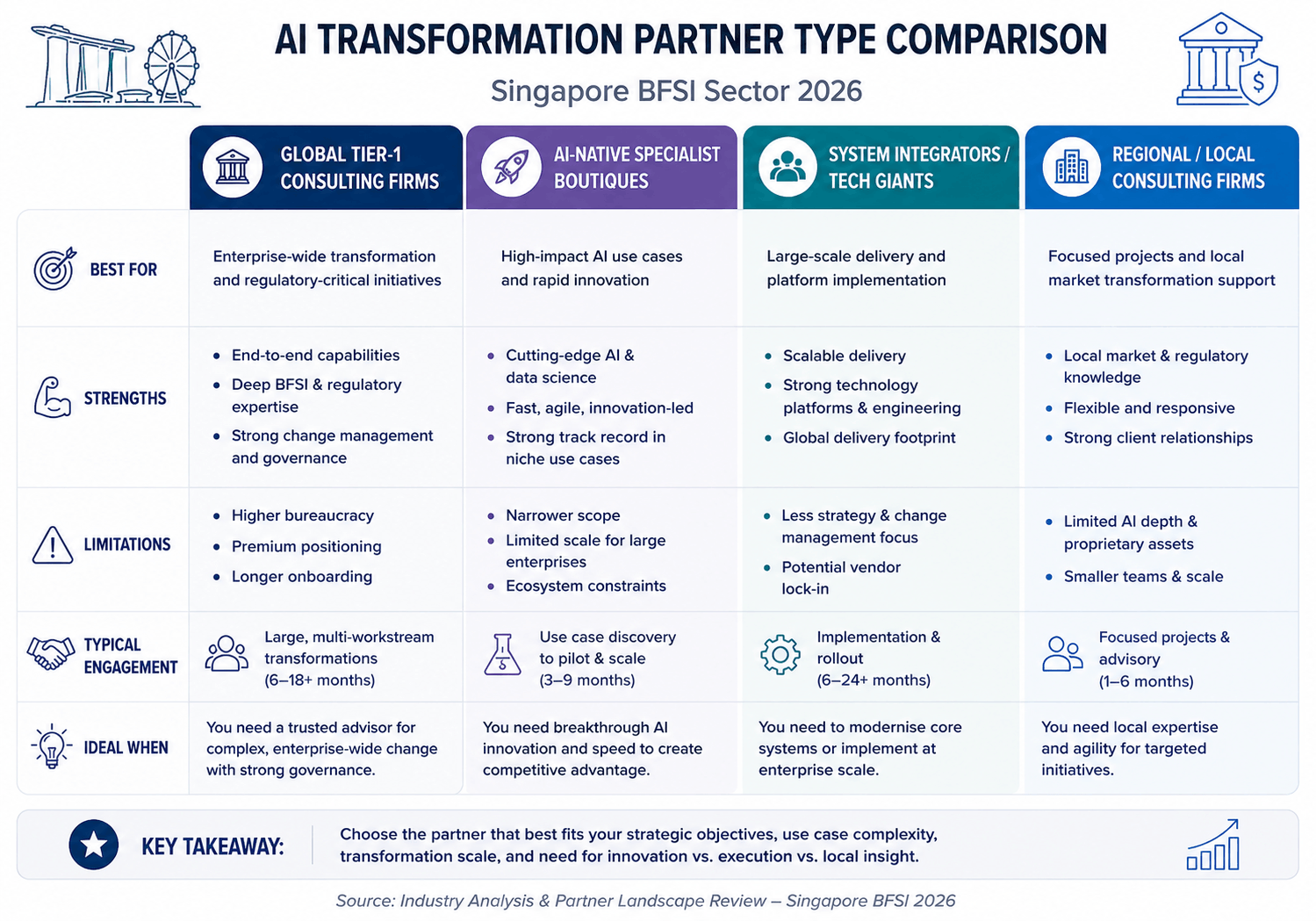
Partner Type | Best Fit | Technical Depth | Governance Capability | Singapore Regulatory Experience |
Global consultancy (McKinsey, Accenture, Deloitte) | Large enterprise, board-level transformation | High, broad across domains | Strong, established frameworks | General, not Singapore-specific |
Regional specialist (Singapore-headquartered) | BFSI and regulated APAC enterprise | Deep in APAC stack and compliance | MAS and PDPA aligned | Strong, sector and jurisdiction specific |
Boutique implementation firm | Mid-market, focused deployment | Strong in specific domain | Varies, ask explicitly | Variable, confirm before engaging |
Offshore-led hybrid model | Cost-sensitive enterprise with clear scope | Engineering depth, less governance | Usually requires augmentation | Low, Singapore oversight model required |
Solo practitioner | Narrow, well-defined problem | Deep in specialization only | Limited, capacity constrained | Depends on individual background |
Get a Clear View of Your AI Risk Exposure
Enterprise Use Cases: What Good Partner Selection Looks Like in Practice
Use Case 1: Singapore Bank Selecting a BFSI-Specific Partner
A Singapore bank shortlisted four ai transformation consulting singapore firms for a credit decisioning AI program. Two were global consultancies with strong brand recognition. One was a regional specialist with documented MAS governance experience. One was a boutique with strong MLOps capability but no regulated industry track record. The bank selected the regional specialist after verifying three production case studies with measurable outcomes in BFSI. The engagement structured governance documentation from day one, consistent with what the building an AI-ready organisation guide recommends as the correct sequencing. The global consultancies were ruled out not on capability grounds but on engagement model their standard approach required a six-month strategy phase before any engineering work began.
Use Case 2: Logistics Enterprise Selecting a Hybrid Delivery Partner
A Singapore logistics company needed demand forecasting AI deployed within 14 months on a constrained budget. They selected a hybrid delivery model: Singapore-side oversight and stakeholder management, with offshore engineering execution. This reduced total cost by approximately 40 percent against a Singapore-only team. The critical selection test was integration track record: the chosen partner had documented integration experience with the company's existing ERP system. Partners without that specific integration experience were ruled out regardless of price. The why 70 percent of AI programs fail guide documents why integration complexity, not model quality, is the most common production failure mode.
Key Risks and Failure Modes
Selecting on brand name or lowest price: Many enterprises choose AI partners based on brand name or lowest price, overlooking production delivery maturity, data governance experience, and integration capability with legacy systems. These are the real predictors of AI project success, not portfolio size or rate card.
Skipping governance capability verification: A recent MIT Media Lab report found 95 percent of corporate generative AI initiatives fail to deliver ROI. Engagements involving external partners succeed 67 percent of the time versus 33 percent for internal-only efforts, but only when the partner has documented governance frameworks, not just technical delivery.
No pilot before full commitment: Consider starting with a smaller pilot engagement before committing to comprehensive transformation programs. A partner's working style, communication quality, and delivery discipline are almost impossible to evaluate from a proposal alone.
Mismatching partner type to organizational maturity: Global consultancies excel at enterprise-scale implementations with board-level presentations and multi-year roadmaps. They are often the wrong choice for mid-market enterprises that need fast deployment and senior practitioner direct involvement throughout, not junior team delegation after the partner pitch.
Know what your engagement should deliver at each phase before you brief any partner. Request the AI Implementation Playbook from Samta.ai and enter the selection process with a structured scope document.
Decision Framework: Is This Partner Right for Your Program?
The partner has documented case studies with measurable production outcomes in your industry, not just pilot metrics
Their data engineering capability has been verified, not assumed from their technology partnerships
Governance and compliance credentials are documented and aligned to MAS or relevant regulatory standards
The engagement model includes post-deployment monitoring and optimization, not just a build hand-off
Cultural fit has been tested through a scoped pilot or structured discovery session before full commitment
Reference checks have been completed with organizations in your size range within the past 24 months
If fewer than four boxes are checked, the partner evaluation is incomplete regardless of how strong the proposal presentation was.
Plan Your Next AI Initiative with Confidence
Conclusion
Selecting the right ai transformation consulting singapore partner is the single most consequential early decision in any enterprise AI program. With Singapore's Enterprise Compute Initiative co-funding up to 70 percent of qualifying consulting costs, the financial barrier to engaging a quality partner has dropped significantly. What has not changed is the organizational risk of a mismatched engagement model, unverified production credentials, or a governance gap that surfaces only after deployment.
About Samta
Samta.ai is a Singapore-headquartered AI Product Engineering & Data Intelligence partner helping enterprises build production-grade AI systems for regulated and data-intensive environments.We help organizations move beyond experimentation by engineering scalable, explainable, and enterprise-ready AI solutions from data foundations and model development to workflow automation and deployment.
Our capabilities combine deep AI expertise, data engineering, and product engineering to deliver measurable business impact across FinTech, BFSI, cybersecurity, regulatory technology, and enterprise operations.
Our enterprise AI products power real-world intelligence systems:
• TATVA : AI-driven data intelligence platform for governed analytics, monitoring, and operational insights
• VEDA : Explainable and audit-ready AI decisioning engine built for compliance-sensitive enterprise workflows
• CORA-Property Management Solutions: : Predictive intelligence platform for real-estate pricing, portfolio optimization, and investment analytics
Backed by ecosystem partnerships with Microsoft, Databricks, Snowflake, and AWS, Samta.ai delivers agile, cost-efficient AI engineering with faster turnaround and enterprise-grade scalability. Trusted by enterprises across FinTech, BFSI, and digital transformation initiatives, Samta.ai embeds AI governance, data privacy, and compliance-by-design principles directly into the AI lifecycle , enabling organizations to scale AI with transparency, accountability, and operational control.
Enterprises leveraging Samta.ai automate 65%+ of repetitive data, analytics, and decision workflows while maintaining governance, explainability, and measurable business outcomes. Samta.ai provides the strategic consulting, AI engineering, and data modernization expertise needed to align enterprise operations with next-generation AI transformation goals.
Frequently Asked Questions
What should I look for in an AI transformation consulting partner in Singapore?
The five most predictive selection criteria are relevant production experience in your industry, full-stack technical depth covering data engineering through MLOps, documented AI governance aligned to MAS or PDPA, integration experience with your category of legacy systems, and an engagement model that includes post-deployment monitoring. Brand recognition and rate card are poor proxies for any of these.
How is AI transformation consulting different from strategy advisory?
ai business process transformation consulting covers implementation, not just roadmap creation. Strategy advisory produces a plan; transformation consulting executes it through data engineering, model deployment, workflow integration, change management, and governance. Firms that treat AI as a strategy exercise leave clients with slide decks; firms that treat it as an implementation problem alone leave clients with tools nobody uses. The right partner does both.
Can Singapore government grants offset the cost of AI transformation consulting?
Yes. The Enterprise Compute Initiative funds 70 percent of qualifying consulting costs up to S$105,000 per company, administered by DISG. The WDG JR+ grant covers up to 70 percent of qualifying workforce transformation consulting costs for SMEs. The Enterprise Development Grant covers up to 50 percent of qualifying project costs. Grant stacking across multiple programmes is possible with correct structuring.
How long does a typical AI transformation consulting engagement take in Singapore?
Depending on scope and complexity, most AI consulting engagements in Singapore run 3 to 12 months. Simple automation projects finish in 6 to 8 weeks; focused single-department deployments take 12 to 18 months end to end; enterprise-wide ai business services consulting programs run 24 to 36 months. Partners who promise enterprise transformation in under six months without a pre-existing data foundation should be questioned on their delivery assumptions.
Is a boutique Singapore-based firm better than a global consultancy for BFSI AI programs?
It depends on the program scope. Global consultancies offer deep specialist benches and enterprise credibility for multi-geography, board-level programs. Regional specialists and boutique firms offer Singapore regulatory experience, faster deployment, and senior practitioner involvement throughout. For MAS-regulated institutions, a partner with documented BFSI compliance experience specific to Singapore regulations typically outperforms a global firm applying a generic governance framework.