
Summarize this post with AI
Most enterprise AI initiatives do not fail because the models are wrong. They fail because no one owns accountability for what the models decide. AI transformation governance, the policies, roles, and controls that determine how AI is built, deployed, and audited, is the missing layer in most digital transformation programs. Organizations that treat governance as a compliance checkbox after deployment consistently face model failures, regulatory scrutiny, and eroded stakeholder trust. Those that embed governance from the start move faster, not slower, because they eliminate costly remediation cycles that can run six to eight times the cost of upfront governance investment.
Executive Summary
AI Transformation Governance
AI transformation governance is the enterprise wide framework of policies, controls, and accountability structures that ensure AI systems are deployed responsibly, monitored continuously, and aligned with regulatory requirements. It goes beyond model selection or data architecture. It defines who owns AI risk, how model decisions are audited, and how organizations comply with the Singapore Model AI Governance Framework, MAS FEAT Principles, and the EU AI Act. In APAC regulated industries, the absence of a formal AI governance model is now a material audit finding, not a best practice gap.
What Is AI Transformation Governance?
AI transformation governance refers to the structured management of AI throughout its entire lifecycle, from data ingestion and model training to production deployment, monitoring, and decommissioning. It is distinct from general ai data governance transformation and evolution or IT governance because AI systems are probabilistic, adaptive, and opaque by nature. A traditional control framework built for deterministic software cannot account for model drift, emergent behavior in large language models, or compounding risk in multi agent pipelines. Understanding governance digital transformation and AI starts with recognizing that governance is not a layer added on top of technology. It is the operating system that determines whether technology delivers value or creates liability.
Key components of an AI transformation governance framework include:
Model Risk Management policies aligned to regulatory standards
Data lineage and quality controls across training and inference pipelines
Explainability and bias audit protocols
Human in the loop escalation paths for high stakes decisions
Board and C suite accountability structures for AI risk
For a deeper look at how governance programs mature across organizations, see Samta.ai's analysis of AI governance maturity models
Assess Your Enterprise AI Readiness in Minutes
Why It Matters in 2026: Regulatory Pressure and APAC Context
Three converging forces have made AI governance a boardroom imperative in 2026.
First, regulatory timelines are activating. The EU AI Act's high risk provisions are now in force for financial services and healthcare. Singapore's MAS has updated its Model AI Governance Framework for Generative AI to specifically address generative AI and agentic AI systems, making it the first jurisdiction in APAC to do so at this level of specificity.
Second, agentic AI has expanded the risk surface. When AI systems execute multi step workflows autonomously, booking, trading, approving, communicating, the blast radius of a governance failure is orders of magnitude larger than a single misclassified output.
Third, enterprise AI programs are scaling. Organizations that piloted two or three models in 2023 now operate dozens. Without governance infrastructure, this creates shadow AI, deployed models with no audit trail, no owner, and no monitoring.
The ai data governance transformation and evolution journey at most enterprises has moved from optional best practice to regulatory obligation in under three years. Organizations that have not formalized their governance posture are now operating with measurable compliance exposure.Read Samta.ai's guide on AI governance for GenAI
The AI Transformation Governance Framework: A Six Layer Model
A governance model for digital transformation must address all six layers below. Gaps at any layer create systemic vulnerability.
Strategy and Accountability: Assign an AI Risk Owner, often the Chief Risk Officer or a dedicated Chief AI Officer. Define the board level escalation path for material AI failures.
Regulatory Alignment: Map every AI use case to applicable frameworks: MAS FEAT, Singapore Model AI Governance Framework for agentic AI, EU AI Act risk tiers, or NIST AI RMF. Do this at intake, not post deployment.
Data Governance Integration: AI governance inherits from data governance. Model performance is only as reliable as the data pipeline. Enforce data lineage, access controls, and quality SLAs at the platform layer.
Model Lifecycle Controls: Enforce version control, approval gates including champion and challenger testing, and documented retraining triggers. Every model in production must have an assigned owner and a scheduled review date.
Monitoring and Drift Detection: Implement continuous monitoring for performance degradation, distributional shift, and bias metrics. For generative AI, this includes output sampling and toxicity scoring.
Audit and Explainability: Maintain immutable logs of model decisions for audit ready retrieval. For regulated decisions covering credit, claims, and hiring, explainability is a legal requirement, not an option.
Samta.ai's Veda AI Data Analytics Platform operationalizes layers 3 through 6, providing lineage tracking, drift alerts, and compliance reporting within a managed services model, so governance teams enforce policy rather than build infrastructure. The NIST AI Risk Management Framework (AI RMF 1.0) provides the international baseline for aligning these six layers to globally recognized controls, recommended reading for governance architects mapping their program to multiple jurisdictions
Is your agentic AI program governance ready?
Most enterprises have the models. Few have the controls. Download the Agentic AI Governance Checklist and audit your current AI program against the six layers that regulators in Singapore, Australia, and the EU are already examining.
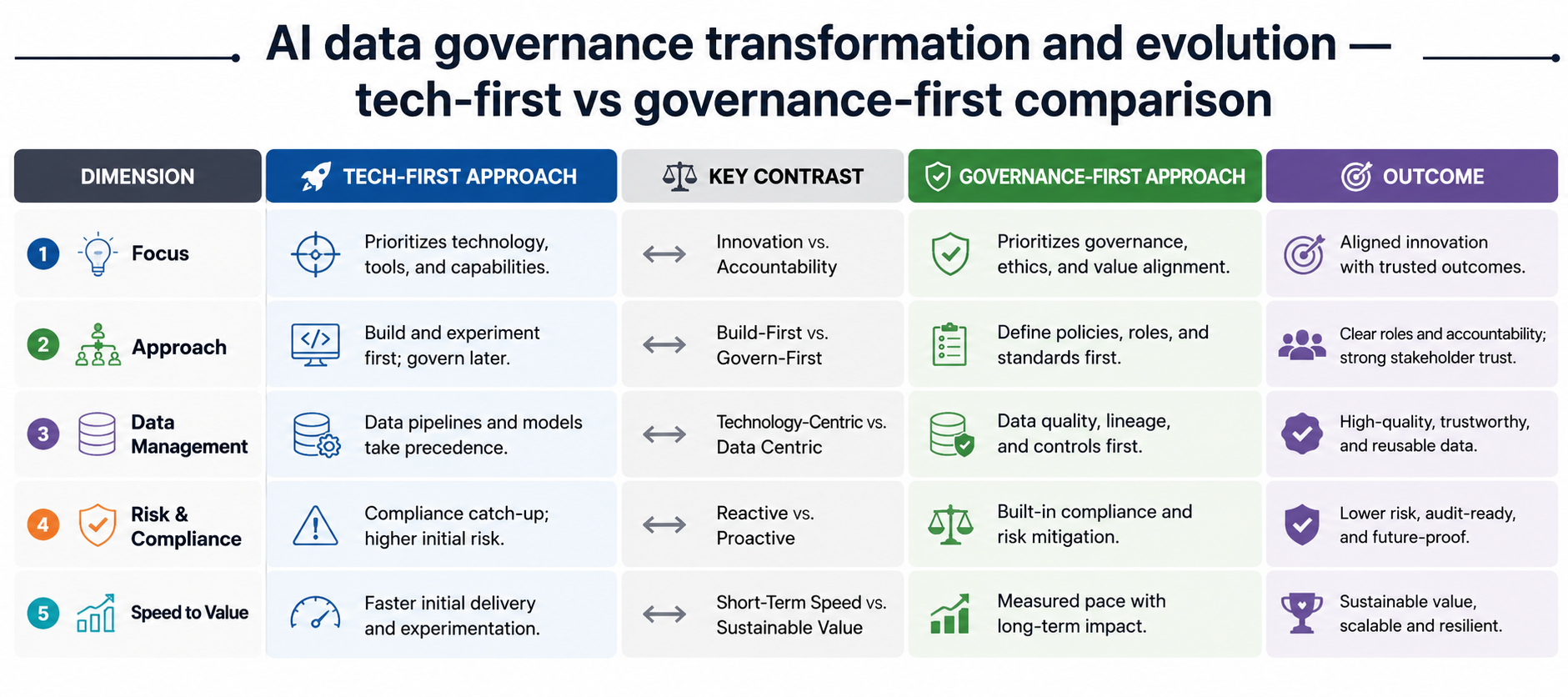
Governance First vs. Tech First: Five Dimension Comparison
The table below contrasts two common enterprise postures. Most AI transformation failures trace back to the tech first column.
Dimension | Tech First Approach | Governance First Approach | Risk Level | Recommended For |
Deployment Speed | Fast, models shipped as soon as ready | Measured, approval gates at each lifecycle stage | High without gates | Regulated industries (BFSI, Health) |
Accountability | Diffuse, owned by IT or data science teams | Defined, AI Risk Owner, CISO, Board oversight | High without clear owner | Enterprise wide AI programs |
Regulatory Alignment | Reactive, adapt policy after audits | Proactive, mapped to MAS FEAT and EU AI Act at intake | Critical in APAC | Cross border operations |
Model Drift Management | Ad hoc monitoring or none | Continuous monitoring with defined retraining triggers | High for LLM and agentic AI | GenAI and agentic deployments |
Audit Readiness | Manual, retrospective documentation | Automated logging and explainability by design | Severe if absent | Regulated enterprises and listed firms |
Organizations in regulated APAC sectors including banking, insurance, and healthcare consistently encounter the failure modes in the tech first column. The governance first posture is not slower. It eliminates rework and regulatory remediation that costs far more than upfront governance investment.
Gain Visibility into AI Model Risk Exposure
Real World Use Cases
BFSI: Credit Decision Automation at a Regional Bank
A Southeast Asian retail bank deployed an ML based credit scoring model to accelerate approval times. Eighteen months post launch, a routine MAS examination found the model produced systematically different approval rates across demographic segments, a violation of MAS FEAT's fairness principle.
The root cause was that no bias audit was conducted at deployment, and no drift monitoring flagged the divergence. The remediation, covering retrospective bias analysis, model retraining, and audit documentation, cost the institution an estimated six to eight times what a governance first deployment would have required. See Samta.ai's detailed breakdown of AI risk management model frameworks for regulated industries
General Enterprise: Agentic AI in Procurement
A regional manufacturing conglomerate deployed an agentic AI system to automate supplier negotiations and purchase order approvals. Without defined human in the loop escalation thresholds, the agent committed the firm to contracts above delegated approval limits. The fix required implementing a governance layer, configuring authority matrices, adding approval gates for transactions above defined thresholds, and creating audit trails for every agent initiated commitment. This is precisely the gap the Singapore Model AI Governance Framework for agentic AI addresses in its 2024 update. For a view of where enterprise agentic governance is headed, read Samta.ai's analysis on the future of AI governance.
Key Risks and Failure Modes in AI Governance Programs
No designated AI Risk Owner. Diffuse accountability means no one escalates model failures until they become regulatory events.
Shadow AI proliferation. Business units deploy models outside approved pipelines, invisible to risk and compliance teams.
Governance as a post launch checkbox. Retrofitting explainability and audit trails to live models is expensive and often incomplete.
Governance disconnected from model performance. Programs designed only for compliance lose organizational support and become ceremonial.
Ignoring agentic AI specifics. Multi agent systems require additional controls including authority limits and inter agent trust models that standard MRM frameworks do not cover.
For compliance specific governance obligations by jurisdiction, see Samta.ai's guide to AI governance compliance.
Which of these failure modes exist in your organization right now?
Shadow AI deployments. No designated risk owner. Zero drift monitoring. These are not edge cases. They are the norm in enterprises that have not run a structured AI risk assessment. Download the AI Risk Assessment Templates and find out exactly where your program stands before your next audit does.
When to Prioritize AI Governance Investment
Prioritize immediately if:
You operate in a regulated industry such as BFSI, healthcare, or insurance in Singapore, Australia, India, or any EU adjacent jurisdiction
You are deploying AI for decisions that affect individuals including credit, claims, hiring, or medical triage
You have more than five AI models in production with no designated risk owners
You are adopting generative AI or agentic AI for customer facing or high value internal workflows
Governance investment can be phased if:
All current AI use cases are internal, low stakes, and fully human reviewed before any action is taken
Your model portfolio is limited to one or two tools with clear, documented owners and no regulatory exposure
Organizations at early governance stages can benchmark their current position using the AI governance maturity model framework before committing to a full governance build out
Accelerate Your AI Transformation with Expert Guidance
Conclusion
AI transformation governance is not a constraint on AI programs. It is the infrastructure that allows them to scale without catastrophic failure. The organizations advancing fastest in APAC are those that built governance alongside their first model deployments, not those racing to catch up after a regulatory event. The framework exists. The regulatory expectations are published. Samta.ai's digital transformation managed services help enterprises close the gap between governance intent and operational reality, without building the infrastructure from scratch
You have the framework. Now you need the execution playbook.
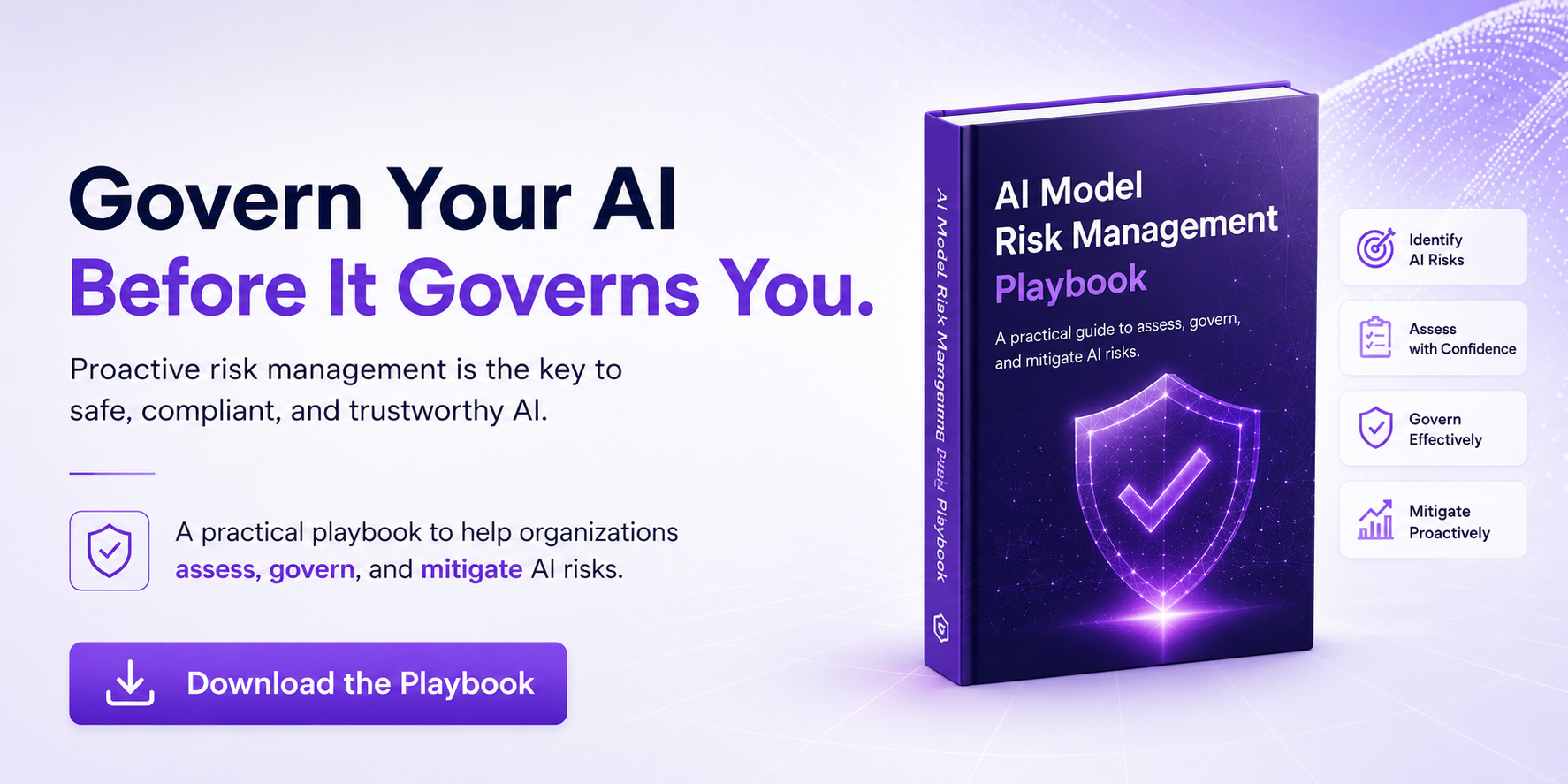
Knowing the six layers of AI governance is the starting point. Operationalizing them across your model portfolio, data pipelines, and compliance function is where most enterprises stall. The AI Model Risk Management Playbook gives your team a step by step execution guide built specifically for regulated enterprises in APAC. Download the AI Model Risk Management Playbook
About Samta
Samta.ai is a Singapore-headquartered AI Product Engineering & Data Intelligence partner helping enterprises build production-grade AI systems for regulated and data-intensive environments.We help organizations move beyond experimentation by engineering scalable, explainable, and enterprise-ready AI solutions from data foundations and model development to workflow automation and deployment.
Our capabilities combine deep AI expertise, data engineering, and product engineering to deliver measurable business impact across FinTech, BFSI, cybersecurity, regulatory technology, and enterprise operations.
Our enterprise AI products power real-world intelligence systems:
• TATVA : AI-driven data intelligence platform for governed analytics, monitoring, and operational insights
• VEDA : Explainable and audit-ready AI decisioning engine built for compliance-sensitive enterprise workflows
• CORA-Property Management Solutions: : Predictive intelligence platform for real-estate pricing, portfolio optimization, and investment analytics
Backed by ecosystem partnerships with Microsoft, Databricks, Snowflake, and AWS, Samta.ai delivers agile, cost-efficient AI engineering with faster turnaround and enterprise-grade scalability. Trusted by enterprises across FinTech, BFSI, and digital transformation initiatives, Samta.ai embeds AI governance, data privacy, and compliance-by-design principles directly into the AI lifecycle , enabling organizations to scale AI with transparency, accountability, and operational control.
Enterprises leveraging Samta.ai automate 65%+ of repetitive data, analytics, and decision workflows while maintaining governance, explainability, and measurable business outcomes. Samta.ai provides the strategic consulting, AI engineering, and data modernization expertise needed to align enterprise operations with next-generation AI transformation goals.
Frequently Asked Questions
What is AI transformation governance?
AI transformation governance is the structured set of policies, roles, and controls that organizations use to ensure AI systems are deployed and operated responsibly. It covers model risk management, data lineage, regulatory compliance, and human oversight. It is distinct from IT governance because of AI's probabilistic and adaptive nature, which deterministic control frameworks like COBIT and ITIL were not designed to manage.
How does AI governance differ from IT governance?
IT governance addresses systems, infrastructure, and processes with deterministic outcomes. AI governance adds controls for model behavior, explainability, bias risk, and dynamic decision making. A system that changes its own outputs based on data inputs requires a fundamentally different oversight model than one that executes fixed business logic.
Which regulatory frameworks apply to AI governance in APAC?
Key frameworks include Singapore's MAS FEAT Principles, the updated MAS Model AI Governance Framework covering GenAI and agentic AI from 2024, Australia's AI Ethics Framework, and the EU AI Act for firms with European exposure. India's DPDP Act applies where personal data is processed across any of these deployments.
What is the Singapore Model AI Governance Framework for agentic AI?
The Singapore Model AI Governance Framework for agentic AI, extended by IMDA and MAS in 2024, covers AI systems that act autonomously across multi step tasks without per action human approval. It introduces requirements for human in the loop controls, agent authority limits, inter agent trust models, and audit trails for every autonomous decision made by the system. It is currently the most detailed agentic AI governance guidance available in APAC.
What are the biggest failure modes in enterprise AI governance?
The five most frequent failures are no designated AI Risk Owner, shadow AI deployments outside approved pipelines, absence of model drift monitoring, no audit ready documentation at deployment, and governance treated as a compliance function only rather than integrated into ongoing model performance management.