
Summarize this post with AI
Most enterprises do not lack AI ideas. They lack execution. The difference between an Enterprise AI and Data Engineering Partner and a traditional consulting firm is not the quality of the strategy deck it is whether production AI actually ships, runs, and delivers measurable business outcomes at the end of the engagement. Samta.ai was built on a single premise: the market has enough firms that present recommendations. What BFSI and enterprise leaders in APAC need is the team that designs, builds, deploys, and scales AI Transformation Partner programs that create real business value not slide decks that describe it. This guide covers what a genuine Enterprise AI Implementation and Consulting partner delivers in 2026 across products, services, data engineering, and governance and how to evaluate whether the partner you are considering actually executes or simply advises.
Enterprise AI and Data Engineering Partner:
A genuine Enterprise AI and Data Engineering Partner in 2026 combines strategy, engineering, and execution in a single delivery model not as separate advisory and implementation tracks. For BFSI and regulated enterprise in APAC, this means production-ready AI models with embedded MAS TRM and PDPA governance, governed data pipelines on Snowflake and Databricks, and AI products that ship to production within defined timelines not proof-of-concept environments that require a second engagement to operationalise. Samta.ai's model covers the full stack: AI software development, data integration consulting services, workflow automation solutions, and AI security compliance delivered as integrated engineering execution, not modular advisory services.
What an Enterprise AI and Data Engineering Partner Actually Delivers
AI software development from a genuine engineering partner is not the same as a consulting engagement with a development team attached. The distinction is where accountability sits. A traditional consulting engagement produces a plan and hands accountability for execution to the client. An engineering partner owns the execution from strategy through production deployment, with measurable outcomes agreed before work begins. The five-point distinction from traditional consulting is documented clearly in Samta.ai's own positioning: where traditional consulting delivers endless presentations, Samta.ai delivers production-ready AI solutions; where traditional consulting delivers recommendations, Samta.ai delivers working software; where traditional consulting produces long implementation cycles, Samta.ai delivers faster deployment; where traditional consulting provides strategy only, Samta.ai provides strategy plus engineering plus execution; and where traditional consulting offers advice, Samta.ai provides execution.
For enterprises evaluating this distinction in product terms, the how modern enterprises build AI-ready operations guide covers the infrastructure requirements that genuine engineering partners build, rather than recommend, and the enterprise data integration engineering guide covers the data layer that every AI product and service sits on.
For a complete picture of how Samta.ai structures end-to-end AI delivery for enterprise clients from use case discovery through production deployment see the enterprise AI consulting services overview.
Evaluate Your AI Strategy Before You Scale
Why the Enterprise AI Partner Model Is Changing in 2026
Three structural shifts have changed what enterprise AI adoption requires from a delivery partner:
1. Production AI requires engineering discipline that advisory firms cannot provide
GenAI and ML model deployment in 2026 requires MLOps CI/CD pipelines, containerised serving infrastructure, drift monitoring, and governance tooling that operate 24/7 in regulated environments. Advisory firms that subcontract engineering to system integrators create handover gaps where governance, data lineage, and model documentation fall between the two organisations. Enterprise leaders need partners who own both the strategy and the wrench.
For a detailed breakdown of how enterprise AI engineering is structured for Singapore's regulated market covering MLOps, governed data pipelines, and MAS TRM-aligned deployment standards see Samta.ai's enterprise AI engineering in Singapore overview.
2. Regulatory obligations extend into the engineering layer
MAS TRM, PDPA, and FEAT requirements now apply at the model inference layer not just at the policy layer. An enterprise AI strategy that does not produce MAS-aligned model cards, audit trails, and explainability APIs as engineering deliverables not documentation afterthoughts will fail the first regulatory examination it encounters (Source Required: MAS Technology Risk Management Guidelines).
3. The cost of pilot purgatory is now quantifiable
Gartner estimates that 85% of AI proof-of-concept projects never reach production (Source Required: Gartner AI Deployment Survey). The cost of a stalled AI program in delayed competitive advantage, sunk engineering cost, and regulatory exposure from ungoverned shadow AI consistently exceeds the cost of the original engagement. Enterprise AI tools that exist only in staging environments are not assets; they are liabilities with ongoing maintenance cost.
Samta.ai's Full-Stack Delivery Model: From Strategy to Shipping
Samta.ai's Enterprise AI Implementation and Consulting model covers four delivery tracks that operate in parallel not sequentially to ensure that governance, data, engineering, and business value are all addressed from the first sprint:
Track 1: AI Software Development and Product Engineering
Samta.ai builds production AI products across three proprietary platforms and custom enterprise software solutions for client-specific use cases:
VEDA (AI Decision Analytics Platform): VEDA is Samta.ai's enterprise AI analytics platform delivering governed, explainable AI decision-making for credit risk, fraud detection, customer analytics, and operational intelligence. It embeds continuous model monitoring, drift detection, and MAS TRM-aligned audit trail generation directly into the serving layer.
VEDA AI Decision Analytics Platform: product overview
VEDA microsite: full capability documentation
VEDA vs data intelligence platform: head-to-head comparison
TATVA (AI Hiring Assessment Platform): TATVA (Talent Aptitude Testing and Verification via Algorithms) is Samta.ai's adaptive AI hiring assessment platform reducing time-to-hire by 40–50% through role-specific, PDPA-compliant assessment with native ATS integration.
TATVA Hiring Assessment Platform: product overview
TATVA microsite: full capability documentation
TATVA vs traditional hiring platforms: head-to-head comparison
CORA (AI-Driven Property Management Software): CORA is Samta.ai's AI property management platform automating lease management, maintenance workflows, tenant communication, and financial reporting for property portfolios at enterprise scale.
CORA AI Property Management: product overview
CORA microsite: full capability documentation
CORA vs traditional property management software: head-to-head comparison
Onboarding KYC (AI-Powered Identity Verification and Compliance): Samta.ai's AI KYC onboarding product automates identity verification, document validation, and compliance screening for BFSI and regulated enterprise clients reducing manual onboarding time while satisfying MAS Notice on Prevention of Money Laundering and PDPA data handling obligations.
Onboarding KYC Platform: product overview
Onboarding KYC microsite: full capability documentation and compliance framework
Track 2: Data Integration and Engineering
Enterprise AI adoption consistently fails when the data foundation is not governed, unified, and audit-ready before model development begins. Samta.ai's data integration consulting services build the data infrastructure that AI programs depend on using Databricks, Snowflake, and Microsoft Azure as the engineering stack.
Deliverables include: column-level data lineage, automated quality scoring, PDPA consent tracking through transformation layers, point-in-time snapshot capability for regulatory reporting, and model training data versioning. Review enterprise data integration engineering for the technical architecture patterns Samta.ai deploys across BFSI and enterprise data programs.
Track 3: AI Security and Compliance
AI security compliance is not a documentation exercise it is an engineering discipline. Samta.ai's AI security and compliance services embed model risk governance, explainability infrastructure, adversarial robustness testing, and MAS TRM alignment into the engineering delivery of every AI program not as a separate compliance workstream added before go-live. The ai security compliance framework Samta.ai applies covers: model inventory and risk classification, model card production, FEAT and VERITAS assessment for consumer-facing decisions, drift monitoring and automated alerting, access audit trails, and Board-level AI risk reporting.
Track 4: Digital Transformation and Workflow Automation
Workflow automation solutions and digital transformation managed services connect AI model outputs to the enterprise workflows that consume them. Samta.ai's digital transformation managed services and workflow automation consulting practices design, build, and operate the integration layer that turns AI model predictions into operational decisions closing the gap between AI capability and business outcome that most programs leave open.
Samta.ai vs Traditional AI Consulting: A Five-Dimension Comparison
Dimension | Traditional Consulting | AI-Native Software Vendor | Boutique Implementation Firm | Offshore Engineering Only | Samta.ai (Enterprise AI and Data Engineering Partner) |
What They Deliver | Strategy, roadmaps, and recommendations; implementation left to client | Software license with implementation services attached | Technical build with limited strategy input | Engineering execution without governance or strategy | Strategy plus engineering plus execution; production-ready AI solutions |
Governance and Compliance | Framework design; implementation delegated | Platform governance tools; regulatory alignment requires additional work | Varies; rarely Singapore BFSI-specific | Low; governance typically out of scope | MAS, PDPA, IMDA MGF, and FEAT compliance built into architecture from day one |
Time to Production | Strategy phase: 3 to 6 months before engineering begins | Faster with pre-built platform; integration timeline varies | 8 to 16 weeks for scoped projects | Fast build; slow governance retrofit | 8 to 14 weeks for scoped engagements; governance embedded in parallel |
Technology Partnerships | Global GSI partnerships; broad but not deep | Platform-specific | Varies by firm | Usually limited | Microsoft, Databricks, Snowflake partnerships; enterprise-grade infrastructure access |
Post-Delivery Support | Knowledge handoff; no ongoing engineering ownership | Platform support; no custom engineering | Project-based; post-delivery retainers optional | Project-based only | Digital transformation managed services for ongoing monitoring and optimization |
Reduce AI Risk with an Enterprise Risk Scorecard
Samta.ai's AI Implementation Roadmap: Discover → Design → Build → Deploy → Scale
The AI Implementation Roadmap shown in Samta.ai's product architecture visible in the firm's own delivery documentation sequences five phases that ensure every AI program reaches production rather than stalling at pilot:
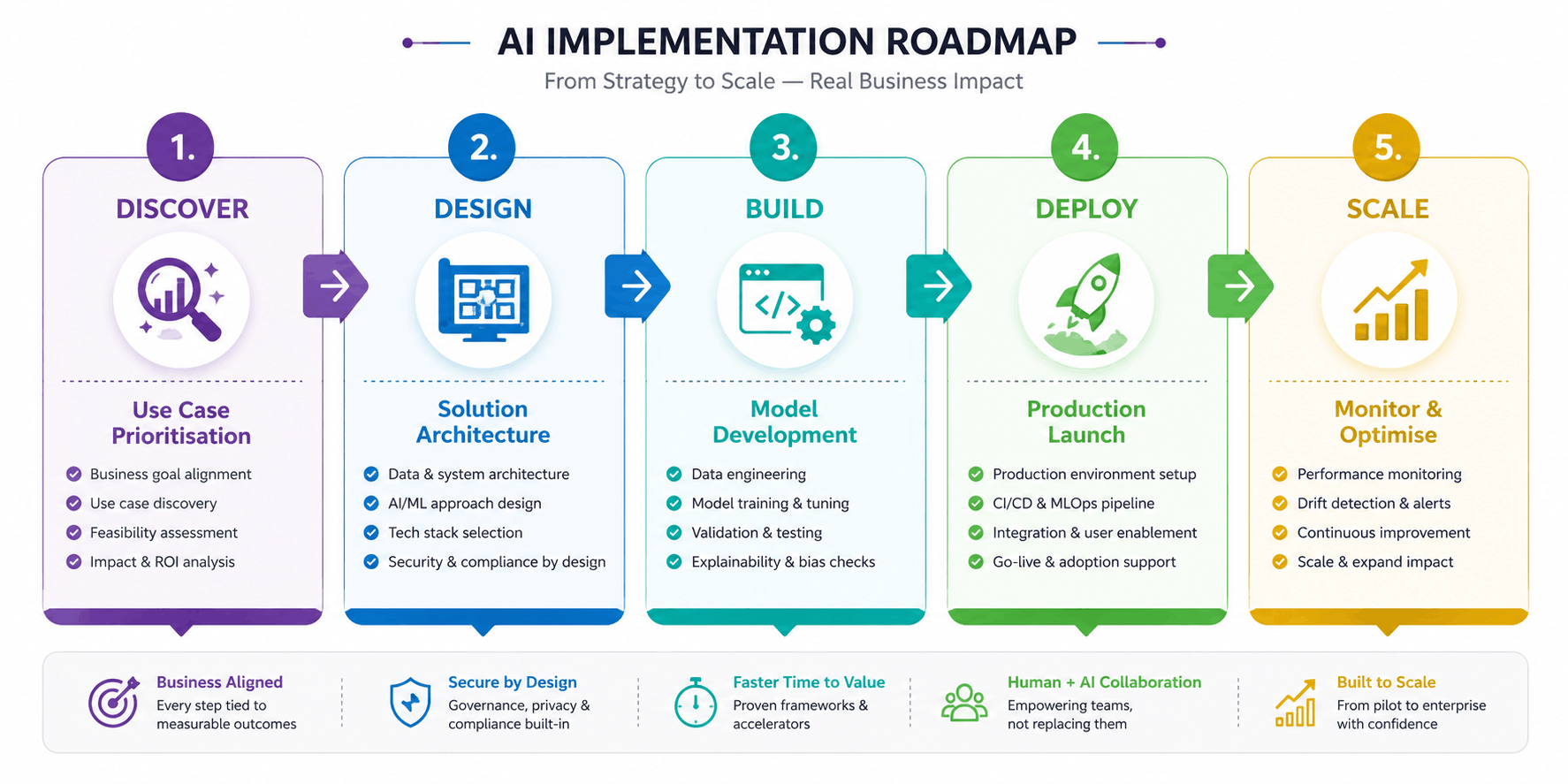
Phase 1: Discover: Use Case Prioritisation
Identify and rank AI use cases by business value, data readiness, and regulatory complexity. Produce a prioritised roadmap with defined ROI hypotheses for each use case and a sequencing logic that ensures the highest-confidence use cases deploy first, building organisational AI confidence and board investment appetite.
Phase 2: Design: Solution Architecture
Design the full technical architecture data pipelines, model serving infrastructure, MLOps tooling, governance layer, and integration patterns before model development begins. Governance requirements (MAS TRM, PDPA, FEAT) are mapped to specific engineering deliverables in this phase, not deferred to post-deployment.
Phase 3: Build: Model Development
Develop, train, and validate models against defined business and statistical benchmarks. Data engineers, ML engineers, and the AI/model risk lead work in parallel not sequentially so that governance documentation, audit trail infrastructure, and explainability APIs are produced alongside the model, not after it.
Phase 4: Deploy: Production Launch
Deploy to production using containerised serving (Kubernetes, Docker), automated CI/CD pipelines, and drift monitoring configured before go-live. Every production deployment produces a versioned deployment manifest, a model card, and an active audit trail from the first inference.
Phase 5: Scale: Monitor and Optimise
Extend the first production use case to additional markets, functions, or data domains while continuous monitoring maintains model performance and governance compliance. New use cases deploy faster because the data infrastructure, MLOps pipeline, and governance framework built for Use Case 1 are reusable across the portfolio.
Real-World Enterprise Use Cases: What Samta.ai Execution Delivers
Use Case 1: Credit Risk AI, Singapore Bank (BFSI)
A Singapore-licensed bank needed a MAS TRM-compliant credit decisioning AI model within 9 months a timeline that ruled out building an in-house team from scratch. Samta.ai delivered the full stack: Snowflake data foundation, feature engineering pipeline, gradient boosting credit model, VEDA-embedded explainability and drift monitoring, MAS-aligned model card and audit trail, and a 90-day hypercare period post-deployment. Time to production: 8 months. MAS examination result: no governance findings. Year 1 credit loss reduction: 22%. The enterprise ai strategy that enabled this outcome was not a recommendation it was an engineered, deployed, and monitored production system. Explore similar outcomes in Samta.ai case studies.
Use Case 2: Workflow Automation, Regional Property Group (General Enterprise)
A Singapore-based property management group managing 3,200 units across four markets needed to automate lease renewal, maintenance ticketing, and financial reporting workflows that consumed 40+ staff hours weekly. Samta.ai deployed CORA across the portfolio with custom workflow automation connecting property management data to the group's ERP and tenant communication systems. Weekly manual hours eliminated: 34 of 40. Tenant satisfaction score improvement: 18 percentage points within 6 months. The product engineering services layer connecting CORA's AI outputs to existing enterprise systems via workflow automation is what produced the operational outcome. AI capability without integration is a feature; AI capability with workflow automation is a business transformation.
Key Risks When Choosing the Wrong Enterprise AI Partner
Advisory without engineering: partners that produce strategy and roadmap deliverables but subcontract or hand off engineering execution consistently create handover gaps where governance, data lineage, and model documentation fall between organisations
Product-led lock-in: technology vendors whose AI delivery is constrained to their own platform create single-stack dependency that limits use case coverage and data portability
Governance as a sales deliverable: partners that produce model cards and MAS TRM documentation as procurement outputs rather than as automated engineering outputs create compliance gaps the moment the engagement ends and maintenance stops
Pilot-to-production gap: engagements scoped to proof-of-concept without a defined production pathway consistently end in stalled programs; require a production deployment gate in the commercial structure before signing
No knowledge transfer: partners that retain model IP and operational knowledge create permanent dependency; require contractual knowledge transfer as a delivery obligation with defined completion criteria
Enterprise ai adoption at scale requires a partner whose commercial model is aligned to your production outcomes not to the number of consulting days billed. Samta.ai's fixed-SOW engagement model ties delivery milestones to production deployment, not activity metrics.
Start Your AI Transformation with a Free Consultation
Decision Framework: What to Require From an Enterprise AI and Data Engineering Partner
Require these before signing any enterprise AI engagement:
Production deployment as a defined commercial milestone not a best-efforts commitment
Governance infrastructure (model cards, audit trails, explainability APIs) as engineering deliverables not documentation annexes
Named data engineering, MLOps, and model risk roles on the engagement team not generic "consulting" resources
Knowledge transfer specified as a contractual obligation with defined completion criteria
Fixed-SOW commercial structure tied to production milestones not time-and-materials with no outcome accountability
Treat these as red flags:
Strategy and roadmap delivered before any data or infrastructure assessment is completed
Governance described as a post-deployment workstream
MLOps and monitoring treated as optional or Phase 2 scope
No APAC regulatory framework experience named in the proposal
References limited to POC or pilot stage no production deployment evidence in your sector
Conclusion
The gap between AI strategy and AI value is an engineering and execution gap not an ideas gap. An Enterprise AI and Data Engineering Partner that owns strategy through to production deployment, embeds governance at the engineering layer, and ties commercial milestones to production outcomes is structurally different from a firm that delivers recommendations and moves on. Most businesses do not lack AI ideas. They lack the execution partner that ships what others only recommend. That is the standard Samta.ai holds itself to on every engagement from the first data audit to the last production deployment milestone.
Frequently Asked Questions
What is an Enterprise AI and Data Engineering Partner?
An Enterprise AI and Data Engineering Partner is an organisation that delivers the complete AI value chain strategy, data infrastructure, model development, production deployment, governance, and workflow integration as a single, owned engagement rather than as modular advisory services. The distinction from a traditional consulting firm is execution accountability: the partner is responsible for production outcomes, not just strategy recommendations.
What is AI software development in an enterprise context?
AI software development in enterprise covers the full engineering stack required to deploy production AI: data pipeline engineering, model development and validation, MLOps CI/CD pipelines, containerised model serving, drift monitoring, explainability APIs, audit trail infrastructure, and ATS or ERP integration layers. Enterprise AI software development is materially more complex than application software development because it requires data governance, model risk management, and continuous monitoring as engineering requirements, not optional add-ons.
What enterprise AI tools does Samta.ai provide?
Samta.ai provides three proprietary enterprise AI tools: VEDA (AI Decision Analytics Platform for credit risk, fraud detection, and enterprise analytics), TATVA (AI Hiring Assessment Platform for adaptive, PDPA-compliant candidate evaluation), and CORA (AI Property Management Software for lease, maintenance, and financial workflow automation). All three are production-ready, governed platforms with embedded explainability, audit trail, and drift monitoring infrastructure.
What are workflow automation solutions in the context of enterprise AI?
Workflow automation solutions connect AI model outputs to the operational workflows that act on them routing credit decisions to loan officers, triggering maintenance requests from predictive models, escalating fraud alerts to investigation teams, or advancing assessed candidates to hiring managers. Without workflow automation, AI model outputs remain in dashboards that humans must manually act on which limits speed advantage and eliminates the efficiency gains that justified the AI investment.
What is AI security compliance for enterprise AI programs?
AI security compliance for enterprise AI covers: adversarial ML robustness testing (evasion, poisoning, inversion attacks), regulated data handling (PDPA consent tracking, data minimisation, lineage documentation), model governance (MAS TRM alignment, FEAT assessment, VERITAS track selection for BFSI), and production security controls (access audit trails, tamper-evident logging, prompt injection defence for GenAI features). An ai security compliance framework embeds all of these as engineering requirements not post-deployment documentation exercises.
How does Samta.ai differ from traditional AI consulting firms?
Samta.ai was explicitly built to not be another consulting layer. Where traditional consulting firms deliver strategy, recommendations, and presentations and subcontract or hand off engineering execution Samta.ai owns the full delivery stack: strategy, data engineering, model development, production deployment, governance embedding, workflow automation, and managed operations. Every engagement is scoped to a production outcome with a fixed-SOW commercial structure, not to a number of consulting days.