
Summarize this post with AI
Property firms that still run operations on spreadsheets, legacy ERP systems, or disconnected tools are not just inefficient. They are carrying operational risk that compounds every quarter. SaaS property management software shifts control from fragmented manual processes to a single, AI driven platform that manages leases, maintenance, compliance, and tenant communication in real time. This is not a technology upgrade. It is a structural shift in how property portfolios are governed, monitored, and scaled across mid market firms, real estate asset managers, and facility management operators and beyond.
SaaS Property Management Software
SaaS property management software is a cloud delivered platform that centralizes lease management, maintenance workflows, tenant communication, compliance tracking, and financial reporting for real estate portfolios of any size. Unlike legacy on premise systems, SaaS property management software updates continuously, scales without infrastructure investment, and integrates with financial, IoT, and compliance tools across the property lifecycle. For mid market property firms and real estate asset managers, the shift to a SaaS model is now a competitive and regulatory baseline, not an optional upgrade.
What Is SaaS Property Management Software?
SaaS property management software is a subscription based, cloud hosted platform that replaces disconnected property operations tools with a unified system of record for the entire portfolio lifecycle. It covers everything from lease origination and rent collection to maintenance ticketing, vendor management, compliance documentation, and tenant communication. Unlike traditional software for property management installed on local servers, SaaS platforms deliver continuous updates, role based access, and real time dashboards accessible from any device.
The category sits at the intersection of real estate management tool capability and enterprise grade workflow automation. It is used by:
Mid market property firms managing 50 to 5,000 units
Real estate asset managers overseeing multi property investment portfolios
Facility management operators running commercial, industrial, or mixed use assets
Property investment trusts requiring audit ready financial and compliance reporting
For a broader view of how AI is reshaping property operations, see Samta.ai's analysis of proptech AI consulting services.
Why It Matters in 2026: The Property Operations Context
Three forces are making the shift to real estate property management software in 2026.
First, portfolio complexity is outpacing manual capacity. Mid market firms managing 200 or more units across multiple locations cannot sustain lease tracking, compliance monitoring, and maintenance coordination through spreadsheets and email threads. The operational cost of manual processes scales linearly with portfolio size. SaaS platforms do not.
Second, regulatory requirements are tightening. In Singapore, Australia, and India, property managers face increasing obligations around tenancy documentation, ESG reporting, and financial audit trails. Legacy systems were not built to generate the structured, exportable compliance data that regulators now expect. (Source Required: JLL APAC Real Estate Outlook 2025.)
Third, tenant expectations have shifted. Institutional and commercial tenants now expect digital communication channels, real time maintenance visibility, and self service portals as baseline requirements, not premium features.
Read Samta.ai's breakdown of the 10 leading proptech consultants shaping property technology.
The SaaS Property Management Framework: Six Operational Layers
A mature property investment management software deployment addresses six operational layers. Gaps at any layer create inefficiency, compliance exposure, or tenant attrition.
Lease Lifecycle Management: Automate lease origination, renewal alerts, rent escalation clauses, and expiry workflows. Every lease event triggers a documented action, not a manual reminder.
Maintenance and Work Order Automation: Route maintenance requests from tenant submission to vendor assignment to completion sign off without manual handoffs. Track SLA compliance per asset and per vendor.
Tenant Communication and Portal Access: Centralize all tenant communication in a single platform with logged history. Self service portals reduce inbound query volume by giving tenants real time visibility into their requests.
Financial Reporting and Rent Collection: Automate rent collection, arrears escalation, and financial reporting across the portfolio. Connect to accounting platforms to eliminate manual reconciliation.
Compliance and Document Management: Store, version control, and audit all tenancy agreements, inspection reports, insurance certificates, and regulatory filings in a structured, searchable repository.
Portfolio Analytics and Forecasting: Surface occupancy trends, revenue variance, maintenance cost per unit, and portfolio level KPIs in real time dashboards built for asset managers and operations directors.
CORA, Samta.ai's AI driven software for property management, operationalizes all six layers in a single platform purpose built for mid market property firms, real estate asset managers, and facility management operators. CORA replaces fragmented tool stacks with one system that manages the full property lifecycle from lease to maintenance to compliance reporting.
The RICS Global PropTech Report identifies unified SaaS platforms as the primary driver of operational efficiency gains in commercial property management globally.
See how CORA manages all six layers in a single platform.
Most property firms are running three to five disconnected tools to do what CORA does in one. Request a live walkthrough and see exactly how CORA handles your current portfolio size, asset type, and compliance requirements.
What Is CORA and Why Does It Matter for Property Operations?
Most property portfolios run on three to five disconnected tools, one for leases, one for maintenance, one for financials, and none of them talking to each other. CORA eliminates that fragmentation. Most platforms store data. CORA acts on it. When a lease is approaching expiry, CORA triggers the renewal workflow automatically. When a maintenance SLA is at risk, CORA escalates to the next available vendor without waiting for a manager to notice. When compliance documents are missing or expired, CORA flags them before an audit does. It is the difference between a system of record and a system of action.
Who CORA Is Built For
Why CORA is for mid market property firms Single dashboard across every asset, every tenant, and every compliance obligation. Updated in real time. No manual intervention required.
Why CORA is for real estate asset managers Audit ready financial and compliance reporting on demand. Occupancy trends, revenue variance, and maintenance cost per unit surfaced automatically.
Why CORA is for facility management operators Automated work order routing, vendor assignment, and SLA tracking from request to closure. No constant manager oversight needed.
How CORA compares to traditional property management tools
Most property operations tools solve one problem well and ignore the rest. CORA is built to manage the entire portfolio lifecycle, from lease to maintenance to compliance, inside a single intelligence layer.
Decision Factor | CORA (AI First Portfolio Operations) | Traditional Tools | Verdict |
Core Offering What you are fundamentally paying for | AI native property and asset management software that unifies occupancy, maintenance, finances, and service delivery into a single operational intelligence layer. Auto surfaces blind spots before they become revenue leaks. | Siloed property management software, accounting tools, and manual spreadsheets. Each property generates its own data island. No portfolio wide control. | CORA For operators who need one source of truth for their entire portfolio, not just a digital filing cabinet. |
Visibility and Control | Live, centralized dashboard showing real time occupancy, maintenance signals, service activity, and financial performance across every property. Scalable property investment management software that grows with your portfolio. | Scattered records, delayed updates, and reactive coordination. Managers rely on WhatsApp, email, and phone calls to understand what is happening on the ground. | CORA Eliminates the visibility gap that plagues multi property operators. (Source Required: JLL APAC Property Operations Report 2025.) |
Speed to Resolution | AI predictive maintenance solutions automatically prioritize tickets, assign vendors, and track SLA compliance. Three times faster issue resolution with automated workflows from request to closure. | Manual triage, no real time SLA tracking, vendor coordination via calls. Delays cause tenant churn and revenue leakage. | CORA Critical for maintaining portfolio wide service standards and tenant retention. |
Scalability | Built to handle 10 units or 500 or more without adding operational complexity. Add new properties in minutes. The intelligence layer adapts automatically. | Traditional tools break at scale. Each new property adds admin burden, headcount, and integration complexity. | CORA The only advanced software for property management designed for portfolio growth, not single property management. |
Integration | Works with existing ERPs, accounting, and leasing tools. CORA sits on top as the intelligence layer. No rip and replace required. | Data locked in separate systems. Manual exports and reconciliation. Weeks of effort to get a portfolio wide view. | CORA De risks adoption by working with your current stack, not against it. |
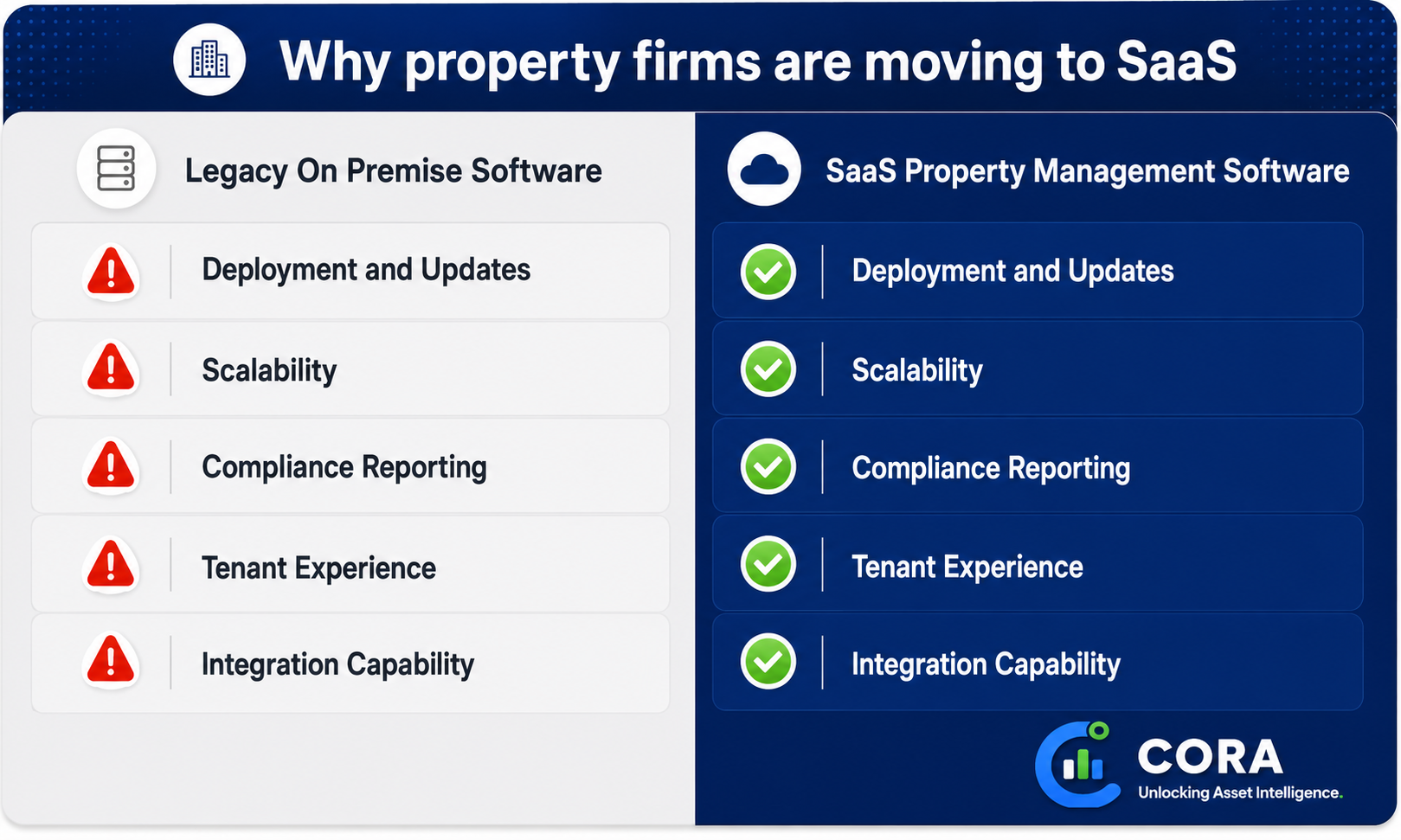
SaaS vs. Legacy Property Management Software: Five Dimension Comparison
The table below compares SaaS platforms against legacy on premise systems across five dimensions that matter most to property operations leaders.
Dimension | Legacy On Premise Software | SaaS Property Management Software | Risk of Staying Legacy | Best Fit For |
Deployment and Updates | Manual IT installation, infrequent updates | Continuous cloud updates, zero IT overhead | Feature lag and security exposure | All portfolio sizes |
Scalability | Requires new licenses and infrastructure per site | Scales instantly across unlimited properties | Growth bottleneck | Expanding mid market firms |
Compliance Reporting | Manual document retrieval, static reports | Automated audit trails, exportable compliance data | Regulatory exposure in APAC | Regulated asset managers |
Tenant Experience | Email and phone only, no self service | Self service portal, real time maintenance tracking | Tenant attrition risk | Commercial and institutional landlords |
Integration Capability | Limited API access, siloed data | Open API, connects to accounting, IoT, and CRM tools | Data silos, manual reconciliation | Multi system property operations |
Property firms still on legacy systems consistently absorb the costs in the right column of this table. The shift to SaaS property management software is not a future consideration for APAC mid market operators. It is a present operational necessity. According to the Gartner Real Estate Technology Market Guide, over 60 percent of mid market property firms that remain on legacy platforms report SLA breach incidents at least once per quarter.
Real World Use Cases
Mid Market Property Firm: Lease Expiry and Renewal Automation
A Singapore based property management firm managing 400 commercial units across four buildings was tracking lease renewals manually in spreadsheets. Renewal reminders were sent inconsistently, resulting in three lease lapses in a single quarter and a combined revenue loss estimated at SGD 180,000. After deploying a real estate management tool with automated lease lifecycle workflows, all renewal alerts, negotiation triggers, and expiry escalations were handled by the platform. Lease lapse rate dropped to zero in the following two quarters. CORA's lease management module delivers this capability out of the box, with configurable alert windows, renewal workflow templates, and full audit trails for every lease event.
Facility Management Operator: Maintenance SLA Compliance
A facility management operator running 12 commercial properties across Australia was managing maintenance requests through email and a shared spreadsheet. Vendor response times were inconsistent, SLA breaches were undocumented, and tenant satisfaction scores were declining. After deploying property investment management software with automated work order routing and SLA tracking, average maintenance resolution time dropped by 34 percent in the first 90 days. Read Samta.ai's guide on building an AI ready property operations function for a step by step approach to operational transformation.
Not sure which property operations gaps to fix first?
Our consultants have mapped the most common operational failure points across mid market property firms, real estate asset managers, and facility management operator. Book a session and get a prioritized action plan for your portfolio.
Key Risks and Failure Modes in Property Software Deployments
Deploying software without process mapping first. A SaaS platform automates existing workflows. If those workflows are broken, the platform scales broken processes faster.
Underestimating data migration complexity. Moving lease, tenant, and financial data from legacy systems to a new platform requires structured data audits. Skipping this step creates data integrity gaps from day one.
No defined system owner post deployment. Without a designated platform owner responsible for configuration, user adoption, and reporting, SaaS deployments drift toward underutilization within six months.
Choosing a platform built for residential at commercial scale. Residential focused software for property management lacks the lease complexity, compliance depth, and multi stakeholder reporting that commercial and mixed use portfolios require.
Ignoring integration requirements at selection stage. A platform that cannot connect to your accounting system, IoT sensors, or CRM creates new data silos rather than eliminating existing ones.
Read Samta.ai's analysis of why 70 percent of AI and property tech implementations underdeliver and how to avoid the same outcome.
When to Prioritize SaaS Property Management Software
Prioritize immediately if:
Your portfolio has more than 50 units and lease tracking is still managed in spreadsheets
You have experienced at least one lease lapse, compliance breach, or missed maintenance SLA in the last 12 months
Your asset managers cannot access portfolio level performance data without requesting manual reports
You are preparing for an audit, investor review, or regulatory examination that requires structured documentation
Evaluation can be phased if:
Your portfolio is under 20 units with a single asset type and no immediate growth plans
All current workflows are documented, digitized, and producing consistent compliance outputs
Organizations evaluating real estate property management software for the first time can assess their current operational maturity using Samta.ai's guide on how to measure AI readiness before committing to a platform.
Conclusion
SaaS property management software is not a productivity tool. It is the operational infrastructure that determines whether a property portfolio scales with control or collapses under its own complexity. Mid market firms, real estate asset managers, and facility management operators in APAC that continue running on legacy systems are not saving money. They are accumulating operational, compliance, and competitive debt that compounds every quarter. CORA is built to close that gap. Visit Samta.ai's workflow automation consulting services for a broader view of how AI driven operations transform property management at scale across portfolios.
Find out exactly where your property operations stand before your next audit does.
The Free AI Assessment Report maps your current lease management, maintenance workflows, compliance documentation, and portfolio analytics against the six operational layers that high performing property firms in APAC use as their baseline. You get a prioritized gap analysis and a clear starting point, at no cost.
Get Your Free AI Assessment Report at samta.ai
About Samta
Samta.ai is a Singapore-headquartered AI Product Engineering & Data Intelligence partner helping enterprises build production-grade AI systems for regulated and data-intensive environments.We help organizations move beyond experimentation by engineering scalable, explainable, and enterprise-ready AI solutions from data foundations and model development to workflow automation and deployment.
Our capabilities combine deep AI expertise, data engineering, and product engineering to deliver measurable business impact across FinTech, BFSI, cybersecurity, regulatory technology, and enterprise operations.
Our enterprise AI products power real-world intelligence systems:
• TATVA : AI-driven data intelligence platform for governed analytics, monitoring, and operational insights
• VEDA : Explainable and audit-ready AI decisioning engine built for compliance-sensitive enterprise workflows
• CORA-Property Management Solutions: : Predictive intelligence platform for real-estate pricing, portfolio optimization, and investment analytics
Backed by ecosystem partnerships with Microsoft, Databricks, Snowflake, and AWS, Samta.ai delivers agile, cost-efficient AI engineering with faster turnaround and enterprise-grade scalability. Trusted by enterprises across FinTech, BFSI, and digital transformation initiatives, Samta.ai embeds AI governance, data privacy, and compliance-by-design principles directly into the AI lifecycle , enabling organizations to scale AI with transparency, accountability, and operational control.
Enterprises leveraging Samta.ai automate 65%+ of repetitive data, analytics, and decision workflows while maintaining governance, explainability, and measurable business outcomes. Samta.ai provides the strategic consulting, AI engineering, and data modernization expertise needed to align enterprise operations with next-generation AI transformation goals.
Frequently Asked Questions
What is SaaS property management software?
SaaS property management software is a cloud hosted, subscription based platform that centralizes lease management, maintenance workflows, tenant communication, compliance documentation, and financial reporting for real estate portfolios. Unlike legacy on premise systems, SaaS platforms update continuously, scale without infrastructure investment, and are accessible from any device with role based permissions for property managers, asset managers, and tenants.
How is SaaS property management software different from traditional property management tools?
Traditional software for property management is installed on local servers, updated infrequently, and requires IT involvement for every configuration change. SaaS platforms are cloud native, updated automatically, and configurable without IT dependency. The operational difference becomes significant at portfolio scale, where manual update cycles and siloed data create compounding inefficiency across lease, maintenance, and compliance functions.
Why is CORA positioned as a SaaS property management solution for mid market firms?
CORA is purpose built for the operational complexity of mid market property firms, real estate asset managers, and facility management operators. Unlike residential focused platforms, CORA handles commercial lease structures, multi stakeholder compliance workflows, and portfolio level analytics out of the box. It is the core real estate management tool in Samta.ai's product suite, designed for property portfolios with 50 to 5,000 units across mixed asset types.
What are the biggest risks in switching to a new property management platform?
The four highest risk areas are data migration integrity, workflow mapping before deployment, user adoption post launch, and integration with existing financial and compliance systems. Organizations that treat platform selection as a technology decision rather than an operational change management program consistently face underutilization, data gaps, and delayed ROI. Samta.ai's workflow automation consulting service addresses all four risk areas as part of a structured deployment methodology.
Which property firms benefit most from SaaS property management software?
Mid market property firms managing 50 or more units, real estate asset managers overseeing multi property investment portfolios, and facility management operators running commercial or mixed use assets benefit most. These segments have the operational complexity that justifies a full SaaS deployment and the compliance requirements that make legacy tools a material liability in regulatory environments