
Summarize this post with AI
A data readiness assessment usually delivers an uncomfortable answer before an enterprise has written a single line of model code. Gartner predicts that through 2026, organizations will abandon 60% of AI projects that are not supported by AI ready data, and a related Gartner survey found 63% of organizations either lack, or are unsure whether they have, the data management practices AI actually needs. The model is rarely the reason an AI initiative stalls. The data underneath it is. This piece sets out what makes data AI ready, why most enterprise data currently is not, and the three steps that close the gap.
Data Readiness Assessment:
A data readiness assessment evaluates whether an organization's data is accurate, integrated, and governed well enough to support a specific AI use case, rather than assuming any existing data warehouse or reporting system is automatically sufficient. Gartner's research places the abandonment risk for AI projects lacking AI ready data at 60% through 2026, and frames AI ready data as data that is actively governed at the asset level, supported by automated pipelines with quality gates, and continuously quality assured, not a one time cleanup exercise. Three steps close most of this gap: assess data quality and discovery, integrate fragmented systems, and put ongoing governance in place, in that order.
What makes data AI ready
What makes data AI ready? It is not the same bar traditional reporting was built for. A dashboard can tolerate a stale field or a duplicate record if a human catches the anomaly. An AI model trained or queried against that same flaw repeats the error at scale, silently, in every output it produces afterward. AI ready data needs to be accurate, complete, consistent, and traceable back to its source, with clear ownership for who maintains each of those properties over time. Our guide on data discovery for AI covers the first practical step most organizations skip, actually finding out what data exists, where it lives, and what condition it is in before assuming it is ready for a model to use.
Put Your Business Decisions on a Stronger Data Foundation
Why this gap matters more in 2026 than it did before
Data readiness has moved from a technical nicety to the single most cited reason AI initiatives fail to reach production this year. Our self assessment guide, is your enterprise data actually ready, walks through the specific signals that indicate an organization is further from AI ready than its leadership assumes.
International standards bodies have also formalized what good data quality actually requires. ISO 8000, the international standard series for data quality and master data, defines specific, measurable dimensions data must meet, rather than leaving quality as a subjective judgment call made differently by every team. Our broader piece on why an AI readiness assessment should come before any model investment covers how this sequencing failure, model first, data second, is the most common and most expensive mistake enterprises make.
The 3 steps that actually fix data readiness
Closing the gap between where enterprise data typically sits and where AI needs it to be follows three steps, not one.
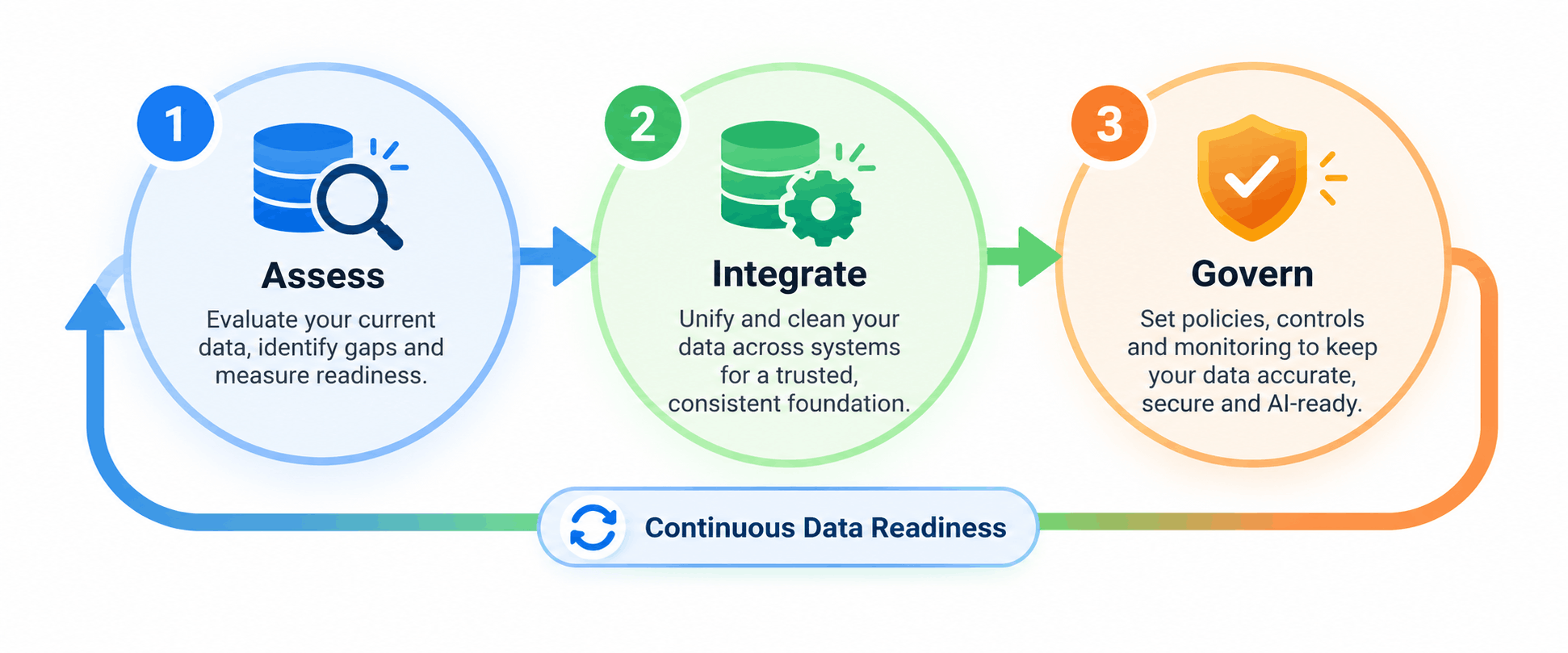
Before any integration or governance work begins, an organization needs an honest picture of what data exists and what condition it is in. This means auditing accuracy, completeness, and consistency against defined thresholds, not assuming existing reporting data is automatically fit for an AI use case. Our guide to AI ready data engineering covers what this assessment stage needs to produce before moving to the next step.
Step 2: Integrate fragmented systems
Data silos are the second most common blocker, since a model that needs to reason across customer, transaction, and operational data cannot do so if that data sits in three disconnected systems requiring manual export. Samta.ai's data integration consulting services connect these systems directly, working with existing Databricks, Snowflake, or Microsoft infrastructure rather than requiring a separate warehouse rebuild before integration can start.
Once systems are connected, the resulting data needs somewhere to actually be used. This is where the VEDA AI decision analytics platform fits, since it is built to consume integrated, AI ready data directly rather than requiring yet another export step before analysis can happen.
Step 3: Put ongoing governance in place
Data quality achieved once and never maintained degrades within months. Ongoing governance, named data owners, documented access policy, and continuous quality monitoring, is what keeps data AI ready rather than briefly AI ready. Our guide on building an AI ready governance structure covers how to assign this ownership so it survives beyond the initial cleanup project.
How VEDA supports each stage of data readiness
A platform built specifically for this progression matters more than a general analytics tool retrofitted to handle it. Organizations comparing options should see how VEDA compares to other data intelligence platforms, since most general platforms were not designed to track data quality and governance status alongside the analysis layer. The VEDA platform treats data readiness as a continuously monitored state rather than a one time gate passed before a project starts, which matters directly for the ongoing governance step above.
Data readiness dimensions at a glance
Readiness Dimension | What Good Looks Like | What Poor Looks Like | How to Assess It | Who Owns It |
Data Quality | Accurate, complete, and consistent records validated on a regular cycle | Duplicate records, missing fields, and outdated values | Run a data quality audit against defined accuracy and completeness thresholds | Data quality or data engineering team |
Data Integration | Systems connected through automated pipelines feeding a single source of truth | Data trapped in disconnected silos requiring manual export | Map every system holding data a given AI use case depends on | Data engineering team |
Data Governance | Documented ownership, access policy, and usage rules for every data asset | No named owner and inconsistent access rules across teams | Check whether a governance policy exists and is actually followed | Data governance function or CDO |
Data Lineage | A traceable record of where data originated and how it was transformed | No visibility into a data point's origin or transformation history | Test whether a specific data point can be traced back to its source | Data engineering and governance teams jointly |
Master Data Management | One consistent version of core entities such as customer or product records | Conflicting versions of the same entity across different systems | Compare how the same entity is represented across every system that holds it | Data governance function with business unit input |
Discover Your AI Readiness With a Free Assessment
Real world enterprise use cases
BFSI: a bank discovering three versions of the same customer record
A bank preparing to deploy a credit risk model discovered, during its first formal data readiness assessment, that a single customer could appear as three slightly different records across its onboarding, lending, and collections systems. Reviewing enterprise AI engineering in Singapore helped the bank sequence its master data management fix ahead of the model build, rather than training a model on data the bank had not yet realized was inconsistent.
General enterprise: a retailer unable to trace a demand forecast back to source
A retailer's demand forecasting model produced results the planning team could not explain, since nobody could trace a specific forecast back to the underlying sales and inventory data that produced it. Building proper data lineage closed that gap, and reviewing Samta.ai's case studies gave the retailer's team a benchmark for how long a lineage remediation project like this typically takes.
Key risks and failure modes
Starting model development before assessing data readiness. This is the single most common and most expensive sequencing error, since a model built on ungoverned data has to be rebuilt once the underlying data problems surface.
Treating a data cleanup as a one time project. Data quality achieved through a single cleanup sprint degrades within months without ongoing monitoring and governance.
Assuming existing reporting data is automatically AI ready. Traditional dashboards tolerate flaws a human can catch. AI systems repeat those same flaws at scale without anyone noticing until the output is clearly wrong.
No named owner for data quality or governance. Without clear accountability, data quality problems get identified but never actually fixed, since no one is responsible for closing the gap.
Ignoring data silos until integration becomes urgent. Waiting until a specific AI project needs cross system data to address integration means discovering the problem at the worst possible moment, mid project.
How to assess data readiness before committing to an AI project
How to assess data readiness? Use the following checklist before allocating budget to a model build.
Proceed with confidence when:
A recent data quality audit shows accuracy and completeness above your defined threshold
The systems your use case depends on are already integrated, not siloed
A named owner exists for governance and can demonstrate an active monitoring process
Address gaps first when:
No data quality audit has been run in the past year
Data required for the use case sits in more than one disconnected system
No governance policy exists, or one exists but is not actually followed in practice
Identify AI Model Risks Before They Escalate
Conclusion
A data readiness assessment exists because the model is rarely what makes an AI project fail, the data underneath it is. Assessing quality, integrating fragmented systems, and putting ongoing governance in place, in that order, closes the gap Gartner's research links to most AI project abandonment. Organizations that run this assessment before committing to a build are the ones whose AI initiatives actually reach production.
About Samta
Samta.ai is a Singapore-headquartered AI Product Engineering & Data Intelligence partner helping enterprises build production-grade AI systems for regulated and data-intensive environments.We help organizations move beyond experimentation by engineering scalable, explainable, and enterprise-ready AI solutions from data foundations and model development to workflow automation and deployment.
Our capabilities combine deep AI expertise, data engineering, and product engineering to deliver measurable business impact across FinTech, BFSI, cybersecurity, regulatory technology, and enterprise operations.
Our enterprise AI products power real-world intelligence systems:
• TATVA : AI-driven data intelligence platform for governed analytics, monitoring, and operational insights
• VEDA : Explainable and audit-ready AI decisioning engine built for compliance-sensitive enterprise workflows
• CORA-Property Management Solutions: : Predictive intelligence platform for real-estate pricing, portfolio optimization, and investment analytics
Backed by ecosystem partnerships with Microsoft, Databricks, Snowflake, and AWS, Samta.ai delivers agile, cost-efficient AI engineering with faster turnaround and enterprise-grade scalability. Trusted by enterprises across FinTech, BFSI, and digital transformation initiatives, Samta.ai embeds AI governance, data privacy, and compliance-by-design principles directly into the AI lifecycle , enabling organizations to scale AI with transparency, accountability, and operational control.
Enterprises leveraging Samta.ai automate 65%+ of repetitive data, analytics, and decision workflows while maintaining governance, explainability, and measurable business outcomes. Samta.ai provides the strategic consulting, AI engineering, and data modernization expertise needed to align enterprise operations with next-generation AI transformation goals.
Frequently asked questions
What makes data AI ready?
AI ready data is accurate, complete, consistent, integrated across the systems a use case depends on, and governed with clear ownership and ongoing quality monitoring, rather than data that merely looks sufficient for a traditional report or dashboard.
How to assess data readiness?
Assess data readiness by auditing data quality against defined accuracy and completeness thresholds, mapping whether the systems a use case depends on are integrated or siloed, and checking whether a governance policy exists and is actually followed in practice.
Why do AI projects fail due to data?
AI projects fail due to data because models trained or queried against inaccurate, incomplete, or inconsistent data repeat those flaws at scale in every output, and Gartner's research links this specifically to a lack of AI ready data as a leading cause of project abandonment.
What is the difference between data quality and data governance?
Data quality refers to the accuracy, completeness, and consistency of the data itself, while data governance refers to the policies, ownership, and processes that keep that quality maintained over time, including who is accountable when a quality issue is found.
What is master data management, and why does it matter for AI?
Master data management ensures a single, consistent version of core entities, such as a customer or product record, exists across every system, which matters for AI because a model reasoning across inconsistent versions of the same entity produces unreliable results.
Unlock Verifiable Insights Across All Data Stores
VEDA connects siloed data sources and empowers business leaders with real-time, governed AI decision analytics.
Explore VEDA Platform >